
Urban Company’s instant home-services business, InstaHelp, reported revenue of ₹20.54 crore in the September quarter of FY27, but its adjusted earnings before interest, taxes, depreciation and amortisation (EBITDA) loss widened to ₹174 crore. The business is expanding rapidly as demand grows for on-demand household assistance, but aggressive customer acquisition, introductory pricing and investments in service-provider capacity continue to weigh on its financial performance.
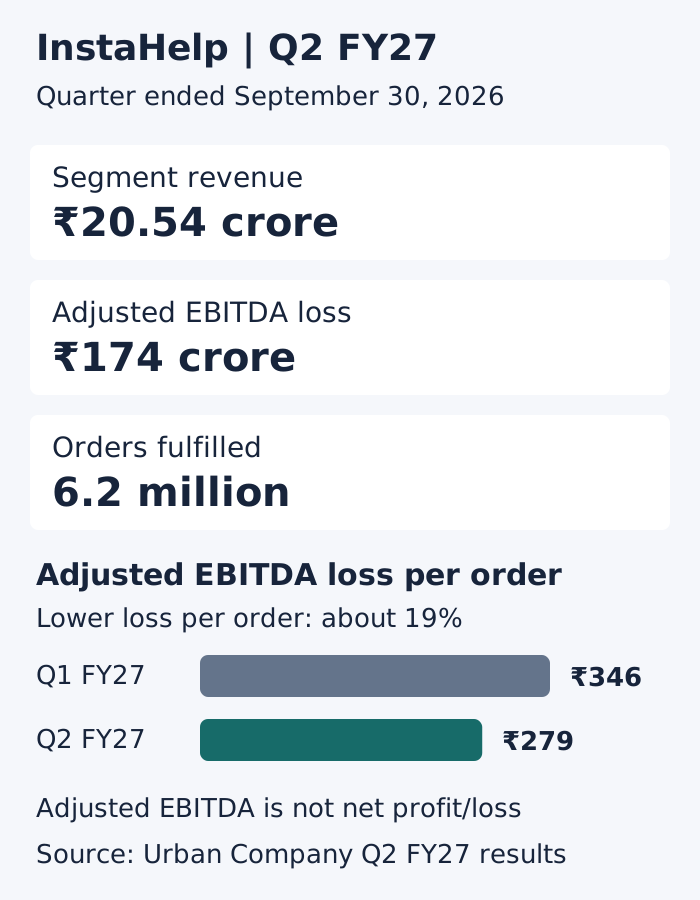
InstaHelp fulfilled 6.2 million orders in Q2 FY27, up 63% sequentially from the June quarter, while its net transaction value (NTV) increased 34% to ₹71 crore. Despite the widening quarterly loss, its adjusted EBITDA loss per order improved from ₹346 to ₹279, suggesting that greater order density is beginning to improve operating efficiency. The results highlight the challenge facing Urban Company as it attempts to build a leading position in India’s emerging instant home-services market while working towards profitability.
Key Takeaways
- Q2 FY27 revenue: InstaHelp generated ₹20.54 crore, up 83.1% quarter-on-quarter.
- Adjusted EBITDA loss: The business recorded a loss of ₹174 crore, compared with ₹132 crore in Q1 FY27.
- Order growth: It fulfilled 6.2 million orders, a 63% sequential increase.
- Loss per order: Adjusted EBITDA loss per order narrowed to ₹279 from ₹346.
- Pricing pressure: Net order value fell to ₹114 from ₹138 amid competitive pricing and introductory offers.
- Urban Company results: Consolidated revenue rose 41% year-on-year to ₹537 crore, while net loss widened to approximately ₹182 crore.
- Fundraising: The board approved a proposal to raise up to ₹2,500 crore, subject to shareholder approval.
- Profitability target: Urban Company remains on track to achieve consolidated adjusted EBITDA breakeven by Q3 FY28.
InstaHelp’s Q2 FY27 Performance at a Glance
InstaHelp is Urban Company’s quick home-services offering, designed to connect customers with household assistance on short notice. Its business model depends on attracting sufficient demand within individual neighbourhoods, ensuring enough service professionals are available and reducing the time and travel required between bookings.
The latest results show that the service is gaining traction, but the cost of building this network remains high.
| Financial and operating metric | Q1 FY27 | Q2 FY27 |
|---|---|---|
| Revenue | — | ₹20.54 crore |
| Adjusted EBITDA loss | ₹132 crore | ₹174 crore |
| Orders fulfilled | — | 6.2 million |
| Sequential order growth | — | 63% |
| Net transaction value | — | ₹71 crore |
| Sequential NTV growth | — | 34% |
| Net order value | ₹138 | ₹114 |
| Adjusted EBITDA loss per order | ₹346 | ₹279 |
Source: Urban Company Q2 FY27 results and reporting published on October 16, 2026. Revenue increased 83.1% sequentially; order and NTV figures reflect the reported quarter-on-quarter comparisons.
The figures reveal two trends moving in opposite directions. InstaHelp is processing more orders and losing less money per order, but the total adjusted EBITDA loss has increased because the business is operating at a larger scale while continuing to invest heavily.
Why Did InstaHelp Lose ₹174 Crore?
The loss reflects Urban Company’s decision to prioritise expansion and market share in a category where multiple platforms are competing for customers.
InstaHelp’s spending includes customer acquisition, introductory offers, expansion into new neighbourhoods and the recruitment and availability of service professionals ahead of expected demand. These investments can be necessary for an instant-service platform, where customers expect assistance to arrive quickly and reliably.
However, they also create substantial costs before a market reaches sufficient density. A platform may need to maintain service-provider availability even when demand fluctuates across the day. If professionals spend too much time waiting or travelling between jobs, the cost of fulfilling each booking can remain high.
Discounting adds another challenge. Lower prices can persuade first-time customers to try a service, but they reduce the amount collected per order unless higher volumes or repeat bookings compensate for the difference.
Urban Company has indicated that it is prioritising leadership in InstaHelp while the market develops. The company believes that building a strong position now could improve its economics as customer demand and service-provider utilisation increase.
The financial risk is that the company must spend substantial amounts before knowing how quickly the business can reach sustainable profitability.
Revenue Has Surpassed InstaHelp’s Entire FY26 Total
One important indicator of InstaHelp’s growth is the increase in quarterly revenue. Its Q2 FY27 revenue of ₹20.54 crore exceeded the approximately ₹17 crore it generated across the whole of FY26.
The comparison suggests that the business is expanding quickly, although its annual revenue remains small relative to the cost of expansion.
| Revenue comparison | Amount |
|---|---|
| Full-year FY26 revenue | Approximately ₹17 crore |
| Q2 FY27 revenue | ₹20.54 crore |
| Q2 FY27 revenue growth over Q1 FY27 | 83.1% |
The rapid increase in revenue indicates that more customers are using the service and that the platform is generating greater transaction activity. Yet revenue growth alone cannot establish whether the business model is sustainable.
For a service marketplace, the critical question is how much money remains after paying for service fulfilment, incentives and other variable costs. If the business can improve utilisation and reduce customer acquisition expenses, rising order volumes may eventually help narrow losses.
If growth depends on continuing discounts and substantial spending to keep professionals available, higher volumes could still require significant funding.
Loss Per Order Is Improving, but Total Losses Are Rising
The decline in adjusted EBITDA loss per order is one of the more encouraging indicators in InstaHelp’s results.
The metric improved from ₹346 in Q1 FY27 to ₹279 in Q2 FY27, a reduction of approximately 19% quarter-on-quarter.
| Unit economics metric | Q1 FY27 | Q2 FY27 | Change |
|---|---|---|---|
| Adjusted EBITDA loss per order | ₹346 | ₹279 | Approximately 19% improvement |
| Net order value | ₹138 | ₹114 | Approximately 17% decline |
The loss-per-order figures are reported adjusted EBITDA metrics. They should not be interpreted as the amount the company loses on every booking under every accounting measure.
The improvement in loss per order suggests that greater order density and better service-provider utilisation are helping the platform reduce its loss on individual bookings.
However, the lower net order value demonstrates the trade-off involved. Introductory offers and competitive pricing can bring in more customers, but they can also reduce the amount earned per transaction.
For InstaHelp, the next stage will involve proving that customers continue using the service after introductory offers expire. Repeat demand at sustainable prices would be a stronger indicator of long-term viability than order growth alone.
Competition With Snabbit and Pronto Is Intensifying
InstaHelp operates in a growing but competitive market for instant household assistance. Rivals such as Snabbit and Pronto are also seeking to attract customers and expand service-provider networks.
The competition is not simply about offering the lowest price. Customers expect a professional to arrive quickly, perform the task reliably and provide a consistent experience. Meeting those expectations requires sufficient service-provider availability in the right neighbourhoods and at the right times.
This creates a network-density challenge. A platform with more orders in a concentrated area can reduce travel time and keep professionals occupied for more of the day. But a platform expanding into new locations may initially have fewer bookings per professional, making each service more expensive to fulfil.
Companies may also need to spend heavily on customer incentives before a neighbourhood generates enough recurring demand. That spending can produce rapid growth in orders without immediately improving profitability.
For Urban Company, the strategic objective is to build a large enough network to create better utilisation and a more dependable customer experience. The financial test is whether those benefits eventually outweigh the costs of acquiring users and expanding supply.
Urban Company’s Overall Q2 FY27 Results
InstaHelp’s performance also influenced Urban Company’s consolidated results for the September quarter.
The company reported revenue from operations of approximately ₹537 crore, up 41% year-on-year. Its net transaction value increased 39% to ₹1,432 crore, while orders delivered rose 103% to 15.1 million.
However, consolidated net loss widened to approximately ₹182 crore, compared with ₹59 crore in the year-ago quarter. The company reported a consolidated adjusted EBITDA loss of ₹144 crore, reflecting the ₹174 crore investment in InstaHelp.
| Consolidated metric | Q2 FY27 result | Year-on-year change |
|---|---|---|
| Revenue from operations | ₹537 crore | +41% |
| Net transaction value | ₹1,432 crore | +39% |
| Orders delivered | 15.1 million | +103% |
| Annual transacting users | Nearly 10 million | +35% |
| Adjusted EBITDA | ₹144 crore loss | — |
| Net loss | Approximately ₹182 crore | Wider than the year-ago loss |
Source: Urban Company’s Q2 FY27 results. Figures are rounded where appropriate.
Excluding InstaHelp, Urban Company’s adjusted EBITDA was ₹30 crore, up 213% year-on-year. This suggests that the established businesses are generating positive adjusted operating earnings even as the quick-services operation consumes capital.
The distinction is important for investors. The consolidated loss reflects both the performance of the core business and the cost of funding a new growth opportunity. Whether that investment creates value will depend on InstaHelp’s ability to improve its unit economics over time.
Why Urban Company Plans to Raise ₹2,500 Crore
Urban Company’s board approved a proposal to raise up to ₹2,500 crore through a qualified institutional placement or other permitted securities, subject to shareholder approval and the applicable process.
The company said the proposed fundraising would provide financial flexibility for investment across its businesses, strengthen its position in InstaHelp and support selective acquisitions.
Urban Company had cash and treasury investments of ₹1,901 crore at the end of Q2 FY27. The proposed fundraising could give it additional capacity to fund expansion without forcing it to choose between investing in InstaHelp and supporting its other business lines.
However, a proposed fundraise is not the same as completed financing. Its final size, structure and timing will depend on the approvals and offering process.
For investors, the decision raises a broader question: how much capital will be required before InstaHelp becomes profitable, and what return will Urban Company earn on that investment?
The company will need to demonstrate that additional funding leads to improved operating efficiency and a credible path towards sustainable earnings.
When Could InstaHelp Become Profitable?
Urban Company has retained its target of achieving consolidated adjusted EBITDA breakeven by Q3 FY28. That is a company target rather than a guaranteed outcome, and it does not necessarily mean InstaHelp itself will break even at the same time.
The business will need to improve several operating measures to reach that milestone. These include reducing losses per order, increasing repeat usage, improving service-provider utilisation and reducing dependence on introductory discounts.
The relationship between order growth and profitability will be especially important. More bookings can improve the economics of a dense service network, but the benefit depends on whether each additional booking contributes enough revenue to cover its incremental costs.
Investors will also monitor whether the business can expand into new neighbourhoods without repeatedly incurring the same high launch costs. A repeatable expansion model would provide stronger evidence that InstaHelp can scale efficiently.
The coming quarters should reveal whether the improvement in loss per order is sustained and whether revenue growth begins to reduce the total loss rather than simply accompany a larger investment programme.
The Bigger Picture
InstaHelp’s Q2 FY27 results capture the difficult economics of building an instant home-services platform. The business has achieved rapid growth in orders and revenue, and its loss per order has improved. Yet its ₹174 crore adjusted EBITDA loss shows that the cost of customer acquisition, pricing incentives and network expansion remains substantial.
Urban Company is betting that scale will eventually produce better utilisation and stronger unit economics. The strategy could establish a leading position in a developing category, but success depends on converting high order volumes into repeat demand at sustainable prices. The company’s planned capital raise and FY28 breakeven target will therefore be important markers for assessing whether the investment is beginning to pay off.
Looking Ahead
InstaHelp’s immediate priorities will be to maintain order growth while improving revenue per booking and reducing losses. The decline in adjusted EBITDA loss per order is an encouraging operating signal, but the next results will need to show whether the trend continues as the platform expands and competition remains intense. Customer retention and the performance of newly opened neighbourhoods will be particularly important indicators.
Urban Company will also need to secure the proposed funding, subject to shareholder approval, and demonstrate progress towards consolidated adjusted EBITDA breakeven by Q3 FY28. For investors, the central question is whether the company can turn InstaHelp from a heavily funded expansion business into a sustainable contributor to long-term profitability.
Frequently Asked Questions
1. How much revenue did InstaHelp generate in Q2 FY27?
InstaHelp generated ₹20.54 crore in revenue during the September quarter, up 83.1% sequentially from Q1 FY27.
2. Why did InstaHelp report a ₹174 crore loss?
The loss reflected spending on customer acquisition, introductory pricing, service-provider capacity and expansion into new neighbourhoods as the company competed for market share.
3. How many orders did InstaHelp fulfil in Q2 FY27?
The business fulfilled 6.2 million orders, up 63% from the preceding quarter.
4. Is InstaHelp becoming more efficient?
Its adjusted EBITDA loss per order improved from ₹346 to ₹279, suggesting better utilisation as order density increased. However, the business still reported a larger total quarterly loss.
5. Why is Urban Company raising up to ₹2,500 crore?
The proposed capital raise is intended to provide financial flexibility, support investment in InstaHelp and fund selective acquisitions, subject to shareholder approval and the applicable process.
6. When does Urban Company expect adjusted EBITDA breakeven?
Urban Company says it remains on track for consolidated adjusted EBITDA breakeven by Q3 FY28. This is a management target, not a guarantee, and does not necessarily mean InstaHelp will individually break even by that date.
Correction, October 16, 2026: InstaHelp’s Q2 FY27 revenue was ₹20.54 crore, rather than ₹20.37 crore. Sequential revenue growth was approximately 83.1%, calculated from ₹11.22 crore in Q1. Source: Urban Company’s Q2 FY27 shareholder letter and financial results, segment revenue table.
Get the day’s top stories in your inbox
One concise email. No spam, unsubscribe anytime.


