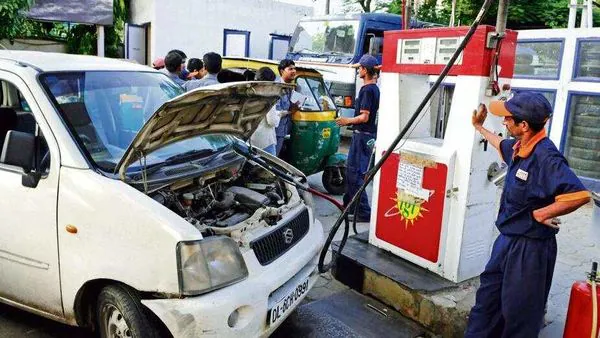
India is preparing to give Compressed Biogas (CBG), or Bio-CNG, a much larger role in its energy mix as the government looks to reduce dependence on imported fossil fuels and turn agricultural and organic waste into a commercial energy resource.
The Union Cabinet has approved the ₹23,731 crore GOBARdhan scheme, formally the National Circular Bioenergy Scheme, which will be implemented from FY2026-27 to FY2035-36. The government aims to increase India’s domestic CBG production nearly tenfold over the coming decade.
The move follows India’s aggressive push for ethanol blending in petrol and could gradually change the composition of the gas supplied to CNG vehicles and households.
What Is Bio-CNG or CBG?
Compressed Biogas is produced from organic waste rather than underground fossil-fuel reserves.
Potential feedstocks include:
- Agricultural residue
- Cattle dung
- Press mud
- Municipal organic waste
- Other forms of biomass
The waste undergoes anaerobic digestion to produce biogas. The gas is then purified to remove impurities and concentrated to obtain methane-rich gas, which can subsequently be compressed into CBG.
In simple terms, CBG is renewable methane produced from waste.
Is Bio-CNG the Same as CNG?
CBG and conventional CNG are not produced from the same source, but their fuel properties are closely related.
| Feature | CNG | CBG/Bio-CNG |
|---|---|---|
| Full form | Compressed Natural Gas | Compressed Biogas |
| Source | Underground natural-gas reserves | Organic waste and biomass |
| Main component | Methane | Purified methane |
| Renewable | No | Yes |
| Can be used as gaseous vehicle fuel | Yes | Yes |
| Existing gas infrastructure | Yes | Can be integrated after purification |
Once purified and compressed to the required standards, CBG has properties similar to natural gas and can enter the existing gas ecosystem.
What Is the GOBARdhan Scheme?
Not every blending route has cleared safety review — see our report on the government holding ethanol-diesel blending over flash point safety concerns.
The ₹23,731 crore programme is designed to build a much larger CBG ecosystem across India.
The scheme combines financial support, assured demand, infrastructure development and financing assistance to make CBG projects more commercially viable.
Its implementation period is FY2026-27 to FY2035-36.
Key Features of the Scheme
| Measure | Government support |
|---|---|
| Total scheme outlay | ₹23,731 crore |
| Implementation period | FY2026-27 to FY2035-36 |
| CBG production goal | Nearly 10x increase |
| CBG procurement obligation | 3% in FY2026-27 |
| Obligation | 4% in FY2027-28 |
| From FY2028-29 | 5% |
| Administered CBG price | ₹2,110/MMBTU |
| Price framework | Minimum 10-year horizon |
| Greenfield capital support | Up to ₹2 crore per TPD |
| Credit support | Dedicated guarantee mechanism for eligible MSME projects |
| Pipeline support | Connections to trunk pipelines and CGD networks |
CBG Blending Target Starts at 3%
One of the most important parts of the scheme is an obligation on City Gas Distribution entities to procure CBG.
The notified obligation is:
- 3% in FY2026-27
- 4% in FY2027-28
- 5% from FY2028-29 onwards
The requirement applies to the CNG transport and PNG domestic segments.
This is designed to create a guaranteed market for CBG producers.
Without assured demand, developers may hesitate to invest hundreds of crores in new biogas plants. The procurement obligation could therefore provide greater certainty for companies considering investments in the sector.
What Does This Mean for CNG Cars?
For existing CNG vehicle owners, the most important point is that this does not mean CNG cars will suddenly need to be modified.
Purified CBG is chemically equivalent to natural gas and can be integrated into the existing gas ecosystem.
Instead of a separate “Bio-CNG” fuel infrastructure being created for every vehicle, renewable gas can increasingly enter the broader gas supply system.
That means the change is expected to happen primarily on the fuel-production and supply side, rather than through a sudden change to vehicle technology.
Will CNG Cars Run on 100% Bio-CNG?
Not immediately.
The government scheme is designed to progressively increase the amount of renewable CBG entering India’s wider gas network.
Therefore, a CNG vehicle could eventually consume a gas supply containing a higher share of renewable methane without the driver necessarily knowing whether a particular molecule of methane came from a biogas plant or a conventional natural-gas field.
Why Is the Government Pushing Bio-CNG?
India has two major problems that the programme attempts to address simultaneously.
The first is rising demand for natural gas across transportation, households, industry and commercial establishments.
The second is the enormous amount of agricultural residue, cattle dung and organic waste generated across the country.
GOBARdhan attempts to connect these two problems.
Instead of treating organic waste purely as a disposal problem, the government wants to turn it into:
Waste → Biogas → CBG → Fuel + Organic manure
This creates what the government describes as a circular economy.
Agriculture Waste Could Become an Energy Resource
India produces large quantities of agricultural residue.
Historically, some crop residue has had limited economic value and can become a waste-management challenge.
CBG plants can create a commercial market for this material.
Farmers and other suppliers could potentially earn money by supplying suitable organic feedstock to plants.
The broader supply chain could also create opportunities for:
- Feedstock aggregators
- Transporters
- CBG plant operators
- Equipment manufacturers
- Organic manure producers
- Rural entrepreneurs
The government expects CBG development to strengthen markets for organic manure such as Fermented Organic Manure (FOM) and Liquid Fermented Organic Manure (LFOM).
Farmers Could Benefit Beyond Fuel Sales
The potential economic impact extends beyond the price paid for agricultural waste.
A functioning CBG ecosystem could create additional rural businesses around collection, transportation, processing and manure production.
This is particularly important because the economics of CBG plants depend heavily on reliable access to feedstock.
The government is therefore attempting to create local ecosystems rather than treating every biogas plant as an isolated facility.
Government Offers Capital Assistance
The scheme provides capital assistance of up to ₹2 crore per tonne per day (TPD) of installed CBG capacity for eligible greenfield projects.
The support can also cover parts of the wider value chain, including feedstock aggregation and organic manure processing. Existing projects expanding their CBG capacity can also qualify for support.
This could reduce the initial capital burden for developers.
CBG plants require significant investment in waste collection, digesters, purification systems, compression equipment and associated infrastructure.
Government assistance could therefore make more projects financially viable.
A 10-Year Pricing Framework Could Attract Investors
Another important feature is a government-backed pricing framework.
The scheme provides for an administered CBG price of ₹2,110 per MMBTU, with a minimum 10-year pricing horizon.
For investors, predictable pricing can be particularly important.
A CBG plant can have a long payback period. If the selling price changes significantly every year, financing becomes more difficult.
A longer-term pricing framework gives developers greater visibility when calculating potential returns.
Pipeline Infrastructure Gets Government Support
Producing CBG is only one part of the challenge.
The gas must also reach customers.
GOBARdhan will support pipeline infrastructure connecting CBG plants with trunk pipelines and City Gas Distribution networks.
Better connectivity could:
- Reduce transportation costs
- Improve supply reliability
- Expand the potential market for CBG
- Make plants viable in more locations
- Connect rural production with urban gas demand
Infrastructure could therefore determine how quickly the industry scales.
Credit Support for Smaller CBG Projects
Financing has been another potential barrier for smaller developers and MSMEs.
The scheme proposes a dedicated credit-guarantee mechanism for eligible MSME-based CBG projects.
By sharing part of the lending risk, the government expects to improve access to institutional credit and potentially reduce collateral requirements.
The programme is also intended to encourage participation from rural entrepreneurs, cooperatives, women entrepreneurs and first-time developers.
A CBG Challenge Fund Will Support Local Ecosystems
The scheme will also establish a CBG Ecosystem Challenge Fund.
It is expected to support:
- Feedstock mapping
- Collection infrastructure
- District-level CBG planning
- Technology adoption
- Process improvements
- Organic manure value addition
The objective is to develop complete local ecosystems around CBG plants instead of building individual plants without supporting infrastructure.
India Already Has a CBG Industry
GOBARdhan is not starting India’s Bio-CNG industry from zero.
The government has already launched initiatives such as:
- SATAT
- Market Development Assistance for organic manure
- Biomass Aggregation Machinery scheme
- Development of Pipeline Infrastructure scheme
- Central Financial Assistance for CBG plants under the National Bioenergy Programme
According to the government, these initiatives have helped enable more than 200 CBG plants and established parts of the production, procurement and organic-manure ecosystem.
The new scheme is intended to take that existing foundation to a much larger scale.
Bio-CNG Could Reduce Fossil-Fuel Dependence
One of the strategic reasons behind the programme is energy security.
India imports a significant share of its fossil-fuel requirements.
Increasing domestic production of renewable methane could reduce the amount of fossil natural gas needed for some applications.
The government is therefore attempting to create a domestic fuel source from materials that are already generated within the country.
This could provide an additional layer of energy security alongside ethanol, electric vehicles, renewable electricity and other alternative-energy initiatives.
Bio-CNG Could Also Improve Waste Management
The programme is not only an energy policy.
It is also a waste-management strategy.
Organic waste can create environmental problems if it is dumped, burned or poorly managed.
Using the material as CBG feedstock provides an economic incentive to collect and process it.
The resulting process also produces organic material that can potentially be used as manure.
That creates a circular model:
Agricultural waste → CBG → Fuel
Organic residue → Manure → Agriculture
How Bio-CNG Differs From Ethanol
India’s ethanol programme and its CBG programme target different fuel systems.
| Factor | Ethanol | CBG/Bio-CNG |
|---|---|---|
| Main fuel | Petrol | CNG/natural gas |
| Feedstock | Sugarcane, grains and other biomass | Organic waste, dung, crop residue |
| Vehicle type | Petrol vehicles | CNG vehicles |
| Production process | Fermentation and distillation | Anaerobic digestion + purification |
| Main strategic objective | Reduce petrol imports | Reduce fossil-gas dependence and manage waste |
| Existing infrastructure | Petrol distribution network | Gas/CGD network |
Together, the two policies form part of India’s broader attempt to increase the share of domestically produced alternative fuels.
Could Bio-CNG Become Cheaper Than Conventional CNG?
The government has created pricing and financial-support mechanisms to improve the economics of CBG.
However, the final retail price paid by consumers will depend on several factors, including production costs, transportation, taxes, distribution margins and the pricing structure used by city gas distributors.
Therefore, the new policy does not automatically mean CNG prices will fall.
Its more immediate objective is to make renewable gas production commercially viable and increase its share in the overall gas supply.
Challenges Remain
Despite the government’s large financial commitment, scaling CBG production will not be easy.
Feedstock Collection
Agricultural waste is widely dispersed, making collection and transportation expensive.
Plant Economics
CBG plants require substantial upfront investment and need high utilisation rates to achieve attractive returns.
Seasonal Supply
Some agricultural residues are available only during specific periods, creating storage and supply-chain challenges.
Transportation
Moving bulky organic waste over long distances can make projects uneconomical.
Technology
Efficient digestion and gas purification require reliable technology and skilled operators.
Market Development
The CBG market needs reliable procurement and infrastructure to grow at the scale envisioned.
These challenges explain why the government’s focus on offtake, pricing, pipelines and financing is important.
What It Means for India’s Energy Companies
The policy could create opportunities across multiple segments of the energy economy.
Potential beneficiaries could include:
- City gas distributors
- CBG producers
- Waste-management companies
- Gas infrastructure companies
- Equipment manufacturers
- Engineering firms
- Agricultural logistics companies
- Organic-fertiliser producers
- Renewable-energy developers
Companies able to build large-scale feedstock networks could have an advantage because reliable raw-material supply is critical to plant economics.
What It Means for CNG Vehicle Owners
For consumers, the transition is likely to be gradual.
A CNG vehicle owner is not expected to need a new vehicle simply because more CBG enters the gas supply chain.
The major change will occur upstream, as more renewable methane is produced and injected into the gas ecosystem.
Over time, this could mean that a growing proportion of the gas used by CNG vehicles comes from renewable sources.
India Is Building a Multi-Fuel Transition
The GOBARdhan programme should be viewed alongside India’s other clean-energy initiatives.
The country is simultaneously expanding:
- Ethanol blending
- Electric vehicles
- Solar and wind power
- Green hydrogen
- Biofuels
- Compressed biogas
- Gas infrastructure
Rather than relying on one technology, India is building multiple alternative-energy pathways.
Bio-CNG is particularly useful because it can leverage existing gas infrastructure and CNG vehicles.
What Investors Should Watch
The success of the programme will depend on whether announced incentives translate into actual projects.
Investors should watch:
- Number of new CBG plants commissioned
- CBG production volumes
- Procurement compliance by city gas distributors
- Feedstock availability
- Capital expenditure by CBG companies
- Pipeline connectivity
- CBG plant utilisation
- Organic-manure sales
- Government subsidy disbursement
- Financial performance of CBG developers
The most important indicator will ultimately be whether India can move from policy announcements to large-scale commercial production.
Broader Industry Impact
The ₹23,731 crore GOBARdhan programme could mark a major expansion of India’s domestic renewable-gas industry. By combining assured demand, a 10-year pricing framework, capital assistance, pipeline support and credit guarantees, the government is attempting to solve several of the biggest problems that have limited CBG investment.
The programme could also create a new commercial market for agricultural residue and organic waste, potentially benefiting farmers and rural businesses while improving waste management.
For the automotive sector, the most important point is that CBG can enter the existing gas ecosystem without requiring a separate vehicle technology. The transition is therefore likely to be gradual and largely invisible to consumers at the vehicle level.
Looking Ahead
India’s ₹23,731 crore GOBARdhan scheme represents a major step in the government’s attempt to turn waste into a domestic energy resource. The programme targets a nearly tenfold increase in CBG production over the next decade, while mandating increasing CBG procurement by city gas distributors.
For CNG vehicle owners, the change will not mean an immediate switch to a new fuel or new vehicle. Instead, renewable methane could gradually become a larger component of the gas supplied through India’s existing network.
For farmers, waste suppliers and energy companies, the policy could create a new commercial ecosystem around agricultural residue, cattle dung and organic waste.
The bigger significance is that India is now applying a strategy similar to its ethanol push to another part of the transport-fuel system: use domestic biological resources to replace a portion of imported fossil fuels while creating new economic value from waste.
Frequently Asked Questions
What is Bio-CNG or CBG?
Compressed Biogas (CBG), also called Bio-CNG, is fuel produced by processing agricultural and organic waste into methane-rich gas that can be compressed and used like CNG.
Is Bio-CNG the same as CNG?
They are used similarly in vehicles, but the source differs: CNG is fossil natural gas, while Bio-CNG is produced from organic and agricultural waste.
What is the CBG blending target?
Blending starts at 3%, backed by the ₹23,731 crore GOBARdhan scheme, as part of reducing dependence on imported fossil fuels.
Get the day’s top stories in your inbox
One concise email. No spam, unsubscribe anytime.


