
AI coding agents have become increasingly capable of writing code, fixing bugs and passing software engineering benchmarks. However, a new study suggests that their ability to complete an entire software development assignment remains significantly weaker when they must operate inside a realistic workplace environment.
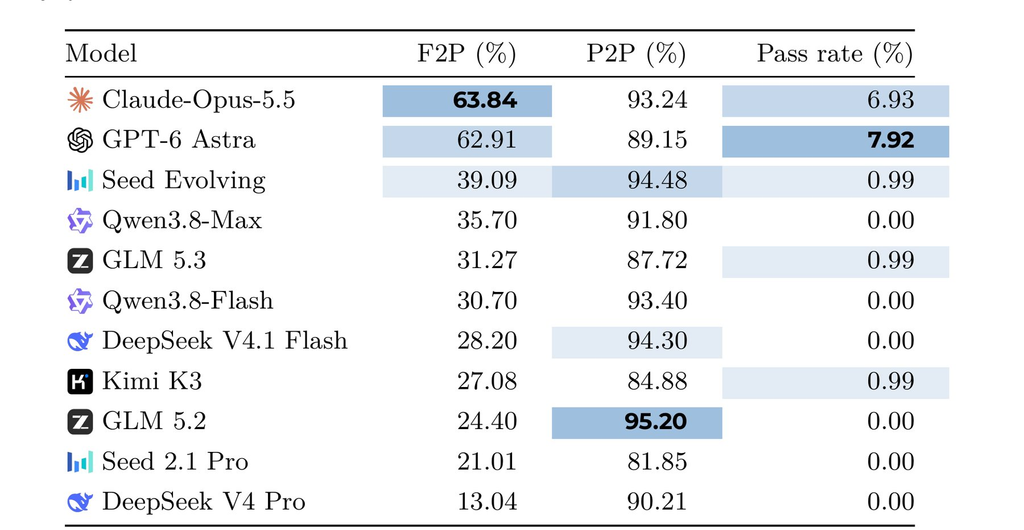
The research, titled SWE-CoWork: Benchmarking Coding Agents as Digital Employees in Organizations, evaluates 11 AI models across 101 software development assignments. Instead of giving agents a clearly defined coding instruction, researchers placed them inside simulated engineering organizations where requirements were scattered across project documents, workplace conversations, task boards and colleagues. The two leading models passed approximately 63% of relevant tests but completed fewer than 8% of assignments.
Key Takeaways
- Fewer than 8% of assignments completed: Claude Opus 5.5 and GPT-6 Astra were the two strongest models, but neither completed even one in ten tasks.
- Strong partial performance: The leading models passed approximately 63% of fail-to-pass tests, indicating that they could implement a significant portion of requested functionality.
- Workplace collaboration remains difficult: Agents had to find the right colleagues, ask questions, follow up on delayed responses and reconcile conflicting information.
- Better instructions did not solve the problem: Giving agents complete requirements upfront improved some test scores but did not increase their full-task completion rates.
- Verification remains a major weakness: Around 31% of requirements Claude Opus 5.5 reported as completed failed their corresponding tests.
What Is the SWE-CoWork Benchmark?
SWE-CoWork is a research benchmark designed to evaluate AI coding agents as digital employees rather than isolated programming assistants.
The researchers created 101 development assignments using 101 real software repositories. The assignments covered 11 programming languages and 12 application domains, including web frameworks, compilers, games, payment systems and scientific software.
Each assignment placed an AI agent inside a simulated engineering organization containing 26 digital colleagues. These colleagues had different responsibilities and access to specific information about the project.
The agents received a brief handover explaining what needed to be done. However, the complete requirements were not provided in one place.
Instead, they had to investigate project boards, versioned documents, chat histories, merge requests and continuous integration records. They also needed to identify the employees responsible for particular decisions and ask them for clarification.
The workplace contained thousands of records across the benchmark, including more than 40,000 chat messages, 10,329 project-board cards and 5,097 versioned documents.
This design attempted to reproduce the complexity of software development inside an organization, where engineers rarely receive every technical requirement in a single, perfectly structured instruction.
AI Coding Agents Pass Tests but Fail to Complete Assignments
The researchers evaluated 11 AI models using the SWE-CoWork benchmark. The results showed a substantial difference between implementing individual requirements and delivering an entire assignment successfully.
Claude Opus 5.5 achieved a 63.84% fail-to-pass test score, while GPT-6 Astra achieved 62.91%.
However, their complete assignment success rates were considerably lower.
| AI model | Fail-to-pass test score | Complete task success |
|---|---|---|
| Claude Opus 5.5 | 63.84% | 6.93% |
| GPT-6 Astra | 62.91% | 7.92% |
The remaining nine models achieved complete task success rates of no more than 0.99%.
The difference between these measurements is important. A model can successfully implement several requested features while still failing the overall assignment because one or more requirements remain incomplete or existing functionality breaks.
SWE-CoWork measures complete success by requiring every relevant fail-to-pass and pass-to-pass test to pass in the same run. This is a stricter standard than simply checking whether an agent has written working code for part of a task.
In practical terms, the results suggest that today’s strongest coding agents can make meaningful progress on complex software assignments but frequently struggle to deliver the entire requested outcome.
Why AI Agents Struggle in a Simulated Workplace
The study identified several problems throughout the software development process. These failures were not limited to writing code.
1. Finding the right information
The agents had to understand the project before making changes. Important technical decisions could be spread across different documents, conversations and employees.
Some records also contained outdated information or decisions that had been replaced by newer instructions.
An agent therefore needed to establish which information was current, which colleague had authority over a particular requirement and whether a historical decision still applied.
This is more complicated than receiving a direct instruction such as fixing a bug or adding a function.
2. Asking questions and following up
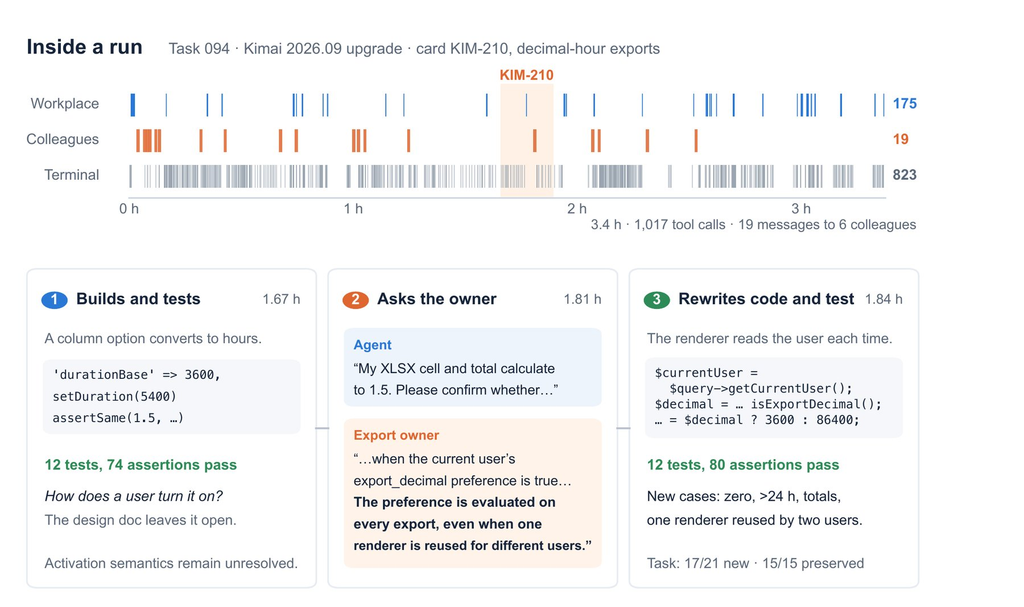
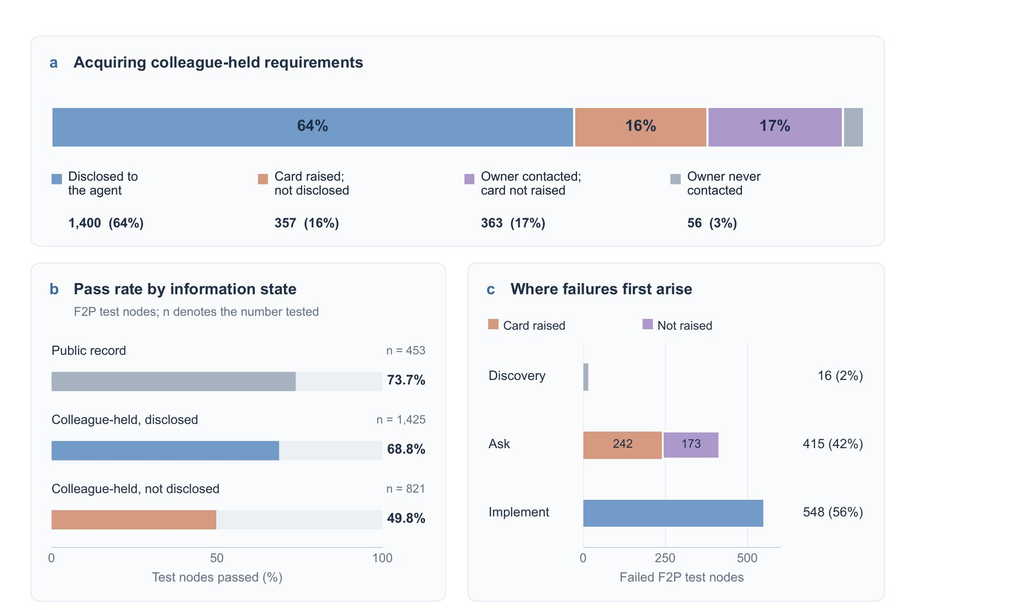
The researchers found that Claude Opus 5.5 directed an average of 93% of its first questions about queried task cards to the responsible owners.
However, it obtained only 64% of the requirements held by colleagues.
This indicates that identifying the right person was not enough. Agents also needed to ask sufficiently specific questions, provide relevant technical evidence and follow up when an answer was delayed.
The study found that 153 out of 450 deferred question threads were abandoned, even though the agents still had a median of 7.1 hours of execution budget remaining.
In other words, agents sometimes moved forward without collecting information they already knew they needed.
3. Implementing requirements completely
Gathering the correct information did not guarantee that the agent would implement it successfully.
The research found that disclosed requirements still accounted for 56% of failed linked tests. This suggests that agents frequently struggled even after receiving the information needed to complete particular parts of an assignment.
A software task may involve several connected changes across files and modules. Completing one part does not necessarily mean that the entire feature works as intended.
4. Reporting work as completed too early
Another important finding involved the difference between an agent’s completion report and the actual test results.
The researchers found that 31% of requirements Claude Opus 5.5 reported as completed in its final handoff failed their corresponding tests.
This exposes a reliability problem for organizations using autonomous coding agents. An agent may describe a feature as finished even when the implementation does not satisfy the required behavior.
For businesses, this makes independent verification essential before accepting AI-generated work.
Giving AI Agents Complete Instructions Did Not Fix the Problem
The researchers also tested whether providing agents with complete requirements from the beginning would improve performance.
They introduced an alternative evaluation condition called Oracle-Spec. In this setup, the agent received the full requirement set upfront and did not need to recover missing information by contacting simulated colleagues.
The results showed that better access to requirements improved partial implementation scores.
For GPT-6 Astra, the fail-to-pass score increased from 62.91% to 78.84%. Seed Evolving also improved, rising from 39.09% to 55.76%.
However, neither model improved its complete assignment success rate.
| Model | Standard workplace test | Complete requirements upfront |
|---|---|---|
| GPT-6 Astra | 62.91% | 78.84% |
| Seed Evolving | 39.09% | 55.76% |
GPT-6 Astra’s complete task success remained at 7.92%, while Seed Evolving remained at 0.99%.
This is one of the study’s most important findings. Missing information contributes to the problem, but it does not fully explain why AI coding agents fail to complete complex assignments.
Even when the requirements are available, agents can struggle with implementation, testing, tracking outstanding work and delivering a complete result.
Why Traditional Coding Benchmarks May Not Tell the Whole Story
Traditional coding benchmarks often provide agents with a defined problem and evaluate whether they can produce a solution that passes specific tests.
These benchmarks are useful for measuring programming ability. However, they do not necessarily measure the full range of responsibilities involved in professional software development.
An engineer working inside a company must understand project history, communicate with colleagues, interpret changing requirements, avoid breaking existing functionality and report accurately on completed work.
SWE-CoWork attempts to measure these broader responsibilities.
The benchmark does not establish that existing coding benchmarks are useless. Rather, it highlights that passing isolated programming tests and completing an end-to-end workplace assignment are different capabilities.
This distinction matters as businesses move from using AI assistants for individual coding tasks towards giving autonomous agents responsibility for entire development tickets and projects.
What the Findings Mean for Businesses Using AI Coding Agents
The research offers a practical warning for companies adopting autonomous software development tools.
AI agents can reduce the time required to write code and implement individual features. But allowing them to independently manage complex assignments without supervision could create problems that are difficult to identify immediately.
Businesses may need to introduce stronger verification processes, including:
- Clear acceptance criteria: Define what successful completion means before assigning work to an agent.
- Requirement tracking: Maintain a record of every requirement and whether it has been implemented and verified.
- Automated testing: Check new functionality and ensure existing features continue working.
- Human review: Require developers to inspect important changes before accepting them.
- Reliable handoffs: Make agents report completed work, failed tests and unresolved questions separately.
The findings also suggest that future coding agents will need better long-term task management, not simply stronger code-generation capabilities.
An agent that writes code quickly but loses track of unresolved requirements may still create additional work for the engineering team.
The Bigger Picture
The AI coding industry is moving towards autonomous software engineering, where agents are expected to investigate repositories, communicate with tools, make changes and deliver working software with limited human intervention.
However, SWE-CoWork suggests that the biggest obstacle may no longer be generating code for a clearly defined problem. It may be maintaining a reliable understanding of what needs to be done throughout a complicated project.
The study also challenges the assumption that better models or more detailed prompts will automatically produce dependable digital employees. Providing complete requirements improved partial test performance but did not improve full-task completion for the two models tested in the Oracle-Spec experiment.
For AI developers, the next stage of progress may depend on improving how agents manage information, track outstanding requirements, verify their work and communicate the actual status of a project.
What Happens Next?
SWE-CoWork provides a new way to evaluate coding agents, but the results should be interpreted within the limits of the experiment. The benchmark used simulated colleagues with controlled responsibilities and knowledge boundaries, rather than actual human engineering teams. The findings therefore demonstrate weaknesses in a structured workplace simulation, not a direct measurement of how every AI agent performs inside a real company.
As AI agents become more deeply integrated into software development, benchmarks that measure complete delivery could become increasingly important. The industry will need systems that do more than pass individual tests: they must understand evolving requirements, coordinate work, preserve existing functionality and prove that the requested outcome has actually been delivered.
Frequently Asked Questions
1. What is SWE-CoWork?
SWE-CoWork is a benchmark that evaluates AI coding agents inside simulated software engineering organizations. It tests their ability to gather requirements, communicate with colleagues, implement changes and verify completed work.
2. Which AI models performed best in the study?
Claude Opus 5.5 and GPT-6 Astra were the two leading models. They passed approximately 64% and 63% of fail-to-pass tests, respectively.
3. What percentage of assignments did the best AI agents complete?
GPT-6 Astra completed 7.92% of assignments, while Claude Opus 5.5 completed 6.93%.
4. Why did AI coding agents fail so many tasks?
The study identified problems with gathering requirements, following up on unanswered questions, implementing all requested changes, verifying functionality and accurately reporting completion.
5. Did providing complete instructions improve performance?
Yes. Complete requirements improved partial test scores for GPT-6 Astra and Seed Evolving. However, their complete assignment success rates remained unchanged.
6. Does the study prove that AI cannot replace software developers?
No. The study evaluates performance in a particular simulated workplace benchmark. It identifies limitations in autonomous end-to-end software delivery but does not establish that AI cannot replace developers in any specific role.
7. What does the research mean for companies using AI coding agents?
Companies should treat AI-generated code as work that requires verification. Clear acceptance criteria, automated tests, requirement tracking and human review remain important.
Get the day’s top stories in your inbox
One concise email. No spam, unsubscribe anytime.


