
AI token spending grew just 0.2% month over month in September 2026, marking its weakest monthly growth since November 2025, according to figures reported by The Kobeissi Letter. The slowdown comes as businesses continue adopting artificial intelligence, raising questions about whether falling model prices are weakening revenue growth for AI providers or simply making AI more affordable.
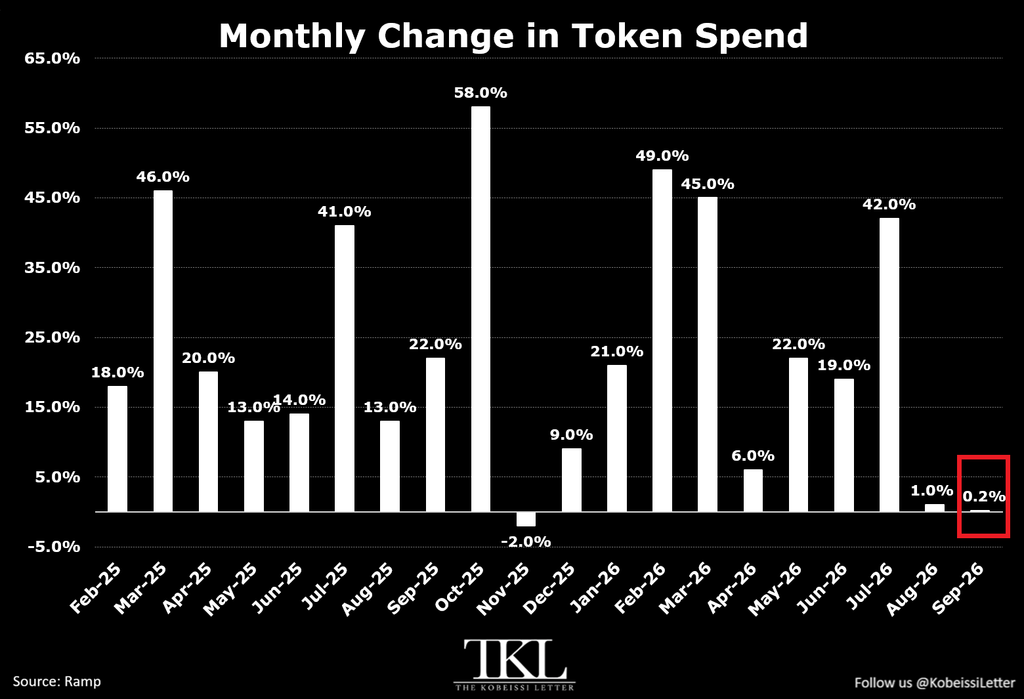
The trend highlights an important distinction in the AI economy: the number of tokens processed can rise even when spending barely increases. Lower prices, cheaper models and more efficient usage allow businesses to perform more AI tasks without increasing their budgets at the same pace. For OpenAI, Anthropic and other model providers, the challenge is converting this growing usage into sustainable revenue while competing in a market where the cost of intelligence is falling.
Key Takeaways
- Spending growth slowed: AI token spending rose just 0.2% month over month in September 2026, according to figures reported by The Kobeissi Letter.
- Prices are falling: Reporting indicates that average token prices have declined sharply since earlier in 2026.
- Usage and spending are diverging: Businesses can process more tokens without spending proportionately more.
- Competition is intensifying: Lower-cost models, open-weight alternatives and provider price cuts are putting pressure on average revenue per token.
- AI adoption continues: Ramp’s index showed that 55.9% of businesses in its sample paid for AI in September, up from 55.2% in August.
- Investment questions are growing: Slower spending growth could complicate expectations for AI companies investing heavily in computing infrastructure.
What Does the 0.2% Growth Figure Mean?
The reported 0.2% month-over-month increase indicates that spending on AI tokens barely changed between August and September. It represents a sharp slowdown from the growth rates that helped fuel optimism about demand for large language models.
AI tokens are units of text or other information processed by a model. Providers commonly charge developers based on the number of input and output tokens processed, although pricing varies by model, service and workload.
For example, a company might use an AI model to summarize customer conversations, classify support requests or generate software code. Each task consumes tokens, and the resulting usage creates revenue for the provider.
If a business processes 10 million tokens at a certain average price, its spending depends on both the volume of tokens and the price paid per token. If the price falls substantially, the business can increase usage without spending much more.
The 0.2% figure should therefore be interpreted as a measure of spending growth, not as direct evidence that AI adoption or token consumption has stopped growing.
Why Are AI Token Prices Falling?
Several changes are putting downward pressure on the cost of AI usage.
1. AI companies are cutting prices
Model providers are competing to attract developers and enterprise customers. Price reductions can make their services more attractive for applications that process large amounts of data or generate lengthy responses.
Lower prices also make it easier for companies to move AI from experimentation into everyday business workflows. However, they reduce the revenue earned for each token unless the additional volume compensates for the decline.
2. Businesses are switching to cheaper models
Not every task requires the most expensive frontier model. A business might use a powerful model for complex reasoning but route routine classification, extraction and summarization tasks to a cheaper alternative.
Open-weight models can provide another option for organizations that want to run models on their own infrastructure or use lower-cost hosting providers. This increases competitive pressure on companies that charge premium prices for proprietary models.
3. AI systems are becoming more efficient
Developers are improving how applications use context, reuse previous computations and select models for particular tasks. Prompt caching, for example, can reduce the cost of repeatedly processing identical input.
Agentic AI introduces a more complicated picture. Agents can make numerous model calls while working through a task, potentially increasing total token consumption. Yet routing, caching and model selection can reduce the average cost of those interactions.
The combined effect is that token demand and token spending no longer necessarily move together.
AI Usage Is Still Expanding
The slowdown in spending comes alongside evidence that businesses continue to adopt AI tools.
Ramp’s AI Index reported that 55.9% of businesses in its sample paid for AI in September, compared with 55.2% in August. The index draws on payment data from more than 85,000 U.S. businesses, although not every business or AI purchase is captured by the same metrics.
Ramp also reported that spending on AI tokens had shown little growth for two consecutive months, even as token volume increased. In its latest complete-week comparison, covering the week ending October 11 against the week ending September 13, token spending rose 23%, while token volume increased 52.4%.
The same comparison showed the blended price per million tokens for OpenAI and Anthropic falling 25.4%, from $0.86 to $0.64.
These figures use different measurement periods and should not be treated as interchangeable with the reported 0.2% monthly growth figure. Together, however, they illustrate how token volume, prices and spending can move in different directions.
What Falling Token Prices Mean for AI Companies
For model providers, revenue depends partly on how much customers pay for each unit of usage. If average prices fall while token volume increases, providers must generate enough additional demand to offset the lower revenue per token.
This creates different outcomes for different companies.
| Market development | Potential effect |
|---|---|
| Lower prices per token | Makes AI more affordable but reduces revenue per unit |
| Higher token consumption | Can offset lower prices if volume grows sufficiently |
| Migration to cheaper models | Increases competition and puts pressure on premium pricing |
| Better caching and efficiency | Reduces customer costs but can lower billable usage per task |
| Wider enterprise adoption | Expands the potential customer base and long-term market |
| Rising infrastructure costs | Increases pressure to demonstrate profitable growth |
The effects will depend on each provider’s costs, pricing structure and customer mix. A company with efficient infrastructure and a large customer base may be able to operate profitably at lower prices. Another provider with expensive computing requirements and slower revenue growth may face greater pressure.
Investors are therefore increasingly interested in the relationship between AI usage, revenue, gross margins and capital expenditure—not just the number of users or tokens processed.
Could Slower Spending Threaten the AI Investment Boom?
The AI industry is supported by enormous investments in advanced chips, data centers, networking equipment and power infrastructure. These investments are based partly on expectations that AI demand will continue growing rapidly for years.
Reuters highlighted the tension in its October 21 analysis of the AI investment cycle, noting that token usage continues to rise even as spending growth slows. The report also pointed to the enormous infrastructure commitments being made by major cloud companies.
If token prices continue falling, AI providers will need either substantially greater usage, higher-value services or improved operating efficiency to sustain revenue growth and justify their investments.
However, lower prices do not automatically signal an impending collapse. Cheaper AI can unlock new applications that were previously too expensive to run. Businesses may deploy models more widely, automate additional tasks and increase the total volume of work handled by AI.
Economists sometimes describe this possibility through the Jevons paradox: when a resource becomes cheaper to use, total consumption can rise enough to offset some or all of the efficiency gains. Whether this effect will be strong enough in AI remains uncertain.
What Businesses Should Watch Next
Companies using AI should look beyond headline token prices and measure the cost of completing useful work.
For example, the relevant metric for a customer-service system may be the cost per successfully resolved ticket rather than the cost per million tokens. A coding assistant might be evaluated by the cost of completing and testing a software change. These measures show whether falling prices translate into better business economics.
Businesses can also manage costs by selecting the right model for each task, limiting unnecessary context, using caching where appropriate and monitoring spending by application or department.
For AI providers, the key metrics will include paid usage, customer retention, revenue per task, infrastructure efficiency and margins. Strong growth in token volume would be more encouraging if it also translated into sustainable revenue and profitable customer relationships.
The Bigger Picture
The slowdown in AI token spending points to a changing phase of the AI market. Early enthusiasm centered on model capabilities and the rapid expansion of usage. Increasingly, the industry must demonstrate that this usage can support the cost of training and running increasingly capable models.
Falling prices can be positive for customers and may expand the market over time. But for providers, the transition creates a difficult balance between winning customers through affordability and earning enough revenue to fund expensive infrastructure. The 0.2% September growth figure is a signal worth watching, not proof that AI demand has peaked.
FAQs
1. What does AI token spending mean?
AI token spending is the money businesses pay to process tokens through language models. Providers commonly charge based on input and output token volumes, with prices varying by model and service.
2. Why did AI token spending grow only 0.2% in September 2026?
The reported figure indicates that spending barely increased compared with August. Falling token prices, competition from cheaper models and more efficient AI usage are possible contributors, although the figure alone does not establish the precise cause.
3. Does slower token spending mean AI adoption is declining?
Not necessarily. Ramp’s September data showed that paid AI adoption increased to 55.9% of businesses in its sample. Spending can remain flat even as adoption and usage rise if the average cost of tokens falls.
4. How do falling token prices affect OpenAI and Anthropic?
Lower prices can attract more customers and increase usage, but they also reduce revenue earned per token. Providers need sufficient volume growth, efficient infrastructure or higher-value services to maintain revenue and margins.
5. Should businesses reduce their AI spending?
Not solely because token spending growth has slowed. Businesses should assess the cost and value of completed tasks, compare models, monitor usage and ensure that AI delivers measurable productivity gains.
Looking Ahead
The next few months will help clarify whether the September slowdown was a temporary pause or part of a longer period of weaker spending growth. Investors and AI companies will be watching token volumes, pricing changes, enterprise adoption and revenue performance to understand whether cheaper AI is expanding the market quickly enough to offset lower prices.
For businesses, the falling cost of AI could create opportunities to automate more work and experiment with new applications. For model providers and infrastructure investors, the challenge is more demanding: proving that rising AI usage can translate into durable revenue and returns on the capital being committed to the industry.
Get the day’s top stories in your inbox
One concise email. No spam, unsubscribe anytime.


