
Ather Energy is targeting at least 20% market share in India’s electric two-wheeler market as it expands manufacturing capacity and resumes dealership additions to meet rising demand. The Bengaluru-based electric scooter maker saw its market share decline to 15.1% in the July–September 2026 quarter, from 17.2% a year earlier, despite recording strong growth in vehicle registrations. CEO and co-founder Tarun Mehta told The Economic Times that the company plans to address supply constraints and strengthen its retail network to capture a larger share of the market.
The strategy comes as Ather reports higher customer enquiries and pre-orders, while India’s electric two-wheeler market continues to expand. The company plans to add 225,000 units of annual manufacturing capacity across its Hosur facility in Tamil Nadu and its new AURIC plant in Chhatrapati Sambhajinagar, Maharashtra. It is also preparing to restart dealership expansion after slowing new-store additions because available scooter supplies could not reliably support additional outlets.
Key Takeaways
- Market-share target: Ather Energy is aiming for at least 20% market share in the near term.
- Recent market share: Its share fell to 15.1% in Q2 FY2027 from 17.2% in the corresponding quarter a year earlier.
- Capacity expansion: The company plans to add 225,000 units of annual production capacity, taking total installed capacity to approximately 1.14 million units by Q2 FY2028.
- Strong demand: Customer pre-orders more than doubled year on year to approximately 180,000 in the September 2026 quarter.
- Dealership growth: Ather plans to restart store additions after temporarily slowing expansion because of supply constraints.
- Financial improvement: Revenue from operations rose 63% over the standalone year-earlier comparative to ₹1,464.24 crore in Q2 FY2027, while the company reported a net profit of ₹1.26 crore.
Why Ather Energy Is Targeting 20% Market Share
Ather’s target comes at a time when India’s electric two-wheeler market is growing quickly, but the company has not kept pace with the industry’s overall expansion.
According to The Economic Times, Ather’s market share declined from 17.2% in the July–September 2025 quarter to 15.1% in the same quarter of 2026. Its registrations grew 60% year on year, but the wider market expanded 82%.
The difference suggests that Ather’s challenge is not simply attracting customers. It also needs to convert more of that demand into deliveries while competing against manufacturers expanding their own electric scooter businesses.
The company has attributed part of the problem to manufacturing constraints. Strong customer interest has outpaced the number of vehicles it can produce, limiting its ability to fulfil potential sales and supply additional dealerships.
Ather’s near-term objective is to improve availability while maintaining product demand. Reaching 20% market share will depend on how quickly its new manufacturing capacity comes online, whether its retail expansion translates into additional registrations and how competitors perform.
Manufacturing Capacity Expansion: The Main Growth Driver
Ather plans to expand production at two facilities to address the gap between demand and supply. The company announced the expansion on October 26, 2026, alongside its second-quarter financial results.
The programme is expected to increase annual installed capacity by 225,000 units, supported by an investment of approximately ₹122 crore.
| Manufacturing facility | Current or initial annual capacity | Planned annual capacity | Expected timeline |
|---|---|---|---|
| Hosur, Tamil Nadu | 420,000 units | 495,000 units | By December 2026 |
| AURIC, Maharashtra | 500,000 units in Phase 1 | 650,000 units | Additional capacity by Q2 FY2028 |
| Combined capacity | — | Approximately 1.14 million units | By Q2 FY2028 |
Source: Ather Energy’s Q2 FY2027 earnings release. Figures represent planned installed annual capacity, not actual production.
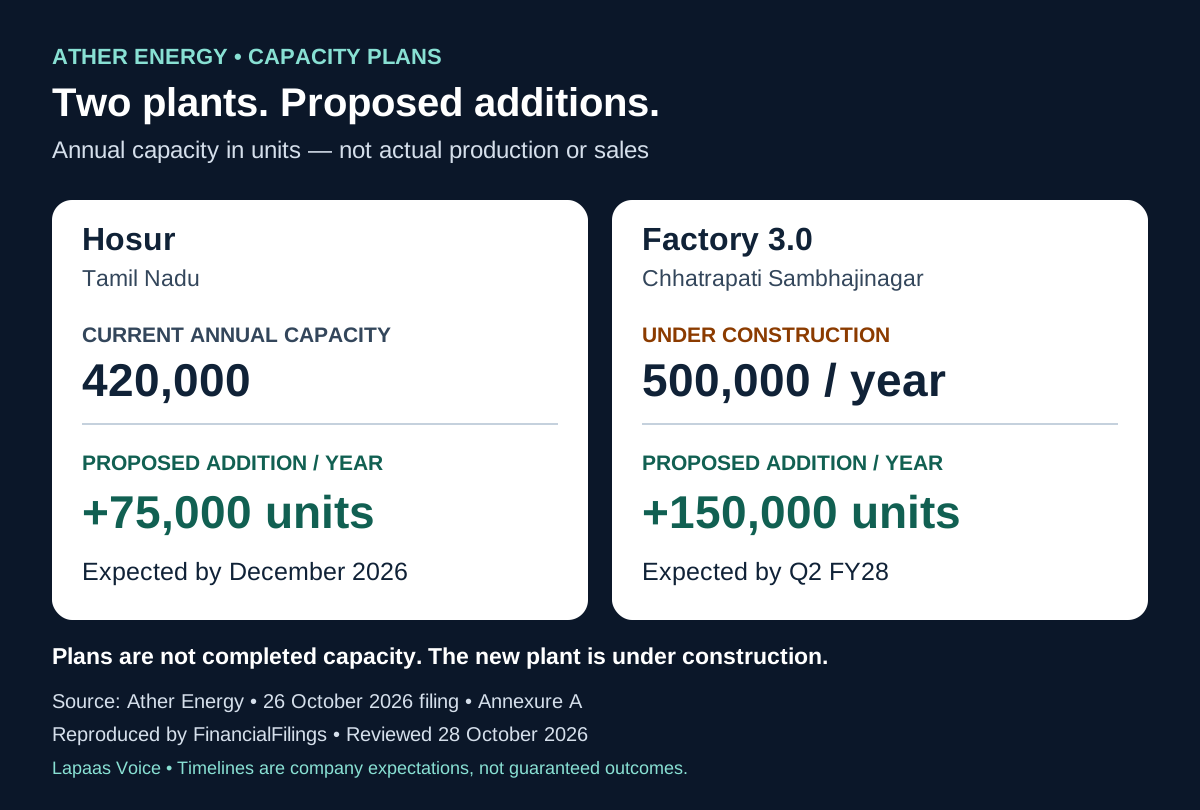
The Hosur expansion will add 75,000 units of annual capacity. Ather’s new AURIC facility is scheduled to begin commercial production in phases from December 2026, starting with a planned annual capacity of 500,000 units. A further 150,000 units of annual capacity are expected to be added at the facility by Q2 FY2028.
The expansion could help Ather fulfil pending orders, improve vehicle availability and support a larger dealer network. However, installed capacity does not immediately translate into equivalent production. New facilities need to ramp up operations, and actual output will depend on equipment readiness, supply chains, workforce availability and production efficiency.
Demand Is Growing Faster Than Supply
Ather’s customer indicators suggest that demand remains strong despite the recent loss of market share.
The company’s Q2 FY2027 earnings release reported approximately 1 million customer enquiries during the quarter, up 109% year on year. Pre-orders more than doubled to approximately 180,000, indicating substantial interest in its electric scooter portfolio.
The company also reported 93,211 vehicle volumes for the quarter, a 42% year-on-year increase. Registrations, including international dispatches, rose 60% to 92,589 units.
| Business metric | Q2 FY2027 | Year-on-year change |
|---|---|---|
| Vehicle volumes | 93,211 units | +42% |
| Registrations, including international dispatches | 92,589 units | +60% |
| Customer enquiries | Approximately 1 million | +109% |
| Customer pre-orders | Approximately 180,000 | More than doubled |
| India’s electric two-wheeler registrations | Approximately 598,000 units | +82% |
Sources: Ather Energy’s Q2 FY2027 earnings release and The Economic Times. Figures refer to different measures and should not be treated as interchangeable.
Ather has said the available supply is limiting potential sales. CEO Tarun Mehta indicated that the company could be missing approximately 18,000–20,000 retail sales per month at the current demand trajectory, according to reporting by Autocar Professional.
If production improves as planned, the company could convert more enquiries and pre-orders into completed sales. However, pre-orders are not equivalent to confirmed deliveries, and some customers may delay or cancel purchases.
Ather Resumes Dealership Expansion
Manufacturing constraints also affected Ather’s retail strategy. The company had slowed the addition of new dealerships because it did not want new outlets to open without enough vehicles to sell.
That approach prioritised inventory availability and dealer economics over rapid network growth. Dealerships need a reliable supply of scooters to generate revenue, serve customers and maintain confidence in the brand.
In September 2026, Ather said it had signed letters of intent for approximately 100 new dealerships and expected to begin executing the expansion from November–December as production from its new facility started. More noticeable additions are expected from Q4 FY2027, according to industry reporting.
A larger retail footprint could help Ather reach customers in additional cities and regions, improve product visibility and expand access to test rides and after-sales services. But opening more outlets will only support sustained growth if the company can maintain vehicle availability and service quality.
The planned expansion therefore depends on two connected factors: additional production capacity and a retail network capable of selling and servicing the resulting volumes.
Financial Performance Improves in Q2 FY2027
Ather’s operational expansion comes alongside an improvement in its financial performance.
For the September 2026 quarter, the company reported revenue from operations of ₹1,464.24 crore, 63% above the standalone year-earlier comparative. It recorded a consolidated net profit of ₹1.26 crore. The ₹154.07 crore loss shown for the corresponding quarter a year earlier is a standalone comparative, not a like-for-like consolidated result.
The company also reported EBITDA of ₹74.2 crore and an EBITDA margin of 4.9%, marking its second consecutive EBITDA-positive quarter.
| Financial metric | Q2 FY2027 (consolidated) | Q2 FY2026 (standalone comparative) |
|---|---|---|
| Revenue from operations | ₹1,464.24 crore | Approximately ₹898 crore |
| Net profit or loss | ₹1.26 crore profit | ₹154.07 crore loss |
| EBITDA margin | 4.9% | Approximately -9.6% |
Source: Ather Energy’s Q2 FY2027 earnings release. The prior-year revenue and EBITDA margin are approximate comparisons.
Clarification, 28 October 2026: Ather began reporting consolidated results in the June 2026 quarter. The September 2025 comparatives in its September 2026 consolidated statement are standalone figures, so the two periods are not like-for-like consolidated comparisons. Source: Ather’s October 26 filing, note (x), reproduced by FinancialFilings.
The improvement suggests that higher volumes and better operating leverage are helping the business. Nevertheless, the company still needs to demonstrate that it can sustain profitability while investing in new capacity, expanding dealerships and supporting a broader customer base.
The additional ₹122 crore capacity investment also means execution and capital discipline will remain important as Ather increases production.
What Could Prevent Ather From Reaching Its Target?
Ather’s 20% market-share goal is a management target, not a guaranteed outcome. Several factors will influence whether the company can achieve it.
First, capacity must become productive on schedule. Delays in commissioning or ramping up the AURIC facility could extend supply constraints.
Second, competition remains intense. If rival manufacturers increase production, expand their dealer networks or introduce competitively priced scooters, Ather may need to grow faster simply to maintain its current position.
Third, manufacturing growth must be matched by service infrastructure. A larger customer base requires spare parts, repair capacity, charging access and consistent after-sales support.
Finally, the economics of growth matter. Selling more scooters will not necessarily improve profitability if the additional volumes require excessive discounts or if manufacturing and distribution costs rise sharply.
The coming quarters will therefore be important for assessing whether Ather can translate its order pipeline and capacity investment into higher deliveries, market-share gains and sustained financial improvement.
The Bigger Picture
Ather Energy’s plans illustrate the challenges facing electric two-wheeler manufacturers in India’s expanding EV market. Strong demand creates an opportunity, but companies must build production capacity, secure supply chains and establish retail and service networks quickly enough to convert interest into sales.
Ather is responding with a coordinated expansion across manufacturing and distribution. If its new capacity comes online as scheduled and customer demand remains strong, the company could regain lost market share. The outcome will depend on execution, competition and the pace at which India’s electric two-wheeler market continues to grow.
FAQs
1. What market share is Ather Energy targeting?
Ather Energy is targeting at least 20% market share in India’s electric two-wheeler market in the near term, according to CEO and co-founder Tarun Mehta.
2. Why did Ather’s market share decline?
Its market share fell to 15.1% in Q2 FY2027 from 17.2% a year earlier. Although registrations increased 60%, the overall electric two-wheeler market grew 82%, meaning Ather expanded more slowly than the industry.
3. How much manufacturing capacity is Ather adding?
Ather plans to add 225,000 units of annual capacity across its Hosur and AURIC facilities. Combined installed annual capacity is expected to reach approximately 1.14 million units by Q2 FY2028.
4. When will Ather resume dealership expansion?
Ather has indicated that dealership additions will restart around November–December 2026, with more noticeable expansion expected from Q4 FY2027 as manufacturing capacity improves.
5. Did Ather report a profit in Q2 FY2027?
Yes. Ather reported a consolidated net profit of ₹1.26 crore for the quarter ended September 2026. The reported ₹154.07 crore year-earlier loss is a standalone comparative because consolidation began in the June 2026 quarter. Revenue from operations was ₹1,464.24 crore, 63% above the standalone year-earlier comparative.
Looking Ahead
Ather’s next milestones will be the planned expansion at Hosur, the start of commercial production at AURIC and the reopening of dealership growth. Investors and customers will be watching whether these steps reduce waiting times, improve vehicle availability and help the company regain market share.
The 20% target will ultimately depend on more than factory capacity. Ather must convert customer interest into deliveries while maintaining product quality, dealer economics and financial discipline. Its performance over the next several quarters will show whether the supply expansion is sufficient to translate strong demand into a larger position in India’s electric two-wheeler market.
Get the day’s top stories in your inbox
One concise email. No spam, unsubscribe anytime.


