
The Reserve Bank of Australia (RBA) has raised its official cash rate by 25 basis points to 4.85%, delivering its fifth interest rate increase of 2026. The decision, announced on November 3, takes Australia’s benchmark borrowing rate to its highest level in 18 years as the central bank attempts to bring persistent inflation under control. The increase follows four earlier hikes that had already lifted the cash rate to 4.60%.
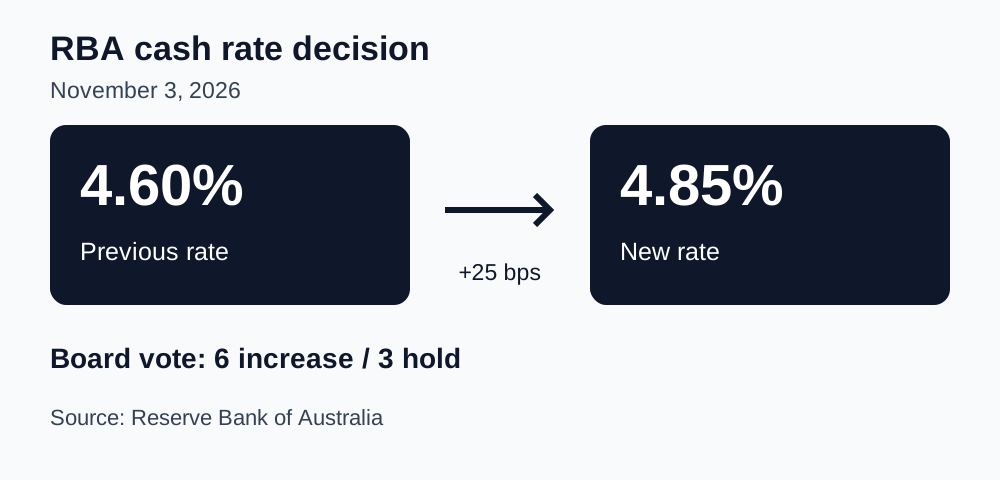
The decision was approved by a 6-3 majority, highlighting differences among policymakers over whether another increase was necessary. The RBA cited elevated inflation, rising energy prices and domestic capacity pressures as reasons for tightening monetary policy further. However, the divided vote and comments from Governor Michele Bullock have also raised questions about whether the central bank will pause before considering another increase.
RBA Raises Cash Rate to 4.85%
The RBA increased its official cash rate by 0.25 percentage points, taking it from 4.60% to 4.85%.
The November decision represents the fifth rate hike of 2026 and reverses the easing cycle that had previously taken place as inflation moderated.
| Monetary policy detail | Information |
|---|---|
| Central bank | Reserve Bank of Australia |
| Previous cash rate | 4.60% |
| New cash rate | 4.85% |
| Rate increase | 25 basis points |
| Decision date | November 3, 2026 |
| Number of hikes in 2026 | Five |
| Voting outcome | 6-3 |
| Previous rate level | Highest since 2008 after the latest increase |
Three of the nine members of the Monetary Policy Board preferred to leave interest rates unchanged, while six supported the increase.
The majority concluded that tighter financial conditions were necessary to prevent inflation from remaining above the central bank’s target for an extended period.
Why Did Australia Raise Interest Rates Again?
Inflation remains the central concern behind the RBA’s decision.
Australia’s headline inflation reached 3.9% in the September quarter compared with the same period a year earlier. The trimmed mean measure, which excludes unusually large price movements and is closely watched by the central bank, reached 3.7%.
Both measures remain above the RBA’s target range of 2% to 3%.
The central bank identified several factors contributing to continued inflationary pressure.
1. Higher Global Energy Prices
Rising global energy prices have added to inflationary pressure in Australia.
The ongoing conflict in the Middle East has disrupted energy markets and pushed up fuel costs. Higher prices for oil and other energy products can affect transportation, manufacturing, electricity and the cost of delivering goods.
These expenses can eventually be passed on to households through higher prices for everyday products and services.
The RBA has also warned that energy-related cost increases could take longer to work their way through the economy.
2. Domestic Capacity Constraints
The central bank believes Australia’s domestic economy has been facing tighter capacity constraints than previously estimated.
Capacity constraints occur when demand for goods and services grows faster than businesses can supply them. This can put pressure on wages, production costs and consumer prices.
Although economic growth has slowed and unemployment has increased, inflation remains broad-based across several parts of the economy.
The RBA believes further tightening is needed to bring demand into better balance with the economy’s ability to produce goods and services.
3. Strong AI and Data Centre Investment
Investment linked to artificial intelligence is also contributing to demand for technology products and infrastructure.
The expansion of data centres requires large investments in computing equipment, electricity, cooling systems and construction. Strong demand for these resources can increase prices and add to capacity pressures.
The RBA has identified AI-related investment as one of the factors contributing to inflation risks, both internationally and domestically.
Inflation Expected to Remain Above Target Until 2027
The RBA has revised its inflation outlook higher in its November 2026 Statement on Monetary Policy.
It now expects headline and underlying inflation to remain above 3% until the end of 2027. Inflation is projected to return to the midpoint of its 2% to 3% target range around mid-2028.
The updated forecasts also indicate that higher interest rates could slow economic activity and increase unemployment.
| Economic indicator | RBA’s November outlook |
|---|---|
| Headline inflation, December 2026 | 4.5% |
| Trimmed mean inflation, December 2026 | 3.6% |
| GDP growth, December 2026 | 1.6% |
| Unemployment rate, December 2026 | 4.7% |
| Unemployment rate, December 2028 | 5.1% |
| Inflation returning to target midpoint | Mid-2028 |
The projections reflect the RBA’s assessment as of its November policy statement and are subject to economic conditions changing.
The central bank expects higher borrowing costs to reduce spending and investment over time, helping ease inflationary pressure.
What Does the Rate Increase Mean for Australian Homeowners?
The latest increase could put additional pressure on households with variable-rate mortgages.
When the RBA raises its cash rate, banks may increase lending rates, making mortgage repayments more expensive for borrowers.
For households already dealing with higher living costs, an additional increase can reduce disposable income and leave less money available for shopping, travel and other spending.
The impact depends on the size of the mortgage, the interest rate charged by the lender and the remaining loan term.
Higher interest rates can also affect people seeking new home loans because borrowing becomes more expensive and lenders may reassess how much customers can afford.
The RBA’s November statement also noted that Australian housing prices had declined by almost 5% from their March peak by September, reflecting higher interest rates and other factors.
Businesses Could Face Higher Borrowing Costs
The rate increase also affects businesses that depend on loans to finance operations, expansion and capital expenditure.
Higher borrowing costs can make it more expensive to invest in equipment, hire employees, develop property and expand production.
Smaller businesses may be particularly sensitive to changes in lending rates because they often have fewer financing options than large corporations.
However, higher interest rates can also help reduce inflation by moderating demand across the economy.
For the RBA, the challenge is to slow price increases without weakening employment and economic activity more than necessary.
A Divided Vote Raises Questions About Another Rate Hike
Although the RBA raised rates, the 6-3 voting outcome suggests that policymakers were divided over the need for further tightening.
Governor Michele Bullock said the central bank would assess incoming economic data before making its next decision. She also acknowledged the pressure higher interest rates place on households but defended the latest increase as necessary to address persistent inflation.
The RBA did not commit to another increase. Its future decisions will depend on inflation, employment, economic growth and how previous rate increases affect spending.
The split vote has led market participants to consider whether the November increase could be the last move in the current tightening cycle. However, the central bank has retained flexibility to respond if inflation remains higher than expected.
The Bigger Picture
Australia’s latest rate increase reflects a wider challenge facing central banks: controlling inflation when higher energy costs and strong investment demand continue to put pressure on prices.
The RBA has already raised borrowing costs five times in 2026, but inflation remains above its target range. This suggests that monetary policy takes time to influence the broader economy, particularly when price increases are being driven by both domestic demand and international supply pressures.
The decision also highlights the trade-off between controlling inflation and supporting economic growth. Higher interest rates can reduce consumer spending and business investment, but leaving inflation elevated for too long can weaken purchasing power and make price stability harder to restore.
Looking Ahead
The RBA’s next policy decisions will depend on whether inflation begins to moderate and whether higher borrowing costs successfully reduce pressure across the Australian economy. The central bank will closely monitor energy prices, underlying inflation, employment conditions and household spending before deciding whether another increase is necessary.
For Australian households and businesses, the 4.85% cash rate means borrowing costs are likely to remain elevated while inflation remains a concern. The next phase of the RBA’s policy cycle will be shaped by whether price pressures ease enough to allow policymakers to hold rates steady or whether additional tightening becomes necessary.
Get the day’s top stories in your inbox
One concise email. No spam, unsubscribe anytime.


