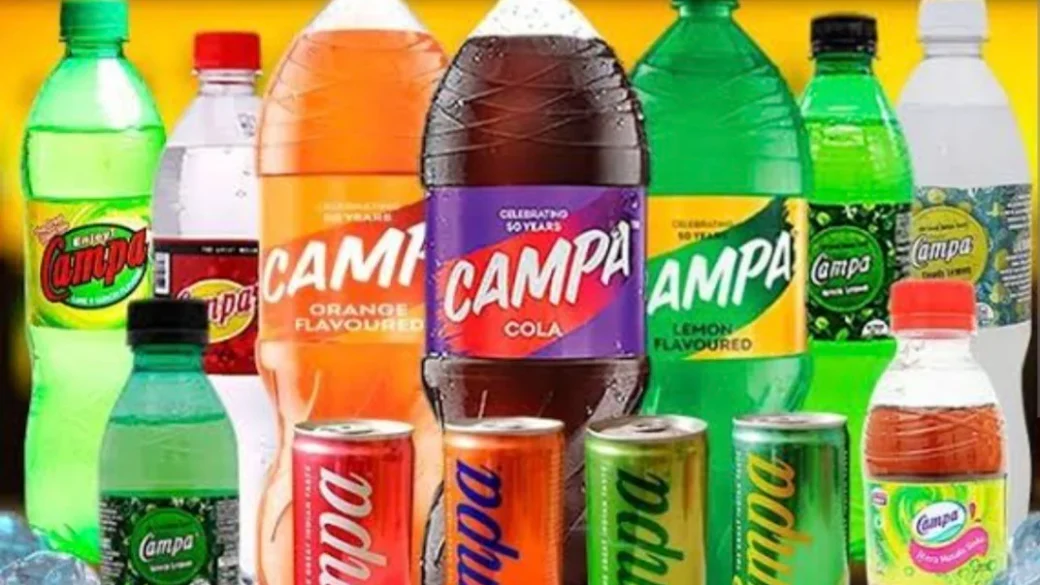
Campa is emerging as one of the strongest growth stories in India’s fast-moving consumer goods (FMCG) sector as the country’s beverage market continues to expand and Reliance Consumer Products Ltd (RCPL) steps up its challenge to established players. The revived beverage brand has rapidly increased its presence since Reliance acquired the Campa brand in 2022 and relaunched it nationally in 2023.
The brand’s momentum comes as India’s non-alcoholic ready-to-drink beverage market becomes an increasingly important contributor to FMCG growth. Campa has benefited from aggressive pricing, expanding distribution and Reliance’s broader retail ecosystem, while the wider category is being reshaped by changing consumer preferences, rising consumption and competition from both global and homegrown brands.
Campa Emerges as a Major Beverage Challenger
Campa’s revival has gone considerably beyond a nostalgia-driven brand relaunch. Reliance has used the brand as a vehicle to build a large-scale beverage business capable of challenging Coca-Cola and PepsiCo in India.
According to Reliance’s FY26 annual report, Campa crossed ₹4,700 crore in gross sales during the financial year and became India’s fourth-largest carbonated soft drink brand by March 2026. The company also reported that Campa had achieved double-digit market share in several key markets.
The growth has been supported by a combination of value pricing and aggressive distribution. Rather than competing solely through advertising and brand recognition, Reliance has focused on making Campa widely available while keeping its products competitively priced.
Campa’s Recent Growth
| Metric | Performance |
|---|---|
| FY26 Gross Sales | More than ₹4,700 crore |
| Market Position | India’s fourth-largest carbonated soft drink brand |
| Key Markets | Double-digit market share |
| Relaunch | 2023 |
| Owner | Reliance Consumer Products Ltd |
| Parent Group | Reliance Industries |
The figures underline how quickly the brand has moved from being a revived legacy name to becoming a meaningful player in India’s beverage market.
Beverages Become a Key FMCG Growth Engine
The broader beverage category is also gaining importance within India’s consumer economy.
Reliance Consumer Products reported particularly strong growth from beverages in the June quarter of FY27. The company’s beverage business generated approximately ₹2,900 crore in revenue during the quarter, growing nearly two-and-a-half times from the year-earlier period.
Campa was a major contributor to that performance.
The ₹2,900 crore quarterly figure represented almost half of the beverage business’s FY26 sales in just three months, according to Reliance’s earnings presentation.
The performance demonstrates why beverages are becoming strategically important for Reliance’s broader FMCG ambitions.
Why Campa Is Gaining Market Share
For more context, see Reliance Consumer Products turned EBITDA positive for the first time.
Campa’s growth is being driven by several factors rather than a single product advantage.
Value Pricing
Price remains one of Campa’s biggest competitive tools.
The brand has targeted the mass market with relatively low-priced products, encouraging consumers to try Campa alongside established brands. This strategy is particularly relevant in India’s price-sensitive markets, where a relatively small difference in the price of a beverage can influence purchasing decisions.
The strategy has also helped Campa compete more aggressively in smaller cities and towns.
Deep Distribution
Reliance has another major advantage: distribution.
RCPL expanded its distribution network to more than 3 million retail outlets through a network of over 5,000 distributors during FY26.
That reach gives Campa access to consumers beyond major urban centres and allows the company to compete more effectively in Tier-2, Tier-3 and rural markets.
Distribution is particularly important for beverages because consumers frequently make purchases at nearby stores, where availability can matter as much as brand preference.
Reliance Retail Ecosystem
Campa also benefits from Reliance’s broader retail infrastructure.
The company can use Reliance’s extensive retail presence, logistics network and consumer ecosystem to increase product availability and gather market intelligence.
This provides an advantage that a standalone beverage startup would have to spend years developing.
Coca-Cola and PepsiCo Face a Stronger Challenge
India’s carbonated soft drink market has traditionally been dominated by Coca-Cola and PepsiCo.
That balance has started to change as Campa and other Indian beverage brands gain traction.
A Business Standard report citing industry data found that smaller brands led by Campa and Lahori Zeera nearly doubled their combined market share to around 15% during January-September 2025, compared with approximately 7% a year earlier. Meanwhile, the combined share of Coca-Cola and PepsiCo fell from about 93% to nearly 85%.
Although these figures cover an earlier period than Campa’s latest FY26 performance, they illustrate the broader competitive shift underway.
The challenge for the multinational beverage companies is not simply the arrival of another cola. It is the combination of lower prices, wider distribution and increasing consumer willingness to experiment with alternative brands.
Campa Is Expanding Beyond Cola
Reliance is also attempting to reduce Campa’s dependence on traditional cola products.
The portfolio has expanded to include lemon and orange flavours as well as energy drinks. This allows the company to participate in multiple segments of the beverage market rather than relying exclusively on carbonated cola.
This diversification is important because consumer preferences are gradually shifting toward a broader range of beverages, including energy, hydration and other functional products.
A wider portfolio can also allow Reliance to use the same distribution infrastructure across several products, potentially improving the economics of its beverage business.
Manufacturing Capacity Is Expanding
Reliance is investing heavily in manufacturing capacity to support the expansion.
The company has commissioned part of a new greenfield beverage manufacturing facility linked to an integrated food park. Additional capacity is important because rapidly increasing sales require a supply chain capable of consistently producing and delivering products across a large geographic area.
Reliance is effectively building the infrastructure needed to support Campa’s next stage of growth rather than relying solely on existing third-party capacity.
That could give the company greater control over production costs, product availability and geographic expansion.
Campa Is Going Global
The brand’s ambitions are no longer limited to India.
Reliance has begun taking Campa into international markets, including Australia, where the company has started manufacturing Campa cans and planned a local launch in 2026. The company has also indicated plans to expand its beverages business into Australia and African markets.
Campa had previously entered markets such as the UAE, Nepal and Sri Lanka through local partnerships.
International expansion could provide a new growth opportunity, although establishing a beverage brand outside India will require local distribution, regulatory compliance and consumer marketing.
India’s Beverage Market Is Becoming More Competitive
The Campa story is part of a wider transformation in India’s beverage sector.
Consumers now have access to a much broader range of products than traditional cola and lemon-lime soft drinks. Energy drinks, sports beverages, packaged water, juices and other functional products are attracting investment from both established FMCG companies and newer entrants.
This has encouraged companies to compete across price, distribution, product innovation and marketing.
For Reliance, beverages are particularly attractive because products are purchased frequently and can benefit from India’s growing consumption in smaller cities and rural areas.
The Bigger FMCG Strategy Behind Campa
Campa is also important because it fits into Reliance’s broader plan to build a large consumer-products business.
RCPL’s portfolio extends beyond beverages into staples, packaged foods and personal and home-care products. Its Independence brand, for example, crossed approximately ₹2,600 crore in sales during FY26.
The strategy is to build multiple consumer brands while using shared distribution, manufacturing and retail infrastructure.
Campa therefore serves as more than an individual beverage brand. Its growth can help Reliance strengthen the broader FMCG ecosystem around it.
The Challenge: Turning Growth Into Sustainable Profit
Rapid sales growth does not automatically translate into long-term profitability.
Campa’s competitive pricing requires careful management of manufacturing costs, retailer margins, logistics expenses and marketing spending.
Reliance’s scale gives it the financial capacity to invest aggressively, but the longer-term test will be whether Campa can maintain market share while gradually improving economics.
The brand will also need to build consumer loyalty beyond its price advantage.
Established competitors have spent decades building emotional connections with consumers, and competing effectively over the long term will require Campa to combine value with brand strength.
Looking Ahead
Campa’s rapid rise is becoming one of the most significant developments in India’s beverage industry. From a relaunched legacy brand, it has grown into India’s fourth-largest carbonated soft drink brand by gross sales and has secured double-digit market share in several important markets. Its success is being driven by a combination of competitive pricing, deep distribution and Reliance’s ability to invest in manufacturing and retail infrastructure.
The next phase will determine whether Campa can convert that momentum into a durable national and international franchise. With Reliance expanding production capacity, introducing new beverage categories and taking Campa overseas, the brand is increasingly becoming a central part of the group’s FMCG strategy. Its continued growth could further challenge the traditional Coca-Cola-PepsiCo dominance and make India’s beverage market one of the country’s most closely watched FMCG battlegrounds.
Frequently Asked Questions
Where does Campa rank now?
It is India’s fourth largest soft drink brand.
Why is Campa gaining share?
Aggressive pricing and Reliance’s distribution reach have accelerated adoption.
What does it mean for Coca-Cola and PepsiCo?
Both face a stronger challenger in a market they have long dominated.
Get the day’s top stories in your inbox
One concise email. No spam, unsubscribe anytime.


