
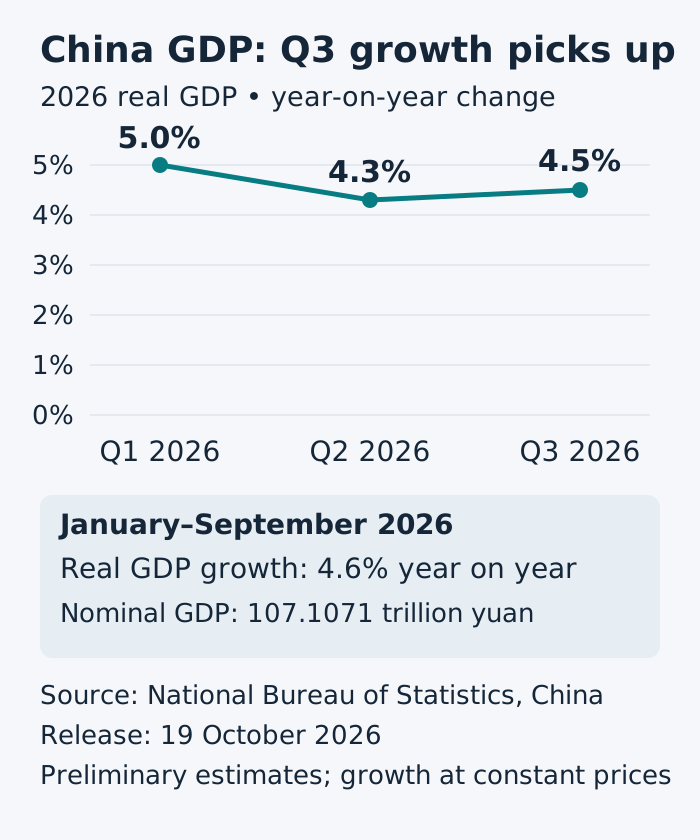
China’s economy grew 4.5% year on year in the third quarter of 2026, accelerating from the previous quarter and slightly exceeding market expectations. Data released by China’s National Bureau of Statistics (NBS) on October 19 showed that gross domestic product (GDP) increased 1.2% quarter on quarter between July and September. The result marked an improvement from the 4.3% annual growth recorded in the second quarter and offered some reassurance that China remains broadly on track to meet its annual economic growth target.
However, the headline figure does not tell the whole story. Industrial production and exports have supported economic activity, while the property sector remains under severe pressure and household demand is comparatively weak. September retail sales and industrial output improved, but investment continued to struggle, particularly in real estate. The latest figures therefore present a mixed picture: China’s economy is expanding faster than in the previous quarter, yet policymakers still face the challenge of making growth more balanced and sustainable.
Key Takeaways
- Q3 GDP growth: China’s economy expanded 4.5% year on year, up from 4.3% in Q2.
- Market expectations: Growth narrowly exceeded the Reuters poll forecast of 4.4%.
- First nine months: GDP increased 4.6% year on year during January–September 2026.
- Industrial output: September industrial production rose 5.5% year on year.
- Retail sales: September retail sales increased 1.1%, showing some improvement in consumer activity.
- Investment weakness: Fixed-asset investment fell 7.2% in January–September, while property investment declined 20.6%.
- Annual target: China is targeting economic growth of 4.5%–5% for 2026.
China’s Economic Growth Accelerates in Q3
The third-quarter figures indicate that China’s economy regained some momentum after slowing to 4.3% growth in the April–June period, its weakest quarterly expansion in more than three years.
The latest 4.5% result was slightly above the 4.4% forecast in a Reuters poll. On a quarter-on-quarter basis, GDP increased 1.2%, compared with 0.9% in the second quarter.
| Economic indicator | Q2 2026 | Q3 2026 |
|---|---|---|
| GDP growth, year on year | 4.3% | 4.5% |
| GDP growth, quarter on quarter | 0.9% | 1.2% |
| Market forecast for annual GDP growth in Q3 | — | 4.4% |
Source: China’s National Bureau of Statistics and Reuters. GDP growth rates are measured at constant prices.
The improvement means that China has maintained growth close to its official annual target despite pressure from the property downturn, uneven household consumption and a complicated international trade environment.
For the first three quarters of 2026, GDP reached approximately 107.1 trillion yuan, according to preliminary official estimates. The economy grew 4.6% over that period compared with the same period a year earlier.
That cumulative growth rate puts China within reach of its annual objective, although the outcome for the full year will depend on activity in the final quarter.
Manufacturing and Industrial Output Support Growth
Industrial production was one of the clearer sources of strength in the September data. Output at industrial enterprises above the designated size rose 5.5% year on year, accelerating from 5.2% in August.
The manufacturing sector has benefited from China’s established industrial supply chains, investment in advanced production and demand for technology-related products. High-tech manufacturing and equipment production have also contributed to the country’s broader industrial expansion.
Official data showed that industrial value added increased 5.3% year on year in the first nine months of 2026. Within that figure, manufacturing grew 5.7%, while equipment manufacturing expanded 10.2% and high-tech manufacturing increased 14.3%.
These figures suggest that industrial upgrading remains an important part of China’s economic strategy. The country has continued investing in areas such as semiconductors, electric vehicles, renewable-energy equipment and advanced machinery.
However, strong factory output does not automatically translate into stronger household spending. Manufacturers can continue producing goods for overseas markets even when domestic consumers remain cautious. This disconnect between production and consumption is one of the central challenges facing China’s economy.
Exports Remain an Important Growth Engine
China’s export sector has helped support economic growth amid weaker domestic demand. Manufacturers have expanded their overseas presence across technology products, electric vehicles, solar equipment and other industrial goods.
The country has also diversified its trade relationships as tariffs and trade restrictions complicate access to some markets. Demand from economies across Asia, Europe, Latin America and other regions has helped Chinese manufacturers find customers beyond their traditional export destinations.
China recorded a goods trade surplus of approximately $938 billion in the first nine months of 2026, according to reporting on the latest economic data. The country was on course to exceed its record annual surplus of around $1.2 trillion recorded in 2025.
A large trade surplus can support industrial production, employment in export-oriented businesses and foreign-exchange earnings. But it can also increase trade tensions when trading partners believe that domestic manufacturers are struggling to compete with imports from China.
The European Union and other economies have expressed concerns about trade imbalances and the effect of Chinese industrial exports on their domestic industries. Further trade restrictions could create uncertainty for Chinese exporters.
China therefore faces a dual challenge: maintaining access to foreign markets while increasing the contribution of domestic consumption to overall growth.
Retail Sales Improve, but Consumer Demand Remains Weak
China’s retail sales increased 1.1% year on year in September, compared with growth of 0.4% in August. The result exceeded the 0.6% forecast in a Reuters poll.
The improvement suggests that consumer activity gained some momentum. However, the growth rate remains modest relative to the strength of industrial production and exports.
Households have remained cautious amid uncertainty over employment, income prospects and property values. The prolonged real estate downturn has also affected household wealth because housing represents a major asset for many Chinese families.
When households feel less financially secure, they may increase savings and postpone discretionary purchases. This can limit demand for consumer goods, restaurants, travel and other services.
Weak consumption creates a challenge for policymakers because domestic spending is important for making economic growth less dependent on exports and investment.
A sustained recovery in retail activity would require stronger consumer confidence, stable employment and a willingness among households to spend a larger share of their income.
China’s Property Sector Remains the Biggest Weak Spot
The property market continues to weigh heavily on the broader economy. Investment in real estate fell 20.6% year on year during January–September 2026, worsening from the 19.9% decline recorded in the first eight months.
The prolonged downturn has affected developers, construction businesses, building-material suppliers and local governments that depend partly on land-related revenue.
Falling property investment also affects demand for steel, cement, furniture, appliances and other products linked to housing construction and home purchases. The consequences therefore extend well beyond real estate companies.
For households, uncertainty about property prices can reduce confidence and discourage spending. For businesses, weak property demand can delay investment and limit opportunities for expansion.
China has introduced measures over recent years to support housing demand and address problems in the property sector. Yet the latest figures suggest that a durable recovery remains difficult.
The sector’s weakness also helps explain why strong exports have not translated into a more broad-based improvement across the economy. Until housing demand and confidence stabilise, the property market is likely to remain a major constraint on domestic growth.
Fixed-Asset Investment Continues to Decline
Fixed-asset investment, which measures spending on assets such as infrastructure, machinery and buildings, fell 7.2% year on year in the first nine months of 2026.
The decline was broadly unchanged from the January–August period and highlights the pressure facing investment beyond export-oriented manufacturing.
Real estate accounts for an important part of the broader investment picture, but businesses and local governments also make decisions based on expected demand, financing conditions and confidence in future returns.
When companies are uncertain about sales, they may postpone factory expansions or purchases of new equipment. Local governments facing financial constraints may also have less room to fund infrastructure projects.
This creates a difficult policy trade-off. Additional investment can support short-term growth, but relying heavily on infrastructure and industrial capacity risks reinforcing existing imbalances if household demand remains weak.
The challenge is to encourage productive investment while improving the conditions that support consumption and private-sector confidence.
Will China Need More Economic Stimulus?
The stronger third-quarter result gives policymakers some additional room to avoid immediate, broad-based stimulus measures. Growth has accelerated, industrial output remains solid and the economy is broadly aligned with its annual target.
However, the latest figures do not eliminate the case for targeted support. Weak property investment, declining fixed-asset investment and modest retail growth remain significant concerns.
China could rely more on fiscal measures to support demand, including targeted spending, consumer incentives and policies aimed at improving household confidence. The appropriate mix will depend on the pace of growth, employment conditions and the government’s assessment of financial risks.
Monetary easing is another possible tool, but policymakers must consider inflation, financial stability and the effectiveness of lower borrowing costs when businesses and households are reluctant to spend.
The central question is not simply how to achieve the annual growth target. It is how to make growth less dependent on exports and industrial production while encouraging domestic consumption and reducing the risks associated with the property downturn.
What China’s Growth Means for the Global Economy
China is a major trading partner for many economies and a central supplier of manufactured goods. Its economic performance affects demand for commodities, industrial machinery, consumer products and components used in global supply chains.
Strong manufacturing and exports can support demand for raw materials and shipping services. However, if domestic demand remains weak, Chinese manufacturers may continue looking overseas to sell excess production.
That can intensify competition for manufacturers in other countries, particularly in sectors such as electric vehicles, solar panels, batteries and industrial equipment.
For commodity exporters, China’s investment and construction activity are especially important. Continued weakness in the property sector could restrain demand for some building materials and industrial inputs even while technology-related manufacturing remains strong.
For India and other Asian economies, China’s performance presents both opportunities and competitive pressures. Strong regional demand can support trade, while the expansion of Chinese manufacturers in global markets can increase price competition across multiple industries.
The overall effect will depend on the composition of China’s growth, rather than the headline GDP number alone.
The Bigger Picture
China’s 4.5% GDP growth in the third quarter shows that the economy has regained some momentum after a weaker second quarter. Strong industrial production and exports have helped keep growth near the government’s annual target, while improved retail sales offer a limited sign of recovery in consumer activity.
Yet the underlying imbalances remain significant. Property investment is still falling sharply, overall fixed-asset investment has declined and domestic demand remains weaker than the industrial sector’s performance would suggest. China’s next economic phase will depend on whether policymakers can turn export-led expansion into broader, more sustainable growth driven by households and private businesses.
Looking Ahead
The fourth quarter will be important for determining whether China can finish 2026 within its 4.5%–5% growth target. Investors and businesses will monitor retail sales, industrial production, property-market activity and new policy measures for evidence that the recovery is becoming more balanced. External trade conditions will also matter as China faces growing scrutiny from trading partners over its large surplus.
For policymakers, the task is to maintain growth while addressing the property downturn and encouraging consumers to spend. A sustained recovery will require more than strong factory output: household confidence, private investment and domestic demand must also improve. The latest figures provide some relief, but they do not yet establish that China’s structural economic challenges have been resolved.
Frequently Asked Questions
1. How much did China’s economy grow in Q3 2026?
China’s GDP grew 4.5% year on year in the third quarter of 2026, compared with 4.3% in the second quarter.
2. Did China beat GDP growth forecasts?
Yes. The 4.5% result was slightly above the 4.4% forecast in a Reuters poll of economists.
3. What is China’s GDP growth target for 2026?
China’s official target is economic growth of 4.5%–5% for 2026. GDP grew 4.6% in the first nine months of the year.
4. Why is China’s economy still facing pressure?
The main challenges include weak domestic demand, a prolonged property downturn, falling fixed-asset investment and uncertainty around international trade.
5. How did China’s industrial output perform in September?
Industrial output rose 5.5% year on year in September, up from 5.2% growth in August.
6. What does China’s economic performance mean for global markets?
China’s growth affects commodity demand, manufacturing supply chains, shipping and global trade. Strong exports can support industrial activity but may also intensify trade tensions with other economies.
Source: China’s National Bureau of Statistics reported on 19 October 2026 that real GDP grew 4.5% year on year in the third quarter, compared with 4.3% in Q2 and 5.0% in Q1. Its preliminary estimates put January–September real growth at 4.6% and GDP at current prices at 107,107.1 billion yuan. Q3 growth from the previous quarter was 1.2%. NBS release.
Get the day’s top stories in your inbox
One concise email. No spam, unsubscribe anytime.


