
China has announced new export controls on tunnel-boring machines (TBMs) and related equipment, raising concerns about supplies for India’s major infrastructure projects. China’s Ministry of Commerce announced the measures on October 19, 2026, with the restrictions scheduled to take effect on November 18. Beijing says the equipment has both civilian and military applications and that the controls are intended to protect national security and national interests.
The move matters for India because tunnel-boring machines are essential for constructing underground metro networks, railway tunnels, highways and other large infrastructure projects. India relies on imported machinery, including equipment sourced from China, and has already faced delays in obtaining some tunnel-boring machines. The new rules do not amount to a blanket ban on exports to India, but they introduce additional regulatory uncertainty that could affect procurement schedules, construction costs and efforts to diversify equipment supplies.
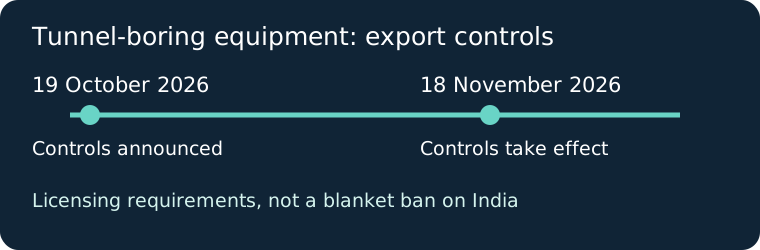
Export-control timeline: Announced 19 October 2026; effective 18 November 2026. Covered exporters must apply for licences. Read the Reuters report.
Key Takeaways
- New restrictions: China announced export controls on tunnel-boring machines and related items on October 19, 2026.
- Effective date: The controls are scheduled to take effect on November 18, 2026.
- China’s justification: Beijing says the machinery has dual-use applications, meaning it can serve both civilian and military purposes.
- Potential impact on India: Metro rail, railway, highway and other tunnelling projects could face procurement uncertainty.
- Not a blanket ban: The announcement establishes export-control requirements rather than an outright prohibition on every shipment to India.
- Existing concerns: India has faced delays involving tunnel-boring machines manufactured in China since 2024.
- Long-term challenge: The development highlights India’s dependence on imported specialised construction equipment and the need to diversify supply.
What Has China Announced?
China’s Ministry of Commerce said it would introduce export controls covering tunnel-boring machines and related items. The measures form part of the country’s broader framework for controlling equipment and technology that can be used for both civilian and military purposes.
Export controls are different from a conventional trade ban. A ban prohibits specified transactions, while export controls can require companies to obtain licences, submit documentation or comply with end-use conditions before shipping covered products overseas.
Under China’s announcement, exporters will need to follow the applicable export-control laws and rules governing dual-use items. The authorities have said applications will be reviewed under the relevant regulations.
The practical consequences will depend on the products covered, the destination, the applicable licensing requirements and the decisions made by Chinese authorities. The announcement does not establish that all tunnel-boring machines destined for India will automatically be refused export permission.
Nevertheless, additional approval requirements can create uncertainty for infrastructure companies that depend on specialised machinery with long manufacturing and delivery schedules.
Why Tunnel-Boring Machines Matter to India
Tunnel-boring machines are large industrial systems that excavate underground passages while supporting the surrounding ground. They are designed for different soil and rock conditions and can incorporate systems for removing excavated material, installing tunnel segments and maintaining stability during construction.
These machines are important for projects where conventional excavation would be impractical, disruptive or too slow.
Metro rail construction
Underground metro lines frequently use TBMs to build tunnels beneath densely populated urban areas. The machines can help reduce disruption to roads, buildings and other surface infrastructure compared with some alternative construction methods.
A delay in receiving a machine can affect the sequence of a tunnelling project. Contractors may have to adjust schedules, keep workers and equipment waiting or reorganise construction activities while they wait for delivery.
The effect will depend on whether a project already has its required machines, whether it has alternative equipment available and how much flexibility exists in the construction schedule.
High-speed rail and railway tunnels
India’s high-speed rail programme includes extensive tunnelling work, particularly along challenging terrain. Railway tunnels can require highly specialised equipment suited to local geology, groundwater conditions and the planned tunnel dimensions.
Replacing a machine with another model is not always straightforward. A contractor may need to reassess technical specifications, construction methods, maintenance arrangements and delivery schedules before changing suppliers.
Consequently, a procurement delay can create costs beyond the price of the machine itself.
Highways and strategic infrastructure
Tunnelling equipment is also used for road projects, underground utilities and infrastructure in mountainous regions. Some projects involve strategically important routes where construction schedules affect regional connectivity.
However, the new controls should not be interpreted as proof that a particular Indian project will stop. The actual impact will depend on which machines are covered, existing inventory, pending shipments and the outcome of export applications.
Why China Cites National Security
China says the equipment covered by its new measures has dual-use characteristics. In export-control policy, dual-use products are items that can serve ordinary commercial purposes but may also have military or security applications.
Tunnel-boring technology is primarily associated with civilian construction, including transport networks and underground infrastructure. However, the same broad category of machinery can be relevant to certain strategic construction activities.
China’s official position is that the controls are intended to protect national security and national interests while meeting its international obligations. Beijing has also said that export applications will be reviewed under its laws and regulations.
The announcement does not name India as the sole target of the restrictions. It is therefore important to distinguish the wider Chinese export-control decision from its possible consequences for Indian infrastructure projects.
India’s exposure arises from its reliance on imported machinery and the difficulties it has previously encountered in obtaining some equipment from China. Whether the new measures result in longer delays will depend on how the licensing framework is applied.
India Has Already Faced TBM Supply Delays
The latest announcement comes against the background of earlier problems involving tunnel-boring machines manufactured in China.
In 2024, India raised concerns about delays in the clearance of machines made by a German company at its Chinese facility. Indian officials discussed the issue with German representatives, highlighting how the location of a manufacturing plant can affect the supply of equipment even when the brand is not Chinese.
That experience exposed a potential weakness in procurement strategies that rely on machinery manufactured in a single country.
For large infrastructure projects, a foreign brand does not necessarily provide supply-chain diversification if its equipment is produced in the same location as other suppliers’ machines. Manufacturing geography, access to components, export rules and customs procedures all matter.
The new controls could add another layer of uncertainty to these existing challenges. Companies with equipment already delivered or available outside China may be less exposed in the short term, while projects awaiting new shipments could need to assess their schedules and alternatives.
How the Restrictions Could Affect Infrastructure Costs
Tunnel-boring machines are specialised capital equipment. Their procurement involves not only the purchase price but also transportation, installation, testing, maintenance and integration with the construction project.
If a shipment is delayed, contractors may face additional costs from idle labour, equipment rentals, revised work schedules and extended project management. A delayed tunnelling operation can also affect subsequent construction activities that depend on completion of the underground section.
The scale of the effect will vary. A project with several available machines may be able to rearrange its work, while a project that depends on a specific machine for a critical section may have fewer options.
Substituting a different machine can also require technical changes. Tunnel diameter, ground conditions, excavation method and the system used to install tunnel lining segments all influence which equipment is suitable.
There is no confirmed nationwide estimate of additional costs arising from the new controls. Any financial impact will depend on how many shipments require approval, whether licences are granted promptly and whether contractors can source equipment elsewhere.
Can India Replace Chinese Tunnel-Boring Machines?
India could pursue several responses, including diversifying imports, strengthening domestic manufacturing and improving coordination between infrastructure developers and equipment suppliers.
Diversifying international suppliers
Importers can explore manufacturers in countries with established tunnelling-equipment industries. However, alternative suppliers may have limited production capacity or long order books, particularly for specialised machines.
Switching suppliers can also involve new technical assessments, contract negotiations and maintenance arrangements. Diversification is therefore a useful long-term strategy, but it may not solve an immediate shortage.
Building domestic manufacturing capacity
Developing Indian manufacturing capabilities could reduce exposure to foreign export controls over time. Domestic production could also create opportunities for engineering firms, component suppliers and specialist service providers.
However, tunnel-boring machines are complex systems requiring expertise in mechanical engineering, hydraulics, electrical controls, geology, precision manufacturing and ground-support technology. Building competitive production capacity requires investment, skilled workers, testing facilities and dependable demand.
Domestic manufacturing is not an instant substitute for imports. The transition would likely require cooperation among equipment makers, infrastructure companies, research institutions and government agencies.
Planning procurement earlier
Infrastructure developers can also reduce some risks by identifying critical machinery requirements earlier, assessing supplier concentration and coordinating delivery schedules with construction milestones.
Maintaining access to spare parts, technical support and alternative suppliers can help projects respond when shipments are delayed. These measures cannot eliminate regulatory uncertainty, but they can reduce the consequences of a disruption.
What the Decision Means for China’s Machinery Industry
China is a major global supplier of tunnelling and other heavy construction equipment. Reuters reported that China exported approximately $793 million worth of self-propelled coal or rock cutters and tunnelling machinery in 2025, based on UN Comtrade data.
Export controls can affect how suppliers manage overseas orders, documentation and compliance. Manufacturers may need to review contracts and ensure that covered shipments meet the new requirements before dispatch.
The rules could also influence the decisions of international companies that manufacture equipment in China. As the earlier German-company case illustrated, the country where a machine is produced can matter even when the company supplying it is headquartered elsewhere.
For buyers, the development highlights the need to evaluate supply-chain risk alongside price, technical performance and delivery time. A machine may be commercially competitive but still carry risks if its export depends on a changing regulatory environment.
The Bigger Picture
China’s new controls demonstrate how export policy can influence infrastructure supply chains, not just trade in finished consumer products. Tunnel-boring machines are essential to projects that require years of planning and construction, making uncertainty around specialised equipment particularly consequential. India’s reliance on imported TBMs means it must consider both immediate procurement needs and the longer-term resilience of its infrastructure supply chains.
The restrictions do not automatically halt Indian projects or prohibit every shipment. Their effect will depend on licensing decisions, existing equipment stocks, alternative suppliers and the ability of contractors to adapt. Over time, the episode could strengthen the case for diversified sourcing and domestic manufacturing, although building competitive production capacity will require sustained investment and technical expertise.
Looking Ahead
The new controls are scheduled to take effect on November 18, 2026. Infrastructure companies and equipment suppliers will need to establish which products and shipments fall under the rules, determine the relevant documentation requirements and monitor the processing of export applications. The first practical indication of the impact will come from how the authorities handle actual shipments and whether contractors report changes to delivery schedules.
For India, the longer-term response will involve more than finding alternative machines for individual projects. Developing domestic capabilities, diversifying imports and improving procurement planning could reduce the risks associated with reliance on a limited number of suppliers. These measures will take time, but they could make future infrastructure projects less vulnerable to sudden changes in international trade policy.
Frequently Asked Questions
1. When will China’s tunnel-boring machine export controls take effect?
China announced the measures on October 19, 2026. They are scheduled to take effect on November 18, 2026.
2. Has China banned all tunnel-boring machine exports to India?
No blanket ban on all exports to India has been announced. The new measures introduce export controls and related compliance requirements. The practical effect will depend on the applicable rules and licence decisions.
3. Why does India need tunnel-boring machines?
TBMs are used to excavate underground passages for metro rail, railway tunnels, highways, utilities and other infrastructure. They are particularly important for projects involving difficult ground conditions or densely populated areas.
4. Why is China citing national security?
China says the controlled equipment has dual-use characteristics, meaning it can have both civilian and military applications. Its stated justification is the protection of national security and national interests.
5. Could India’s metro and bullet train projects be delayed?
Some projects could face procurement uncertainty if they depend on covered equipment that has not yet been shipped. However, the extent of any delays is not yet established and will depend on licence approvals, existing machinery and alternative supply arrangements.
6. Can India manufacture its own tunnel-boring machines?
India could expand domestic manufacturing, but producing advanced TBMs requires specialised engineering, technology, testing facilities and a dependable supply chain. Domestic capacity could reduce import dependence over time, but it is unlikely to replace every specialised import immediately.
Get the day’s top stories in your inbox
One concise email. No spam, unsubscribe anytime.


