
China’s imports of non-monetary gold reached a record $209 billion in the first 10 months of 2026, reflecting a sharp increase in demand for bullion among households, investors and financial institutions. The purchases accounted for nearly 8% of the country’s total goods imports during the January-October period, making gold an increasingly important component of China’s international trade flows.
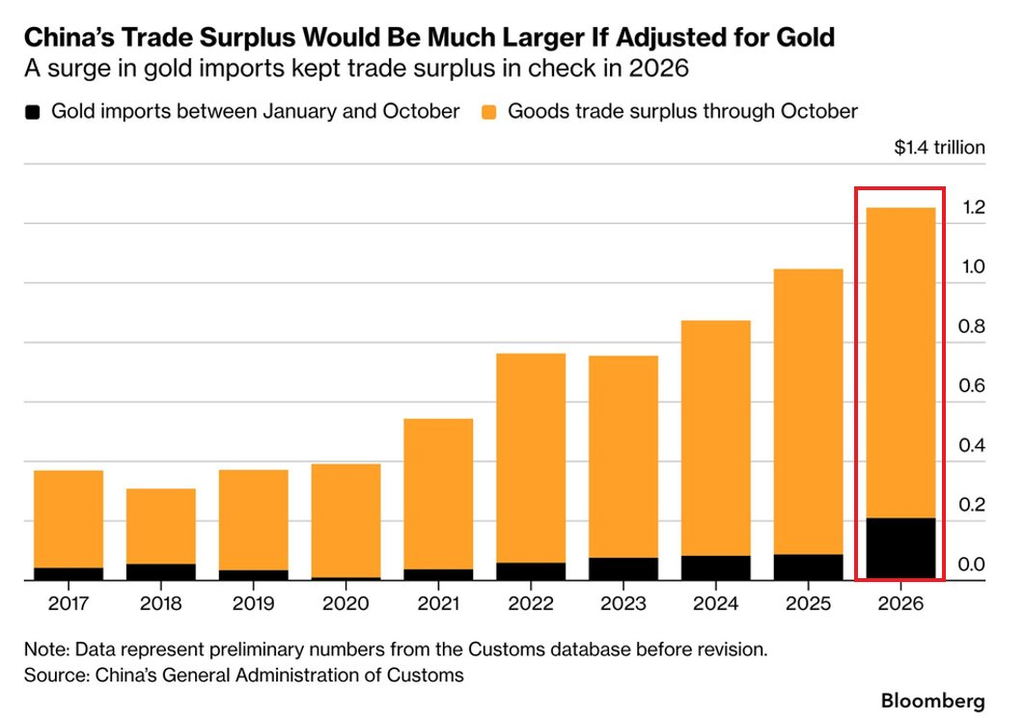
The surge comes as Chinese households seek alternative stores of value amid a prolonged property-market downturn and uncertainty surrounding other investment options. Rising investment demand has helped push gold imports higher, while the increased value of bullion purchases has also reduced China’s reported merchandise trade surplus. However, the record figure represents import value rather than a confirmed record in the physical quantity of gold imported.
China Spends Record $209 Billion on Gold Imports
According to Chinese customs data cited in recent Bloomberg reporting, the value of China’s non-monetary gold imports reached approximately $209 billion between January and October 2026.
The figure is already more than twice the approximately $100.5 billion spent importing gold during the whole of 2025.
Gold’s share of China’s import bill has also increased significantly. The metal accounted for nearly 8% of total goods imports during the first 10 months, highlighting the scale of the country’s bullion-buying activity.
October was particularly strong. China imported 155.85 tonnes of unwrought non-monetary gold during the month, representing a 174.1% increase compared with October 2025. The value of those imports rose 183.5% year on year to $20.73 billion.
Gold consequently became China’s third-largest import category by value in October, behind memory chips and crude oil.
| Indicator | Reported figure |
|---|---|
| Non-monetary gold imports, Jan-Oct 2026 | $209 billion |
| Share of total goods imports | Nearly 8% |
| Gold imports during all of 2025 | Approximately $100.5 billion |
| October 2026 import volume | 155.85 tonnes |
| October 2026 import value | $20.73 billion |
| October volume growth, year on year | 174.1% |
| October value growth, year on year | 183.5% |
The distinction between import value and physical volume is important. Higher international gold prices can increase the dollar value of imports even without an equivalent increase in the quantity of metal purchased.
Why Chinese Households Are Buying More Gold
One of the biggest drivers behind China’s gold-buying activity is growing demand for assets that can preserve wealth.
The country’s property market has remained under pressure, reducing the appeal of real estate as a reliable investment for many households. At the same time, uncertainty surrounding financial markets and alternative investment opportunities has encouraged some investors to diversify their savings into physical gold.
Gold has traditionally been viewed as a store of value during periods of economic and geopolitical uncertainty. Its role as a portfolio diversifier has become particularly important for Chinese investors seeking alternatives to property and other financial assets.
The shift is also visible in China’s jewellery market. According to the World Gold Council, jewellery accounts for less than one-third of Chinese bullion demand, while jewellery consumption in the first half of 2026 was the weakest in two decades.
This suggests that investment demand, rather than traditional jewellery purchases alone, is playing an increasingly important role in China’s gold market.
Gold Imports Help Reduce China’s Trade Surplus
The surge in gold imports has another important economic consequence: it mechanically reduces China’s reported merchandise trade surplus.
A country’s merchandise trade surplus is calculated by subtracting the value of imports from exports. When China imports large quantities of gold, those purchases are included in its goods-import figures, increasing the import bill and narrowing the difference between exports and imports.
This happens even if China’s export performance remains unchanged.
China’s merchandise trade surplus exceeded $1 trillion during the first 10 months of 2026. However, analysts argue that the reported imbalance would have been considerably larger without the increase in gold purchases.
Brad Setser, a fellow at the Council on Foreign Relations and a former US Treasury official, has estimated that China’s full-year trade surplus could approach $1.3 trillion at the current pace. Without the gold accumulation, he estimates that the figure could be closer to $1.5 trillion.
The difference highlights how gold imports can influence the headline trade balance without necessarily indicating a corresponding improvement in domestic consumption or a reduction in export competitiveness.
Could China’s Gold Buying Reflect a Policy Shift?
China tightly controls physical gold imports through a quota system administered by the central bank. Selected commercial banks receive permissions to import bullion, while the details of individual allocations are not publicly disclosed.
The sharp increase in imports has therefore raised questions about whether authorities have expanded import quotas.
Setser has suggested that a possible increase in quotas could help explain the unusually rapid growth in gold imports. One potential effect would be to increase imports and reduce the country’s recorded trade surplus.
However, an expansion of import quotas has not been officially confirmed as the reason behind the surge.
Other factors have also supported purchases. A firmer Chinese yuan can make internationally traded gold cheaper for domestic buyers, while differences between domestic and international prices can encourage authorised importers to bring additional bullion into the country.
China is also one of the world’s largest gold producers and consumers, giving developments in its domestic market an important influence on global bullion demand.
Non-Monetary Gold Imports Are Different From Central Bank Purchases
An important distinction in the latest figures is the term non-monetary gold.
Non-monetary gold generally refers to bullion held for investment, trading, industrial or other private-sector purposes rather than gold held as part of official monetary reserves.
This means the $209 billion figure should not be interpreted as the amount of gold purchased by China’s central bank.
The People’s Bank of China has separately been adding gold to its official reserves. Those reserve transactions are distinct from non-monetary gold imports recorded in merchandise trade statistics.
The distinction matters because the two categories reflect different types of demand. Household investment, commercial bullion trading and central-bank reserve diversification can all influence the gold market, but they are not interchangeable measures.
The Bigger Picture
China’s record gold imports reflect a combination of investment demand, currency movements, international gold prices and the country’s tightly managed bullion-import system.
The surge also highlights a broader change in the way Chinese households are allocating their savings. With property-sector uncertainty continuing to influence investment decisions, gold has become an important alternative for investors looking to preserve wealth.
For global markets, China’s buying activity is significant because the country is one of the world’s largest gold consumers. Sustained demand from Chinese households, financial institutions and official reserves can influence international bullion flows and market sentiment.
However, the $209 billion figure should be interpreted carefully. It measures the value of imports, not necessarily a record quantity of physical gold. It also does not establish that China’s broader domestic demand has recovered.
Looking Ahead
The next important indicators will include China’s monthly gold-import volumes, domestic bullion premiums, Shanghai Gold Exchange withdrawals and further updates from the World Gold Council. These figures will help determine whether the import surge reflects sustained end-user demand, inventory accumulation or changes in the country’s import-quota arrangements. The distinction will be important for assessing the durability of China’s gold-buying trend.
For the global gold market, continued Chinese investment demand could remain a significant source of support, particularly if households continue shifting savings away from property and other investment options. At the same time, changes in gold prices, the yuan and domestic economic conditions could influence future purchases. China’s record $209 billion import bill is therefore an important signal of changing investment behaviour, but it should not be treated as a standalone forecast for gold prices.
Get the day’s top stories in your inbox
One concise email. No spam, unsubscribe anytime.


