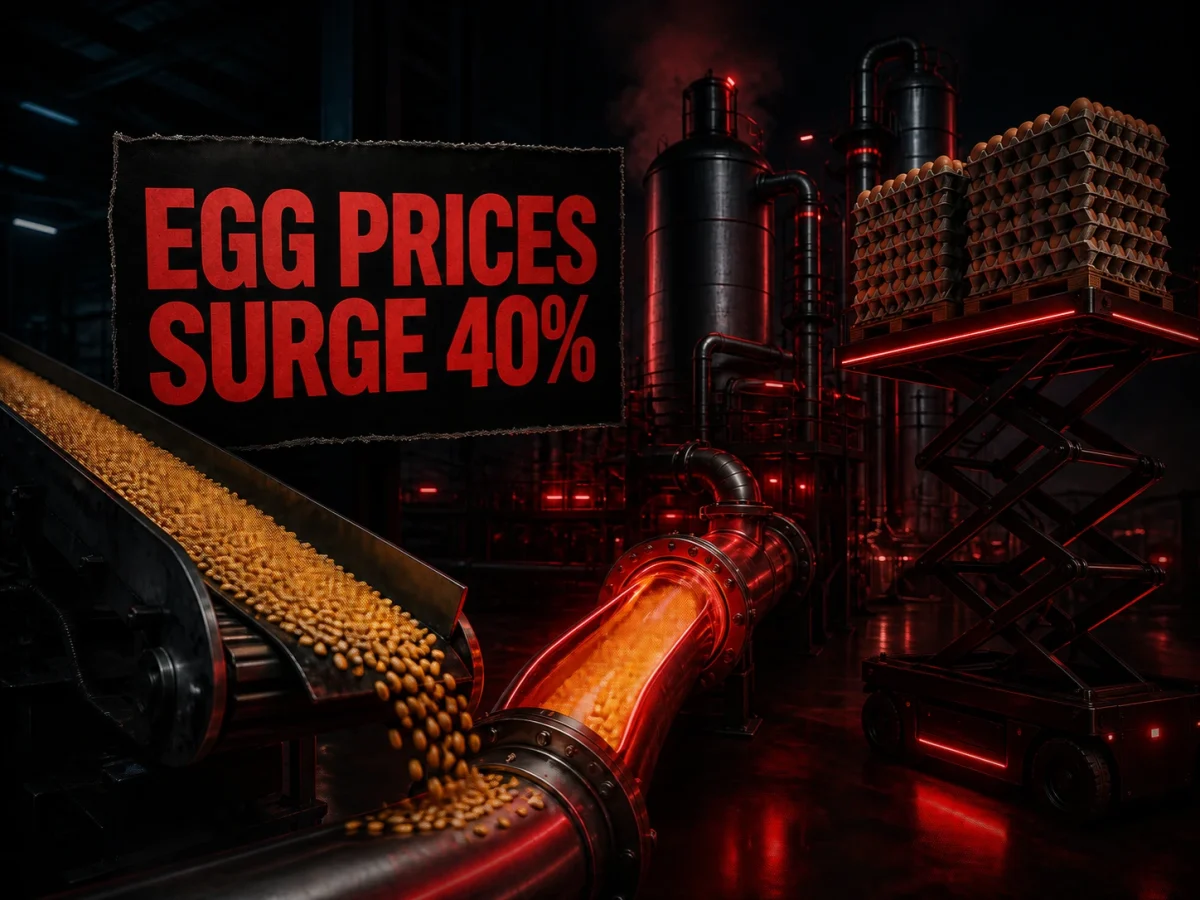
Egg prices in India have climbed by 35–40% over the past year, with farm-gate prices reaching around ₹7 per egg and retail prices touching ₹8.50–₹9 in several markets. A major factor behind the increase is the rising diversion of maize toward ethanol production, which is tightening supplies of a critical poultry-feed ingredient and pushing up the cost of producing eggs.
The pressure comes as India’s ethanol-blending program has expanded, with the blending rate reaching 20%. Parliament data shows that India produces around 43.4 million tonnes of maize, of which nearly 17 million tonnes are now being used for ethanol. At the same time, the poultry industry consumes roughly 60% of India’s maize, creating direct competition between food and fuel demand. Industry officials expect egg prices to remain firm and potentially rise further as winter approaches and egg consumption typically increases.
Egg Prices Rise 35–40% In A Year
The latest data from the National Egg Co-ordination Committee (NECC) shows that egg prices have risen sharply over the past year.
Farm-gate prices are now around ₹7 per egg, while consumers are paying roughly ₹8.50–₹9 at retail outlets. The increase has been driven primarily by higher poultry-feed costs, although industry executives caution that ethanol demand is not the only factor influencing egg prices.
Egg Price Snapshot
| Particular | Current Level |
|---|---|
| Egg price increase over past year | 35–40% |
| Farm-gate price | ~₹7/egg |
| Retail price | ₹8.50–₹9/egg |
| Maize price | ~₹26,500/tonne |
| Maize price 3 years ago | ~₹14,000/tonne |
| Maize price rise in 5 months | ~20% |
| India’s maize production | ~43.4 Mn tonnes |
| Maize used for ethanol | ~17 Mn tonnes |
The price increase is particularly important because eggs are a widely consumed source of affordable protein. Even a ₹1–₹2 increase per egg can raise household food expenses and operating costs for restaurants, bakeries and food businesses.
How Ethanol Is Making Eggs More Expensive
The connection between ethanol and egg prices runs through maize, which is a major component of poultry feed.
India’s ethanol-blending program has increased demand for maize as distilleries use the crop to produce biofuel. That means poultry producers and ethanol manufacturers are competing for the same agricultural commodity.
Higher Ethanol Blending
        ↓
More Maize Diverted To Ethanol
        ↓
Lower Maize Availability For Feed
        ↓
Higher Maize Prices
        ↓
Higher Poultry Feed Costs
        ↓
Higher Egg Production Costs
        ↓
Higher Egg Prices
A senior NECC official told the Economic Times that roughly 37% of total maize production is now going to ethanol distilleries, while egg prices have increased nearly 40% over the past year.
Maize Prices Have Nearly Doubled In Three Years
The most direct cost pressure facing poultry farmers is the price of maize.
Maize prices have increased to approximately ₹26,500 per tonne, compared with about ₹14,000 three years ago. Prices have also increased by nearly 20% over the past five months.
Maize is particularly important for poultry because it provides a major source of energy in feed.
According to industry officials, maize and soybean prices have a direct impact on poultry-feed costs, meaning sustained increases can eventually be reflected in egg and chicken prices.
Maize Price Movement
3 Years Ago
₹14,000/tonne
       ↓
Strong Ethanol + Feed Demand
       ↓
₹26,500/tonne
Current Price
       ↓
~89% Increase
The increase means farmers need to spend considerably more to maintain the same level of poultry production.
Poultry Industry Uses About 60% Of India’s Maize
India’s poultry sector is one of the largest consumers of maize.
Industry estimates indicate that poultry accounts for around 60% of India’s maize consumption. At the same time, ethanol producers are increasingly absorbing domestic maize supplies.
This creates a competition between two important sectors:
| Maize User | Main Purpose |
|---|---|
| Poultry industry | Animal feed |
| Ethanol producers | Biofuel |
| Food industry | Human consumption |
| Industrial users | Various applications |
| Export market | Overseas demand |
As ethanol production expands, the amount of maize available for poultry feed can become tighter unless domestic production rises sufficiently.
Ethanol Production Has Expanded Rapidly
India’s maize-based ethanol industry has grown dramatically in recent years.
Production has increased from around 1 million tonnes in 2022 to more than 6 million tonnes in 2024 and approximately 17 million tonnes currently, according to industry estimates cited by multiple reports. Production could reach around 25 million tonnes by 2030 if the trend continues.
Maize-Based Ethanol Growth
| Year | Approx. Maize-Based Ethanol Production |
|---|---|
| 2022 | ~1 Mn tonnes |
| 2024 | >6 Mn tonnes |
| 2026 | ~17 Mn tonnes |
| 2030 projection | ~25 Mn tonnes |
The expansion reflects India’s strategy of increasing domestic ethanol availability to reduce dependence on imported crude oil and improve energy security.
However, the growing use of agricultural commodities for fuel creates a policy trade-off when the same crops are needed for food and animal feed.
India’s 20% Ethanol-Blending Target Is Central To The Shift
The government’s ethanol-blending program requires oil companies to mix ethanol with petrol before it reaches consumers.
With blending reaching 20%, demand for ethanol feedstocks has increased. Sugarcane remains an important source, but maize has become increasingly significant.
The policy has delivered broader energy benefits, but its impact on agricultural markets is becoming increasingly visible.
Food Vs. Fuel Competition
| Demand Source | Crop Requirement | Impact |
|---|---|---|
| Petrol blending | Maize / sugarcane | Higher ethanol demand |
| Poultry feed | Maize / soybean | Higher feed demand |
| Food | Maize | Human consumption |
| Exports | Maize | Overseas demand |
The challenge for policymakers is to expand ethanol without creating excessive pressure on food and feed prices.
India Is Turning To Maize Imports
The growing domestic demand has also changed India’s position in the global maize market.
India was previously an exporter of maize to countries including Bangladesh and Vietnam. But increasing domestic consumption by the poultry and ethanol industries has reduced the surplus available for exports.
Maize imports reached a record 1 million tonnes in FY25, according to industry reports. India has also sourced non-GMO maize from countries including Myanmar and Ukraine.
Current imports are estimated at around 500,000 tonnes, with industry participants expecting imports to increase if domestic production does not keep pace with demand.
India’s Changing Maize Trade Position
Earlier
Domestic Surplus
      ↓
Maize Exports
      ↓
Bangladesh + Vietnam

Now
Higher Domestic Demand
      ↓
Poultry + Ethanol
      ↓
Lower Surplus
      ↓
Maize Imports
The shift from exporter toward importer highlights how quickly domestic demand has changed the economics of the maize market.
Feed Costs Are The Biggest Pressure On Poultry Farmers
For poultry farmers, feed represents the largest operating expense.
The NECC has estimated that maize accounts for 65–70% of total poultry production costs, underscoring why changes in maize prices can have such a large impact on farmers’ economics.
However, maize is not the only input affecting egg prices.
Soybean meal, amino acids, imported feed ingredients, energy costs and animal-health expenses also influence production costs.
Poultry Cost Drivers
| Cost Factor | Effect On Egg Production |
|---|---|
| Maize | Major feed-energy component |
| Soybean meal | Protein source |
| Amino acids | Feed nutrition |
| Electricity | Farm operations |
| Veterinary expenses | Bird health |
| Labor | Farm management |
| Weather | Production efficiency |
| Mortality | Reduces output |
This means it would be inaccurate to attribute the entire 40% increase in egg prices to ethanol alone.
Ethanol Is A Major Factor, But Not The Only One
Poultry industry executives have cautioned that ethanol demand is not the sole driver of egg prices.
Heat stress, bird mortality, weather disruptions and the cost and availability of imported feed ingredients can also affect production costs and market prices.
This distinction is important because poultry prices are influenced by both supply and demand.
Maize Prices
      +
Soybean Prices
      +
Weather
      +
Bird Mortality
      +
Feed Imports
      +
Seasonal Demand
      ↓
Poultry Production Cost
      ↓
Egg Prices
The current rally is therefore best understood as a combination of higher feed costs and broader supply-demand pressures, with ethanol-driven maize demand an increasingly important component.
Winter Demand Could Push Egg Prices Higher
The poultry industry is entering a period when demand for eggs generally increases.
Egg consumption typically rises during colder months, making the upcoming winter season particularly important for prices.
Industry officials expect egg prices to remain firm and potentially rise further if maize costs remain elevated and demand strengthens.
Seasonal Egg Demand
| Period | Typical Demand Trend |
|---|---|
| Summer | Relatively weaker in some markets |
| Monsoon | Variable |
| Festive period | Mixed |
| Winter | Typically stronger |
| Peak winter | Potentially higher egg demand |
If supply growth fails to match winter demand, consumers could face additional price increases.
What Higher Egg Prices Mean For Consumers
The increase may appear modest when measured per egg, but it can have a wider impact.
A family consuming 30 eggs a month would spend approximately:
| Retail Price Per Egg | Monthly Cost For 30 Eggs |
|---|---|
| ₹6 | ₹180 |
| ₹7 | ₹210 |
| ₹8 | ₹240 |
| ₹9 | ₹270 |
| ₹10 | ₹300 |
At ₹9 per egg, a household buying 30 eggs a month spends ₹270, compared with ₹180 at ₹6 per egg.
The effect is larger for restaurants, bakeries and food manufacturers that purchase eggs in bulk.
Restaurants And Food Businesses Could Face Higher Costs
Eggs are used extensively in the food-service industry.
Higher prices can affect:
- Omelettes
- Egg rolls
- Sandwiches
- Cakes
- Biscuits
- Bakery products
- Mayonnaise
- Desserts
- Breakfast menus
- Prepared foods
Restaurants have several options when input prices rise: absorb the increase, reduce portion sizes, substitute ingredients or raise menu prices.
For small businesses operating on thin margins, sustained egg inflation can therefore become a meaningful cost issue.
Poultry Farmers Face A Margin Squeeze
The biggest challenge is that farmers cannot always pass higher feed costs directly to consumers.
Egg prices are determined by market demand and supply, while feed prices can move independently.
When feed costs rise faster than egg prices, farmers’ margins contract.
Poultry Margin Pressure
Higher Maize Prices
        ↓
Higher Feed Cost
        ↓
Higher Cost Per Bird
        ↓
Farmer Margin Squeeze
        ↓
Possible Production Adjustment
        ↓
Tighter Egg Supply
        ↓
Further Price Pressure
Small producers can be especially vulnerable because they generally have less purchasing power and fewer opportunities to hedge input-price volatility.
India May Need More Maize To Balance Food And Fuel Demand
The growing use of maize for ethanol is creating a structural question for India’s agricultural policy.
If ethanol production continues rising toward the estimated 25 million tonnes by 2030, domestic maize production may need to increase significantly to meet simultaneous demand from poultry, food, exports and industrial users.
Possible responses include higher maize yields, expanded cultivation, improved irrigation, better storage and greater reliance on imports.
Possible Supply Responses
| Measure | Potential Benefit |
|---|---|
| Higher crop yields | More maize without proportionate land expansion |
| Better irrigation | Greater production stability |
| Improved seeds | Higher productivity |
| Lower post-harvest losses | More usable supply |
| Maize imports | Short-term supply support |
| Storage expansion | Better seasonal availability |
| Policy adjustments | Balance food and fuel demand |
The challenge will be finding a sustainable balance between India’s energy and food requirements.
Ethanol Policy Has A Broader Food-Price Effect
The egg-price story follows a similar pattern seen in sugar markets.
When agricultural commodities are diverted toward ethanol, their availability for other uses can tighten.
That does not automatically mean ethanol causes food inflation, because higher production, imports and changing demand can offset the impact.
But when supplies are already tight, additional fuel demand can amplify price pressures.
The Food-Fuel Link
Ethanol Policy
      ↓
Higher Biofuel Demand
      ↓
More Maize / Sugarcane Use
      ↓
Reduced Availability For Other Uses
      ↓
Higher Commodity Prices
      ↓
Higher Feed / Food Costs
      ↓
Higher Consumer Prices
The egg market demonstrates how an energy policy can eventually reach a household’s breakfast table.
What To Watch Next
Several factors will determine whether egg prices rise further or stabilize.
Key Indicators
| Indicator | Why It Matters |
|---|---|
| Maize prices | Biggest feed-cost signal |
| Maize imports | Indicates domestic supply pressure |
| Ethanol production | Determines competing demand |
| Winter egg demand | Key consumption driver |
| Poultry mortality | Affects supply |
| Soybean meal prices | Important feed input |
| New maize crop | Determines supply recovery |
| Government ethanol policy | Could alter feedstock demand |
A sustained decline in maize prices would provide relief to poultry farmers. Conversely, further increases could translate into additional egg-price inflation.
The Bigger Picture
India’s 35–40% increase in egg prices shows how an energy policy can create ripple effects across the food supply chain. The government’s 20% ethanol-blending push has increased demand for maize, with around 17 million tonnes of India’s 43.4 million-tonne maize production now estimated to be directed toward ethanol. Because poultry consumes roughly 60% of India’s maize and maize accounts for a substantial share of poultry production costs, tighter supplies can quickly raise feed costs and eventually reach consumers.
However, ethanol is not the only explanation for higher egg prices. Industry executives also point to soybean prices, heat stress, bird mortality, weather disruptions and imported feed ingredients. India’s response is increasingly involving maize imports, with FY25 imports reaching a record 1 million tonnes and current imports estimated at around 500,000 tonnes. The longer-term challenge will be increasing maize supply fast enough to serve the competing demands of food, animal feed and fuel.
Looking Ahead
The next major test will come during the winter months, when egg demand normally strengthens. If maize prices remain around ₹26,500 per tonne or rise further, poultry producers could face continued cost pressure and pass some of it through to consumers. Additional maize imports could provide relief, but the scale and timing of imports will matter, particularly if domestic production does not expand quickly enough.
For policymakers, the egg-price surge highlights the need to balance India’s ethanol ambitions with food and feed security. Increasing domestic maize productivity could reduce the conflict, while imports can help bridge short-term supply gaps. For consumers and food businesses, the immediate question is whether higher feed costs will stabilize or intensify. If ethanol demand continues to grow while maize supply remains constrained, eggs may remain under price pressure well beyond the current spike
Get the day’s top stories in your inbox
One concise email. No spam, unsubscribe anytime.


