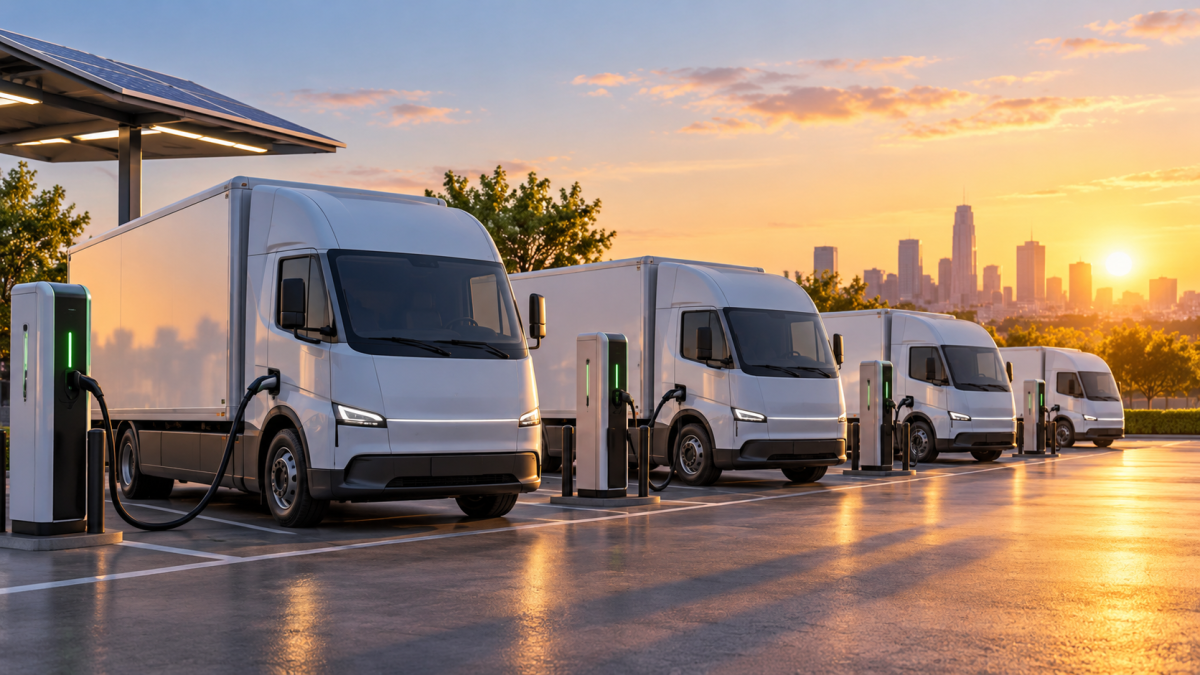
Electric trucks have moved from a pilot to a substantial purchase order at FedEx. Harbinger says the parcel carrier ordered 2,000 medium-duty battery-electric vehicles in a deal worth more than $300 million, with delivery planned by the end of 2027 for the United States and Canada. The announcement is a commitment to buy and build vehicles, not evidence that all 2,000 have entered service.
Key takeaways
- Harbinger announced the order on 30 September 2026, describing it as a binding commitment valued above $300 million.
- The vehicles are planned as one-for-one replacements for conventional pickup-and-delivery trucks, with delivery by the end of 2027.
- Harbinger projects $40 million of annual fuel savings and more than 1.7 million tons of lifetime carbon-dioxide avoidance. Those are its estimates, not audited FedEx operating results.
- The decisive test is whether manufacturing, charging, service and route utilisation scale together.
Everyone else is reporting a large electric-truck order. The more useful question is what a fleet buyer must prove after the announcement: whether a supplier can deliver thousands of vehicles on time and whether the carrier can run them on real routes at lower total cost. That distinction matters for Indian logistics operators too, even though this order is for North America and does not announce an Indian deployment.
Electric trucks: what the FedEx order actually covers
Harbinger’s company announcement says the order covers a mix of its all-electric models and is valued at more than $300 million. It plans to build and deliver all 2,000 in approximately 18 months, with the vehicles intended for FedEx pickup-and-delivery operations in the United States and Canada. Harbinger calls it one of the largest binding orders for medium- or heavy-duty electric trucks. That superlative is the company’s characterization; the disclosed unit count and value are the verifiable news.
The announcement does not provide the model split, the vehicle-by-vehicle price, an installation schedule for charging equipment, or a route list. Dividing the lower-bound $300 million headline by 2,000 yields more than $150,000 per vehicle on a simple arithmetic basis, but it would be misleading to label that a truck sticker price. The published contract value may cover different configurations or commercial terms that have not been itemised. Harbinger and FedEx have not supplied enough detail to calculate a comparable delivered cost per truck.
Bloomberg’s original report, republished by SupplyChainBrain with Bloomberg credited, said Harbinger would replace an equal number of combustion vehicles and quoted chief executive John Harris on the proposed delivery pace. TechCrunch separately contacted Harbinger, which confirmed the plan to deliver the entire order by the end of next year. FreightWaves’ trucking report placed the order in the context of FedEx’s earlier 53-vehicle commitment and its fleet goal. These are three publisher reports, not three copies of a wire story.
Why the earlier 53 trucks matter
FedEx did not start with a 2,000-vehicle bet. FedEx’s annual report says it made a strategic investment in Harbinger during the manufacturer’s $160 million Series C financing in 2025, alongside an initial order for 53 medium-duty vehicles. TechCrunch reports those 53 had already been delivered. The step from 53 to 2,000 does not prove a perfect operating record, but it means the companies have some shared product and operating history rather than a purely speculative design relationship.
FedEx senior vice-president Paul Melander also sits on Harbinger’s board, according to the company announcement and FreightWaves. That connection may help the supplier understand fleet requirements, but readers should recognise it when weighing enthusiastic statements about projected savings. A customer that also invested in a supplier has incentives beyond a single purchase order. The practical proof remains uptime, cost per route and actual diesel work displaced.
Harbinger makes medium-duty platforms rather than long-haul tractor-trailers. FedEx can allocate a parcel truck to repeat routes, return it to a depot and charge it between shifts. This is why last-mile pickup and delivery is a different engineering problem from a long-distance freight corridor: a depot can potentially control charging times and maintenance, while the vehicle’s duty cycle is more predictable. It still must carry the planned load, tolerate weather and traffic, and fit existing dispatch schedules. None of those operational outcomes is established by the order alone.
For comparison, Lapaas Voice’s report on Hindustan Zinc’s electric-truck contract described a defined mine-to-smelter route in Rajasthan where charging and payload can be monitored against diesel operations. The FedEx network is much larger and more dispersed, but the measurement principle is the same: count electric kilometres and completed work, not only vehicles purchased.
The $800 million savings figure is a model, not a result
Harbinger estimates that one of its electric trucks reduces diesel fuel costs by an average of $20,000 a year compared with the vehicle it replaces. Multiplying that stated average by 2,000 produces $40 million a year. Multiplying again by the company’s assumed 20-year medium-duty service life yields $800 million. The arithmetic is transparent, but each input is an assumption about routes, diesel prices, electricity costs, usage and vehicle life. An order announced in 2026 cannot establish two decades of realised savings.
Harbinger also estimates that the 2,000-truck deployment would avoid more than 1.7 million tons of carbon dioxide over the trucks’ operating lives, saying it used published US Department of Energy data. The announcement does not publish a route-level baseline, electricity mix, charging schedule or full life-cycle calculation. The figure should therefore be read as a company model, not a measured emissions reduction or a guarantee that the purchased vehicles will remain in service for 20 years.
| Number | Meaning | Status |
|---|---|---|
| 2,000 trucks | Vehicles in the new FedEx order | Ordered; planned delivery by end-2027 |
| More than $300m | Announced total order value | Harbinger disclosure |
| $40m a year | Projected fleet fuel-cost reduction | Harbinger estimate, not observed saving |
| 1.7m-plus tons CO₂ | Projected lifetime avoidance | Harbinger model, not audited result |
FreightWaves notes that the new vehicles are intended to replace conventional models one for one. If that happens, the case for emissions reduction becomes more straightforward than adding electric vehicles on top of unchanged diesel capacity. Yet a purchase announcement does not show when each truck arrives, whether an old vehicle leaves service at the same time, or how much of the replacement truck’s annual mileage is electric. Those are the milestones worth checking in future FedEx reporting.
What could slow the electric trucks rollout?
Manufacturing is the first hurdle. The company’s plan calls for roughly 2,000 units across about 18 months. Bloomberg reported that Harbinger had recently built its 1,000th vehicle, citing Harris. That shows the company has moved beyond a prototype, but it also suggests this single order would be a major production commitment relative to its cumulative output. A factory can expand, yet ramping production while keeping component quality and after-sales support consistent is harder than announcing capacity.
Charging is the second hurdle. The announcement does not specify how many depots need upgrades, who pays for them, or whether power will be ready before each route receives a truck. Even when a vehicle has adequate nominal range, chargers, electrical connections and parking layouts have to fit shift changes and traffic peaks. A truck that sits waiting for a charger is not a one-for-one replacement in operational terms. FedEx’s experience with the first 53 vehicles may guide deployment, but the public documents do not give their energy use, uptime or route economics.
Service coverage is the third hurdle. Harbinger says its Canadian dealer Kaizen Automotive Group will support deployment in Canada. The company also points to driver-assistance features, suspension and a 42-foot turning diameter. Those specifications may help dense delivery routes, but they do not substitute for spare parts, trained mechanics or rapid repair. With thousands of vehicles, a small recurring fault can become a network problem. The carrier and manufacturer have not published service-level commitments for this order.
Commercial fleet economics depend on total cost of ownership, not a fuel estimate alone. Purchase cost, electricity, charging equipment, financing, insurance, maintenance, tyre use, battery health and residual value all matter. One firm’s calculated diesel saving could coexist with a longer payback period if depot upgrades or downtime are expensive. Conversely, predictable high-use routes can improve the economics. The public order does not contain enough inputs for an independent payback calculation.
Why this US deal matters to India’s EV market
The order does not mean Harbinger plans to sell these trucks in India, and FedEx has not announced an Indian deployment through this transaction. Its relevance for Indian readers is an operating question: what happens when a logistics buyer tries to replace a working diesel fleet at scale rather than test a small number of demonstration vehicles? Indian commercial-EV companies, fleet operators and charging networks face versions of the same production, depot-power and utilisation challenges, though local road conditions, vehicle classes and economics differ.
JSW Ampstar’s commercial-EV plans and Jio-bp and DRIVN’s charging arrangement show why an Indian order needs more than a vehicle brochure. It needs practical charging locations, a dependable operator and a duty cycle that lets the investment earn its keep. The FedEx case supplies a large overseas order to observe; it is not a ready-made Indian cost benchmark. The comparable metric in any market is delivered work per vehicle over time.
A useful future disclosure would pair the number of trucks delivered with the number in active service, kilometres driven, parcels handled, diesel units retired, charging uptime and energy spending. FedEx could then compare like-for-like routes with its older vehicles. Without those measures, an impressive order size says more about purchasing intent than operating success. The headline is meaningful precisely because it creates a measurable test over the next 18 months.
What happens next?
Harbinger has set a delivery target of the end of 2027. The first checkpoints are the pace of production and deliveries, then confirmation from FedEx that vehicles have entered regular pickup-and-delivery service. Later data could show whether the company-reported $20,000 average annual fuel saving is realistic on routes with different climates, distances and depot conditions. Until then, the $40 million and $800 million claims remain forecasts.
For investors and fleet buyers, the test extends beyond this contract. A successful rollout would show that a relatively young manufacturer can supply and support a large commercial customer. A delayed or costly rollout would reveal the limits of extrapolating from a 53-truck pilot. Neither outcome can be assumed from a signed order. The news is that FedEx and Harbinger have moved from pilot-scale procurement to a large, dated delivery commitment; operational evidence must now catch up.
Frequently asked questions
How many electric trucks did FedEx order from Harbinger?
Harbinger says FedEx ordered 2,000 electric medium-duty trucks in a transaction valued above $300 million. They are planned for delivery by the end of 2027, and the announcement does not say that all 2,000 are already operating.
Are the reported $800 million savings guaranteed?
No. The figure is Harbinger’s model: $20,000 in estimated fuel savings per vehicle each year, multiplied by 2,000 vehicles and a 20-year assumed service life. Actual results depend on delivery, utilisation, energy prices and maintenance.
Will these trucks be deployed in India?
No Indian deployment was announced. Harbinger says this order is intended for FedEx pickup-and-delivery operations in the United States and Canada.
What evidence will show whether the order worked?
Deliveries, active vehicle counts, comparable route costs, charging uptime, kilometres driven and verified diesel replacements will say more than the original purchase value or modelled emissions figures.
Get the day’s top stories in your inbox
One concise email. No spam, unsubscribe anytime.


