
Global borrowing linked to artificial intelligence has reached a record $599 billion in 2026, highlighting how rapidly the financing requirements of the AI industry are expanding. Technology companies are increasingly tapping bond markets, private credit providers and other financing channels to fund the construction of data centres, purchase advanced computing hardware and expand their cloud infrastructure.
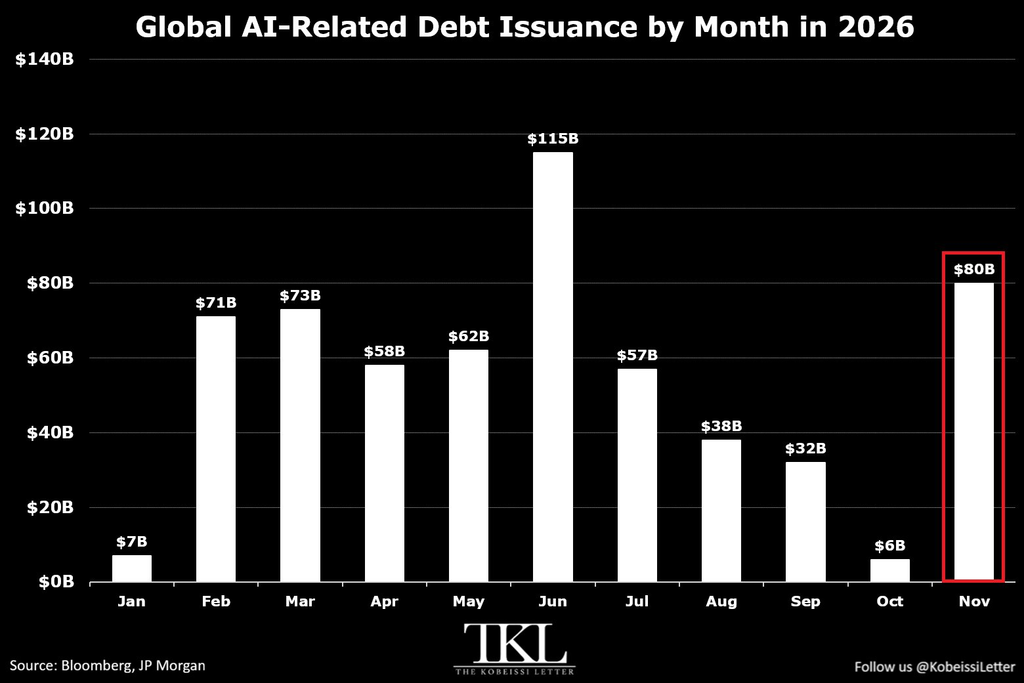
The surge reflects a significant change in how the world’s largest technology companies are financing the AI race. Companies that historically relied heavily on operating cash flows to fund expansion are now using external debt to support increasingly expensive investment programmes. The borrowing is concentrated among major cloud and technology companies, but the financing ecosystem also includes infrastructure developers, semiconductor businesses, private lenders and institutional investors.
AI-Related Debt Issuance Reaches a Record
According to estimates reported in November 2026, global AI-related debt issuance has climbed to approximately $599 billion during the year.
The figure is more than twice the $226 billion recorded during the whole of 2025, demonstrating the speed at which debt financing has expanded alongside AI infrastructure investment.
JPMorgan Asset Management estimated that AI-related debt issuance was approaching $600 billion as of November 2026. However, there is no single universally accepted definition of AI-related debt. Estimates vary depending on whether they include only direct corporate borrowing or also loans, project financing, securitisation and private-market transactions.
The Federal Reserve’s November 2026 Financial Stability Report used a broader measure covering advanced-computing infrastructure. It estimated that related debt issuance exceeded $680 billion by October, approximately five times the $130 billion recorded during all of 2023.
| Indicator | Reported figure |
|---|---|
| AI-related debt issuance in 2026 | Approximately $599 billion |
| Global AI-related debt issuance in 2025 | $226 billion |
| Federal Reserve’s broader advanced-computing debt issuance estimate | More than $680 billion |
| Advanced-computing debt issuance in 2023 | $130 billion |
| Outstanding public advanced-computing debt, October 2026 | More than $1.1 trillion |
These figures use different methodologies and should not be added together. They nevertheless demonstrate the scale of financing entering the AI infrastructure market.
Why Big Tech Companies Are Borrowing More Money
The primary reason behind the borrowing surge is the enormous cost of building AI infrastructure.
Training and operating advanced AI models require specialised processors, large data centres, high-capacity networking equipment, electricity and cooling systems. Companies must also invest in land, buildings, power connections and supporting infrastructure before these facilities can generate revenue.
The world’s largest cloud providers are increasing their investment programmes to meet expected demand for AI computing services.
The five major hyperscalers are Amazon, Alphabet, Microsoft, Meta and Oracle. These companies operate large cloud and computing infrastructure networks and are among the biggest investors in the AI ecosystem.
Their capital expenditure commitments have increased substantially as competition intensifies to develop more powerful AI models and provide computing capacity to businesses, developers and consumers.
Debt financing allows these companies to spread the cost of infrastructure investments over time rather than funding every project entirely through existing cash reserves.
It also provides access to a broader investor base, including pension funds, insurance companies, asset managers and institutional bond investors.
Data Centres Are Driving the Borrowing Boom
Data centres are among the biggest beneficiaries of the AI investment cycle.
Modern AI systems require specialised computing infrastructure capable of handling enormous volumes of data and complex calculations. This has increased demand for facilities equipped with advanced processors, high-speed networking systems and specialised cooling technologies.
Building these facilities requires billions of dollars in investment, creating financing opportunities for technology companies and independent infrastructure developers.
The financing structure is also becoming more complex. Instead of relying exclusively on traditional corporate bonds, companies are using several channels:
- Corporate bonds: Technology companies raise money directly from investors by issuing debt securities.
- Bank loans: Financial institutions provide loans to fund infrastructure development and equipment purchases.
- Private credit: Private lenders finance projects that may not rely on traditional public bond markets.
- Project finance: Borrowing is linked to individual infrastructure projects and their expected future cash flows.
- Securitisation: Financial assets and contractual payment streams are packaged into securities that can be sold to investors.
The Federal Reserve has highlighted this transition from conventional corporate bonds towards a combination of public and private debt, structured credit and project finance.
Amazon, Alphabet, Microsoft, Meta and Oracle Lead the Expansion
The major hyperscalers are central to the AI-related borrowing cycle.
Amazon is investing heavily in data centres and computing infrastructure to support Amazon Web Services and its AI offerings.
Alphabet is expanding its infrastructure to support Google Cloud, Gemini and other AI services.
Microsoft is increasing its computing capacity to support Azure, Copilot and its broader AI partnerships.
Meta is developing large-scale data centre infrastructure to support its AI models and products.
Oracle is also expanding its cloud infrastructure to serve customers requiring large amounts of computing capacity for AI workloads.
These companies have substantial existing businesses and revenue streams, which provide them with access to investment-grade debt markets.
However, the scale of their infrastructure commitments means that even financially strong companies are increasingly using external financing to support expansion.
The Federal Reserve reported that investment-grade technology companies accounted for most of the advanced-computing-related borrowing tracked in its analysis.
Federal Reserve Warns About Financial Risks
The rapid increase in AI-related borrowing has attracted attention from financial regulators.
In its November 2026 Financial Stability Report, the Federal Reserve highlighted the growing debt requirements associated with the data centre buildout.
The report estimated that outstanding public debt related to advanced computing exceeded $1.1 trillion as of October 2026. It also identified substantial additional obligations through leases, guarantees and long-term contractual commitments.
For seven major technology and semiconductor companies included in its analysis, the Federal Reserve estimated that:
- Undiscounted lease obligations that have not yet commenced exceeded $1 trillion.
- Other commitments, including take-or-pay contracts and residual value guarantees, exceeded $2 trillion.
These obligations are not directly comparable with conventional balance-sheet debt because they are generally undiscounted and may involve different payment conditions.
Nevertheless, they demonstrate that the financial exposure associated with AI infrastructure extends beyond the borrowing visible in corporate balance sheets.
The Federal Reserve also highlighted connections between major technology companies, smaller data centre developers, private credit providers and other financial institutions.
If demand for AI computing weakens or infrastructure projects fail to generate expected returns, some of these interconnected businesses could face repayment difficulties.
What Happens If AI Demand Slows?
The AI infrastructure investment cycle is built around expectations of continued growth in demand for computing power.
Technology companies are spending heavily today because they expect businesses and consumers to use more AI services in the coming years.
However, the financial returns from these investments are not guaranteed.
Data centres require significant upfront capital, while their commercial success depends on utilisation rates, customer contracts, electricity costs and the prices companies can charge for computing services.
If AI adoption grows more slowly than expected, infrastructure providers could struggle to generate enough revenue to justify their investment.
Companies with high borrowing requirements could then face pressure from interest payments, refinancing costs and contractual commitments.
The risk is not identical across all borrowers. Large investment-grade technology companies generally have stronger balance sheets and debt-servicing capacity than smaller infrastructure developers or lower-rated AI businesses.
This distinction matters because financial stress in a smaller company could affect lenders, investors and infrastructure partners without necessarily creating an immediate crisis for the largest technology companies.
The Bigger Picture
The record $599 billion borrowing figure illustrates how AI is transforming not only the technology industry but also global credit markets.
The construction of data centres, development of advanced computing systems and expansion of cloud infrastructure are creating financing requirements on a scale that increasingly involves banks, bond investors, private credit funds and institutional lenders.
For investors, AI-related debt is becoming an increasingly important part of the corporate bond and infrastructure financing landscape. For technology companies, borrowing provides additional capital to compete in a market where access to computing capacity is becoming a strategic advantage.
However, the expansion also creates financial interconnections that regulators will need to monitor. The sustainability of this borrowing will ultimately depend on whether AI-related revenues and productivity gains justify the enormous investment being made today.
Looking Ahead
AI-related borrowing could remain elevated as hyperscalers continue expanding their data centre networks and computing capacity. The next important indicators will include corporate bond issuance, private credit activity, infrastructure investment commitments, interest expenses and the cash flows generated by AI services. Investors will also monitor whether smaller infrastructure companies can secure enough long-term customer contracts to support their financing obligations.
The record issuance does not automatically indicate a debt crisis, particularly because many of the largest borrowers have strong credit profiles. However, it shows that the AI boom is increasingly connected to global financial markets. If AI demand meets expectations, the borrowing could support a major expansion in digital infrastructure. If returns fall short, the financial consequences could extend well beyond the technology sector.
Get the day’s top stories in your inbox
One concise email. No spam, unsubscribe anytime.


