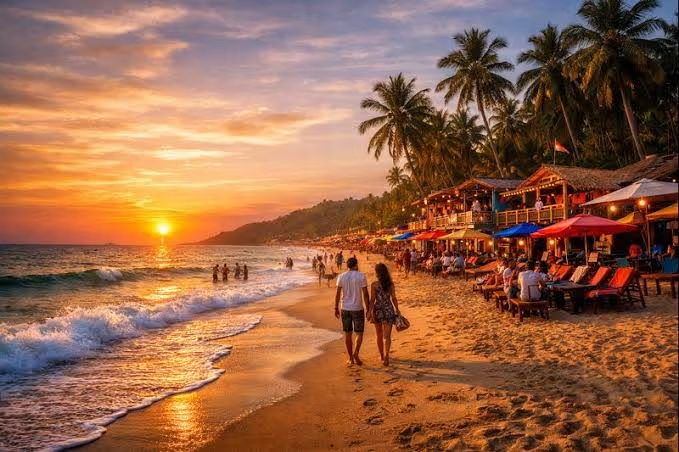
Goa welcomed 61.38 lakh tourists between January and July 2026, showing that the coastal state’s appeal is holding up even outside its traditional peak travel season. Tourism arrivals during the seven-month period were broadly stable compared with the same period last year, rising 0.08%, while July recorded a stronger 2.27% year-on-year increase. The latest figures underline the growing importance of Goa as a year-round tourism destination rather than a market dependent only on the winter holiday season.
The numbers also highlight the dominance of domestic travel in Goa’s tourism economy. Of the roughly 61.4 lakh visitors recorded during the first seven months, around 59 lakh were domestic tourists and approximately 2.4 lakh were international visitors. The July increase is particularly notable because it came during the monsoon, traditionally considered an off-season for Goa. Tourism authorities have increasingly promoted the state’s monsoon landscape, wellness experiences, food, culture and short-break travel to reduce dependence on the peak season.
Goa Tourism Crosses 61 Lakh Visitors In Seven Months
Goa recorded 61.38 lakh tourist arrivals between January and July 2026. The increase over the corresponding period of 2025 was modest at 0.08%, indicating that overall visitor volumes remained largely stable.
However, the July performance was stronger than the cumulative trend. Tourist arrivals in July increased 2.27% from the same month a year earlier, suggesting that demand remained resilient even as the state entered the monsoon period.
Goa Tourism: Key Numbers
| Tourism Indicator | January-July 2026 |
|---|---|
| Total tourist arrivals | 61.38 lakh |
| Domestic tourists | About 59 lakh |
| International tourists | About 2.4 lakh |
| Overall growth vs Jan-July 2025 | 0.08% |
| July 2026 growth | 2.27% |
| Tourism period covered | January-July 2026 |
Tourism At A Glance
61.38 LAKH
Total visitors in seven months
59 LAKH
Domestic visitors
2.4 LAKH
International visitors
+0.08%
January-July growth
+2.27%
July year-on-year growth
The figures indicate that Goa’s tourism market is being sustained overwhelmingly by domestic travellers, while international tourism remains a smaller but strategically important component of the state’s visitor economy.
Domestic Tourists Continue To Drive Goa’s Tourism Economy
Domestic travellers accounted for the vast majority of Goa’s tourist arrivals during the first seven months of the year.
Based on the reported figures of approximately 59 lakh domestic visitors and 2.4 lakh international visitors, domestic travellers represented roughly 96% of the total arrivals during the period, while international tourists accounted for about 4%.
Goa’s Tourist Mix
| Visitor Category | Approx. Arrivals | Approx. Share |
|---|---|---|
| Domestic tourists | 59 lakh | 96.1% |
| International tourists | 2.4 lakh | 3.9% |
| Total | 61.4 lakh | 100% |
Infographic — Visitor Composition
Domestic
████████████████████████████████████████████████ 96%
International
██ 4%
The composition demonstrates how important India’s domestic travel market has become for Goa. The state is no longer relying solely on overseas visitors from traditional source markets to maintain tourism activity.
That shift also gives hotels, restaurants, transport operators and tourism businesses a broader customer base during periods when international arrivals are typically weaker.
July Growth Shows Monsoon Travel Is Gaining Ground
The 2.27% increase in July is one of the most important figures in the latest tourism data.
Goa has traditionally experienced a significant seasonal pattern, with the December-to-March period attracting large numbers of leisure travellers. The monsoon months have historically been considered a quieter period because of heavy rainfall and rough sea conditions.
However, changing travel preferences are creating opportunities for Goa during the rainy season.
Recent data cited by the Goa Tourism Department showed a nearly 40% year-on-year increase in domestic travel searches for Goa during the monsoon, with shorter “micro-cations” emerging as a growing travel trend.
January-July Vs July Performance
| Measure | Growth |
|---|---|
| January-July 2026 vs January-July 2025 | 0.08% |
| July 2026 vs July 2025 | 2.27% |
| July growth premium over seven-month growth | 2.19 percentage points |
This difference suggests that July performed better than the cumulative seven-month trend.
Growth Visual
January-July
0.08% ▏
July
2.27% ███████████████████████
The comparison should not be interpreted as proof that Goa has permanently eliminated seasonality. Instead, it indicates that the monsoon period is showing signs of becoming more commercially relevant for tourism operators.
Why Goa Is Becoming A Year-Round Destination
Travel booking is consolidating onto bigger platforms too — see Uber adding train ticket booking with ixigo.
Goa’s tourism strategy has increasingly moved beyond the traditional beach-and-nightlife proposition.
The monsoon creates a different experience for travellers, with green landscapes, waterfalls, rivers, heritage sites and comparatively lower accommodation prices becoming part of the destination’s appeal.
The growth of short domestic trips is also important. Travellers from cities such as Mumbai, Bengaluru, Delhi and other major urban centres can visit Goa for relatively short breaks rather than planning week-long holidays.
Factors Supporting Monsoon Tourism
| Factor | Potential Tourism Impact |
|---|---|
| Short weekend trips | Encourages quick getaways |
| Monsoon landscapes | Creates a different destination experience |
| Lower-season pricing | Can make hotels more attractive |
| Improved connectivity | Makes short trips easier |
| Food and cultural tourism | Reduces dependence on beach activities |
| Wellness tourism | Supports off-season demand |
| Digital travel discovery | Helps promote monsoon experiences |
Goa’s tourism department has also been emphasizing diversified experiences and connectivity as part of the state’s strategy to maintain visitor demand throughout the year. Earlier 2026 data showed more than 46.39 lakh visitors between January and May, up 0.39% from the same period a year earlier.
Tourism Growth Remains Modest Despite Higher Visitor Numbers
Although 61.38 lakh arrivals represent a substantial volume, the 0.08% growth rate shows that Goa’s tourism market is not currently experiencing a major expansion in visitor numbers.
This distinction matters for the hospitality industry.
Hotels and resorts may receive more visitors without necessarily seeing equivalent increases in revenue if travellers stay for fewer nights, spend less per trip or choose lower-priced accommodation.
Consequently, tourism businesses increasingly have to focus on visitor spending and length of stay rather than arrivals alone.
What The Numbers Do — And Do Not — Show
| Indicator | What It Tells Us |
|---|---|
| 61.38 lakh arrivals | Scale of Goa’s tourism market |
| 0.08% growth | Overall visitor numbers are broadly stable |
| 2.27% July growth | Monsoon demand showed improvement |
| 59 lakh domestic tourists | Domestic travel dominates |
| 2.4 lakh foreign tourists | International tourism remains a smaller segment |
The arrival figures therefore provide a useful measure of demand but do not by themselves determine the financial performance of hotels, restaurants, airlines or other tourism businesses.
Hospitality Industry Gets A Boost From Monsoon Demand
A stronger monsoon tourism market could help Goa’s hospitality industry reduce the sharp difference between peak and off-peak periods.
Hotels and resorts generally benefit when occupancy becomes more evenly distributed across the year. Restaurants, taxis, tour operators, event businesses and other local services can also benefit from a more consistent flow of visitors.
The state’s official tourism infrastructure includes thousands of accommodation establishments. Goa’s 2026 economic data reported 9,573 hotels and lodging houses with about 1.22 lakh beds in 2025-26, compared with 9,005 establishments and roughly 1.20 lakh beds in 2024-25.
Goa’s Accommodation Capacity
| Metric | 2024-25 | 2025-26 |
|---|---|---|
| Hotels/lodging houses | 9,005 | 9,573 |
| Available beds | 119,719 | 122,490 |
| Domestic tourist arrivals | 101.34 lakh | 103.09 lakh |
| Foreign tourist arrivals | 5.45 lakh | 4.93 lakh |
The broader annual figures show that Goa’s accommodation capacity has continued to expand, increasing the importance of maintaining demand outside the traditional peak season.
International Tourism Remains A Key Opportunity
While domestic travellers dominate Goa’s visitor numbers, international tourists remain important because they can have different spending patterns and longer average stays.
The state has historically attracted visitors from markets including the UK, Russia and the United States. Data placed before the Goa Legislative Assembly showed more than 8.8 lakh foreign-tourist “C” Form declarations had been filed between January 2022 and February 24, 2026, reflecting continued international visitor activity.
The challenge for Goa is to grow international arrivals without becoming overly dependent on a small number of source markets.
Air connectivity, visa accessibility, destination marketing and geopolitical conditions can all influence international tourism flows.
Goa’s Tourism Economy Is Becoming More Diversified
The latest arrival data points to a broader change in how Goa is positioning itself.
Instead of relying primarily on beaches, nightlife and peak-season holidays, the state is increasingly promoting heritage, nature, wellness, food, adventure and monsoon travel.
This diversification can help tourism businesses create demand across different seasons and attract different types of travellers.
From Seasonal Tourism To Year-Round Tourism
Traditional model
Peak season
↓
Beach holidays
↓
High hotel occupancy
↓
Off-season slowdown
Emerging model
Peak season
+
Monsoon travel
+
Weekend micro-cations
+
Wellness
+
Food and culture
+
Nature tourism
↓
More consistent year-round demand
The shift is strategically important because a more evenly distributed tourism economy can reduce pressure on infrastructure during peak periods while supporting businesses during traditionally weaker months.
The Bigger Picture
Goa’s 61.38 lakh tourist arrivals in the first seven months of 2026 show that the state’s tourism market remains resilient, but the modest 0.08% cumulative growth also indicates that visitor numbers are broadly stable rather than surging. The stronger 2.27% July increase is therefore particularly significant because it demonstrates that monsoon tourism can generate incremental demand even during a traditionally weaker period.
The overwhelming dominance of domestic travellers is another defining feature of Goa’s tourism economy. With roughly 59 lakh domestic visitors compared with 2.4 lakh international visitors during the seven-month period, India’s growing domestic travel market is providing the foundation for Goa’s year-round tourism strategy.
Looking Ahead
The next challenge for Goa will be to convert rising interest in monsoon and short-break travel into sustained visitor spending. Higher arrivals can benefit hotels, restaurants, transport operators and local businesses, but the economic impact will depend on factors such as length of stay, occupancy, visitor spending and the ability of tourism businesses to attract customers during traditionally weaker months.
If the monsoon trend continues, Goa could gradually strengthen its position as a year-round destination rather than one dominated by peak-season tourism. The 2.27% July growth, combined with rising domestic interest in monsoon trips, suggests that changing traveller preferences may provide the state with an opportunity to spread tourism demand more evenly across the calendar.
Frequently Asked Questions
How many tourists visited Goa in 2026 so far?
Goa welcomed 61.38 lakh tourists between January and July 2026.
Who drives Goa’s tourism?
Domestic tourists continue to drive the state’s tourism economy.
Is monsoon travel growing in Goa?
Yes. July growth indicates monsoon travel is gaining ground, helping the state become more of a year-round destination.
Get the day’s top stories in your inbox
One concise email. No spam, unsubscribe anytime.


