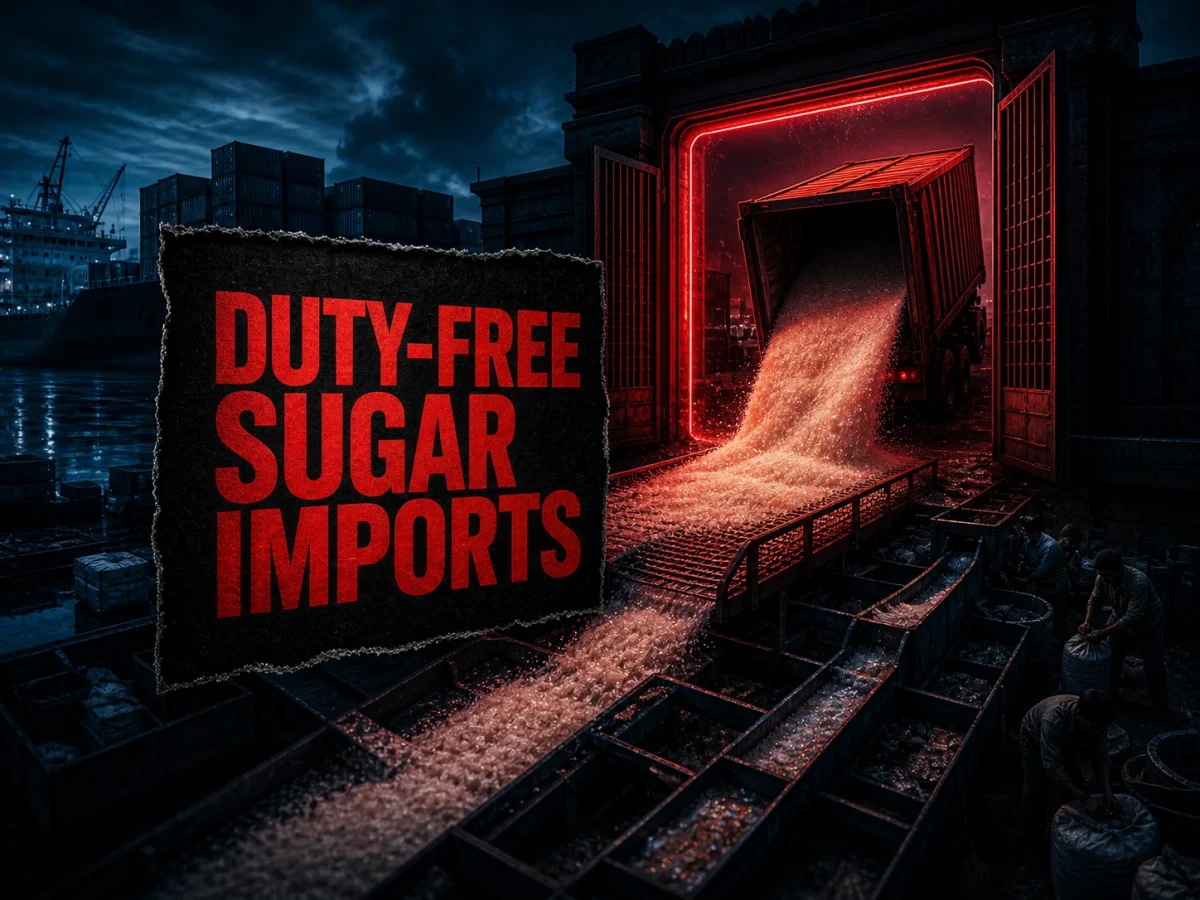
India is turning to overseas supplies to cool a sharp sugar-price rally, with the government allowing duty-free imports of up to 1 million metric tons of raw sugar through October 31, 2026. The move comes after domestic sugar prices surged by nearly 40% in two months, reaching record levels ahead of the country’s peak festive consumption period. It is India’s first major sugar-import decision in nearly a decade and represents a significant policy reversal for the world’s largest sugar consumer.
The import window was opened as concerns over tightening stocks intensified ahead of festivals including Ganesh Chaturthi, Dussehra and Diwali. However, the response from the industry has already changed as domestic prices have fallen sharply from their peak following the government’s announcement. Reuters now reports that mills and refiners may import only about 500,000 tons, or roughly half of the permitted quota, because the economics of importing have weakened.
India Opens 1 Million-Ton Duty-Free Sugar Import Window
The government has permitted imports of up to 1 million metric tons of raw sugar at zero duty under a tariff-rate quota (TRQ). The permission is valid until October 31, 2026.
The policy is designed to increase domestic availability at a time when prices have climbed rapidly and demand is expected to remain elevated during the festive season.
India normally imposes a 100% import duty on sugar, making the temporary removal of the tariff a significant intervention in the domestic market.
Sugar Import Policy At A Glance
| Particular | Details |
|---|---|
| Import quota | 1 million metric tons |
| Sugar type | Raw sugar |
| Import duty | Zero |
| Import deadline | October 31, 2026 |
| Normal sugar import duty | 100% |
| Applications | August 21–28, 2026 |
| Main objective | Increase domestic supply and curb prices |
| Previous major imports | Nearly a decade ago |
Only eligible mills and refiners with refining capacity can participate in the quota, according to the government’s notification.
Sugar Prices Surge Nearly 40% In Two Months
The immediate trigger for the government’s intervention was a dramatic increase in domestic sugar prices.
Prices have risen nearly 40% over the past two months, according to Reuters, with the rally taking domestic sugar to record levels. The increase has been attributed to tightening supplies, lower availability at mills and expectations of strong demand during the festive season.
Retail prices have also climbed sharply. Some markets have reported sugar prices reaching around ₹70 per kg, although prices vary by location and grade.
Sugar Price Movement
Normal Market Levels
        ↓
Tightening Mill Stocks
        ↓
Higher Wholesale Prices
        ↓
Retail Price Increase
        ↓
Nearly 40% Rally In Two Months
        ↓
Government Opens Duty-Free Imports
The rapid price increase has created concerns for households as well as food and beverage manufacturers that use sugar as a key input.
Why Is Sugar Supply Tight?
India’s sugar situation is being shaped by several factors rather than a single supply shock.
Sugar production during the current marketing year is estimated at 27.9 million tons, according to the Indian Sugar & Bio-energy Manufacturers Association (ISMA), compared with consumption estimated at approximately 28 million to 28.5 million tons. Production is higher than the previous year’s 26.1 million tons, but available stocks are expected to be considerably lower.
The government has also allowed significant quantities of sugar to be diverted toward ethanol production.
India’s Sugar Balance
| Metric | Current Position |
|---|---|
| FY/Marketing-year production | ~27.9 Mn tons |
| Estimated consumption | ~28–28.5 Mn tons |
| Previous-year production | ~26.1 Mn tons |
| Sugar diverted to ethanol | ~3 Mn tons |
| Sugar exports already completed | ~0.8 Mn tons |
| Permitted exports | Up to 2 Mn tons |
| Expected opening stock | ~3.5 Mn tons |
| Previous-year opening stock | ~5 Mn tons |
The lower expected opening inventory is one of the main reasons the market has become more sensitive to any disruption in supply.
Ethanol Diversion Adds Pressure To Sugar Availability
India’s ethanol-blending program has become an increasingly important part of the sugar industry’s economics.
Sugar mills can divert sugarcane and its products toward ethanol production, reducing the amount of cane ultimately converted into sugar.
Around 3 million tons of sugar-equivalent production has been diverted for ethanol in the current marketing year, according to ISMA data cited by Reuters.
The policy creates a strategic trade-off.
Sugarcane
    ↓
 ┌───────────────┐
 │               │
Sugar          Ethanol
 │               │
 ↓               ↓
Food Supply   Fuel Supply
Higher ethanol demand can support mill profitability and India’s energy-security objectives, but it can also reduce the amount of sugar available for domestic consumption.
Weather Conditions Add To Supply Concerns
Weather has also contributed to uncertainty around sugarcane production.
Sugarcane is a water-intensive crop, and unfavorable weather conditions can affect yields and cane availability. Reuters reported that poor weather and supply concerns were among the factors behind the recent price increase.
The combination of weather risks, ethanol diversion and lower inventories has made the market more vulnerable to price spikes even though total production is not dramatically below consumption.
Government Takes Multiple Steps To Control Prices
The sugar import decision is not the government’s only intervention.
Authorities have also introduced stockholding limits for dealers and bulk consumers in an attempt to prevent excessive inventory accumulation and speculative buying.
From September 1 through November 30, bulk consumers using more than 10 metric tons of sugar per month will be limited to holding 15 days’ worth of inventory. Dealers have separately been subjected to a 30-day stock limit.
Government Measures
| Measure | Objective |
|---|---|
| 1 Mn tons duty-free imports | Increase supply |
| Stock limits for dealers | Prevent hoarding |
| Bulk-user inventory limits | Restrict excessive stockpiling |
| Earlier crushing | Bring new-season sugar to market sooner |
| Export restrictions | Preserve domestic availability |
| Monitoring of supplies | Control speculation |
The measures are intended to stabilize the market before demand reaches its seasonal peak.
Import Economics Have Already Changed
The most interesting development since the import announcement is that the full 1-million-ton quota may not actually be used.
Domestic ex-mill sugar prices have fallen nearly 20% from the record reached last week, according to Reuters. That has sharply reduced the profitability of importing raw sugar from overseas.
Industry officials now expect imports of only about 500,000 tons, or half the permitted quantity.
Import Quota Vs. Expected Actual Imports
| Metric | Amount |
|---|---|
| Government-approved quota | 1 Mn tons |
| Potential utilization | ~500,000 tons |
| Expected utilization rate | ~50% |
| Remaining unused quota | ~500,000 tons |
| Main likely importers | Port-based refiners |
The shift shows how quickly commodity-market economics can change after a government policy announcement.
Why Mills Are Reluctant To Import
For sugar mills, importing raw sugar involves several risks.
First, the imported product takes time to arrive. Shipments from Brazil, the world’s largest sugar producer, could take several weeks or close to two months to reach India.
Second, domestic supplies are expected to improve when the new crushing season begins around mid-October.
The government has asked mills to start crushing from October 15, earlier than usual, in an effort to increase supplies.
Import Decision Factors
| Factor | Impact On Imports |
|---|---|
| Current domestic price | Determines import profitability |
| International sugar price | Determines landed cost |
| Freight | Raises import cost |
| Transit time | Creates price risk |
| October crushing season | Expected to increase local supply |
| Festival demand | Supports domestic prices |
| Future price uncertainty | Makes imports riskier |
As a result, mills may prefer to wait for domestic supplies rather than commit to expensive overseas cargoes.
Port-Based Refiners Could Dominate Imports
Port-based sugar refineries are expected to account for a significant share of actual imports.
These companies already import raw sugar, refine it and traditionally export the resulting white sugar. Under the government’s new arrangement, eligible refiners can sell refined sugar into the domestic market.
This provides a faster route to increase domestic availability because some refiners already have raw sugar stocks.
Reuters estimates that port-based refineries could release around 300,000 tons of existing stock into the domestic market.
Potential Immediate Supply
Existing Refiner Stocks
        ↓
~300,000 Tons
        ↓
Refining / Domestic Release
        ↓
Additional Local Availability
        ↓
Price Pressure Eases
This means the policy could influence domestic prices even without the full 1 million tons being newly imported.
India May Need White Sugar Imports Too
The government’s decision specifically allows raw sugar imports, which must then be processed before being sold domestically.
Some industry participants argue that allowing duty-free imports of white sugar as well could provide faster relief because it would eliminate the refining step.
Reuters quoted an industry dealer as saying there is a need to allow duty-free white sugar imports alongside raw sugar.
The distinction matters because raw sugar imports take additional time to reach consumers.
Raw Sugar Vs. White Sugar
| Factor | Raw Sugar | White Sugar |
|---|---|---|
| Requires refining | Yes | No |
| Domestic availability | Slower | Faster |
| Eligible under current quota | Yes | No |
| Likely source | Brazil and other producers | Global suppliers |
| Immediate price impact | Moderate | Potentially faster |
Whether the government expands the import policy will depend on how domestic prices behave through the festive season.
Sugar Prices Fall After Import Announcement
The policy has already affected market sentiment.
After the government announced the import window, domestic ex-mill prices declined sharply. Reuters reported a fall of nearly 20% from the previous record.
The development illustrates the importance of expectations in commodity markets.
Even before significant imported sugar physically reaches India, the prospect of additional supply can change trader behavior.
Market Reaction
Government Announces
1 Mn-Ton Duty-Free Quota
          ↓
Supply Expectations Rise
          ↓
Speculative Buying Eases
          ↓
Domestic Prices Fall
          ↓
Import Margins Shrink
          ↓
Actual Import Demand Falls
This dynamic could ultimately result in much less imported sugar than the headline quota suggests.
Is India Facing A Sugar Shortage?
Not necessarily.
The Indian Sugar & Bio-energy Manufacturers Association has said the recent price rally is being driven substantially by speculative buying rather than an actual shortage.
According to ISMA president Niraj Shirgaokar, available stocks are sufficient to meet increased festival-season demand from August through November.
This distinction is important.
A market can experience sharply rising prices because traders and consumers expect future shortages even when physical supplies remain sufficient for total consumption.
Shortage Vs. Market Tightness
| Factor | Current Situation |
|---|---|
| Production | ~27.9 Mn tons |
| Consumption | ~28–28.5 Mn tons |
| Opening stock | Lower than last year |
| Festival demand | High |
| Ethanol diversion | ~3 Mn tons |
| Physical shortage | Disputed |
| Price pressure | Significant |
| Speculation | Identified as a factor |
The government’s import decision therefore appears aimed at preventing a supply squeeze from becoming a more serious shortage, rather than responding to an outright absence of sugar.
Impact On Consumers And Food Companies
For households, sugar is a relatively small component of overall food expenditure but is widely consumed and politically sensitive.
Higher prices also affect businesses that use sugar as a major input.
Industries Potentially Affected
- Confectionery
- Packaged foods
- Soft drinks
- Bakeries
- Ice cream
- Sweets and mithai
- Restaurants
- Hotels
- Beverage manufacturers
- Food-processing companies
A prolonged sugar-price rally could increase production costs for these businesses.
If the government’s import and stock-control measures succeed, some of that pressure could ease before the peak festive period.
Impact On Sugar Companies
The import decision has had an immediate negative impact on investor sentiment toward sugar producers.
Shares of major sugar companies, including Balrampur Chini Mills and Dhampur Sugar Mills, fell by as much as 5% after the government announced the duty-free import policy.
For sugar producers, higher domestic prices can improve realizations. Imports, however, can put a ceiling on prices by increasing available supply.
Sugar Industry Impact
| Development | Likely Impact |
|---|---|
| Higher domestic sugar prices | Positive for mills |
| Duty-free imports | Negative for domestic realizations |
| Lower import utilization | Reduces downside pressure |
| Earlier crushing | Increases future supply |
| Ethanol diversion | Supports alternative revenue |
| Export restrictions | Supports domestic availability |
| Festival demand | Supports consumption |
The profitability outlook for mills will therefore depend heavily on the balance between sugar prices and ethanol revenues.
Global Sugar Market Also Reacts
India’s role in the global sugar market means domestic policy changes can influence international prices.
When India announced the 1-million-ton import quota, sugar futures in London and New York rose about 4%, reflecting expectations that India would return to the international market as a buyer.
However, expectations have since moderated as domestic prices fell and traders concluded that India might import only half the authorized volume.
The latest developments demonstrate how India’s domestic supply position can influence global sugar-market sentiment.
The Bigger Picture
India’s decision to allow 1 million tons of duty-free raw sugar imports is a major policy reversal after nearly a decade without significant imports. The government acted after domestic prices surged nearly 40% in two months, with tightening stocks and festival-season demand raising concerns about availability.
But the market has already begun to correct. Domestic ex-mill prices have fallen nearly 20% from their recent peak, reducing the profitability of imports and leading industry participants to estimate that only around 500,000 tons of the permitted 1 million tons may actually be imported. Meanwhile, port-based refiners could release around 300,000 tons of existing stocks into the domestic market, while the new crushing season is expected to increase supply from mid-October.
Looking Ahead
The key question is whether India’s sugar market will remain tight through the October-November festive period. The government has several tools available, including the duty-free import quota, stockholding limits and an earlier start to sugarcane crushing. If domestic prices remain subdued, actual imports could fall well below the 1-million-ton ceiling. If prices rise again, however, the quota provides a mechanism for mills and refiners to bring additional supplies into the country.
For consumers and food manufacturers, the most important factor will be whether the combination of imports, existing refinery stocks and new-season production is sufficient to prevent another price spike. For sugar mills, the policy creates a more challenging pricing environment, particularly if imports become economically viable. The next few months will therefore be shaped by the interaction of domestic stocks, festival demand, ethanol diversion, crushing schedules and global sugar prices
Get the day’s top stories in your inbox
One concise email. No spam, unsubscribe anytime.


