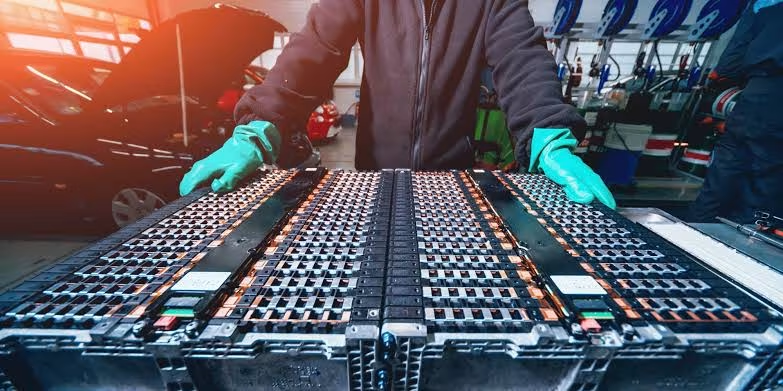
India has delayed its ambitious ₹18,100 crore programme to build a domestic advanced-chemistry-cell battery manufacturing ecosystem, with beneficiaries facing setbacks in setting up plants and achieving production milestones. The delay comes as manufacturers continue to face technology, equipment, skilled manpower and supply-chain constraints, highlighting the challenges involved in reducing India’s dependence on imported battery cells.
The Production Linked Incentive (PLI) programme, approved in 2021, was designed to establish 50 GWh of domestic advanced chemistry cell (ACC) manufacturing capacity. However, official government data show that only 1 GWh of the 40 GWh capacity awarded to four companies had been installed as of March 2026. By June 2026, the programme was still facing implementation delays, with Ola Electric remaining the only beneficiary to have started commercial-scale cell production. :contentReference[oaicite:0]{index=0}
₹18,100 Crore Battery PLI Scheme Faces Delays
The National Programme on Advanced Chemistry Cell (ACC) Battery Storage was approved in May 2021 with a total government outlay of ₹18,100 crore.
The scheme aims to establish 50 GWh of domestic ACC manufacturing capacity and reduce India’s dependence on imported battery cells. Of the targeted 50 GWh, 40 GWh has been awarded to four beneficiary companies through two rounds of bidding. :contentReference[oaicite:1]{index=1}
The programme provides financial incentives to manufacturers based on factors including battery sales, quoted subsidy per kWh and the level of domestic value addition achieved.
India’s Battery PLI Scheme At A Glance
| Parameter | Details |
|---|---|
| Scheme | PLI for Advanced Chemistry Cell Batteries |
| Approval | May 2021 |
| Total outlay | ₹18,100 crore |
| Target capacity | 50 GWh |
| Capacity awarded | 40 GWh |
| Beneficiary companies | 4 |
| Capacity installed as of March 2026 | 1 GWh |
| Domestic manufacturing goal | Reduce battery import dependence |
| Scheme structure | Production-linked incentives |
The gap between the 50 GWh target and the capacity actually commissioned demonstrates the scale of the implementation challenge.
Only 1 GWh Of Awarded Capacity Was Installed
The latest government data available in March 2026 showed that only 1 GWh of the 40 GWh awarded capacity had been installed.
Ola Cell Technologies accounted for that 1 GWh, while ACC Energy Storage, Reliance New Energy Battery Storage and Reliance New Energy Battery had yet to report installed capacity at that point. :contentReference[oaicite:2]{index=2}
Beneficiary-Wise Progress
| Company | Capacity Awarded | Capacity Installed* |
|---|---|---|
| ACC Energy Storage Pvt. Ltd. | 5 GWh | 0 GWh |
| Ola Cell Technologies Pvt. Ltd. | 20 GWh | 1 GWh |
| Reliance New Energy Battery Storage Ltd. | 5 GWh | 0 GWh |
| Reliance New Energy Battery Ltd. | 10 GWh | 0 GWh |
| Total | 40 GWh | 1 GWh |
*Government data reported as of March 2026.
This means only about 2.5% of the 40 GWh capacity awarded under the scheme had been installed at that stage.
Capacity Progress
Targeted national capacity
50 GWh
██████████████████████████████████████████████████
Awarded capacity
40 GWh
████████████████████████████████████████
Installed capacity
1 GWh
█
The difference shows why the government has faced pressure to extend timelines for the programme.
Why The Battery Manufacturing Programme Is Delayed
Battery-cell manufacturing is significantly more complex than assembling battery packs from imported cells.
Manufacturers need specialised equipment, technical expertise, upstream materials and access to advanced cell technology.
The government has identified several challenges facing beneficiaries, including shortages of skilled manpower, imports of critical equipment and machinery, and the non-availability of upstream components. :contentReference[oaicite:3]{index=3}
Major Bottlenecks
| Challenge | Impact |
|---|---|
| Skilled manpower shortage | Slower plant commissioning |
| Imported equipment | Longer procurement and installation timelines |
| Specialist technicians | Delays in commissioning machinery |
| Upstream component shortages | Limits local production |
| Battery technology access | Makes localisation more difficult |
| Supply-chain dependence | Creates external vulnerabilities |
These constraints have made it difficult for companies to move quickly from investment announcements to commercial-scale cell production.
China Remains A Major Technology And Equipment Challenge
India’s battery ambitions are also being affected by its dependence on China-linked technology and equipment supply chains.
Battery manufacturers need specialised machinery and technical support for cell-production lines. Business Today reported that manufacturers have faced difficulties obtaining equipment and bringing qualified technicians to India for installation and commissioning. :contentReference[oaicite:4]{index=4}
The problem is particularly important because India wants to develop an indigenous battery ecosystem while much of the global battery supply chain remains concentrated in China.
Battery Manufacturing Dependency
China-linked ecosystem
↓
Specialised equipment
↓
Technical installation
↓
Cell-production commissioning
↓
Domestic battery manufacturing
If access to equipment, technicians or technology is delayed, the commissioning of Indian plants can also be pushed back.
Amara Raja Highlights Technology Challenges
Amara Raja Energy & Mobility, which is developing its own battery-cell capabilities outside the PLI scheme, has also highlighted the difficulties involved in localising battery production.
The company said its proposed partnership with China’s Gotion had not progressed because of geopolitical issues and that it was therefore developing much of its technology in-house. :contentReference[oaicite:5]{index=5}
Amara Raja plans to commission an initial 2 GWh battery-cell facility and eventually add capacity in phases.
The company has also invested about $100 million in a research and engineering centre and a qualification plant as part of its effort to develop cell capabilities internally. :contentReference[oaicite:6]{index=6}
Amara Raja’s Battery Plans
| Parameter | Plan |
|---|---|
| Initial gigafactory capacity | 2 GWh |
| Planned eventual capacity | 16 GWh |
| Target horizon | 2030-31 |
| R&D and qualification investment | ~$100 million |
| Initial chemistry | NMC lithium-ion |
| Future chemistries | NMC, LFP and others |
The company’s experience illustrates the wider difficulty Indian companies face in building cell manufacturing capabilities from the ground up.
India Still Depends Heavily On Imported Battery Cells
Despite the government’s battery-manufacturing programme, domestic demand continues to be met largely through imports.
The Ministry of Heavy Industries said in March that the PLI ACC programme was specifically designed to reduce India’s dependence on imported ACCs, but domestic demand was still being met largely through imports. :contentReference[oaicite:7]{index=7}
This creates a strategic challenge because India’s electric-vehicle market is expanding rapidly.
India’s EV Adoption Is Rising
Official government data show that EV penetration increased from 0.7% of vehicle sales in FY2020 to 8.2% in FY2026, supported by schemes including FAME-II and PM E-DRIVE. :contentReference[oaicite:8]{index=8}
| Financial Year | EV Penetration |
|---|---|
| FY2019-20 | 0.7% |
| FY2025-26 | 8.2% |
| Increase | 7.5 percentage points |
As electric-vehicle adoption grows, demand for battery cells is expected to rise as well.
This makes the delay in domestic cell manufacturing particularly significant.
Battery PLI Has Already Attracted ₹3,237 Crore Of Investment
Although capacity commissioning has been slow, the scheme has helped trigger investment in the broader battery ecosystem.
As of December 31, 2025, the four PLI beneficiaries had reported cumulative investment of ₹3,237 crore and employment generation of 1,118 people. :contentReference[oaicite:9]{index=9}
Investment And Employment
| Indicator | Reported Figure |
|---|---|
| Cumulative investment | ₹3,237 crore |
| Direct employment | 1,118 |
| Capacity awarded | 40 GWh |
| Capacity installed | 1 GWh |
The government says the scheme has also encouraged companies outside the PLI programme to announce additional battery-cell manufacturing projects.
Companies Outside The PLI Scheme Have Announced 178 GWh
At least 10 manufacturers outside the PLI applicants have announced cumulative battery-cell capacity of about 178 GWh over the next five years, according to the Ministry of Heavy Industries. :contentReference[oaicite:10]{index=10}
This suggests that the government’s battery policy has had a broader signalling effect beyond the four companies directly receiving PLI incentives.
India’s Announced Battery Capacity
PLI-awarded capacity
40 GWh
Other announced capacity
178 GWh
Combined announced/awarded
218 GWh
However, announced capacity should not be confused with operational capacity. Actual production will depend on whether companies complete investment, equipment installation, qualification and commercial commissioning.
Reliance And Ola Are Central To The Plan
Two of the most prominent companies involved in the PLI programme are Reliance and Ola Electric.
Reliance has received a combined 15 GWh allocation across two entities, while Ola Electric has received the largest single allocation of 20 GWh. :contentReference[oaicite:11]{index=11}
Major PLI Allocations
| Company / Group | Capacity Awarded |
|---|---|
| Ola Cell Technologies | 20 GWh |
| Reliance entities combined | 15 GWh |
| ACC Energy Storage | 5 GWh |
| Total | 40 GWh |
Ola Electric has already begun commercial operations with battery-cell capacity, although its operating capacity remains well below its total PLI allocation. :contentReference[oaicite:12]{index=12}
The Scheme Requires Domestic Value Addition
The PLI programme is not designed simply to assemble imported battery cells.
Beneficiaries must progressively increase domestic value addition.
Under the framework, companies are required to achieve at least 25% value addition at the mother-unit level within two years of the appointed date and raise it to 60% within five years. :contentReference[oaicite:13]{index=13}
Domestic Value-Addition Requirement
| Stage | Minimum Value Addition |
|---|---|
| Within 2 years | 25% |
| Within 5 years | 60% |
This requirement is important because the government’s objective is to create an Indian battery manufacturing ecosystem rather than simply move battery assembly into the country.
Why Delays Matter For Electric Vehicles
Battery cells are one of the most expensive and strategically important components of an electric vehicle.
If India continues importing a large share of cells, EV manufacturers remain exposed to international prices, currency movements, shipping costs and geopolitical disruptions.
Local manufacturing could potentially improve supply-chain resilience while supporting domestic battery technology development.
Imported Vs Domestic Battery Supply
Imported cells
↓
International supply chains
↓
Currency + shipping + geopolitical risks
↓
EV manufacturers
Domestic cells
↓
Indian manufacturing ecosystem
↓
Local supply chain
↓
Potentially greater resilience
However, domestic production will need to become competitive on cost, quality and scale before it can significantly displace imports.
Battery Manufacturing Is Expanding Beyond PLI Beneficiaries
The government’s February 2026 update said at least 10 manufacturers had announced approximately 178 GWh of cumulative capacity outside the PLI programme.
That broader investment pipeline suggests India’s battery sector is developing even though the flagship PLI projects have encountered delays. :contentReference[oaicite:14]{index=14}
The emerging ecosystem also includes battery-material companies, recycling firms, pack manufacturers and technology providers.
This could eventually create a more integrated domestic supply chain.
India Wants To Build A Complete Battery Ecosystem
The government’s broader objective extends beyond cell manufacturing.
A competitive battery industry requires access to cathode materials, anodes, separators, foils, chemicals, recycling infrastructure and manufacturing equipment.
The Ministry of Heavy Industries said the PLI programme had already increased demand for components including cathode active materials, anode active materials and foils. :contentReference[oaicite:15]{index=15}
Battery Value Chain
Raw materials
↓
Cathode materials
+
Anode materials
+
Electrolytes / separators
↓
Cell manufacturing
↓
Battery packs
↓
Electric vehicles
↓
Battery recycling
India’s current weakness is particularly pronounced in several upstream segments, making the development of a complete domestic ecosystem a longer-term challenge.
The Government Has Not Yet Fully Assessed Import Reduction
The Ministry of Heavy Industries said in a July 2026 parliamentary response that it had not conducted an assessment of the reduction in battery import dependence resulting from the programme. :contentReference[oaicite:16]{index=16}
This is significant because reducing import dependence is one of the main objectives of the PLI programme.
The government can therefore track capacity installation and investment, but the exact reduction in India’s battery-import dependence has not yet been formally assessed.
The Bigger Picture
India’s decision to delay its ₹18,100 crore homegrown battery manufacturing programme by two years highlights the difficulty of creating a domestic battery industry in a sector dominated by established global supply chains. The PLI scheme has targeted 50 GWh of capacity and awarded 40 GWh to four companies, but only about 1 GWh had been installed as of March 2026. :contentReference[oaicite:17]{index=17}
The delay does not mean India’s battery ambitions have stalled completely. Companies outside the PLI scheme have announced around 178 GWh of additional capacity, while EV adoption has increased sharply and domestic manufacturers are investing in technology and production capabilities. But the slow commissioning of PLI plants demonstrates that India still faces major challenges around technology, equipment, skilled labour, upstream components and supply-chain dependence. :contentReference[oaicite:18]{index=18}
Looking Ahead
The next two years will be critical for India’s battery-manufacturing ambitions. The government will need to ensure that PLI beneficiaries can obtain specialised equipment, close technology gaps, recruit skilled workers and build reliable domestic supply chains. Companies will also need to move from pilot and qualification lines to commercially viable gigawatt-scale production.
For India’s EV industry, faster domestic cell production could eventually reduce dependence on imports and strengthen the country’s position in the global clean-energy supply chain. But the real measure of the ₹18,100 crore programme will not be the amount allocated or the capacity announced; it will be the number of gigawatt-hours actually produced competitively in India and the extent to which that production replaces imported cells.
Get the day’s top stories in your inbox
One concise email. No spam, unsubscribe anytime.