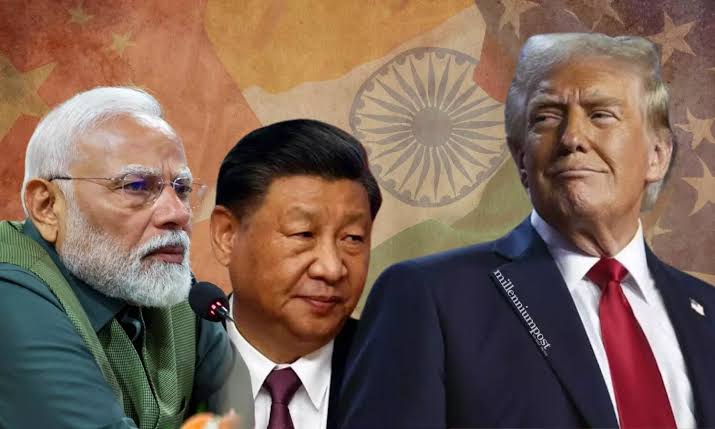
The United States has identified India among more than 40 countries that it says are being used as potential routes for Chinese goods to enter the American market while avoiding higher tariffs. A new White House report has warned that illegal transshipment through third countries could be costing the US between $19 billion and $26 billion in tariff revenue every year.
The report, released by the Trump administration, describes a global network in which Chinese goods can be rerouted through countries with lower US tariff rates before entering the American market. India, Mexico, Canada, Vietnam, Malaysia, Japan, South Korea and countries across the European Union are among those identified as transshipment-risk locations. The US is considering tougher measures, including penalty tariffs and other enforcement actions, while stressing that the presence of a country on the list does not by itself establish that its government or exporters are participating in illegal activity.
White House Accuses China of Using Third Countries
The White House report, titled “The Great Transshipment Scam,” argues that Chinese exporters have adapted to US tariffs by routing goods through third countries.
The practice becomes problematic when goods are deliberately relabeled, repackaged or subjected to insufficient processing to make them appear to originate from another country.
The objective is to obtain a lower tariff rate than would apply if the goods were declared as Chinese-origin products.
| Key Detail | Information |
|---|---|
| Countries identified | More than 40 |
| India included | Yes |
| Estimated annual US tariff revenue loss | $19 billion-$26 billion |
| Main country highlighted | China |
| Practice under scrutiny | Illegal transshipment |
| Potential response | Penalty tariffs and sanctions |
| US enforcement agency | Customs and Border Protection |
| New technology | AI-assisted detection |
| Report | The Great Transshipment Scam |
The White House says the problem has become significant enough to warrant a stronger enforcement strategy.
What Is Transshipment?
For more context, see how Trump’s car tariffs cut US imports and exports.
Transshipment itself is not illegal.
Companies routinely move goods through multiple countries for legitimate reasons, including logistics, manufacturing and distribution.
The problem arises when businesses deliberately manipulate the declared country of origin to avoid applicable tariffs.
How Illegal Transshipment Can Work
Chinese manufacturer
↓
Goods shipped to third country
↓
Repackaging or limited processing
↓
Origin information changed or misrepresented
↓
Goods exported to the US
↓
Lower tariff applied
The US administration argues that Chinese exporters have increasingly used this approach as tariffs on Chinese products have risen.
India Is Listed as a Transshipment Risk
India’s inclusion in the report has attracted particular attention because of its growing trade relationship with the United States.
The White House lists India alongside numerous other major trading partners as a potential transshipment route.
However, being identified as a country with transshipment risk is not the same as proving that India is systematically helping China evade US tariffs.
The report broadly identifies countries through which Chinese goods may be routed, while questions remain about the scale of illegal activity involving individual countries.
India Could Face Greater US Scrutiny
The inclusion of India could increase scrutiny of Indian exporters shipping products to the United States.
US authorities could examine whether products declared as Indian-origin actually meet US rules of origin.
This could be particularly relevant in industries where Chinese components or intermediate goods are widely used.
Potential Compliance Process
Indian exporter
↓
Imports components
↓
Manufactures product in India
↓
Exports to US
↓
US customs checks origin
↓
Documentation and production records reviewed
↓
Tariff treatment determined
The key issue will be whether enough processing has occurred in India for the product to legally qualify as Indian-origin under applicable US rules.
Chinese Components Do Not Automatically Make a Product Chinese
An important distinction in the controversy is that using Chinese inputs does not automatically mean a finished product is Chinese-origin.
Modern supply chains are highly international.
A product may contain components from China, India, South Korea, Japan and other countries before being assembled into a final product.
The determination of country of origin depends on applicable customs rules and the extent of processing undertaken.
This distinction could become increasingly important for Indian exporters facing additional scrutiny.
US Says It Is Losing Billions in Tariff Revenue
The White House estimates that illegal transshipment is costing the United States between $19 billion and $26 billion in tariff revenue each year.
The administration argues that higher tariffs have created incentives for exporters to find alternative routes into the US market.
Tariff Evasion Incentive
Higher tariff on Chinese goods
↓
Chinese exporters seek alternative routes
↓
Third-country processing or routing
↓
Lower effective US tariff
↓
Higher incentive for transshipment
↓
Potential loss of US tariff revenue
The White House believes stronger enforcement is necessary to close these gaps.
The Scale of the Trade Is Difficult to Measure
Determining the exact value of goods involved in illegal transshipment is challenging because legitimate and illegitimate supply-chain activity can look similar.
A Chinese company may legitimately manufacture components in one country and assemble them in another.
Distinguishing that activity from deliberate origin laundering requires detailed customs, production and ownership information.
This is one reason the US administration is increasing its use of technology and data analysis.
US Deploys AI to Detect Suspicious Shipments
US Customs and Border Protection is developing AI-supported systems to identify potentially fraudulent shipments.
The technology can analyze information including shipping routes, company relationships, production capacity and other indicators to identify unusual patterns.
AI-Based Customs Enforcement
Shipment data
+
Routing information
+
Company ownership
+
Production capacity
+
Packaging information
+
Imaging data
↓
Risk analysis
↓
Potentially suspicious shipment
↓
Customs inspection
The use of AI could allow authorities to identify suspicious cargo before it enters the US market rather than relying entirely on investigations after imports have cleared customs.
India-US Trade Relations Could Face New Pressure
The development comes at a sensitive time for India-US trade relations.
India and the United States have been negotiating trade arrangements while Washington has pursued a more aggressive tariff policy.
The new transshipment allegations could add another issue to negotiations.
Washington may seek stronger commitments from India on customs enforcement and country-of-origin verification.
India May Need Stronger Origin Verification
Indian exporters could face pressure to provide more detailed evidence showing where products are actually manufactured.
This could include:
- Production records
- Import documents
- Bills of materials
- Factory records
- Supplier information
- Customs declarations
- Ownership details
- Processing records
Greater documentation could increase compliance costs but may also help legitimate Indian exporters distinguish themselves from businesses involved in tariff evasion.
The Impact Could Extend Beyond China
Although China is the central focus of the White House report, the issue affects global supply chains.
More than 40 countries have been identified as potential transshipment locations.
This includes some of the United States’ closest trading partners.
Global Supply Chain
China
↓
Third countries
↓
US market
↓
Customs enforcement
↓
Potential tariffs or penalties
The US approach could therefore affect companies that operate legitimate international manufacturing networks.
Companies Could Reconsider Supply Chains
If the United States increases penalties on goods suspected of being transshipped, multinational companies may reconsider how they organize production.
Companies could shift more manufacturing into countries where they can demonstrate substantial transformation and maintain detailed records.
Potential Supply Chain Response
US tariff risk
↓
Review manufacturing structure
↓
Increase local production
↓
Strengthen documentation
↓
Diversify suppliers
↓
Reduce customs uncertainty
India could potentially benefit if multinational companies decide to establish genuine manufacturing operations there rather than merely using the country as a routing point.
India Could Also Gain From Supply Chain Diversification
India has been seeking to attract companies looking to diversify manufacturing away from China.
Electronics, pharmaceuticals, automobiles, textiles and industrial products are among sectors where India has sought greater participation in global supply chains.
If US companies distinguish legitimate Indian manufacturing from transshipment, India could still benefit from the broader shift toward supply-chain diversification.
But Exporters Face Greater Compliance Risks
At the same time, Indian businesses could face more customs checks and documentation requirements.
Companies using Chinese components may need to demonstrate clearly how and where products are transformed in India.
This could increase administrative costs, particularly for smaller exporters.
Exporter Challenge
Chinese inputs
↓
Indian manufacturing
↓
US export
↓
Detailed origin verification
↓
Higher compliance costs
+
Potential customs delays
The impact will vary substantially by industry.
The US May Impose Anti-Transshipment Penalties
The White House is considering stronger measures against countries or companies that facilitate tariff evasion.
Potential tools include penalty tariffs, sanctions, stricter customs enforcement and restrictions on market access.
However, the administration has not established that every country named in the report will automatically face penalties.
Possible US Response
Warning
↓
Increased inspections
↓
Retroactive tariff assessments
↓
Penalty tariffs
↓
Sanctions
↓
Potential market restrictions
The eventual policy could depend on the results of investigations and trade negotiations.
The Policy Could Affect India’s Export Competitiveness
If Indian exports face additional scrutiny or penalties, shipments could become slower and more expensive.
This could affect companies competing with suppliers from other countries.
However, stronger origin verification could also benefit legitimate manufacturers by reducing unfair competition from companies using false origin declarations.
What It Means for Indian Exporters
Indian exporters should expect greater attention to supply-chain documentation if the US expands its transshipment crackdown.
Businesses that source heavily from China may face particular scrutiny.
Companies may need to demonstrate the extent of manufacturing and transformation carried out in India.
What It Means for China
For China, stronger enforcement could make it harder to use third countries as alternative routes into the US market.
If customs authorities become more effective at identifying origin manipulation, Chinese exporters may need to absorb higher tariffs or establish more genuine production capacity outside China.
What It Means for the US
For the United States, the crackdown is intended to protect tariff revenue and domestic manufacturers.
The administration argues that tariff evasion undermines the purpose of trade restrictions by allowing foreign goods to enter the US at lower rates than intended.
The challenge will be ensuring enforcement does not disrupt legitimate global supply chains.
What Investors Should Watch
Investors should monitor:
- US customs investigations
- Penalty tariffs on transshipment
- New US rules of origin
- India-US trade negotiations
- Indian export documentation requirements
- US imports from India
- Chinese exports through third countries
- AI-based customs enforcement
- Sector-specific tariff actions
- Supply-chain relocation decisions
The biggest risk for companies will be uncertainty over how aggressively Washington applies the new measures.
Key Facts at a Glance
| Metric | Detail |
|---|---|
| White House report | The Great Transshipment Scam |
| Countries identified | More than 40 |
| India included | Yes |
| Main country accused of using network | China |
| Estimated annual US tariff revenue loss | $19 billion-$26 billion |
| Main issue | Illegal transshipment |
| Potential penalties | Tariffs, sanctions and other enforcement |
| US enforcement agency | Customs and Border Protection |
| Technology being deployed | AI-assisted customs detection |
| Main concern for India | Exporter scrutiny and origin verification |
Infographic: How the US Transshipment Crackdown Could Work
CHINESE GOODS
↓
THIRD COUNTRY
↓
PROCESSING / REPACKAGING / ROUTING
↓
US MARKET
↓
LOWER TARIFF
↓
POTENTIAL TARIFF EVASION
↓
US CUSTOMS
↓
AI-BASED RISK DETECTION
+
ORIGIN VERIFICATION
↓
SUSPICIOUS SHIPMENT
↓
INVESTIGATION
↓
POSSIBLE PENALTY
↓
TARIFF
+
SANCTIONS
+
OTHER ENFORCEMENT
The Bigger Picture
The White House’s decision to identify India among more than 40 countries linked to transshipment risks adds a new layer of complexity to global trade. The US estimates that illegal transshipment, largely involving Chinese goods, costs the country between $19 billion and $26 billion in tariff revenue annually. Washington argues that Chinese exporters have responded to higher tariffs by routing goods through third countries and, in some cases, using limited processing, repackaging or relabeling to make products appear to originate elsewhere.
For India, the immediate issue is not that the US has established widespread wrongdoing by Indian exporters, but that Indian trade routes are receiving greater scrutiny. Legitimate Indian manufacturers that use Chinese components may need to provide stronger evidence of where and how products are transformed. At the same time, stricter US enforcement could create opportunities for India if multinational companies move genuine production and supply-chain operations into the country. The outcome will depend heavily on how Washington defines and enforces origin rules and whether India can demonstrate robust customs compliance.
Looking Ahead
The next major development will be the specific measures the Trump administration chooses to implement against transshipment. The United States is considering stronger customs enforcement and potential penalties, while AI tools are being deployed to identify suspicious shipments. India-US trade negotiations could also be affected if Washington seeks additional commitments from New Delhi on origin verification and customs enforcement.
Over the longer term, the crackdown could accelerate a broader restructuring of global supply chains. Companies will have greater incentives to establish genuine manufacturing operations in lower-tariff countries rather than simply routing Chinese goods through them. For India, this creates both a risk and an opportunity: exporters could face higher compliance costs and scrutiny, but companies able to demonstrate substantial domestic manufacturing could benefit as global businesses seek alternatives to China.
Frequently Asked Questions
What is transshipment in trade?
Transshipment is routing goods through a third country so they appear to originate there, which can be used to avoid the higher tariffs applied to the true country of origin.
Why is India named in the US report?
India is listed among more than 40 countries the White House flags as potential routes for Chinese goods entering the US, which could mean greater scrutiny of Indian exports.
How much does the US say it is losing?
The report estimates illegal transshipment costs the US between $19 billion and $26 billion a year in tariff revenue.
Get the day’s top stories in your inbox
One concise email. No spam, unsubscribe anytime.


