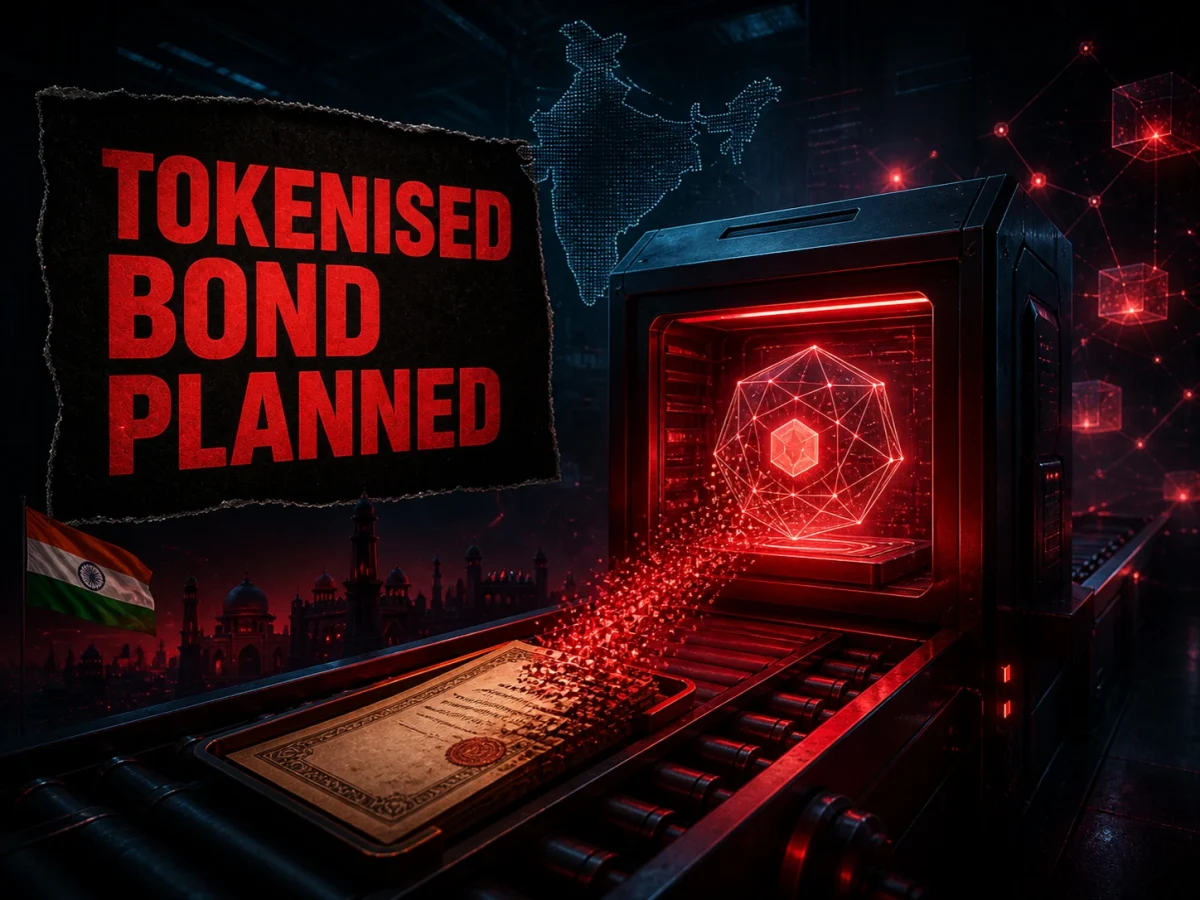
India is preparing to launch its first tokenised corporate bond issue in September 2026, marking a significant step in the country’s experiment with blockchain-based securities and faster settlement. State-owned power financier REC is expected to become the first issuer under the pilot, with the bonds valued at less than ₹500 crore, or about $57 million. The initiative is being developed jointly by India’s market regulator and central bank and is intended to test whether distributed-ledger technology can make bond issuance and settlement faster and more efficient.
The pilot will use India’s central bank digital currency (CBDC) to purchase the tokenised bonds, while investors will need both a wholesale digital-currency wallet and a new electronic securities wallet. Indian depositories are developing the securities wallet, referred to as “DEMAT 2.0,” which will record bond holdings on a distributed ledger. The initial offering will be limited to selected investors, with a three-month lock-in and a potential secondary market expected to be developed by December 2026.
India Moves Toward Blockchain-Based Corporate Bonds
Tokenised bonds are conventional financial securities represented digitally on a blockchain or distributed ledger. Instead of relying entirely on separate systems for issuance, ownership records, trading and settlement, tokenisation can allow these functions to be recorded and processed on a shared digital infrastructure.
The Indian pilot is intended to test whether that architecture can enable near-instant settlement while reducing the reconciliation and administrative work involved in conventional bond transactions. The Securities and Exchange Board of India (SEBI) has been exploring tokenisation as a way to improve settlement speed, transparency and traceability in the corporate bond market.
REC to Lead the First Pilot
REC, formerly known as Rural Electrification Corporation, is expected to issue the first tokenised corporate bonds under the programme. The proposed issue will be below ₹5 billion, making it a relatively small transaction compared with the overall Indian corporate bond market.
The limited size is consistent with the project’s status as a pilot. Regulators can use a controlled issue to test the technology, investor onboarding, settlement mechanism and digital-wallet infrastructure before considering a wider rollout.
| Key Detail | Proposed Pilot |
|---|---|
| First expected issuer | REC |
| Issue type | Tokenised corporate bonds |
| Expected launch | September 2026 |
| Issue size | Below ₹500 crore |
| Approx. U.S. dollar value | Below $57 million |
| Settlement technology | Blockchain / distributed ledger |
| Purchase mechanism | Wholesale CBDC |
| Initial investors | Selected investors |
| Initial lock-in | 3 months |
| Expected secondary market | December 2026 |
| Conventional bond platform | Not to be used |
The final issuer, investor list and detailed framework had not been publicly disclosed at the time of the report, and the central bank, market regulator and REC had not responded to requests for comment.
How Tokenised Bonds Will Work
The proposed system connects the securities side of the transaction with the cash side. Investors will need two compatible digital accounts: one for the wholesale central bank digital currency and another for holding the tokenised securities.
The structure is intended to allow the digital money and digital security to move together rather than requiring multiple intermediaries and reconciliation steps.
INVESTOR
   │
   ├───────────────┐
   ↓               ↓
Wholesale CBDC   DEMAT 2.0
Wallet           Securities Wallet
   │               │
   └───────┬───────┘
           ↓
   Tokenised Corporate Bond
           ↓
 Distributed Ledger Record
           ↓
 Faster / Near-Instant Settlement
This model is particularly important because settlement is one of the areas where tokenisation could produce measurable efficiency gains. SEBI has said its pilot will examine faster settlement, improved traceability, automated servicing and greater transparency.
What Is DEMAT 2.0?
The proposed DEMAT 2.0 wallet would serve as the securities side of the tokenised transaction. Unlike a conventional demat account, the pilot wallet is designed to record bond ownership on distributed-ledger technology.
Subsequent trades would reportedly be restricted to participants holding compatible CBDC and securities wallets. This creates a closed digital ecosystem for the pilot rather than immediately connecting tokenised bonds with India’s conventional bond-trading infrastructure.
SEBI and RBI Are Working Together
The pilot represents a joint effort involving India’s securities-market regulator and central bank.
SEBI Chairman Tuhin Kanta Pandey had previously said the regulator was considering a pilot to determine whether corporate-bond tokenisation could deliver faster settlement, better traceability, automated servicing and greater transparency. In August, SEBI officials reiterated that the pilot would explore whether shared-ledger technology could enable simultaneous movement of securities and money and reduce reconciliation costs.
The RBI’s involvement is particularly important because the proposed cash leg will use India’s wholesale CBDC. This means the experiment is not simply about putting bonds on a blockchain; it is also testing how tokenised securities can interact with central-bank digital money.
The Corporate Bond Market Provides a Large Test Case
The potential impact of tokenisation becomes clearer when compared with the size of India’s corporate bond market.
SEBI’s proposal is aimed at improving the existing market rather than creating a separate parallel bond market. The regulator has emphasized accessibility, transparency and efficiency as key objectives of the tokenisation experiment.
| Area | Conventional Process | Tokenised Model Being Tested |
|---|---|---|
| Ownership record | Traditional securities infrastructure | Distributed ledger |
| Cash settlement | Existing payment rails | Wholesale CBDC |
| Securities wallet | Conventional demat account | Proposed DEMAT 2.0 |
| Settlement | Multiple processing steps | Near-instant settlement target |
| Reconciliation | Required between systems | Potentially reduced |
| Coupon servicing | Conventional processing | Potential smart-contract automation |
| Trading venue | Existing bond platforms | Dedicated pilot infrastructure |
The objective is not necessarily to replace the existing system immediately. Instead, regulators are testing whether distributed-ledger technology can improve specific parts of the existing infrastructure.
Faster Settlement Is a Major Goal
A conventional securities transaction involves several parties and systems that must confirm the transfer of money and ownership. This can create reconciliation requirements and operational delays.
Tokenisation can potentially bring those processes onto a shared ledger. If both the cash and securities legs are represented digitally, the transaction can theoretically be completed simultaneously.
This is commonly described as delivery versus payment, or DvP.
TRADITIONAL MODEL

Buyer → Payment System → Intermediaries
                         ↓
                   Reconciliation
                         ↓
Seller ← Securities System ← Depository


TOKENISED MODEL

      Buyer
        ↓
   Digital CBDC
        ↘
      Shared
     Ledger
        ↗
 Digital Bond
        ↓
      Seller

        ↓
 Simultaneous Settlement
For corporate bonds, faster settlement could reduce counterparty exposure and operational complexity while potentially improving liquidity. However, the pilot will need to establish whether those theoretical benefits work reliably under actual market conditions.
Smart Contracts Could Automate Bond Servicing
Tokenisation can also be used beyond the initial purchase and settlement of a security.
SEBI has said the pilot will examine the possibility of automating coupon payments and other bond-servicing events using smart contracts.
A smart contract can be programmed to execute a predefined action when specified conditions are met. For a bond, this could potentially include calculating and distributing interest payments according to the terms encoded into the digital security.
Bond Issued
    ↓
Coupon Date Reached
    ↓
Smart Contract Verifies Conditions
    ↓
CBDC Payment Triggered
    ↓
Eligible Investor Receives Payment
Such automation could reduce manual processing, although the reliability of the underlying code, legal enforceability and handling of exceptional situations would remain important considerations.
Three-Month Lock-In Limits the Initial Experiment
The first tokenised bonds are expected to carry a three-month lock-in period. This means investors participating in the initial issue would not immediately have unrestricted secondary-market liquidity.
The restriction gives regulators time to test the primary issuance and settlement infrastructure before opening a broader trading environment.
Exchanges are expected to develop a secondary market for the tokenised securities by December, according to sources cited by Reuters. The securities will not initially trade through the conventional electronic book provider platform.
Expected Pilot Timeline
| Stage | Expected Timing |
|---|---|
| Regulatory and infrastructure preparation | 2026 |
| First tokenised REC bond | September 2026 |
| Initial investor lock-in | 3 months |
| Potential secondary market | December 2026 |
| Broader assessment | Following pilot |
The timeline remains subject to the final framework and implementation decisions because the initiative is still at the pilot stage.
Why CBDC Integration Matters
The use of India’s wholesale CBDC makes the experiment broader than a conventional blockchain securities project.
A tokenised bond needs a corresponding method for transferring value. If the cash leg continues to rely on traditional systems, some of the efficiency gained through tokenised securities can be lost.
By using the wholesale CBDC, the pilot can test whether digital central-bank money can function alongside tokenised securities in a regulated financial-market environment.
This could eventually provide a foundation for more sophisticated forms of delivery-versus-payment settlement across bonds and other financial assets.
India Joins a Growing Global Experiment
India is not the first market to explore tokenised bonds. Financial institutions and regulators in Europe and Hong Kong have also experimented with blockchain-based issuance and settlement.
The difference for India is the combination of tokenised securities with its wholesale CBDC infrastructure. The pilot therefore brings together two major strands of financial-market modernization: digital securities and central-bank digital money.
If successful, the approach could strengthen India’s position as a technology-driven financial market while providing a practical use case for distributed-ledger technology beyond cryptocurrencies.
What the Pilot Could Mean for Investors
For investors, tokenised bonds could eventually offer faster settlement, more transparent ownership records and potentially easier access to secondary-market liquidity.
However, the first issue will be limited to selected participants, meaning retail investors are unlikely to gain immediate access. The pilot is primarily designed to test infrastructure rather than democratize corporate bond investing from day one.
The eventual benefits will depend on whether tokenisation can lower costs and improve market efficiency without introducing new technological, cybersecurity or operational risks.
Key Opportunities and Challenges
| Potential Benefits | Potential Challenges |
|---|---|
| Faster settlement | Technology reliability |
| Lower reconciliation costs | Cybersecurity risks |
| Better transaction traceability | Limited initial liquidity |
| Automated coupon payments | Regulatory complexity |
| Transparent ownership records | Integration with existing systems |
| CBDC-based settlement | Need for compatible wallets |
| Potentially lower operational costs | Scalability |
The pilot will therefore need to demonstrate more than technical functionality. Regulators will also need to assess whether the system can operate securely, efficiently and at sufficient scale.
The Bigger Picture
India’s planned tokenised corporate bond issue represents an important experiment in bringing blockchain technology into the regulated financial system. By combining a tokenised REC bond with the wholesale CBDC and a new securities wallet, regulators are testing an end-to-end digital settlement model rather than simply putting ownership records on a blockchain.
The significance could extend well beyond the initial ₹500 crore pilot. If the system successfully delivers faster settlement, automated servicing and lower reconciliation costs, tokenisation could eventually become part of India’s broader corporate-bond infrastructure. The challenge will be proving that these benefits can be achieved securely and economically at much larger volumes.
Looking Ahead
The immediate focus will be on the September pilot, the onboarding of selected investors and the performance of the two-wallet structure. The three-month lock-in will give regulators time to test the system before a potential secondary market is introduced in December. The experience will also help determine whether the proposed DEMAT 2.0 architecture can support trading and settlement beyond the initial issue.
Over the longer term, the success of the experiment could influence how India approaches tokenisation across other securities and financial assets. If CBDC-based delivery-versus-payment works effectively alongside distributed-ledger securities, the pilot could become an important building block for a faster, more automated and digitally native Indian bond market.
Get the day’s top stories in your inbox
One concise email. No spam, unsubscribe anytime.


