
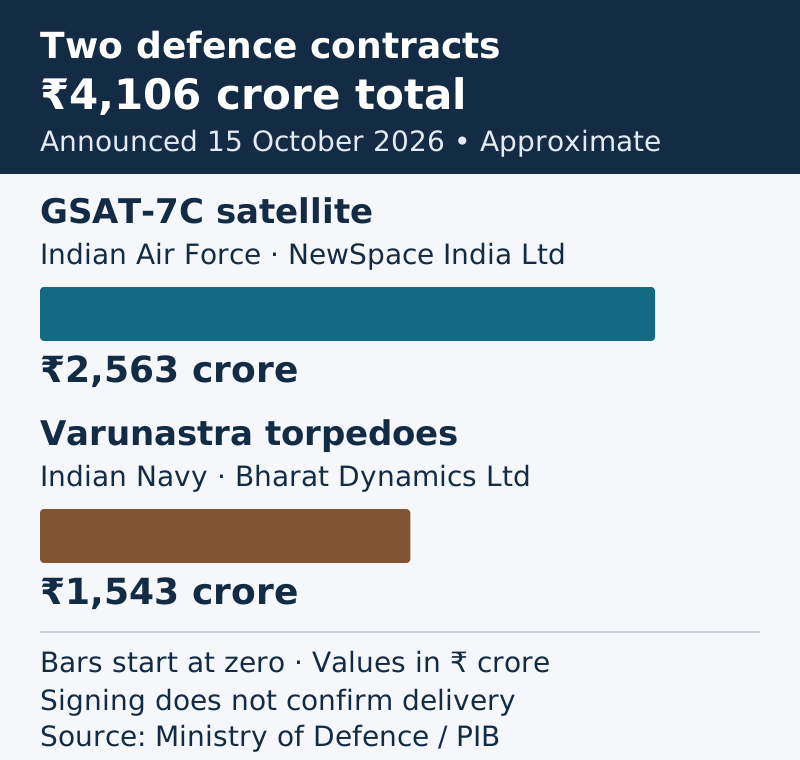
India’s Ministry of Defence has signed contracts worth approximately ₹4,106 crore for a dedicated GSAT-7C communication satellite for the Indian Air Force (IAF) and Varunastra heavy-weight torpedoes for the Indian Navy. Announced on October 15, 2026, the agreements cover ₹2,563 crore for the satellite programme and ₹1,543 crore for the torpedoes. Both contracts have been awarded to Indian public sector enterprises and are intended to strengthen the country’s military capabilities while supporting domestic defence manufacturing.
The satellite contract was signed with NewSpace India Limited (NSIL), the commercial arm of the Indian Space Research Organisation (ISRO), while the torpedo contract went to Bharat Dynamics Limited (BDL). GSAT-7C is expected to improve secure and resilient communications among IAF assets, while Varunastra will strengthen the Navy’s ability to detect and engage submarines. The agreements align with India’s broader push to develop critical defence technologies domestically and reduce dependence on foreign suppliers.
Key Takeaways
- Total contract value: Approximately ₹4,106 crore across two defence agreements.
- GSAT-7C satellite: ₹2,563 crore contract awarded to NewSpace India Limited for the Indian Air Force.
- Varunastra torpedoes: ₹1,543 crore contract awarded to Bharat Dynamics Limited for the Indian Navy.
- Communications capability: GSAT-7C is designed to improve secure, resilient and seamless communications for IAF assets.
- Anti-submarine warfare: Varunastra is an indigenously developed, ship-launched heavy-weight torpedo.
- Domestic manufacturing: Both contracts support India’s effort to build defence technology and production capabilities at home.
- Strategic significance: The agreements strengthen military communications and undersea warfare capabilities, two important areas of modern defence.
India Signs ₹4,106 Crore Defence Contracts
The Ministry of Defence signed the two agreements in New Delhi on October 15, 2026, in the presence of A. Anbarasu, Additional Secretary and Director General (Acquisition) in the Department of Defence.
The contracts are divided between satellite communications and underwater weapons, reflecting different operational requirements of the Indian armed forces.
| Defence programme | Contract value | Supplier | Primary user |
|---|---|---|---|
| GSAT-7C communication satellite | ₹2,563 crore | NewSpace India Limited | Indian Air Force |
| Varunastra heavy-weight torpedoes | ₹1,543 crore | Bharat Dynamics Limited | Indian Navy |
| Total | ₹4,106 crore | Two Indian public sector enterprises | Armed forces |
The combined value of the agreements represents investment in two different layers of military capability. Satellite communications help armed forces exchange information across geographically dispersed units, while torpedoes provide a means of engaging underwater threats.
The contracts also create business for Indian defence and space-sector organisations. Their execution will depend on programme development, production, testing and delivery requirements.
GSAT-7C: A Dedicated Communication Satellite for the Indian Air Force
The larger of the two contracts, valued at ₹2,563 crore, covers GSAT-7C, a communication satellite programme for the Indian Air Force.
The satellite is intended to provide secure, resilient and seamless communications for IAF assets. Such communications can support coordination between aircraft, airbases, ground stations and other military systems operating across wide distances.
Military satellite communications are important because conventional radio and line-of-sight links may not provide adequate connectivity across every operational environment. Satellite-based systems can extend communication coverage and help connect units that are separated geographically.
Why Secure Military Communications Matter
Modern air operations depend on the timely exchange of information. Aircraft, ground-based radar installations, command centres and airborne surveillance platforms may need to share information to coordinate activities.
A dedicated satellite communications capability can help provide a more resilient communications network for these assets. It can also reduce reliance on systems that were not designed specifically for military operational requirements.
Security and resilience are particularly important in a contested environment, where communication links may face interference, disruption or other threats. The Ministry of Defence says GSAT-7C will strengthen the IAF’s operational effectiveness through improved connectivity.
However, the contract announcement does not provide a confirmed launch date, detailed technical specifications or a full deployment timetable for GSAT-7C. Those details should not be assumed from the signing of the agreement alone.
India’s Military Space Capabilities
GSAT-7C is part of India’s wider effort to develop dedicated space-based infrastructure for its armed forces. Satellite communications can provide operational advantages by connecting units across large areas and supporting coordination beyond the range of conventional terrestrial links.
India has pursued separate satellite capabilities for the Navy, Air Force and Army. These systems serve different operational needs, from maritime communications to air operations and land-based military networks.
Developing such systems domestically can also support India’s space industry, including satellite engineering, manufacturing, ground systems and related technology services. The extent of the domestic industrial benefit will depend on the programme’s execution and the participation of Indian suppliers.
Varunastra Torpedoes: Strengthening the Indian Navy’s Anti-Submarine Warfare
The second contract, worth ₹1,543 crore, was signed with Bharat Dynamics Limited for Varunastra heavy-weight torpedoes. Developed by the Naval Science and Technological Laboratory (NSTL), a defence research laboratory, Varunastra is an indigenously designed, ship-launched anti-submarine torpedo.
The weapon is designed to engage submarines at long ranges and has advanced manoeuvring capabilities. Its role is to improve the Navy’s ability to respond to underwater threats.
Submarines can operate covertly and remain difficult to detect, making anti-submarine warfare an important part of maritime security. Navies use a combination of sensors, patrol aircraft, helicopters, surface ships and underwater systems to locate and respond to submarine activity.
Why Heavy-Weight Torpedoes Matter
Heavy-weight torpedoes are among the weapons used by naval platforms to engage submarines. Their effectiveness depends on a range of factors, including detection, targeting information, platform integration, weapon reliability and the operating environment.
Varunastra’s indigenous development is significant because it gives India a domestic source for a specialised naval weapon system. Local production can help support maintenance, technical expertise and the development of a domestic supply chain.
The contract will provide further orders for Bharat Dynamics, a public sector defence manufacturer that produces guided weapons and other military systems. The scale of the order is relevant to the company’s defence manufacturing business, although the financial impact will depend on delivery schedules, production costs and contract execution.
The Ministry of Defence has not specified in its announcement the delivery schedule or the number of torpedoes covered by the new contract.
What the Contracts Mean for India’s Defence Industry
The two agreements demonstrate how defence procurement can support domestic industrial capabilities in different technology areas.
The satellite programme involves India’s space and communications ecosystem, while the torpedo programme draws on defence research, naval systems engineering and specialised weapons manufacturing. Both require technical expertise and coordination across multiple stages of development and production.
Domestic procurement can offer several potential benefits. It may reduce reliance on overseas suppliers, help retain technical knowledge within India and create opportunities for local companies involved in components, testing, software and support services.
However, domestic production does not automatically mean that every component is sourced locally or that a programme is free from supply-chain risks. The degree of localisation and the extent of technology ownership vary by programme.
For the GSAT-7C and Varunastra contracts, the government’s stated objective is to strengthen indigenous defence capabilities under its Aatmanirbhar Bharat and Make in India initiatives.
Opportunities for Public Sector Defence Companies
NewSpace India Limited serves as the commercial arm of India’s space programme, while Bharat Dynamics Limited manufactures defence equipment and weapon systems. The contracts reinforce the role of public sector enterprises in delivering specialised systems for the armed forces.
For suppliers, defence contracts can provide production visibility and support investment in manufacturing capacity. They may also create opportunities to develop specialised skills and expand relationships with research institutions and other suppliers.
The benefits depend on timely delivery, quality control, successful testing and the ability to manage costs. Defence programmes often involve complex technical requirements, so execution remains as important as the initial contract announcement.
How the Agreements Fit India’s Strategic Priorities
The contracts address two distinct defence priorities: reliable communications for air operations and stronger anti-submarine warfare capability at sea.
The satellite programme can help improve the connectivity needed for coordinated air operations. The torpedo programme strengthens the Navy’s ability to respond to underwater threats. Together, the agreements support India’s effort to modernise military systems while expanding domestic manufacturing.
The strategic context includes a growing emphasis on information sharing, surveillance, secure communications and the protection of maritime approaches. As military operations become more networked, communications infrastructure and specialised weapons increasingly form parts of a wider operational system.
The agreements are not, by themselves, evidence of a change in India’s military posture. They are procurement decisions intended to strengthen existing capabilities and address operational requirements.
The Bigger Picture
India’s ₹4,106 crore contracts for GSAT-7C and Varunastra reflect the growing importance of domestic capabilities in military communications and undersea warfare. The ₹2,563 crore satellite agreement supports the Indian Air Force’s dedicated communication infrastructure, while the ₹1,543 crore torpedo contract strengthens the Navy’s anti-submarine warfare inventory. Both programmes rely on Indian public sector enterprises and indigenous technology development.
The wider significance lies in building the ability to design, produce and support sophisticated defence systems within the country. Such programmes can strengthen supply chains and technical expertise, but their success depends on delivery, integration, reliability and lifecycle support. The next milestones will be the progress of satellite development and the production and supply of the contracted torpedoes.
What Happens Next?
The immediate next steps involve programme execution, including development and delivery milestones for GSAT-7C and production and supply arrangements for Varunastra. The Ministry of Defence’s announcement does not specify a final launch date for the satellite or a delivery schedule and quantity for the torpedoes, so further official updates will be needed to establish those timelines.
Investors and industry observers will watch how the contracts translate into revenue and production activity for NewSpace India Limited and Bharat Dynamics Limited. From a strategic perspective, the key test will be whether the programmes deliver reliable systems that improve the armed forces’ operational capabilities while building sustainable domestic expertise. Contract signing marks the beginning of that process, rather than its completion.
Frequently Asked Questions
1. What is the total value of India’s GSAT-7C and Varunastra contracts?
The Ministry of Defence signed contracts worth approximately ₹4,106 crore: ₹2,563 crore for GSAT-7C and ₹1,543 crore for Varunastra torpedoes.
2. What is GSAT-7C used for?
GSAT-7C is a dedicated communication satellite programme for the Indian Air Force. It is intended to improve secure, resilient and seamless communications among IAF assets.
3. What is the Varunastra torpedo?
Varunastra is an indigenously developed, ship-launched heavy-weight anti-submarine torpedo designed to engage submarines at long ranges.
4. Which companies received the contracts?
NewSpace India Limited received the ₹2,563 crore GSAT-7C contract, while Bharat Dynamics Limited received the ₹1,543 crore Varunastra contract.
Get the day’s top stories in your inbox
One concise email. No spam, unsubscribe anytime.


