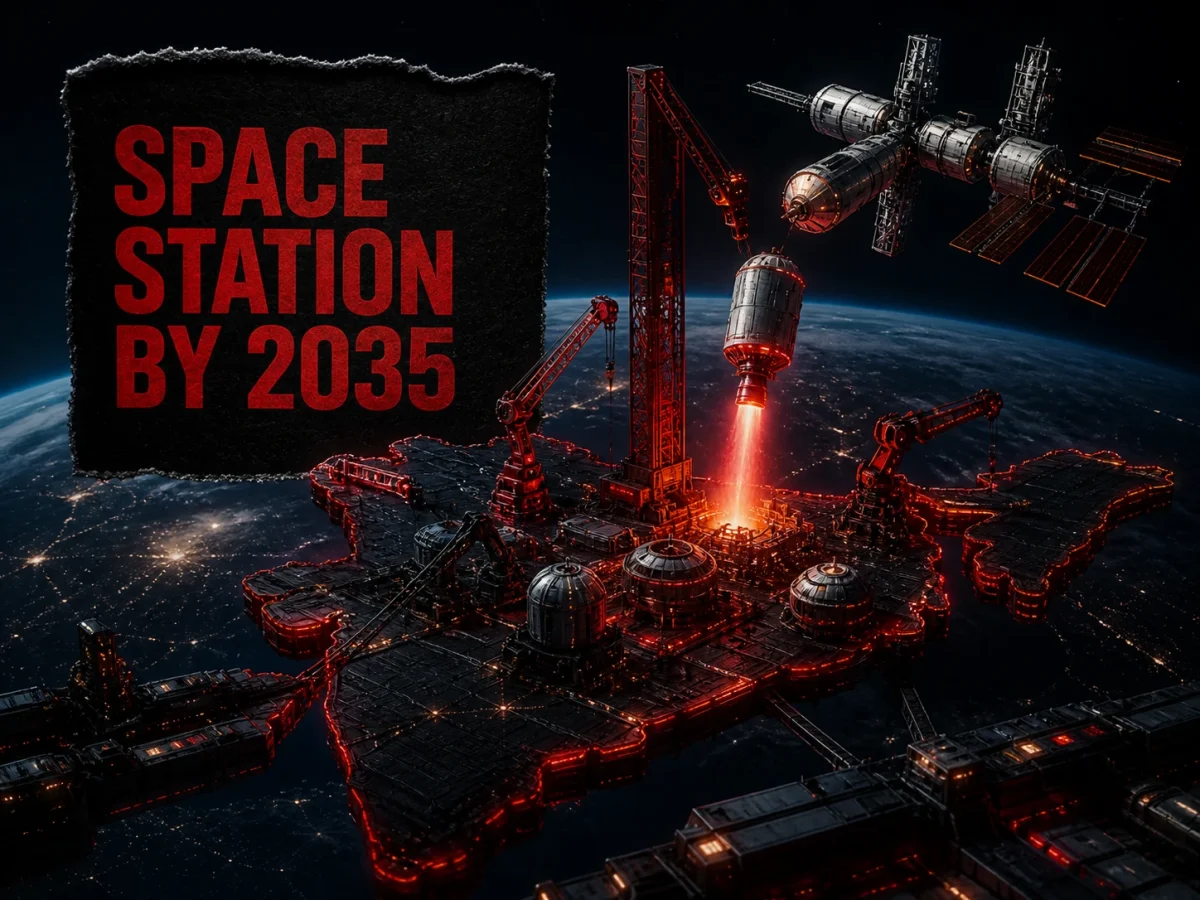
India is moving toward a major new phase in human spaceflight, with the Indian Space Research Organisation (ISRO) targeting the establishment of the Bharatiya Antariksh Station (BAS) by 2035. ISRO Chairman V. Narayanan reiterated the target on August 23, 2026, saying the first module of the proposed station has already been approved. The announcement came during celebrations of India’s third National Space Day in Ahmedabad.
The space station is part of India’s broader Space Vision 2047, which links sustained human presence in low-Earth orbit with a planned crewed lunar landing by 2040. ISRO’s current roadmap calls for the first BAS module to be launched by 2028, followed by phased assembly of the full station by 2035. The program will build on technologies being developed through Gaganyaan, spacecraft docking, life-support systems and next-generation launch vehicles.
India’s Bharatiya Antariksh Station Plan
The Bharatiya Antariksh Station is envisioned as India’s own modular space station in low-Earth orbit. Rather than launching the entire facility in one mission, ISRO plans to assemble it progressively from multiple modules.
Government documents have previously stated that the station’s architecture was still being studied, including the number and type of modules and docking ports. The station is therefore better understood as a phased national program than as a single spacecraft with a finalized configuration.
ISRO’s 2025-26 annual report, however, identifies three major milestones: launching the first BAS module by 2028, establishing the complete BAS by 2035 and achieving an Indian crewed lunar landing by 2040.
Key BAS Milestones
| Milestone | Target |
|---|---|
| First BAS module | 2028 |
| Complete Bharatiya Antariksh Station | 2035 |
| Indian crewed lunar landing | 2040 |
| Next Generation Launch Vehicle development | 2032 |
| Chandrayaan-4 | 2027 target |
| Venus Orbiter Mission | 2028 target |
| Third Launch Pad | 4-year implementation period |
These milestones show that the space station is being developed as part of a much larger human-spaceflight and deep-space exploration strategy rather than as an isolated project.
First Module Is Already Moving Toward Hardware
The BAS program has progressed beyond a purely conceptual stage. In January 2026, ISRO’s Vikram Sarabhai Space Centre issued an Expression of Interest seeking Indian aerospace industry partners for the development and realization of the structure for the first BAS module, known as BAS-01.
The procurement document describes BAS-01 as a structure measuring approximately 3.8 meters in diameter and 8 meters in height. It calls for the development and realization of two sets of the structure and includes advanced manufacturing and welding requirements.
The involvement of domestic industrial partners is significant because a space station requires manufacturing capabilities that extend beyond conventional satellite production.
BAS-01 Structure Requirements
| Parameter | Current ISRO Requirement |
|---|---|
| Module | BAS-01 |
| Diameter | 3.8 meters |
| Height | 8 meters |
| Material | AA-2219 aluminum alloy |
| Structures sought | 2 sets |
| Manufacturing | Complex aerospace fabrication |
| Welding technologies | GTAW, FSW and EBW |
| Lead organization | Vikram Sarabhai Space Centre |
| Industry participation | Indian aerospace manufacturing partners |
The procurement process indicates that ISRO is working on actual station hardware while simultaneously developing the wider architecture and supporting technologies.
Gaganyaan Is The First Major Building Block
India’s space station ambitions are closely connected to Gaganyaan, the country’s human spaceflight program. Before astronauts can spend extended periods aboard an Indian orbital station, India needs to demonstrate reliable human-rated launch systems, crew safety, orbital operations and recovery capabilities.
ISRO says Gaganyaan is intended to lay the foundation for India’s long-term human space exploration program. The organization is also developing technologies for sustained human missions, including regenerative life-support systems, rendezvous and docking, space robotics and human-factors engineering.
This creates a technology chain in which each program contributes to the next.
India’s Human Spaceflight Roadmap
Gaganyaan
↓
Human-rated launch and crew systems
↓
Orbital rendezvous and docking
↓
BAS-01 launch
↓
Additional station modules
↓
Bharatiya Antariksh Station by 2035
↓
Crewed lunar mission target by 2040
The successful development of docking technology is particularly important because a modular station cannot be assembled efficiently without spacecraft being able to rendezvous and connect safely in orbit.
Space Station To Become A National Research Laboratory
BAS is expected to serve purposes beyond keeping astronauts in orbit. ISRO describes the planned station as a national space laboratory capable of supporting multidisciplinary microgravity research.
Potential research areas include science, technology, medicine, agriculture and space manufacturing. The station is also expected to provide a platform for national and international collaboration and contribute to India’s broader space economy.
Microgravity can provide researchers with an environment that is difficult or impossible to reproduce on Earth. Experiments in such an environment can help researchers study biological processes, materials and physical phenomena under reduced gravity.
ISRO has already begun preparing India’s research community for this future. Its IMEx-2026 initiative invited Indian researchers to propose microgravity experiments that could eventually receive opportunities for flight in low-Earth orbit, including aboard BAS.
Potential Uses Of BAS
| Area | Potential Role |
|---|---|
| Scientific research | Microgravity experiments |
| Medicine | Research into biological and medical processes |
| Agriculture | Studying biological systems in microgravity |
| Technology | Testing space technologies |
| Manufacturing | Demonstrating space-based production |
| Earth observation | Observational research from orbit |
| International cooperation | Joint experiments and missions |
| Lunar exploration | Technology and operational preparation |
New Launch Infrastructure Will Be Critical
A station requiring repeated module launches will put greater demands on India’s launch infrastructure. The government has therefore linked the country’s future heavy-lift requirements to the BAS and lunar exploration programs.
The planned Third Launch Pad at Sriharikota has been approved with an estimated expenditure of ₹3,984.86 crore and a targeted construction period of 48 months. ISRO says the facility will support higher launch frequencies and future human-spaceflight missions.
The infrastructure is particularly important because India’s existing launch pads were designed around current launch systems. The government’s space roadmap calls for heavier next-generation vehicles capable of supporting the requirements of BAS and future crewed lunar missions.
The Economic And Industrial Impact
The space station program could expand India’s domestic space manufacturing ecosystem. Building a modular orbital facility requires structural manufacturing, propulsion, avionics, life-support equipment, electronics, robotics, docking systems and specialized materials.
Greater participation from private companies could therefore become an important part of the program. ISRO’s BAS-01 procurement already seeks participation from experienced Indian aerospace manufacturers, while India’s broader Space Vision 2047 emphasizes increasing private-sector participation in space activities.
The program could also create demand for technologies that have applications beyond space, including advanced materials, precision manufacturing, autonomous robotics, sensors and life-support systems.
India’s Space Vision Extends Beyond 2035
The space station is only one component of India’s long-term exploration strategy. The government’s Space Vision 2047 includes the development of a next-generation launch vehicle, lunar sample-return missions, a Venus mission and eventually a crewed Moon landing.
ISRO’s annual report identifies the full BAS by 2035 and an Indian lunar landing by 2040 as two major milestones. It also identifies the Next Generation Satellite Launch Vehicle, Chandrayaan-4 and the Venus Orbiter Mission among the programs supporting the broader roadmap.
This means the station is expected to function as a bridge between India’s initial human spaceflight missions and more ambitious deep-space operations.
The Bigger Picture
India’s 2035 space-station target represents a shift from visiting space to maintaining a sustained national presence in orbit. The Bharatiya Antariksh Station is being developed alongside human-rated spacecraft, docking technology, research programs, industrial manufacturing and new launch infrastructure. Together, these projects could give India a much broader capability in human spaceflight and orbital research.
The program also has implications for India’s emerging commercial space sector. A national orbital laboratory could create opportunities for private companies, universities and research institutions to develop experiments, hardware and services for use in space. If the roadmap remains on schedule, BAS could become one of the country’s most important technology and science platforms during the next decade.
Looking Ahead
The immediate milestone is the first BAS module, targeted for launch by 2028. Before reaching that point, India must continue advancing Gaganyaan, human-rated launch systems, docking technologies, life-support systems and the manufacturing infrastructure required for orbital hardware. The development of BAS-01 and the planned Third Launch Pad indicate that several parts of this ecosystem are already moving forward.
By 2035, the objective is to move from individual human-spaceflight missions to a sustained Indian presence in low-Earth orbit. If ISRO achieves that milestone, the Bharatiya Antariksh Station could serve not only as India’s first national space station but also as a stepping stone toward the country’s planned crewed lunar mission in 2040 and its broader Space Vision 2047.
Get the day’s top stories in your inbox
One concise email. No spam, unsubscribe anytime.


