India’s private space sector has taken another step toward in-orbit satellite servicing, after Bengaluru-based deep-tech startup Aule Space successfully tested its relative guidance, navigation and control (GNC) technology at the ISRO Rendezvous Simulation Laboratory (RSL).
The startup says it is the first private company to access and test its technology at the facility. The successful demonstration has taken Aule Space’s technology to Technology Readiness Level 6 (TRL-6), meaning the system has been demonstrated in a relevant simulated environment.
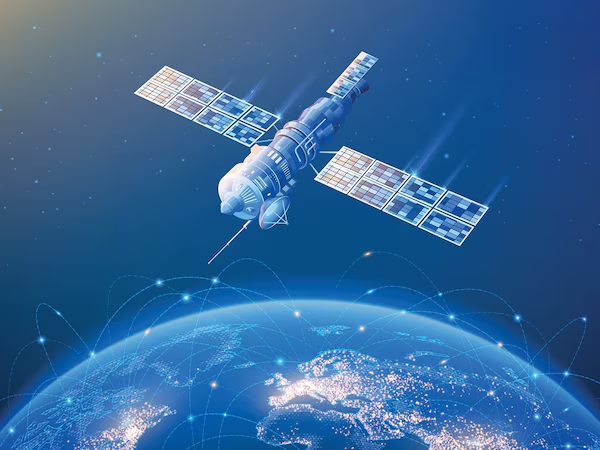
Aule Space is developing autonomous spacecraft that could function as “tow trucks” for satellites—approaching failed, tumbling or otherwise non-cooperative spacecraft, attaching to them and potentially moving or stabilising them in orbit.
Aule Space tests satellite “tow truck” technology
The startup’s latest milestone centres on its relative GNC stack, a critical technology required for spacecraft to safely approach another object in orbit.
Aule Space tested the system at ISRO’s Rendezvous Simulation Laboratory, which is designed to reproduce the relative motion between a spacecraft approaching a target.
The startup said the test demonstrated its autonomous navigation capabilities in a simulated space environment and took the technology to TRL-6.
AULE SPACE TECHNOLOGY

Relative GNC
     ↓
Understand target spacecraft
     ↓
Determine position + velocity + rotation
     ↓
Plan autonomous approach
     ↓
Proximity operations
     ↓
Potential docking / capture
     ↓
Satellite servicing
The achievement is important because autonomous rendezvous and proximity operations are among the most technically demanding capabilities needed for future satellite servicing missions.
What is a space “tow truck”?
A space tow truck is essentially a servicing spacecraft designed to approach another spacecraft and help it after launch.
The target satellite could have:
- Run out of fuel
- Lost communications
- Suffered a technical failure
- Entered an undesirable orbit
- Begun tumbling
- Reached the end of its useful life
Instead of abandoning the spacecraft, a servicing vehicle could potentially approach it, attach itself and use its own propulsion system to alter the target’s orbit.
FAILED SATELLITE
      ↓
Servicing spacecraft approaches
      ↓
Autonomous navigation
      ↓
Capture / docking
      ↓
Servicer attaches
      ↓
Provides propulsion
      ↓
Satellite repositioned
Aule Space is specifically working on spacecraft capable of dealing with non-cooperative targets, including satellites that may be tumbling or unable to communicate.
Why autonomous navigation is so important
The test fits a wider opening of Indian space infrastructure to industry, including the ₹986-crore Kulasekarapattinam launch complex being handed to a private operator.
A servicing spacecraft cannot simply fly toward another satellite like a car approaching a stationary vehicle.
Both objects are moving rapidly through orbit.
The servicing spacecraft must continuously understand the target’s:
- Position
- Velocity
- Rotation
- Relative movement
- Orientation
Aule Space’s GNC technology is intended to solve this problem.
CHASER SPACECRAFT
       ↓
     Sensors
       ↓
Computer vision
       +
Navigation algorithms
       ↓
Target position
       +
Target velocity
       +
Target rotation
       ↓
Autonomous manoeuvre
The NewsBytes report says the spacecraft would use computer vision and autonomous navigation to determine the target’s position, velocity and rotation before approaching it.
The ISRO test is a major milestone
The test was conducted at ISRO’s Rendezvous Simulation Laboratory, a facility used to test technologies related to spacecraft rendezvous and docking.
Aule Space said the facility was also used for the final docking approach work associated with ISRO’s SpaDeX mission. The laboratory can reproduce the relative motion of a chaser and target spacecraft using robotic systems.
ISRO RENDEZVOUS SIMULATION LAB

       TARGET
          ↑
          │
   Relative motion
          │
          ↓
       CHASER

Simulation reproduces
spacecraft movement
in multiple degrees of freedom
Testing in such an environment allows engineers to evaluate navigation and proximity-operation algorithms before attempting a much more expensive orbital demonstration.
Aule Space becomes first private company to test at the facility
Aule Space says it is the first private company to access and test its technology at ISRO’s Rendezvous Simulation Laboratory.
That is significant for India’s emerging private space ecosystem.
Until recently, advanced rendezvous and docking capabilities were largely associated with government-led space programmes.
The availability of specialised ISRO facilities to private companies can help startups develop sophisticated technologies without having to build every piece of testing infrastructure themselves.
ISRO CAPABILITIES
       +
PRIVATE STARTUP
       ↓
Shared testing infrastructure
       ↓
Faster technology development
       ↓
Orbital demonstration
       ↓
Commercial space services
What does TRL-6 mean?
Technology Readiness Level 6 generally means a technology has been demonstrated in a relevant environment.
It is an important step above laboratory-level proof of concept, but it does not mean the technology is ready for commercial orbital operations.
A simplified progression looks like this:
| Stage | Meaning |
|---|---|
| TRL 1–2 | Basic concept / early research |
| TRL 3 | Experimental proof of concept |
| TRL 4 | Tested in laboratory |
| TRL 5 | Tested in a relevant environment |
| TRL 6 | Demonstrated in a relevant simulated environment |
| TRL 7 | Demonstrated in an operational environment |
| TRL 8 | System completed and qualified |
| TRL 9 | Proven in actual operation |
Aule Space’s latest achievement therefore represents an important development milestone, but the company still needs to progress toward an actual orbital demonstration.
From simulation to actual space
The biggest remaining challenge is moving from a controlled simulation to the unpredictability of real orbital operations.
In space, the servicing spacecraft would have to deal with:
- Lighting changes
- Sensor uncertainty
- Communication constraints
- Fuel limitations
- Orbital dynamics
- Target rotation
- Unknown satellite conditions
- Collision risks
SIMULATION
     ↓
Controlled environment
     ↓
TRL-6
     ↓
Hardware development
     ↓
Orbital demonstration
     ↓
Real satellite
     ↓
Commercial servicing
Aule Space has said its latest milestone is a step toward orbital validation.
Aule Space has raised $2 million
The Bengaluru startup has raised $2 million in pre-seed funding, according to NewsBytes.
The capital is being used to support hardware development and eventual orbital validation of its technology.
$2 MILLION FUNDING
        ↓
Hardware development
        ↓
GNC technology
        ↓
Servicing spacecraft
        ↓
Orbital validation
The funding gives the company resources to move beyond software and simulation toward physical spacecraft hardware.
Why satellite servicing matters
Satellites are expensive assets.
A spacecraft can cost millions or even hundreds of millions of dollars to develop, launch and operate.
If a satellite suffers a failure after reaching orbit, replacing it can require another launch.
A servicing spacecraft could potentially extend the life of such assets.
TRADITIONAL

Satellite fails
      ↓
Mission ends
      ↓
Satellite remains in orbit
      ↓
Replacement satellite launched


SERVICING MODEL

Satellite fails
      ↓
Servicing spacecraft
      ↓
Approach + capture
      ↓
Repair / reposition / deorbit
      ↓
Extended mission or safer disposal
This creates a potential new commercial market around in-space servicing.
Satellite servicing can reduce space debris
Space debris is becoming a major concern as the number of spacecraft in orbit increases.
A failed satellite that remains uncontrolled can become a long-term object in orbit.
Servicing spacecraft could potentially help manage some of these objects.
FAILED SPACECRAFT
       ↓
No control
       ↓
Orbital debris risk
       ↓
Servicing spacecraft
       ↓
Capture / reposition
       ↓
Lower debris risk
Aule Space says its technology could eventually help reduce the creation of new debris by enabling failed spacecraft to be handled rather than simply abandoned.
Servicing could also extend satellite life
Not every satellite failure means that the spacecraft is completely unusable.
A satellite could still have functioning communications or payload systems but lack sufficient propulsion to maintain its orbit.
A servicing spacecraft could potentially provide the missing propulsion capability.
SATELLITE
Payload ✓
Communications ✓
Power ✓
Propulsion ✗

        ↓

SERVICING SPACECRAFT
        ↓
Provides propulsion
        ↓
Satellite remains operational
This could be particularly valuable for expensive commercial satellites.
The challenge of non-cooperative satellites
One of Aule Space’s more ambitious goals is servicing non-cooperative targets.
A cooperative satellite can communicate with the servicing vehicle and provide information about its position and orientation.
A failed or tumbling satellite may provide none of that information.
COOPERATIVE TARGET
        ↓
Communicates
        ↓
Known position
        ↓
Easier rendezvous


NON-COOPERATIVE TARGET
        ↓
No communication
        ↓
Unknown state
        ↓
Computer vision
+
Autonomous navigation
        ↓
Much harder rendezvous
This makes autonomous GNC particularly important.
Why computer vision matters
A servicing spacecraft cannot depend entirely on ground controllers.
The spacecraft needs to interpret what its sensors see and make rapid decisions.
Computer vision can help determine the target’s orientation and movement.
CAMERA / SENSORS
       ↓
Visual information
       ↓
Computer vision
       ↓
Target identification
       ↓
Position + orientation
       ↓
Navigation decision
The closer the spacecraft gets to the target, the more important accurate relative navigation becomes.
The final metres are the hardest
Rendezvous operations can become particularly challenging during the final approach.
At this stage, even small navigation errors can create a collision risk.
Aule Space’s testing of the GNC system therefore focuses on the technology required for close-proximity operations.
DISTANT
Satellite
   ↓
Approach
   ↓
Proximity operations
   ↓
Final metres
   ↓
Capture / docking
ISRO’s Rendezvous Simulation Laboratory is designed specifically to help test these types of relative spacecraft motions.
India’s SpaDeX mission provides an important foundation
India has already demonstrated autonomous rendezvous and docking capabilities through ISRO’s SpaDeX mission.
SpaDeX was designed to demonstrate technologies including:
- Orbital rendezvous
- Docking
- Formation flying
- Proximity operations
- Future in-space servicing capabilities
The mission involved two spacecraft, with one acting as the Chaser and the other as the Target.
SpaDeX

SDX01
Chaser
   ↓
Approach
   ↓
Relative navigation
   ↓
Docking
   ↕
SDX02
Target
This technology foundation is relevant to the private sector because satellite servicing depends on many of the same capabilities.
From government demonstration to commercial service
The emergence of companies such as Aule Space could allow India to move from demonstrating docking technology to building commercial services around it.
ISRO
Technology demonstration
        ↓
Private-sector development
        ↓
Aule Space
        ↓
Servicing spacecraft
        ↓
Commercial customers
        ↓
Global in-orbit services
This is one of the broader goals of India’s expanding private space ecosystem.
What could Aule Space’s spacecraft eventually do?
If the technology successfully reaches orbit, servicing spacecraft could potentially perform several functions.
Satellite repositioning
A servicer could alter the orbit of another spacecraft.
Orbit maintenance
It could provide propulsion to help a satellite remain in its intended orbit.
End-of-life disposal
A servicing spacecraft could potentially move a satellite toward a safer disposal orbit.
Debris management
It could potentially interact with selected debris or failed spacecraft.
Life extension
It could help extend the operational life of spacecraft that have exhausted their propulsion systems.
SPACE SERVICING

        Aule Space
            ↓
   ┌────────┼────────┐
   ↓        ↓        ↓
Reposition Maintenance Disposal
   ↓        ↓        ↓
        Life extension
             ↓
       Debris management
These are potential applications rather than services Aule Space is already commercially providing.
The commercial opportunity could be large
As more satellites are launched, the demand for services that keep spacecraft operational could grow.
The market could eventually include:
- Satellite operators
- Communications companies
- Earth-observation companies
- Government agencies
- Defence organisations
- Space stations
- Debris-management operators
MORE SATELLITES
      ↓
More spacecraft in orbit
      ↓
More failures / end-of-life events
      ↓
More servicing demand
      ↓
In-orbit servicing market
For India, developing domestic capabilities could create a new high-value space-services industry.
Why this matters for India’s private space sector
India has been encouraging greater private-sector participation in space.
Startups are increasingly working on:
- Launch vehicles
- Satellites
- Earth observation
- Propulsion
- Space electronics
- In-space manufacturing
- Satellite servicing
Aule Space’s latest test fits into this wider expansion.
INDIA'S PRIVATE SPACE ECOSYSTEM

Launch
   +
Satellites
   +
Propulsion
   +
Earth observation
   +
Space software
   +
In-orbit servicing
   ↓
Broader space economy
The shift means Indian startups are moving beyond simply building satellites for launch.
They are beginning to develop technologies for what happens after a spacecraft reaches orbit.
A new business model: “space infrastructure”
Satellite servicing could eventually become part of a broader space-infrastructure economy.
Instead of each satellite being treated as an isolated spacecraft, operators could rely on a network of services.
LAUNCH
  ↓
ORBIT
  ↓
OPERATE
  ↓
SERVICE
  ↓
REPOSITION
  ↓
EXTEND LIFE
  ↓
DEORBIT
This could make space operations more similar to other infrastructure industries, where maintenance and servicing are built into the lifecycle.
Challenges remain
Despite the successful test, several challenges remain before Aule Space can operate a real tow truck in orbit.
1. Orbital demonstration
The GNC technology still needs to be proven in actual space.
2. Capture mechanism
Approaching a satellite is only part of the problem. The servicer must safely attach to the target.
3. Autonomous safety
The spacecraft must be capable of aborting an approach if navigation becomes uncertain.
4. Target diversity
Satellites come in different shapes, sizes and configurations.
5. Economics
Servicing must be cheaper or more valuable than simply replacing the satellite.
6. Regulation
In-orbit servicing involves complex questions around ownership, consent, liability and space traffic management.
TECHNOLOGY
   +
SAFETY
   +
ECONOMICS
   +
REGULATION
   ↓
Commercial viability
The biggest test will be in orbit
A simulation is a critical step, but actual space operations introduce additional uncertainty.
The next major milestone for Aule Space will therefore be an orbital demonstration.
CURRENT
TRL-6
 ↓
Hardware
 ↓
Flight qualification
 ↓
Launch
 ↓
Orbital test
 ↓
Real target
 ↓
Commercial service
The company has raised funding specifically to support hardware development and eventual orbital validation.
A potential “tow truck” for India’s space economy
The phrase “tow truck” makes the technology easy to understand, but the underlying engineering is extremely sophisticated.
The vehicle must effectively perform a highly precise autonomous operation around another spacecraft moving at orbital velocity.
Simple description:
"Tow truck"

Actual technology:
Sensors
+
Computer vision
+
Relative navigation
+
Guidance algorithms
+
Autonomous control
+
Propulsion
+
Capture mechanism
+
Fault handling
The successful GNC demonstration therefore represents a significant technical milestone.
Why the development is important beyond Aule Space
The importance of the test goes beyond one startup.
If Indian companies can develop reliable autonomous rendezvous and servicing systems, India could eventually participate in a global market for in-space transportation and servicing.
That could include moving satellites, extending spacecraft life, managing debris and supporting future space infrastructure.
Aule Space
    ↓
GNC technology
    ↓
Servicing spacecraft
    ↓
In-orbit operations
    ↓
Indian space services
    ↓
Global customers
Key takeaways
1. Aule Space has successfully tested its relative GNC technology at ISRO’s Rendezvous Simulation Laboratory.
2. The Bengaluru startup says it is the first private company to test its technology at the facility.
3. The technology has reached TRL-6, meaning it has been demonstrated in a relevant simulated environment.
4. Aule Space is developing autonomous spacecraft that could act as “tow trucks” for failed or non-cooperative satellites.
5. The spacecraft would use computer vision and autonomous navigation to determine a target’s position, velocity and rotation before approaching it.
6. Potential applications include satellite life extension, orbit maintenance, repositioning and debris management.
7. Aule Space has raised $2 million in pre-seed funding to support hardware development and eventual orbital validation.
8. The technology still needs to be demonstrated in actual orbit before it can become a commercial satellite-servicing system.
Conclusion
Aule Space’s successful test of its relative guidance, navigation and control technology at ISRO’s Rendezvous Simulation Laboratory is an important milestone for India’s emerging private space industry.
The Bengaluru-based startup has reached TRL-6, demonstrating its autonomous GNC technology in a relevant simulated environment. The company says it is the first private entity to test its technology at the facility.
The technology has a simple description but an extremely complex purpose.
Aule Space wants to build autonomous spacecraft that can effectively act as “tow trucks” in space.
Such a vehicle could approach a satellite that has failed, lost communications, run out of fuel or begun tumbling. Using computer vision and autonomous navigation, it could determine the target’s position, velocity and rotation, approach safely and potentially attach itself to the spacecraft.
Once attached, the servicing vehicle could potentially provide propulsion to alter the satellite’s orbit, maintain its position or help move it toward a safer trajectory.
The long-term applications could be significant.
Instead of treating a failed satellite as an abandoned object, operators could potentially repair, reposition, refuel, extend or safely dispose of spacecraft through dedicated servicing missions.
This could create an entirely new layer of the space economy.
The technology is also particularly relevant as the number of satellites in orbit continues to increase. More spacecraft mean more potential failures, more end-of-life objects and greater pressure to manage orbital debris.
However, Aule Space still has a considerable journey ahead.
TRL-6 is an important milestone, but it is not the same as proving the technology in orbit.
The company must still develop flight-ready hardware, qualify it for launch, conduct an orbital demonstration and prove that the system can safely interact with a real spacecraft.
The economics will also matter.
Satellite servicing only becomes commercially attractive if the cost of sending a servicing spacecraft into orbit is justified by the value of the satellite being protected or the debris-management service being provided.
India’s growing private space ecosystem gives companies such as Aule Space an opportunity to build capabilities around this emerging market.
ISRO has already demonstrated rendezvous and docking through SpaDeX, while startups are now beginning to build commercial technologies that could use similar capabilities for different purposes.
That creates a potentially important transition:
ISRO demonstrates the technology → Indian startups commercialise it → operators eventually buy in-orbit services.
If Aule Space can successfully move from today’s simulated test to an actual orbital demonstration, India’s space industry could gain a new capability that goes beyond launching satellites.
It could begin to service them after they reach space.
And that could turn the idea of a “space tow truck” from a futuristic concept into a real part of India’s commercial space economy.
Frequently Asked Questions
What is a space tow truck?
It is a servicing spacecraft that can approach another satellite in orbit and move it — for example, to reposition a satellite that has failed or to shift one out of a crowded orbit.
What did Aule Space actually test?
It tested its relative guidance, navigation and control (GNC) technology at the ISRO Rendezvous Simulation Laboratory, becoming the first private company to test at that facility.
What does TRL-6 mean?
Technology Readiness Level 6 means the system has been demonstrated in a relevant environment. It is a step along the path from simulation toward an actual flight demonstration, not a finished operational product.
Get the day’s top stories in your inbox
One concise email. No spam, unsubscribe anytime.


