India’s 300 most valuable family businesses have reached a combined valuation of ₹138 lakh crore ($1.46 trillion), according to the 2026 Barclays Private Clients Hurun India Most Valuable Family Businesses List. The combined value is comparable to an economy that would rank around 18th globally, highlighting the enormous scale of family-controlled enterprises in India’s corporate landscape.
The latest ranking also shows that India’s family-business wealth is increasingly being driven by both established industrial groups and newer entrepreneurial families. The Ambani family retained the top position, while the Jindal family recorded one of the strongest increases in value during FY26. Together, India’s largest family businesses continue to play a major role across energy, manufacturing, infrastructure, financial services and consumer industries.
Top 300 Family Businesses Reach $1.46 Trillion
The 300 businesses covered by the latest Hurun ranking are collectively valued at ₹138 lakh crore, equivalent to approximately $1.46 trillion. That scale would place the group among the world’s largest economies if treated as a standalone economic entity.
The figure also represents substantial growth in recent years. Another analysis of the ranking estimates that India’s top family businesses added nearly ₹30 lakh crore in value over two years.
Family Business Wealth Snapshot
| Metric | 2026 |
|---|---|
| Top family businesses | 300 |
| Combined value | ₹138 lakh crore |
| Dollar value | $1.46 trillion |
| Equivalent global economic rank | Around 18th |
| Top family | Ambani |
Ambani Family Retains Top Position
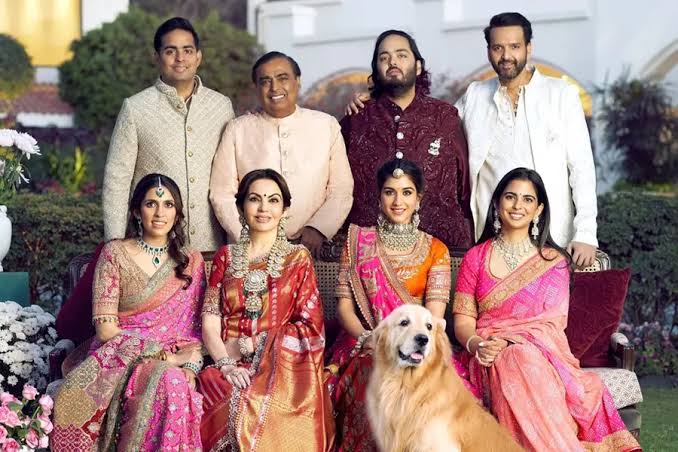
The Ambani family, which controls the Reliance Industries group, remains India’s most valuable business family.
Its estimated value stands at around ₹25.8 lakh crore, although the family’s value declined by approximately 8.5% in the latest assessment. Despite the decline, the Ambanis remain well ahead of other business families.
The group’s businesses span energy, telecommunications, retail, media and consumer sectors, giving the family exposure to some of India’s largest and fastest-growing industries.
Birlas and Jindals Follow
The Birla family ranked second with an estimated value of around ₹8.1 lakh crore, while the Jindal family ranked third at approximately ₹8 lakh crore.
The Jindal family’s rise was particularly notable. Its wealth increased substantially during FY26, with strong performance from businesses connected to heavy industry, engineering and manufacturing.
Leading Family Businesses
| Rank | Family | Approx. Value |
|---|---|---|
| 1 | Ambani | ₹25.8 lakh crore |
| 2 | Birla | ₹8.1 lakh crore |
| 3 | Jindal | ₹8.0 lakh crore |
The three leading families together account for roughly ₹42 lakh crore in value.
Industrial Businesses Drive Value Creation
The scale of these fortunes is also visible in India’s capital markets, where celebrity investors are buying pre-IPO NSE shares, and in consolidation deals such as Modern Bazaar talking to Reliance Retail.
One of the clearest trends from the latest ranking is the continued strength of traditional industrial businesses.
Heavy industry, engineering and manufacturing businesses recorded some of the largest increases in value over the past three years. By contrast, technology, real estate and consumer businesses experienced weaker valuations in the same period.
This shift reflects changing market conditions and investor preferences, particularly as capital-intensive sectors benefit from India’s infrastructure spending, manufacturing expansion and rising domestic demand.
New Generation of Family Businesses Emerges
The latest ranking also highlights the growing importance of first-generation family enterprises.
A separate list of 100 first-generation family businesses has been valued at around ₹77.8 lakh crore, demonstrating that India’s family-business ecosystem is no longer dominated exclusively by companies founded several generations ago.
The emergence of these newer businesses points to a broader shift in India’s corporate landscape, where entrepreneurs who built companies in recent decades are increasingly becoming major sources of family-controlled wealth.
Family Businesses Remain Major Employers
The economic importance of these companies extends beyond their valuations.
India’s leading family businesses collectively employ more than 54 lakh people, according to analysis of the latest ranking.
Their operations span a wide range of sectors, including:
- Energy
- Manufacturing
- Steel and metals
- Infrastructure
- Telecommunications
- Retail
- Financial services
- Pharmaceuticals
- Consumer products
This broad footprint makes family-controlled companies an important component of India’s employment and investment ecosystem.
Why the $1.46 Trillion Figure Matters
The combined valuation illustrates the scale of India’s private corporate wealth and the continued influence of family ownership in the country’s economy.
The comparison with national economies is particularly striking. At $1.46 trillion, the combined value of the 300 businesses would be comparable to an economy ranked around 18th globally.
However, the comparison should be viewed as a measure of corporate valuation rather than economic output. A company’s market value and a country’s GDP measure different things, so the ranking illustrates scale rather than suggesting that the businesses collectively generate GDP equivalent to that country.
Looking Ahead
India’s top 300 family businesses have reached a combined valuation of $1.46 trillion, underscoring the extraordinary scale of family-controlled corporate enterprises in the country. The latest Hurun ranking shows that established groups such as the Ambanis, Birlas and Jindals continue to dominate the top positions, while industrial and manufacturing businesses have emerged as major drivers of value creation.
Looking ahead, the increasing presence of first-generation family enterprises could reshape India’s family-business landscape over the coming decades. As newer entrepreneurs build companies in technology, manufacturing, consumer goods and other sectors, India’s corporate wealth is likely to become more diversified, while established family groups continue to expand across India’s rapidly growing economy.
Frequently Asked Questions
How much are India’s top family businesses worth?
The 300 most valuable family businesses have a combined valuation of ₹138 lakh crore, or about $1.46 trillion.
Which family tops the list?
The Ambani family retains the top position in the 2026 Barclays Private Clients Hurun India Most Valuable Family Businesses List.
How significant is this valuation?
The combined value is comparable to an economy that would rank around 18th globally.
Get the day’s top stories in your inbox
One concise email. No spam, unsubscribe anytime.


