
Nearly half of the world’s oil supply now comes from countries affected by war, geopolitical conflict or major export restrictions, underscoring how deeply global energy markets have become exposed to military and political disruptions. Reuters calculations using International Energy Agency data show that countries affected by the Iran conflict, the Russia-Ukraine war, instability in Libya and U.S. restrictions on Venezuelan oil exports produced about 45 million barrels of oil per day in 2025, representing more than 43% of global supply.
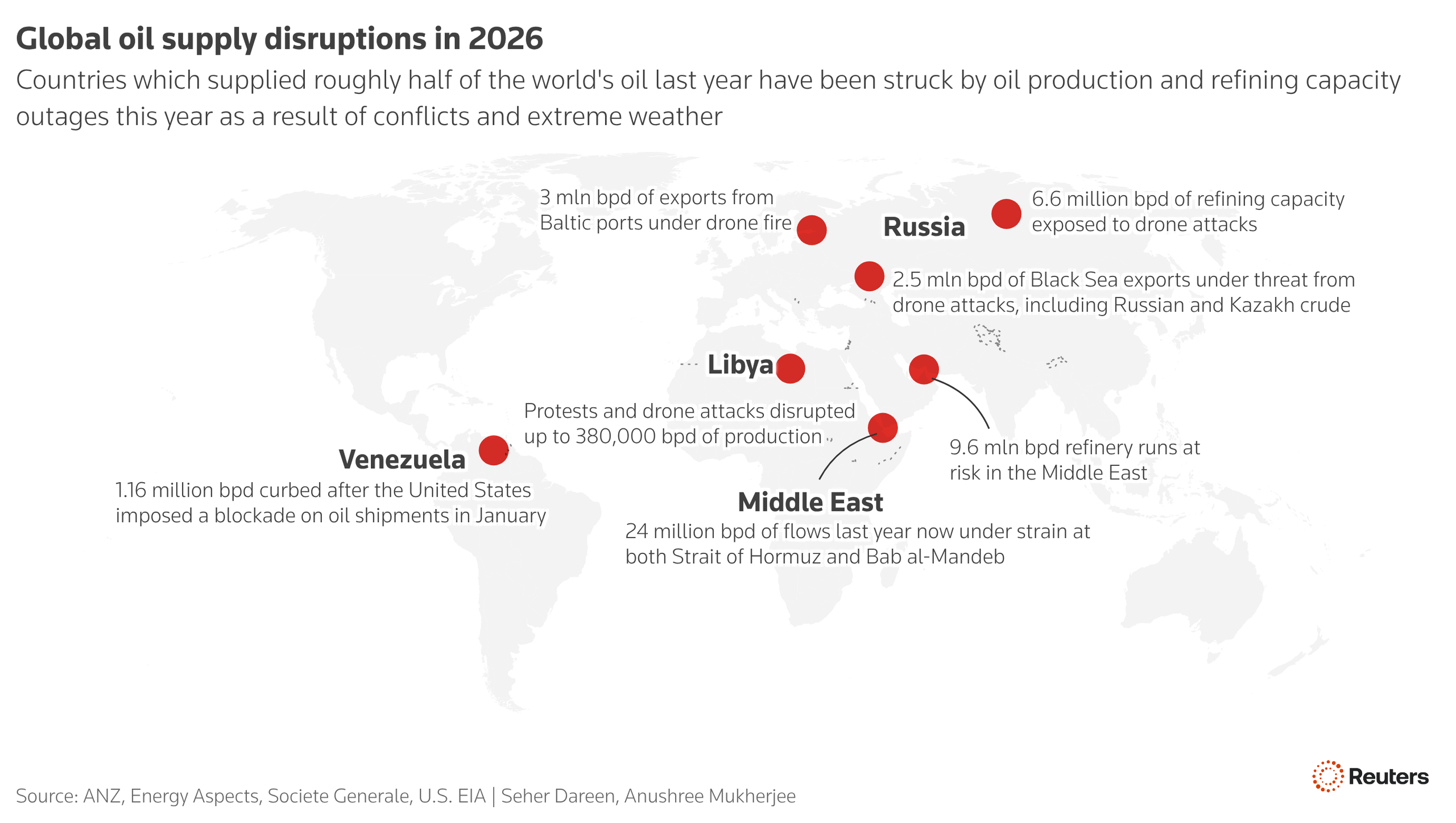
The concentration of oil production in conflict-affected regions has become particularly important six months after U.S. and Israeli attacks on Iran triggered what Reuters describes as the largest oil supply shock on record. Although not all affected production has been disrupted simultaneously, the combination of damaged infrastructure, shipping risks, refinery outages and restricted exports has tightened energy markets. Gulf producers have rerouted shipments, Ukraine has targeted Russian refining infrastructure and emergency oil stockpile releases have been used to cushion the shock.
More Than 43% Of Global Oil Supply Is Linked To Conflict-Affected Regions
The scale of the current exposure is unusual because several major oil-producing regions are simultaneously facing geopolitical disruption. Iran and other Gulf producers have been affected by the war, while Russia’s oil and refining infrastructure remains under pressure from the Russia-Ukraine conflict. Libya continues to face instability, and Venezuela has been affected by U.S. restrictions on oil exports.
Together, these countries produced approximately 45 million barrels per day in 2025. Based on global production of roughly 104 million barrels per day, the affected output represents more than 43% of global supply.
Global Oil Supply At Risk
| Indicator | Approximate Figure |
|---|---|
| Oil production from affected countries | 45 million barrels/day |
| Share of global supply | More than 43% |
| Global oil supply benchmark | About 104 million barrels/day |
| Current Iran war duration | About six months |
| Gulf disruption estimate | 5–7 million barrels/day |
| Global refining capacity affected | About 10% |
The calculation does not mean that 43% of the world’s oil is currently unavailable. Rather, it measures the share of global production originating in countries experiencing conflict, instability or significant export restrictions. This distinction is important because some oil continues to reach international markets despite the disruptions.
Iran War Creates The Biggest Immediate Supply Shock
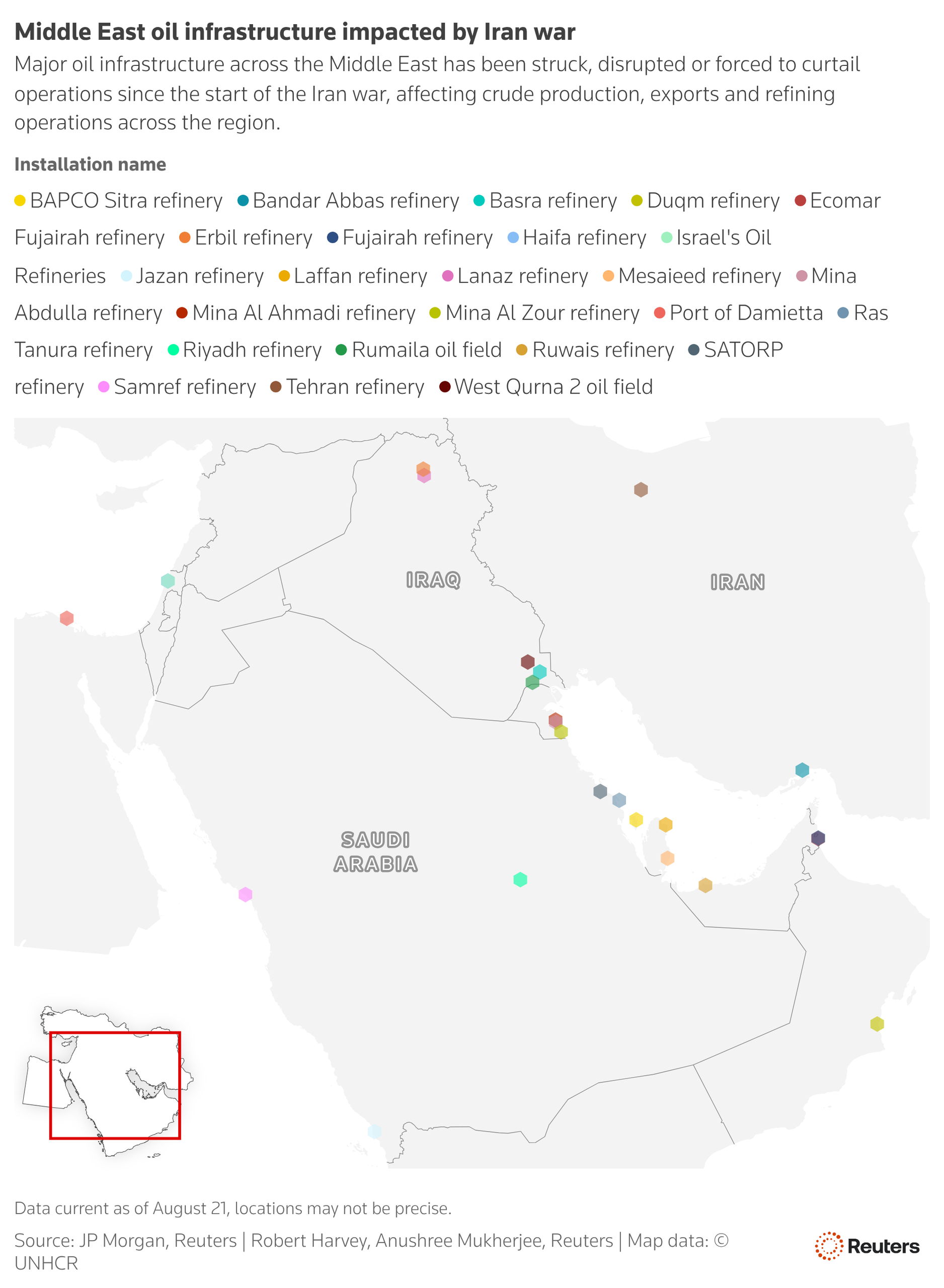
The Iran conflict has become the most significant source of disruption because of the importance of the Persian Gulf and the Strait of Hormuz to global energy trade.
Analysts estimate that the current Gulf disruption has reduced flows by around 5 million to 7 million barrels per day. Saudi Arabia and other Gulf exporters have sought alternative routes, including rerouting some shipments toward the Red Sea, while some cargoes have continued to move through the Strait of Hormuz under more difficult conditions.
The disruption is particularly important because the Gulf accounts for a substantial proportion of globally traded crude. Even when oil production continues, the inability to transport barrels efficiently can effectively turn available production into stranded supply.

How The Gulf Shock Moves Through The Oil Market
Conflict In Iran
        ↓
Shipping And Infrastructure Risk
        ↓
Lower Gulf Oil Flows
        ↓
Higher Freight And Insurance Costs
        ↓
Tighter Global Crude Supply
        ↓
Higher Refinery Feedstock Costs
        ↓
Higher Fuel Prices
        ↓
Inflation Pressure
The effect therefore extends beyond crude prices. Refiners, shipping companies, airlines, transport operators and consumers can all face higher costs when the movement of petroleum products becomes more expensive or unreliable.
Russia-Ukraine War Adds A Second Major Energy Shock
The Russia-Ukraine war is creating another layer of disruption in global energy markets.
Ukraine has increasingly targeted Russian refineries, including facilities located far from the front line. Reuters reported that Ukrainian strikes have reached Russia’s Omsk refinery, about 2,700 kilometers from Ukrainian-held territory. The attacks have reduced Russian refining activity and contributed to domestic fuel shortages.
Russia has responded by restricting gasoline and diesel exports, tightening global product markets at a time when other refining systems are already under pressure.
Conflict-Related Oil Market Disruptions
| Region | Main Disruption | Global Impact |
|---|---|---|
| Iran/Gulf | War and shipping disruption | Lower crude flows |
| Russia | Refinery attacks and export restrictions | Tighter fuel markets |
| Libya | Political and security instability | Production uncertainty |
| Venezuela | U.S. export restrictions | Reduced accessible supply |
| Kazakhstan | Spillover effects from Russia-Ukraine war | Production/refining disruption |
The Russian situation is particularly significant because crude oil and refined petroleum products behave differently in global markets. Even when crude can be redirected to another buyer, a shortage of refining capacity can still produce shortages of gasoline, diesel or jet fuel.
Global Refining Capacity Has Also Been Hit
The current energy crisis is not only a crude-oil supply problem. Reuters estimates that conflicts in the Gulf and Ukraine have reduced global refining capacity by about 10%.
That distinction is crucial for consumers because crude oil must be processed into products such as gasoline, diesel and jet fuel before it can be used by most end users.
A country can therefore have access to crude but still experience fuel shortages if refineries are damaged, shut down or operating below capacity.
Crude Versus Refined Products
| Stage | Current Pressure |
|---|---|
| Oil production | Conflict affecting major producers |
| Export terminals | Shipping and security risks |
| Tanker transportation | Higher risk and rerouting |
| Refineries | Capacity reduced by conflict |
| Gasoline | Tight supply in affected markets |
| Diesel | Export restrictions and refinery outages |
| Jet fuel | Higher costs and supply-chain pressure |
This explains why fuel prices can remain elevated even when headline crude prices temporarily decline.
Gulf Producers Are Rerouting Oil
Saudi Arabia and other Gulf producers have been attempting to maintain international exports by changing shipping routes.
Rerouting can reduce the immediate impact of a chokepoint disruption, but it does not eliminate the underlying risk. Longer routes increase voyage times, tanker requirements and potentially insurance and freight costs.
The Red Sea itself has also experienced security problems. Attacks near the Red Sea and Egypt’s Suez Canal in July demonstrated that alternative shipping routes can carry their own risks.
The Global Shipping Challenge
Normal Route
Gulf Producers
      ↓
Strait Of Hormuz
      ↓
Asian / European Buyers

Disrupted Route
Gulf Producers
      ↓
Alternative Export Route
      ↓
Longer Voyage
      ↓
Higher Freight + Insurance
      ↓
Higher Delivered Oil Cost
For Asian importers, the consequences can be particularly significant because many major buyers rely heavily on Gulf crude.
The United States Is Carrying More Of The Supply Burden
The disruptions have increased the world’s reliance on U.S. oil production. American producers have therefore become an important source of incremental supply as other regions face constraints.
However, U.S. production has also experienced occasional weather-related disruptions, limiting the extent to which American barrels can completely offset geopolitical losses elsewhere.
This creates a more concentrated global dependence on a smaller number of reliable producers.

Where Replacement Supply Can Come From
| Potential Source | Role |
|---|---|
| United States | Increase or maintain production |
| Saudi Arabia | Redirect available exports |
| Other Gulf producers | Reroute shipments |
| Strategic reserves | Temporary emergency supply |
| Non-conflict producers | Incremental production |
| Demand reduction | Lower consumption during shortages |
The problem is that spare capacity and emergency inventories cannot necessarily replace every barrel immediately, particularly when transportation and refining capacity are also constrained.
Strategic Oil Reserves Are Being Drawn Down
The International Energy Agency has released record volumes from emergency stockpiles to help cushion the supply shock. Those releases have provided an important temporary source of additional supply, but the emergency response is approaching its limits.
Reuters reported that the major stockpile releases are now largely complete while global oil inventories continue to decline.
This creates a potentially important vulnerability. Strategic reserves are designed to provide a bridge during temporary disruptions, not to permanently replace lost production.
Emergency Response
Supply Shock
     ↓
Strategic Reserves Released
     ↓
Temporary Supply Cushion
     ↓
Inventories Continue Falling
     ↓
Reserve Capacity Becomes More Limited
     ↓
Market Becomes More Sensitive
To New Disruptions
If another major production or transportation disruption occurs while inventories remain low, governments and markets could have fewer immediate buffers available.
Fuel Prices Are Feeding Into Inflation
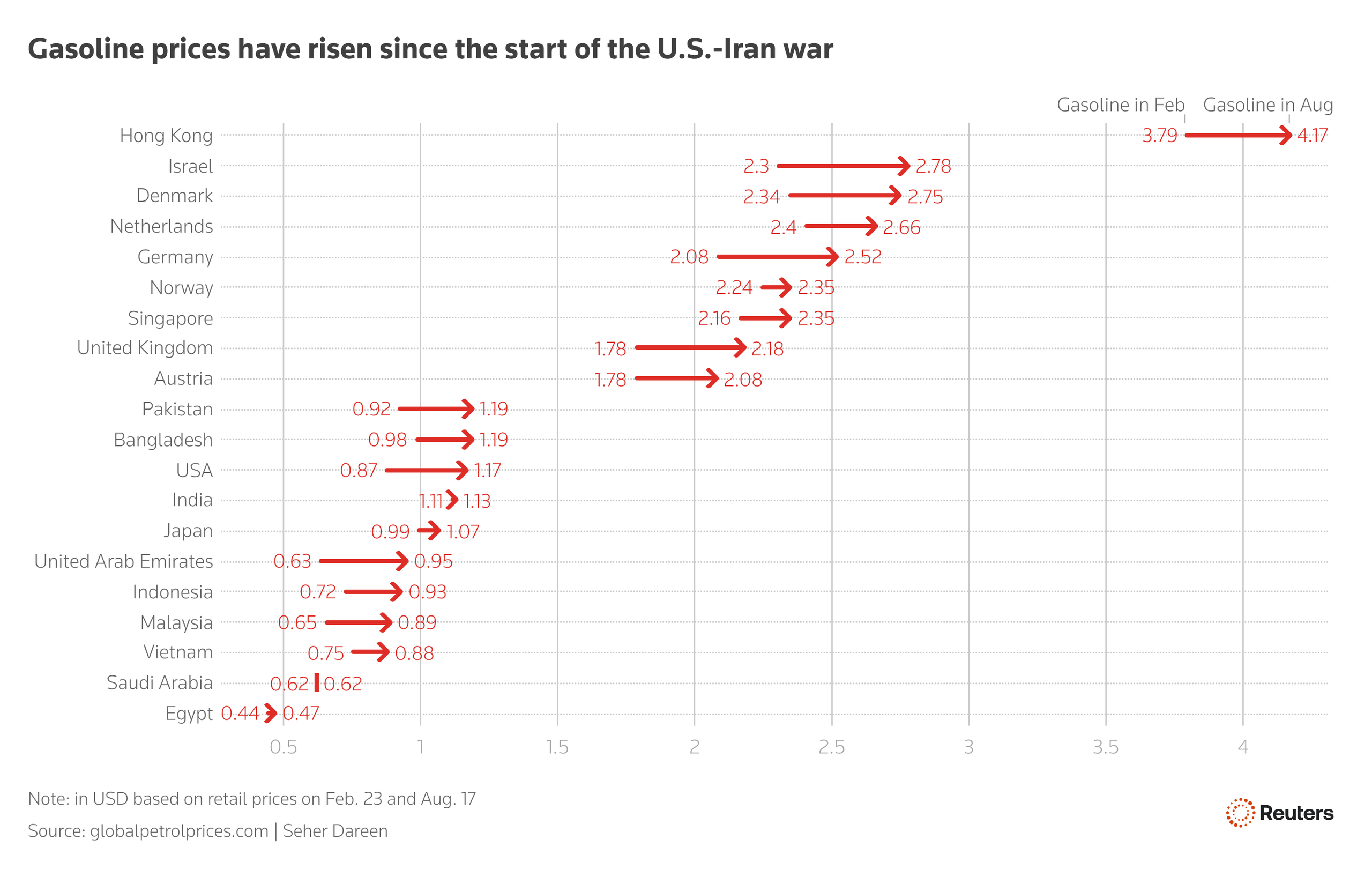
Higher energy costs have become an important source of inflationary pressure.
Oil is a direct input into transportation, manufacturing, agriculture and logistics. Diesel prices affect trucking and shipping, while jet-fuel costs affect airlines. Higher energy prices can also increase the cost of producing and transporting food and industrial goods.
The result is a second-round inflation effect that can extend well beyond petrol stations.
Oil Shock → Broader Economy
| Sector | Potential Impact |
|---|---|
| Transportation | Higher fuel costs |
| Airlines | Higher jet-fuel expenses |
| Agriculture | Higher diesel and input costs |
| Manufacturing | Higher energy and logistics costs |
| Shipping | Higher freight and insurance costs |
| Consumer goods | Higher distribution costs |
| Central banks | Greater inflation pressure |
Reuters reported that higher fuel prices have become a key inflation driver and have contributed to higher borrowing costs.
Why The Current Crisis Is Different From Earlier Oil Shocks
Earlier oil crises were often associated with a single major geopolitical event or a concentrated supply disruption. The current environment is more complicated because multiple producing and refining regions are simultaneously affected.
The Iran war is the dominant immediate shock, but Russia-Ukraine disruptions, instability in Libya and restrictions affecting Venezuelan exports create additional layers of uncertainty.
This makes the global oil market less capable of relying on one simple source of replacement supply.
Multiple Sources Of Risk
Iran War
   +
Russia-Ukraine Conflict
   +
Libya Instability
   +
Venezuela Export Restrictions
   +
Refinery Disruptions
   +
Shipping Risks
   ↓
Broad-Based Global Energy Vulnerability
The geographic diversity of the disruptions means that even if one conflict eases, other constraints may continue to keep energy markets tight.
India And Other Asian Importers Face Higher Exposure
Asian economies are particularly sensitive to Gulf disruptions because the region is a major destination for Middle Eastern crude.
India’s large dependence on imported crude means sustained increases in international oil prices can affect its trade balance, inflation and currency. Higher crude prices can also increase the cost of fertilizers, petrochemicals, transport and electricity generation.
For other major Asian importers such as China, Japan and South Korea, the impact can similarly spread across manufacturing and household energy costs.
The ability of Gulf producers to reroute exports therefore remains critical for Asian economies even when direct physical shortages can be avoided.
The Bigger Picture
Six months into the Iran war, the most important feature of the global oil market is not simply the amount of production currently offline. It is the extraordinary concentration of oil supply in regions facing conflict or geopolitical restrictions. Countries affected by the current disruptions produced more than 43% of global oil supply in 2025, according to Reuters calculations based on IEA data.
The combination of disrupted crude flows, damaged refineries, higher shipping risks and depleted emergency inventories has made the energy system more vulnerable to additional shocks. Even if individual disruptions are contained, the simultaneous presence of several risks means that global fuel markets can remain tight for longer than crude-production figures alone might suggest.
Looking Ahead
The next phase of the oil crisis will depend heavily on the duration and intensity of the Iran conflict and the reliability of shipping through the Gulf. A sustained improvement in flows through the Strait of Hormuz could ease crude shortages and reduce freight and insurance costs, while continued disruption could keep 5 million to 7 million barrels per day of Gulf flows at risk. The condition of Russian refineries and the availability of alternative export routes will also remain important.
For the global economy, the biggest concern is that another major disruption could arrive while inventories and emergency reserves are already under pressure. Governments and oil companies will therefore have to balance immediate supply needs with the need to rebuild inventories, protect refining capacity and diversify transportation routes. The longer the conflict-related disruptions persist, the greater the risk that an oil-market shock becomes a broader inflation and growth problem.
Get the day’s top stories in your inbox
One concise email. No spam, unsubscribe anytime.


