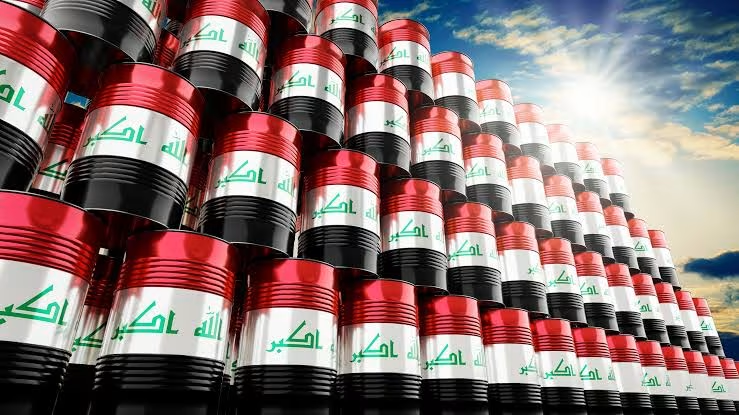
Iraq is accelerating efforts to develop alternative crude oil export routes after the closure of the Strait of Hormuz caused its daily oil shipments to international markets to fall by more than half. Iraqi crude exports have declined from nearly 3.4 million barrels per day before the latest escalation to between 1.5 million and 1.7 million barrels per day, according to Oil Minister Basim Khudair.
The disruption has exposed Iraq’s heavy dependence on the Strait of Hormuz for moving crude to overseas buyers. With current production at around 2.7 million barrels per day, Baghdad is now pursuing infrastructure projects that could provide alternative outlets, including an oil-export route through Jordan’s Port of Aqaba and the proposed Basra-Fishkhabur pipeline.
What Happened
Iraq’s crude oil exports have fallen sharply following the closure of the Strait of Hormuz, forcing the government to accelerate plans to diversify its export infrastructure.
Oil Minister Basim Khudair said on August 8 that Iraq’s crude production is currently around 2.7 million barrels per day, while exports have dropped to between 1.5 million and 1.7 million barrels per day. Before the escalation, Iraq was exporting almost 3.4 million barrels per day through the Strait of Hormuz.
The reduction represents a major disruption for a country whose government finances and foreign-exchange earnings are heavily dependent on crude oil.
Rather than relying solely on the Strait once normal shipping conditions return, Baghdad is looking at longer-term alternatives to make its oil sector more resilient to future geopolitical disruptions.
Key Oil Export Figures
| Metric | Current Situation |
|---|---|
| Pre-escalation exports | Nearly 3.4 million barrels/day |
| Current exports | 1.5–1.7 million barrels/day |
| Current production | Around 2.7 million barrels/day |
| Export reduction from previous level | More than 1.6 million barrels/day |
| Main disrupted route | Strait of Hormuz |
| Alternative projects | Aqaba route and Basra-Fishkhabur pipeline |
The gap between production and exports demonstrates the scale of the problem. Iraq is currently producing more crude than it can move to international customers through its available export infrastructure.
Why the Strait of Hormuz Matters to Iraq
The Strait of Hormuz is a critical maritime chokepoint connecting the Persian Gulf with international shipping routes.
For Iraq, the waterway is particularly important because much of its southern crude production is transported to export terminals in the Gulf before being shipped to overseas refiners.
When the strait becomes unavailable or commercial shipping is severely restricted, Iraq cannot simply redirect all of its production elsewhere.
This creates a storage problem for oil producers and can ultimately force reductions in production if crude cannot be moved out of the country.
The current decline in exports illustrates the vulnerability created by dependence on a single major export corridor.
Iraq Looks to Port of Aqaba
One of Baghdad’s proposed solutions is to develop an export route through Jordan’s Port of Aqaba on the Red Sea.
The project could provide Iraq with an outlet to international markets that does not depend on ships passing through the Strait of Hormuz.
Aqaba’s location gives it access to Red Sea shipping routes and therefore provides a potential alternative connection between Iraqi oil fields and international buyers.
However, establishing such a route would require substantial infrastructure, investment and coordination between Iraq and Jordan.
The project is therefore a longer-term diversification strategy rather than an immediate replacement for Iraq’s existing Gulf export system.
Basra-Fishkhabur Pipeline Project
Iraq is also pursuing the Basra-Fishkhabur pipeline project.
The proposed pipeline would connect Iraq’s southern oil-producing region with export infrastructure in the north, potentially providing access to routes leading toward the Mediterranean.
Khudair said the project is expected to be implemented under a build-operate-transfer, or BOT, model.
Under a BOT arrangement, a private or consortium partner typically finances and builds infrastructure, operates it for an agreed period and subsequently transfers ownership or control to the relevant government entity.
Such a structure could allow Iraq to develop major infrastructure while limiting the immediate burden on public finances.
Why Export Diversification Matters
Iraq’s latest experience demonstrates why oil-producing countries seek multiple export routes.
A diversified network can reduce the consequences of a disruption affecting any individual pipeline, port or maritime corridor.
For Iraq, alternative infrastructure could provide several benefits:
- Reduce dependence on the Strait of Hormuz
- Improve the resilience of crude exports
- Reduce the risk of forced production cuts
- Give Iraq greater flexibility in choosing export markets
- Improve long-term energy security
- Support higher production once additional capacity becomes available
The projects could become particularly valuable during periods of geopolitical tension.
Production Capacity Remains Intact
Despite the export disruption, Iraq’s oil minister said the country’s fields remain capable of restoring previous production and export levels.
That distinction is important.
The current decline is primarily an export and transportation problem rather than evidence that Iraq has permanently lost oil-production capacity.
If additional export routes become available and shipping conditions normalize, Iraq could potentially increase production again.
However, restoring output will require sufficient storage, transportation and international shipping capacity.
Impact on Iraq’s Government Revenue
Oil exports are central to Iraq’s public finances.
The government depends heavily on crude revenues to fund public spending, salaries, infrastructure projects and other economic programmes.
A prolonged reduction in exports could therefore create fiscal pressure even if international oil prices remain elevated.
Higher crude prices can partially compensate for lower volumes, but they cannot necessarily fully offset a large reduction in shipments.
The longer the disruption lasts, the more important alternative export infrastructure becomes for Iraq’s fiscal stability.
Impact on Global Oil Supply
Supply-route risk of this kind is one reason importing nations are hardening their own energy positions, from crude sourcing to India’s plan to build domestic polysilicon capacity for solar manufacturing.
The decline in Iraqi exports also matters to the international oil market.
Iraq is a major crude producer, and a sustained reduction of more than 1.5 million barrels per day from its normal export level would remove a substantial amount of supply from international markets.
The actual market effect depends on several factors, including production changes by other oil producers, inventories and demand.
Still, Iraq’s reduced exports contribute to tighter global supply conditions at a time when traders are closely monitoring developments around the Strait of Hormuz.
Asian Refiners Face Greater Uncertainty
Iraqi crude is an important source of supply for refiners, particularly in Asia.
When Iraqi shipments become uncertain, refiners may need to find alternative grades from other producers.
This can increase competition for available cargoes and potentially raise procurement costs.
The impact will vary by refinery because different plants are designed to process different types of crude.
Iraq’s Basrah crude grades are particularly important to refiners that have configured their facilities around those supplies.
Alternative Routes Will Take Time
The biggest limitation facing Iraq is that new export infrastructure cannot be created quickly.
Pipeline projects require engineering, financing, land access, construction and testing.
Ports require storage terminals, loading facilities and supporting infrastructure.
There are also geopolitical and commercial considerations involving transit countries.
Consequently, the Aqaba and Basra-Fishkhabur projects are better viewed as strategic investments in future resilience than immediate solutions to the current disruption.
Iraq’s Oil Storage Challenge
The sharp decline in exports can also create problems inside Iraq’s oil-producing regions.
When crude cannot be exported, storage tanks can fill quickly.
Once storage capacity becomes constrained, producers may have to reduce output even if underground reserves and production facilities remain capable of producing more oil.
This makes export infrastructure just as important as production infrastructure.
For Iraq, increasing pipeline and port capacity could therefore help prevent future disruptions from forcing oil-field shutdowns.
Government Focuses on Oil Infrastructure
Khudair said Iraq remains committed to advancing oil infrastructure and diversifying export routes.
The government is also seeking to create a secure and stable environment for international oil companies and investment in the sector.
This is important because large infrastructure projects require significant amounts of capital and technical expertise.
International energy companies and infrastructure investors could play a role in developing new pipelines, terminals and processing facilities.
Iraq Also Pushes Gas Investment
The government’s energy strategy extends beyond crude oil.
Khudair said Iraq is pursuing two parallel tracks in the gas sector: reducing the flaring of associated gas and developing gas fields.
Fourteen contracts have been referred to international companies for gas-related projects, according to the minister.
Reducing gas flaring could help Iraq capture energy that is currently wasted while potentially reducing the country’s reliance on imported gas for electricity generation.
The gas strategy is therefore linked to broader efforts to improve the efficiency and resilience of Iraq’s energy system.
Energy Security Becomes a Priority
Long-running contractual disputes can complicate upstream investment as well, as seen in the $3.86 billion arbitration claim the Indian government is pursuing against Reliance Industries.
The Hormuz disruption has highlighted a broader issue for Iraq: energy security is not only about having sufficient oil reserves.
A country can have substantial production capacity but still struggle to generate export revenue if it lacks reliable routes to international markets.
This makes pipelines, ports, storage terminals and shipping access strategic assets.
The current crisis could therefore accelerate Iraq’s efforts to build an oil-export system with multiple routes instead of relying predominantly on a single maritime chokepoint.
Challenges Facing the Alternative Projects
Several obstacles could complicate Iraq’s diversification plans.
Financing
Large pipelines and export terminals require billions of dollars in long-term investment. Iraq will need to attract private and international capital while ensuring commercially viable returns.
Regional Coordination
The Aqaba route would require close cooperation with Jordan, while northern export infrastructure involves additional regional relationships.
Security
Oil infrastructure in the region remains exposed to geopolitical and security risks. Alternative routes reduce dependence on Hormuz but do not eliminate geopolitical risk altogether.
Construction Timelines
Major energy infrastructure projects can take years to complete. Iraq therefore cannot rely on new routes as an immediate solution to the current export shortfall.
What Oil Markets Should Watch
The next developments in Iraq’s oil sector will be closely watched by traders, refiners and energy companies.
Important indicators include:
- Iraq’s daily export volumes
- Progress on the Aqaba export project
- Development of the Basra-Fishkhabur pipeline
- Production levels at southern Iraqi fields
- Storage capacity
- Shipping activity through Hormuz
- Global crude prices
- Demand from Asian refiners
- International investment in Iraqi oil infrastructure
A recovery in Iraqi exports would provide an important signal that supply disruptions are easing.
Industry Impact
Iraq’s situation demonstrates the importance of export-route diversification in global energy markets.
For oil producers, the ability to move crude through multiple pipelines, ports and maritime corridors can reduce the economic impact of geopolitical disruptions. For refiners, diversified supply routes can improve procurement security and reduce dependence on individual producers or transportation corridors.
The episode could also encourage other energy-producing countries to reassess their own infrastructure. Pipelines and alternative ports may have lower utilization during normal periods, but their strategic value becomes much greater when a major shipping chokepoint is disrupted.
Looking Ahead
Iraq’s sharp decline in crude exports following the Strait of Hormuz closure has exposed a major structural vulnerability in its oil economy. Exports have fallen from nearly 3.4 million barrels per day to between 1.5 million and 1.7 million barrels per day, even though the country’s current production capacity remains around 2.7 million barrels per day. The immediate challenge is maintaining enough storage and transportation capacity to prevent further production constraints, while the longer-term priority is building export routes that can operate independently of Hormuz.
The proposed Port of Aqaba route and Basra-Fishkhabur pipeline could become important components of that strategy, but both require substantial investment and time before they can provide meaningful additional capacity. Investors and oil companies will therefore be watching project financing, construction progress and Iraq’s ability to attract international partners. For global energy markets, the development is another reminder that physical infrastructure can be as important as production capacity in determining how much crude actually reaches consumers.
Frequently Asked Questions
How much have Iraq oil exports fallen?
Iraqi crude exports have dropped from nearly 3.4 million barrels per day before the latest escalation to between 1.5 million and 1.7 million barrels per day, according to Oil Minister Basim Khudair — a fall of more than half.
Why does the Strait of Hormuz matter to Iraq?
The bulk of Iraq’s crude reaches international markets through the Gulf, so a closure of the Strait of Hormuz cuts off its main export channel. Production capacity itself remains intact; the constraint is getting barrels out.
What alternative export routes is Iraq developing?
Baghdad is looking at the Port of Aqaba in Jordan and the Basra-Fishkhabur pipeline project to move crude without transiting Hormuz. Both take time to build, so they cannot offset the shortfall immediately, and storage capacity is a near-term constraint.
Get the day’s top stories in your inbox
One concise email. No spam, unsubscribe anytime.


