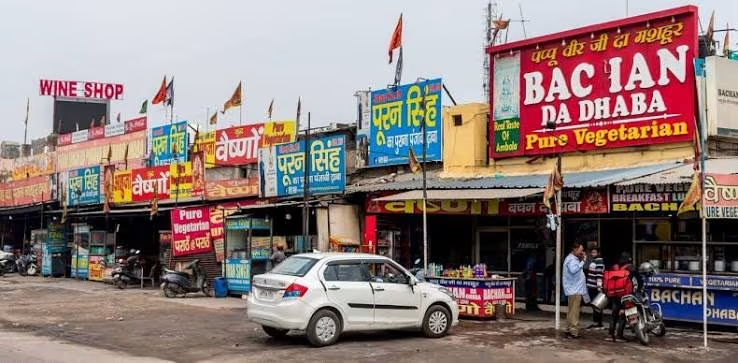
Maharashtra has ordered a ban on new hotels, dhabas, eateries and other commercial establishments within the right of way (ROW) of National Highways, while directing authorities to remove unauthorised structures already operating in these areas. The move follows Supreme Court directions aimed at improving highway safety and preventing accidents caused by roadside encroachments, unauthorised parking and commercial activity.
The Maharashtra government has instructed municipal corporations, municipal councils and nagar panchayats to strictly implement the directions. District administrations have also been given a time-bound framework to identify and remove unauthorised structures.
What Maharashtra has ordered
Under the new directions, the construction or operation of new dhabas, hotels, eateries and other commercial establishments within the ROW of a National Highway is prohibited.
The government has also ordered action against unauthorised structures that are already present in these areas.
| Measure | Government direction |
|---|---|
| New dhabas within highway ROW | Prohibited |
| New hotels/eateries within ROW | Prohibited |
| Unauthorised structures | Removal/demolition ordered |
| Time for removal of unauthorised structures | 60 days |
| Existing licences | Review within 30 days |
| New/renewed approvals | Require highway authority clearance |
| District highway safety task forces | To be formed |
MAHARASHTRA HIGHWAY ACTION

National Highway
       ↓
Right of Way (ROW)
       ↓
Unauthorised hotel / dhaba
       ↓
Identification
       ↓
Demolition / removal
       ↓
Clearer highway corridor
       ↓
Improved safety
What is the highway right of way?
The right of way, or ROW, is the land acquired and reserved by the government for a highway and its associated infrastructure.
It is broader than simply the portion of road where vehicles travel.
The ROW can include land required for:
- Carriageways
- Shoulders
- Drainage
- Service infrastructure
- Future road expansion
- Safety facilities
- Other highway-related infrastructure
This distinction is important because a commercial establishment can be physically away from the traffic lanes while still occupying land falling within the highway’s legally designated corridor.
Why are dhabas and hotels being targeted?
It is part of a broader tightening around transport infrastructure in India — see also the ₹1.8-trillion PPP pipeline Indian Railways has prepared for private firms.
The government’s action follows concerns that roadside commercial establishments can create multiple highway-safety problems.
A popular dhaba can attract:
Cars + trucks + buses + pedestrians + delivery vehicles
When these vehicles stop directly along a high-speed highway, the resulting traffic movement can create dangerous conditions.
HIGHWAY

Fast traffic ─────────────────────→

             ↓
        Unauthorised
          dhaba
             ↓
       🚗  🚛  🚌
       Parking / entry
             ↓
   Pedestrians crossing
             ↓
      Accident risk
The Supreme Court’s directions were prompted by fatal highway accidents and focused on unauthorised parking, dhabas and commercial structures that can interfere with highway safety.
Supreme Court directions are behind the move
The Maharashtra order follows the Supreme Court’s April 13, 2026 directions in a suo motu case concerning highway safety after a fatal accident in Phalodi, Rajasthan.
The court’s broader directions called for stronger enforcement against unauthorised parking and commercial structures along National Highways.
The underlying concern is the combination of high-speed traffic and poorly controlled roadside activity.
FATAL HIGHWAY ACCIDENTS
          ↓
Supreme Court intervention
          ↓
Highway safety directions
          ↓
State-level implementation
          ↓
Maharashtra government order
          ↓
Action against unauthorised structures
Existing unauthorised structures face demolition
The order does not only concern future construction.
District Magistrates have been directed to ensure the demolition or removal of unauthorised structures within 60 days.
That could affect existing roadside establishments if they are found to have been constructed or operated without the required permissions in the relevant highway safety areas.
EXISTING STRUCTURE

Hotel / Dhaba / Shop
        ↓
Located within restricted area?
        ↓
       YES
        ↓
Check authorisation
        ↓
Unauthorised
        ↓
Removal / demolition
This means businesses operating close to National Highways may need to verify whether their premises fall within the relevant ROW and whether all required approvals are valid.
Existing licences will also be reviewed
The Maharashtra government has instructed authorities to review existing licences issued to establishments operating in these areas.
The review is expected to take place within 30 days.
This is significant because an establishment may have a local trade licence but still require clearance from the authority responsible for the highway.
The new framework therefore places greater emphasis on coordination between local authorities and highway agencies.
New licences and approvals face tighter scrutiny
Government departments, local authorities and other agencies have been instructed not to issue or renew licences, No Objection Certificates or trade approvals for establishments located in highway safety zones without prior clearance from the National Highways Authority of India (NHAI) or the relevant Public Works Department (PWD), depending on the road.
BUSINESS APPLICATION
        ↓
Hotel / Dhaba / Eatery
        ↓
Location check
        ↓
Highway safety zone?
        ↓
      YES
        ↓
NHAI / PWD clearance
        ↓
Approval process
This could make it considerably harder to establish new roadside commercial businesses in restricted highway areas.
District highway safety task forces to be created
Maharashtra has also directed the formation of a district highway safety task force in every district through which a National Highway passes.
The task force will be constituted by the District Collector and include officials from relevant agencies.
The proposed members include:
- District administration
- Police
- NHAI or the relevant land-owning agency
- PWD
- Local bodies
DISTRICT HIGHWAY SAFETY TASK FORCE

District Collector
       │
 ┌─────┼─────┬─────┐
 ↓     ↓     ↓     ↓
Police NHAI  PWD  Local bodies
       │
       ↓
Highway safety enforcement
The structure is intended to improve coordination between agencies that previously may have dealt with roadside encroachments separately.
Why the government is acting now
National Highways carry a disproportionately high share of India’s road traffic and fatalities.
The Supreme Court has highlighted the safety risks associated with high-speed highways where roadside infrastructure and enforcement are inadequate.
The policy approach is therefore based on a simple principle:
Keep high-speed traffic corridors free from avoidable obstacles and uncontrolled roadside activity.
HIGHWAY SAFETY MODEL

High-speed traffic
       +
Heavy vehicles
       +
Pedestrians
       +
Unauthorised parking
       +
Roadside businesses
       ↓
Higher conflict points
       ↓
Accident risk

REMOVE CONFLICT POINTS
       ↓
Improved safety
What this means for dhaba owners
The biggest immediate impact will be on businesses operating directly within highway land or restricted safety zones.
Owners may need to determine:
- Whether their property falls within the highway ROW.
- Whether the structure is authorised.
- Whether the required highway clearance was obtained.
- Whether existing licences remain valid.
- Whether the establishment creates a traffic or safety obstruction.
A local business licence alone may not necessarily resolve the highway-related requirements.
Not every roadside restaurant is automatically being shut
The order should not be interpreted as a blanket closure of every hotel or dhaba located anywhere near a highway.
The key issue is whether the establishment falls within the relevant right of way or highway safety zone and whether it has the required authorisations.
NEAR HIGHWAY
     ↓
Does NOT automatically mean demolition

BUT

Within restricted ROW / safety zone
          ↓
Authorisation check
          ↓
Unauthorised
          ↓
Action
This distinction is important for businesses and travellers alike.
Potential impact on highway food stops
Dhabas are an important part of India’s road-travel ecosystem, particularly for truck drivers and long-distance travellers.
They provide:
- Food
- Rest areas
- Parking
- Toilets
- Vehicle-related services
- Local employment
The government’s challenge will therefore be to improve safety without eliminating legitimate roadside services that are needed by highway users.
The likely long-term direction is toward better-planned facilities away from dangerous highway stretches rather than simply removing every roadside service.
OLD MODEL

Highway
   ↓
Unplanned roadside dhaba
   ↓
Direct highway access
   ↓
Parking on shoulder


SAFER MODEL

Highway
   ↓
Controlled exit
   ↓
Service road / designated facility
   ↓
Parking area
   ↓
Food + rest services
Truck drivers could be particularly affected
Heavy trucks often need designated places to stop for:
- Driver rest
- Food
- Toilets
- Vehicle checks
- Loading-related activities
If roadside dhabas are removed without adequate alternatives, truck drivers could potentially be forced to stop in unsafe locations.
That makes the development of properly planned highway amenities important alongside enforcement.
Highway safety versus roadside livelihoods
The policy creates a balance that authorities will need to manage.
| Objective | Potential impact |
|---|---|
| Remove illegal structures | Better highway clearance |
| Prevent roadside parking | Lower accident risk |
| Control highway access | Fewer traffic conflicts |
| Protect highway land | Easier future expansion |
| Remove unsafe businesses | Safety improvement |
| Preserve legitimate services | Need for designated facilities |
| Protect livelihoods | Need for lawful alternatives |
The enforcement process will therefore matter as much as the order itself.
What happens within 30 days?
The immediate phase involves reviewing existing permissions.
FIRST 30 DAYS
      ↓
Review existing licences
      ↓
Identify highway-zone businesses
      ↓
Check NHAI / PWD permissions
      ↓
Separate authorised
from unauthorised structures
Authorities will then move toward enforcement against structures that do not comply.
What happens within 60 days?
Unauthorised structures identified under the order are expected to be removed or demolished within the prescribed 60-day period.
DAY 0
Order issued
   ↓
DAY 30
Licence review
   ↓
DAY 60
Removal / demolition
of unauthorised structures
The exact implementation for individual establishments will depend on the findings of local authorities and applicable legal procedures.
Impact on highway-side land values
The order could also have implications for commercial properties located close to National Highways.
Land that previously benefited from direct highway access could become less commercially attractive if businesses cannot operate within the ROW.
At the same time, properly authorised commercial zones with controlled access could become more valuable.
UNAUTHORISED HIGHWAY FRONTAGE
          ↓
Regulatory risk
          ↓
Lower commercial certainty

DESIGNATED COMMERCIAL ZONE
          ↓
Legal access
+
Parking
+
Infrastructure
          ↓
Potentially stronger long-term value
The actual effect will vary significantly by location and zoning.
Highway development could also benefit
Keeping the ROW free from unauthorised construction can help highway agencies with future infrastructure projects.
Clear corridors can make it easier to build or expand:
- Service roads
- Drainage
- Flyovers
- Interchanges
- Bus bays
- Safety barriers
- Pedestrian infrastructure
- Road-widening projects
CLEAR ROW
   ↓
Infrastructure flexibility
   ↓
Future highway upgrades
   ↓
Better traffic management
This is another reason governments seek to prevent permanent commercial encroachment on highway land.
The bigger road-safety issue
The Maharashtra action is part of a wider national discussion about highway safety.
The Supreme Court’s intervention came after fatal accidents raised questions about unauthorised parking, roadside commercial activity and enforcement on high-speed corridors.
The broader safety framework involves more than removing dhabas.
It also includes:
- Proper truck parking
- Emergency response
- Road engineering
- Signage
- Speed management
- Highway patrols
- Access control
- Pedestrian safety
- Enforcement
ROAD SAFETY
    │
 ┌──┼───────────────┐
 ↓  ↓               ↓
Road design     Enforcement
 ↓                  ↓
Parking         Police
 ↓                  ↓
Pedestrians     Highway agencies
 └───────┬──────────┘
         ↓
     Safer highway
Key numbers at a glance
┌──────────────────────────────────┐
│ MAHARASHTRA HIGHWAY ORDER        │
├──────────────────────────────────┤
│ New dhabas in highway ROW   Banned│
│ New hotels/eateries          Banned│
│ Licence review               30 days│
│ Unauthorised structure removal 60 days│
│ District task forces         Every NH district│
│ Key agencies                 NHAI / PWD / Police│
└──────────────────────────────────┘
What travellers should expect
For people travelling on Maharashtra’s National Highways, the policy could eventually mean fewer informal roadside stops directly accessible from the highway.
Over time, travellers could see greater emphasis on:
- Designated rest areas
- Controlled entry and exit points
- Formal parking facilities
- Authorised food outlets
- Highway amenities away from the main carriageway
The transition could initially be disruptive in areas where travellers have become accustomed to stopping at informal roadside businesses.
The policy’s central objective
The Maharashtra government’s approach can essentially be reduced to one principle:
Highways should function as high-speed transport corridors, not as uncontrolled commercial streets.
HIGHWAY
   ↓
MOVEMENT
   ↓
Safety + speed + controlled access

NOT

HIGHWAY
   ↓
Traffic
   +
Parking
   +
Dhabas
   +
Pedestrians
   +
Uncontrolled entrances
That distinction is at the heart of the new enforcement drive.
Conclusion
Maharashtra has ordered authorities to stop new hotels, dhabas, eateries and other commercial establishments from operating within the right of way of National Highways, while also beginning the process of removing unauthorised structures already occupying these areas.
The move follows the Supreme Court’s April 2026 directions on highway safety, issued after fatal accidents highlighted risks associated with unauthorised parking, roadside commercial activity and inadequate enforcement.
Under the Maharashtra government’s framework, District Magistrates have been directed to ensure the removal or demolition of unauthorised structures within 60 days, while existing licences are to be reviewed within 30 days. Government departments and local bodies have also been told not to issue or renew relevant approvals for establishments in highway safety zones without clearance from NHAI or the appropriate PWD authority.
The government is also creating district-level highway safety task forces involving the district administration, police, NHAI or the relevant land-owning agency, PWD and local bodies. The aim is to create a more coordinated system for identifying encroachments and enforcing highway-safety rules.
The policy does not mean that every hotel or dhaba located near a National Highway will automatically be demolished. The crucial factors are the property’s location in relation to the highway’s ROW or safety zone and whether the establishment has the necessary authorisations.
For legitimate roadside businesses, however, the order could lead to tighter scrutiny and potentially significant changes in where and how they operate.
There is also an important economic and social dimension. Dhabas and roadside restaurants provide food, rest facilities and employment, while truck drivers depend heavily on such establishments during long journeys. Simply removing roadside businesses without creating adequate alternatives could shift the problem toward unsafe parking and informal stopping elsewhere.
The longer-term solution is therefore likely to involve planned highway amenities, designated parking, controlled access and properly authorised food and rest facilities rather than uncontrolled roadside development.
For Maharashtra, the immediate focus is enforcement: identify unauthorised structures, review existing permissions and remove establishments that violate the rules.
The broader objective is to make National Highways function primarily as safe, high-speed transport corridors, while moving commercial activity into locations where vehicles can enter, park and exit without creating dangerous conflicts with fast-moving traffic.
Frequently Asked Questions
What exactly has Maharashtra banned?
New hotels, dhabas, eateries and other commercial establishments within the right of way of National Highways, with authorities directed to remove unauthorised structures already operating there.
What is a highway right of way?
The right of way is the strip of land legally reserved for the highway and its future widening, drainage and safety margins. Building on it is not permitted.
What happens to existing dhabas with licences?
Existing unauthorised structures face demolition, existing licences will be reviewed, and new licences and approvals face tighter scrutiny.
Get the day’s top stories in your inbox
One concise email. No spam, unsubscribe anytime.


