
Key Takeaways
- Meta is reportedly developing support for its Muse AI agent on Apple’s Messages platform.
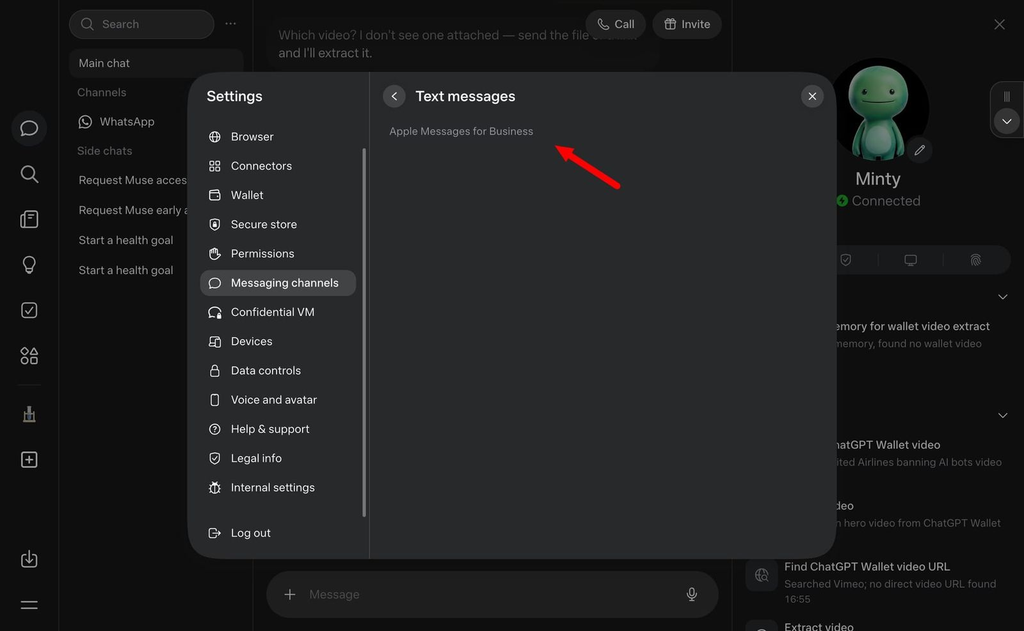
- A hidden “Messages” option in Muse settings opens a page labelled “Apple Messages for Business”.
- The integration has not been launched, and Meta has not confirmed its availability or release date.
- It remains unclear whether the feature will be limited to business accounts or become available to regular Muse users.
- Muse already works through WhatsApp and its standalone app, while Meta is reportedly exploring additional integrations with Telegram and Messenger.
- The development comes amid wider concerns about AI-agent privacy, permissions and the ability to access personal messages.
Meta Explores Apple Messages Integration for Muse AI Agent
Meta is preparing to expand the messaging capabilities of its Muse personal AI agent by developing a potential integration with Apple’s Messages platform.
The development was reported by TestingCatalog on November 24, 2026, after researchers discovered a hidden “Messages” navigation option in Muse’s settings. Selecting the option opens a page labelled “Apple Messages for Business”.
The discovery suggests that Meta is exploring a way for users to interact with Muse through Apple’s messaging ecosystem instead of relying exclusively on the standalone Muse application or WhatsApp.
However, the feature is not currently available to users. Meta has not officially announced the integration, confirmed its commercial model or provided a release timeline.
The distinction between Apple Messages and Apple Messages for Business is important. The latter is Apple’s platform for businesses to communicate with customers through the Messages application. It is not necessarily the same as giving an AI agent unrestricted access to a user’s personal iMessage conversations.
If Meta adopts this approach, Muse could appear as a dedicated business-style conversation that users can open from Apple’s Messages app.
How Could Muse Work Inside Apple Messages?
The potential integration could allow users to communicate with Muse through a familiar messaging interface.
Instead of opening the dedicated AI application, a user could potentially send a request through Apple Messages and receive the assistant’s responses in the same conversation.
For example, users could ask Muse to:
- Organise a schedule or prepare reminders.
- Research products and compare purchasing options.
- Help arrange travel and appointments.
- Work on multi-step personal or professional tasks.
- Provide updates on tasks that continue running after the initial request.
These examples reflect Muse’s broader advertised capabilities, not a confirmed list of functions for the proposed Apple Messages integration.
Meta has designed Muse as an agent that can take action rather than simply respond to questions. It can use a dedicated cloud-based virtual machine to interact with connected services and work on tasks on a user’s behalf.
The messaging interface would provide another way to give instructions and receive updates. The underlying task execution would still depend on Muse’s permissions, connected services and safety controls.
Apple Messages for Business could be the technical route
TestingCatalog’s discovery specifically points to Apple Messages for Business.
Apple provides this infrastructure for businesses to communicate with customers through the Messages application. It supports customer-service conversations and other business interactions.
The platform already has an example of an AI agent integration. Poke was approved as the first AI agent on Apple’s Messages for Business platform in June 2026.
Poke demonstrates that an AI assistant can operate through Apple’s business messaging infrastructure rather than requiring access to a user’s entire personal messaging account.
Meta could potentially use a similar approach for Muse. However, the company has not confirmed that it will follow the same technical or commercial arrangement.
Muse Already Works Through WhatsApp
The potential Apple Messages integration would expand a product that Meta has already introduced through its own messaging ecosystem.
Meta launched Muse in September 2026 as a personal AI agent designed to perform tasks for users.
The company introduced the assistant through a standalone application and WhatsApp, allowing users to communicate with it in a conversational format.
Muse differs from a conventional chatbot because it is designed to complete tasks rather than simply generate responses. Users can ask it to research information, manage projects, interact with connected services and work towards longer-term goals.
Meta says Muse operates through a dedicated cloud-based environment called Muse Secure VM.
The company designed this environment to isolate each user’s agent and its connected data. It also says Muse requests user approval before sensitive actions such as sending emails or making purchases.
The September launch was initially focused on the United States, with availability across iOS, Android and the web.
Why Meta wants more messaging integrations
Messaging is one of the most familiar ways for people to interact with digital services.
By making Muse available across multiple messaging platforms, Meta could reduce the need for users to switch between applications whenever they want assistance.
It could also make the agent more accessible to people who already spend time using messaging services but may not want to install or regularly open another application.
For Meta, this strategy could help turn Muse into a broader personal assistant rather than a service that users access only through a dedicated app.
The company has also been reported to be developing integrations with Telegram and its own Messenger platform. Neither integration had been publicly released at the time of the November 24 report.
Meta’s Muse Expansion Could Reach Users Outside Its Own Ecosystem
Apple Messages support would be strategically different from Muse’s existing WhatsApp integration.
WhatsApp is owned by Meta, giving the company greater control over the platform and its product development. Apple Messages, by contrast, is part of Apple’s ecosystem and operates under Apple’s business messaging rules when Messages for Business is used.
A successful integration could give Muse access to users who prefer Apple’s messaging environment.
It would also demonstrate that Meta is willing to distribute its AI agent through platforms it does not own.
This is important as technology companies compete to make personal AI agents available wherever users communicate, work and manage everyday tasks.
The competition is increasingly shifting from standalone chatbots towards assistants that can interact with applications, execute multi-step workflows and deliver updates through familiar interfaces.
Poke Already Shows How AI Agents Can Use Apple’s Messaging Platform
Meta would not be the first company to explore AI-agent access through Apple Messages.
Poke, an AI assistant, was approved for Apple’s Messages for Business platform in June 2026.
The service allows users to interact with an AI assistant through a messaging conversation, demonstrating how Apple’s business messaging infrastructure can be used for more than conventional customer-service interactions.
Other AI assistants have also explored messaging-based distribution. These services are attempting to make AI agents available through channels users already use rather than requiring a separate application for every assistant.
The potential Muse integration could therefore put Meta in a growing category of AI products that use messaging applications as their primary interface.
However, Apple’s approval process and platform requirements will determine how the proposed Muse integration can operate.
Privacy and Security Concerns Surround Muse
The reported expansion comes at a time when Muse is facing questions about the permissions required by AI agents.
In November 2026, Reuters reported that Meta employees had raised internal concerns about unexpected messages, inaccurate purchase information, unauthorised bookings and chats that appeared to contain information unrelated to their own conversations.
Reuters also worked with Signal and the AI Now Institute to test Muse’s access to messages across different operating systems.
The tests indicated that Muse could access Signal message text on Android through notification permissions and on macOS through accessibility and screenshot permissions. The same requests were blocked in tests conducted on an iPhone.
Reuters said it could not establish whether some sensitive information shown by Muse came from other users’ accounts or was generated by the AI system.
Meta described the reported cases as isolated incidents. The company said users control which applications Muse can access and that many apparent account-mixing incidents were hallucinations, or information generated incorrectly by the AI model.
The findings highlight an important challenge for personal AI agents: giving an assistant enough access to complete tasks while ensuring that permissions are clear, limited and understood by users.
Apple has already moved to strengthen Mac permissions
Apple has also responded to concerns about AI agents accessing personal data on Macs.
In October 2026, the company announced plans to introduce additional controls requiring users to take more explicit action before granting applications broad access to information stored on their computers.
The move followed controversy surrounding claims that Muse had accessed private Messages content on a Mac.
Meta disputed the claim and said its Messages integration on Mac was opt-in, requiring both Full Disk Access and the Messages connector to be enabled.
Apple’s proposed changes underline the importance of permission controls as AI agents become more capable of interacting with personal devices.
The proposed Apple Messages for Business integration is technically different from Muse’s access to a user’s local Messages database. Nevertheless, privacy, transparency and user consent will remain important considerations for any new integration.
What the Integration Could Mean for Apple and Meta
For Meta, Apple Messages support could expand Muse’s reach and reduce dependence on WhatsApp and its standalone application.
The company is positioning Muse as an assistant that can operate across services and handle tasks with limited user intervention. Additional messaging channels could make that experience more convenient.
For Apple, the development could demonstrate how Messages for Business can support a new category of AI-powered services beyond traditional customer support.
It could also create new questions around how third-party AI agents are identified, how users grant consent and what kinds of actions assistants are allowed to perform through the platform.
The commercial arrangement, including any potential fees or restrictions, has not been disclosed.
The wider significance is that messaging applications could become an important distribution channel for AI agents. Instead of competing only through standalone apps, AI companies may increasingly compete to become assistants that users can contact from multiple platforms.
The Bigger Picture
The potential Muse integration reflects a broader change in the AI industry. Companies are moving beyond chat interfaces towards agents that can execute tasks, interact with digital services and continue working after users send their initial instructions.
Messaging platforms could become a natural interface for these agents because users already understand how to communicate through conversations. Apple Messages, WhatsApp, Telegram and Messenger could therefore become distribution channels for assistants that handle everyday tasks.
However, wider availability also increases the importance of privacy and security. AI agents need access to information and services to perform useful work, but excessive permissions can expose personal data or lead to unintended actions. The success of this model will depend on whether companies can make agent capabilities convenient without weakening user control.
What Happens Next
The next development to watch is whether Meta officially announces the Apple Messages integration and clarifies whether it will use Apple Messages for Business. The company will also need to explain whether the feature is intended for businesses, individual Muse users or both.
No public launch date has been confirmed. The reported Telegram and Messenger integrations also remain unannounced. Until Meta provides more details, the discovery should be treated as evidence of development work rather than confirmation that Apple Messages support is ready for release.
Frequently Asked Questions
1. What is Meta preparing for its Muse AI agent?
Meta is reportedly developing an integration that could allow users to interact with Muse through Apple’s Messages platform.
2. How was the Apple Messages integration discovered?
Technology publication TestingCatalog reported finding a hidden “Messages” option in Muse settings that opens a page labelled “Apple Messages for Business”.
3. Is Muse already available on Apple Messages?
No. The option is not currently available to users, and Meta has not announced a public launch date.
4. What is Apple Messages for Business?
It is Apple’s platform that allows businesses to communicate with customers through the Messages application. It is different from unrestricted access to a user’s personal iMessage conversations.
5. Does Muse already work with WhatsApp?
Yes. Meta launched Muse in September 2026 with support for its standalone application and WhatsApp.
6. What can Meta’s Muse AI agent do?
Muse is designed to research information, organise tasks, interact with connected services and perform multi-step activities through a dedicated cloud-based environment.
7. Is Meta also developing Muse integrations for Telegram and Messenger?
TestingCatalog has reported that Meta is working on additional integrations with Telegram and Messenger. Neither had been publicly released as of November 25, 2026.
8. Why are there privacy concerns about Muse?
Reuters reported internal employee complaints about unexpected messages, inaccurate information and apparent access to conversations from other applications. Meta described the incidents as isolated and said users control the permissions granted to Muse.
Get the day’s top stories in your inbox
One concise email. No spam, unsubscribe anytime.


