
Meta has introduced Muse Wonder and Muse Wonder Full, two advanced artificial intelligence models that mark the company’s first major release aimed directly at the frontier of AI capabilities. Announced on October 12, 2026, the models are designed to handle complex professional and personal tasks, including software development, financial analysis, document interpretation and multi-step workflows. The launch represents a significant development in Meta’s effort to compete with leading AI companies after reorganizing its AI research operations and investing heavily in talent and computing infrastructure.
The new models build on Muse Spark, Meta’s earlier lightweight AI model, but target more demanding applications that require stronger reasoning, coding capabilities and the ability to retain information across conversations. Meta is also emphasizing features called Active Memory and Active Focus, which are designed to help its models remember relevant details, stay focused on longer tasks and recover when an approach fails. The company says the models achieve frontier-level performance on several evaluations, although independent testing will be important in determining how they compare with competing systems in everyday use.
Key Takeaways
- New frontier models: Meta has released Muse Wonder and Muse Wonder Full, its most capable AI models to date, according to the company.
- Complex tasks: The models target coding, document analysis, professional workflows and personal AI assistance.
- Long-term memory: Active Memory is designed to help models retain and retrieve useful information across conversations.
- Persistent task execution: Active Focus helps models continue working, try alternative approaches and recover from errors.
- Availability: Muse Wonder is available through Meta Model API and Muse Code, while Muse Wonder Full is available to Muse Code subscribers.
- API pricing: Muse Wonder costs $4 per million input tokens and $20 per million output tokens.
- Strategic significance: The launch signals Meta’s renewed push to compete with OpenAI, Anthropic and other advanced AI developers.
What Is Meta Muse Wonder?
Muse Wonder is a frontier-class AI model developed by Meta’s Superintelligence Lab. Meta describes it as a system designed for personal and professional AI agents, which go beyond answering individual questions to help users complete tasks involving multiple steps.
Traditional chatbots typically respond to a prompt and wait for the next instruction. An AI agent can instead break a task into smaller steps, gather information, work with tools, evaluate intermediate results and continue toward a goal.
For example, a user might ask an AI assistant to review a lease, identify important clauses and prepare a list of questions for a lawyer. Another user might request help building an application, which could require writing code, checking errors and revising the implementation.
Meta says Muse Wonder is designed for this kind of work. The model family targets areas including law, finance, healthcare-related workflows and software development. These are domains where the ability to interpret context, retain important details and follow instructions over time can be as important as producing a fluent answer.
Muse Wonder is also intended to power Meta’s Muse personal AI agent. The company plans to use the models for more advanced Muse experiences, including artifact generation and processes requiring greater intelligence.
Muse Wonder vs Muse Wonder Full
Meta launched two versions rather than making a single model responsible for every use case. The distinction matters because AI systems can be offered through different products, access levels and workflows.
| Feature | Muse Wonder | Muse Wonder Full |
|---|---|---|
| Purpose | Advanced personal and professional tasks | More demanding agentic tasks |
| Model family | Muse Wonder series | Muse Wonder series |
| API access | Available through Meta Model API | Not offered through the API at launch |
| Muse Code access | Available | Available to subscribers |
| Intended capabilities | Coding, memory, reasoning and task execution | Higher-capability workflows for complex tasks |
| Pricing | $4 per million input tokens; $20 per million output tokens | Available through Muse Code subscription |
| Muse integration | Planned for broader Muse experiences | Access through Muse Code at launch |
The two models are intended to support different ways of using Meta’s AI technology. Muse Wonder offers developers API access, allowing them to integrate the model into applications and automated workflows. Muse Wonder Full is positioned as a more capable option for users of Meta’s coding product.
Meta has not made Muse Wonder Full available through its public API at launch. That limits how developers can access it directly compared with the standard Muse Wonder model.
Active Memory: Helping AI Remember Information Over Time
One of Meta’s central claims is that Muse Wonder improves the way an AI system retains and retrieves information across conversations.
The company calls this capability Active Memory. The feature is intended to help an AI assistant remember relevant user information over days, weeks and months rather than treating each interaction as an isolated exchange.
This could be useful when a task extends over multiple sessions. A developer working on an application, for example, may want an assistant to remember the project’s architecture, previous decisions, unresolved bugs and preferred development approach.
Similarly, a user managing a complex personal project may not want to explain the background every time they return to the conversation. A memory-enabled assistant could use previously retained information to provide more relevant responses and continue unfinished work.
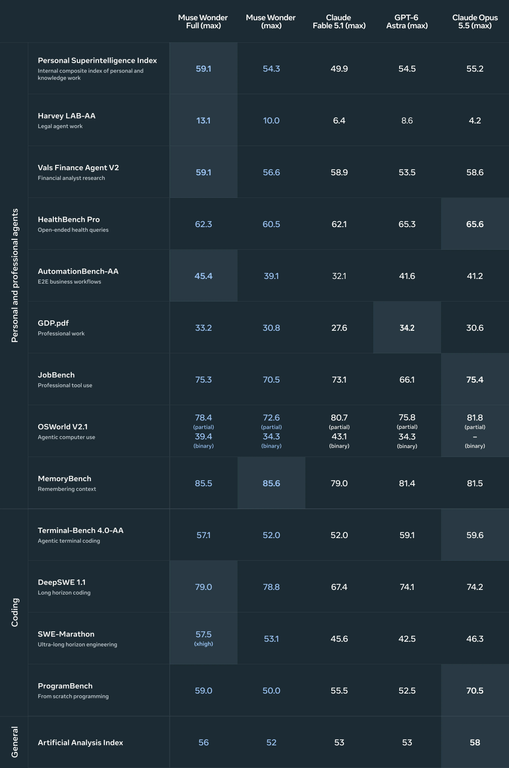
Meta highlighted MemoryBench in its launch materials. The company said Muse Wonder scored higher on the benchmark than several competing models, including Fable, Opus and Astra, according to its own testing.
However, benchmark results should be interpreted carefully. Performance on a memory evaluation does not automatically establish that a model will remember every important detail accurately in everyday use. Real-world performance also depends on how information is stored, retrieved, updated and protected.
Memory introduces privacy considerations as well. An assistant that retains information over long periods must distinguish relevant details from sensitive information and follow appropriate permissions when using or sharing user data.
Active Focus: Keeping AI Agents on Track
Muse Wonder also introduces a capability Meta calls Active Focus. It is designed to help the model continue working toward a goal when a task becomes difficult.
Long-running AI tasks often fail for reasons that are less obvious than a simple factual mistake. A model may pursue an ineffective strategy, encounter an error, lose track of an earlier requirement or produce an incomplete result.
Active Focus is intended to help the model respond to such situations by trying alternative approaches, recovering from errors and asking for clarification when necessary. Meta also says its models are designed to check in before following through on important actions.
Consider a coding task in which an application fails to run after the initial implementation. An agent with effective task persistence could examine the error, revise its code, test the new version and continue until it reaches a useful result—or determine that it needs additional information.
The same principle could apply to document analysis, administrative work and other workflows involving several dependent steps.
However, persistence does not guarantee correctness. An AI agent can continue working while making flawed assumptions, and a successful-looking output may still contain errors. Users and developers will need appropriate verification, permission controls and review mechanisms, particularly when agents can take consequential actions.
Meta Targets Coding and Professional AI Workflows
Coding is one of the most important applications Meta highlighted for the Muse Wonder family. AI coding tools increasingly help developers generate software, explain unfamiliar code, find errors and build applications from natural-language instructions.
Meta says its new models offer frontier coding performance. If that capability translates into reliable results, Muse Wonder could help developers handle more complicated tasks than simple code completion, including multi-file changes, debugging and building working applications.
The model family also targets professional tasks involving law, finance and healthcare-related work. These applications often require an AI system to interpret lengthy documents, identify relevant details and explain the implications of the information it finds.
For example, a model might help a user understand a lease, navigate an insurance claim or organize information related to personal finances. Meta specifically highlighted these types of real-world tasks in its announcement.
The distinction between assistance and professional judgment remains important. A model can help summarize documents or organize information without replacing qualified legal, financial or medical professionals. High-stakes outputs still require appropriate human review.
For businesses, the broader opportunity is to automate repetitive portions of knowledge work while keeping people involved in decisions that require accountability, contextual judgment or specialized expertise.
Muse Wonder Benchmark Performance and Competition
Meta says Muse Wonder and Muse Wonder Full deliver state-of-the-art performance across several personal and professional agent evaluations. In its model card and launch materials, the company presented comparisons with competing frontier models.
TechCrunch reported that Meta’s testing showed the new models achieving benchmark scores comparable to Fable 5.1 and GPT-6 Astra. Meta also emphasized Muse Wonder’s MemoryBench results and its coding capabilities.
| Evaluation area | Meta’s stated focus | What it could mean in practice |
|---|---|---|
| Coding | Frontier-level software development | Generating, debugging and improving code |
| Memory | Stronger recall and memory construction | Maintaining relevant context across sessions |
| Agentic tasks | Multi-step personal and professional work | Completing workflows rather than isolated prompts |
| Reasoning | Complex task interpretation | Working through documents and interconnected problems |
| Error recovery | Active Focus | Trying alternative approaches when an initial attempt fails |
These results are based on company-reported evaluations and should not be treated as a definitive ranking of all available AI models. Different benchmarks measure different capabilities, and results can vary depending on test design, model configuration and whether external tools are permitted.
Independent evaluations will help establish how the models perform on realistic tasks, including reliability over long sessions, the accuracy of their memory and the frequency with which they need human intervention.
Muse Wonder API Pricing and Developer Access
Meta is making Muse Wonder available through its Meta Model API and Muse Code, giving developers and builders ways to experiment with the model.
According to TechCrunch, the API pricing is $4 per million input tokens and $20 per million output tokens. Input tokens represent the information sent to the model, while output tokens represent the content it generates.
| API usage | Price per million tokens |
|---|---|
| Input tokens | $4 |
| Output tokens | $20 |
The difference between input and output pricing matters for applications that generate long responses or run multi-step agent workflows. Such applications can consume substantial output tokens as the model plans, writes code, analyzes information and revises results.
The cost of a complete workflow may also include tool usage, external services, storage and repeated model calls. Developers should therefore evaluate total task cost rather than relying only on the price of a single request.
Muse Wonder Full is not being served through the API at launch. Its availability is restricted to Muse Code subscribers, according to TechCrunch. Meta has not provided a comparable public per-token API price for this version.
The access model gives Meta a way to introduce advanced capabilities through its own products while providing developers with a separate route to build applications using Muse Wonder.
Meta’s AI Strategy After Muse Spark
The release follows a broader reorganization of Meta’s AI efforts. The company has spent the past year rebuilding parts of its AI research and infrastructure strategy as it seeks to compete more directly with companies that have released highly capable models and AI assistants.
Muse Spark represented an earlier step in this effort, focusing on a lightweight model with low latency. Muse Wonder expands the strategy toward more capable systems intended to handle complicated tasks and longer-running workflows.
Meta says the new models were trained at its Prometheus data center in central Ohio, which came online earlier in 2026. The facility reflects the importance of computing infrastructure in developing and serving increasingly capable AI systems.
The company is also working to connect its models to Muse, its personal AI agent. This creates a path for Meta to turn improvements in model capability into features users can access through its products.
The strategy is significant because Meta operates major consumer platforms and communication services. Stronger AI capabilities could support personal assistance, content creation, productivity and developer tools across its ecosystem.
However, the commercial impact will depend on adoption, product quality, operating costs and user trust. Releasing a frontier model is an important milestone, but sustaining performance and delivering useful experiences at scale are separate challenges.
Safety, Privacy and Long-Term AI Agents
Meta says the Muse Wonder family was trained to avoid sharing private information without permission, refuse requests to assist with harmful activities and help improve security against cyberattacks.
The company also said it designed the models to support defensive cybersecurity work, such as identifying weaknesses in a developer’s own code. Meta plans to provide a fuller report on safety evaluations.
These safeguards are especially relevant for agentic systems. A model that can work across messages, calendars and documents may have access to information that is more sensitive than an ordinary question-and-answer exchange.
Memory and persistence create additional challenges. The system must use stored information appropriately, recognize when it lacks permission to take an action and avoid treating an incorrect assumption as a reliable fact.
Safety evaluations, permission boundaries, audit logs and human confirmation for consequential actions can help reduce risks. Yet no single model-level safeguard eliminates every possibility of error or misuse.
The quality of the surrounding software and the way developers configure access will also influence how safely these models operate in practice.
The Bigger Picture
Meta’s Muse Wonder launch signals a shift in its AI ambitions from lightweight conversational systems toward more capable agents that can work through complex tasks over time. The combination of memory, persistence and coding ability reflects a wider industry focus on AI systems that can do more than produce a single response.
The release also puts Meta more directly into competition with established frontier-model developers. Its API access, subscription-based coding product and planned integration with Muse create several routes to adoption. But benchmark claims alone will not determine success: real-world reliability, privacy, operating costs and the ability to complete tasks without excessive supervision will matter just as much.
Looking Ahead
The next stage for Muse Wonder will be its integration into Muse and the expansion of access to users. Meta says the model will begin powering additional Muse experiences, with the rollout starting with subscribers. Developers will also be able to evaluate the standard model through the API and Muse Code, while further independent testing should clarify its strengths and limitations across coding, memory and long-running agent workflows.
For the broader AI industry, the launch highlights how competition is increasingly centered on agents that can retain context, recover from mistakes and execute multi-step work. If Meta can translate its stated capabilities into dependable products, Muse Wonder could become an important part of its AI ecosystem. Its longer-term impact will depend on how well the models perform outside benchmark environments and whether users trust them with increasingly complex personal and professional tasks.
Get the day’s top stories in your inbox
One concise email. No spam, unsubscribe anytime.


