
Microsoft AI has introduced MAI-Transcribe-2-Streaming alongside MAI-Voice 2.1, expanding its proprietary foundational speech ecosystem for enterprise and consumer applications. Engineered under the leadership of Microsoft AI Chief Executive Officer Mustafa Suleyman, the dual release provides the real-time audio foundations required to run natural, fluid voice agents—combining ultra-low-latency automatic speech recognition (ASR) with expressive, emotionally nuanced neural text-to-speech (TTS) across more than 40 global languages.
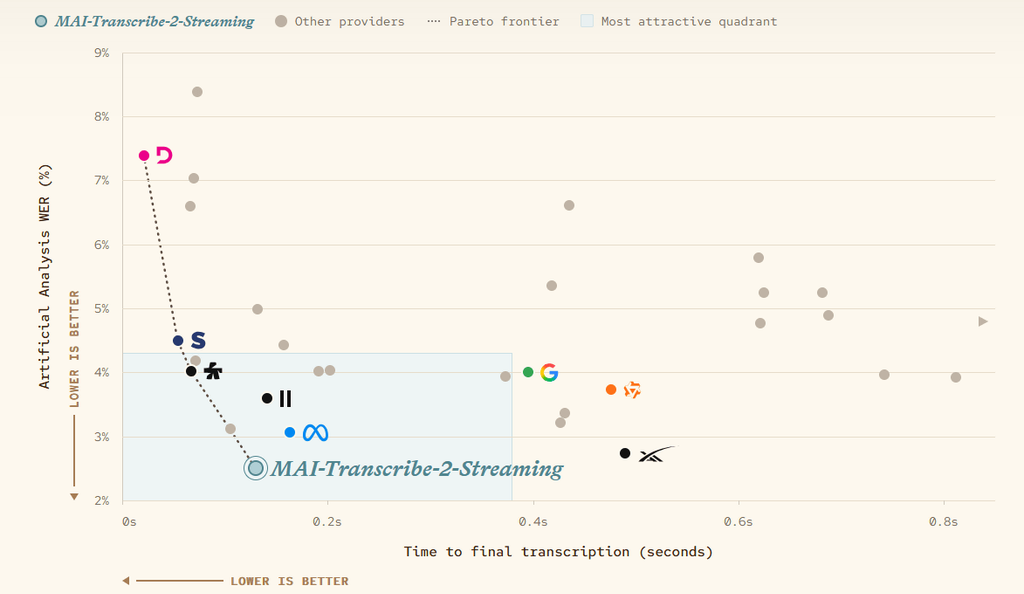
The releases address the central bottleneck in voice-based artificial intelligence: turn-taking latency. While text-based reasoning models have accelerated rapidly, interactive voice systems have historically been slowed down by multi-second delays as audio is recorded, sent to the cloud, transcribed, reasoned over, synthesized, and played back. By lowering the speech-to-text transcription latency down to sub-150-millisecond windows and pairing it with instant, token-streamed vocal generation, Microsoft aims to make human-to-machine voice interaction feel as responsive as a natural phone conversation.
Key Takeaways
- The Dual Audio Architecture: Microsoft AI has rolled out MAI-Transcribe-2-Streaming (for instantaneous speech-to-text) and MAI-Voice 2.1 (for natural, emotionally calibrated speech generation), designed to function as an integrated real-time audio pipeline.
- Sub-150ms Streaming Latency: MAI-Transcribe-2-Streaming processes live audio chunks as small as 80–120 milliseconds, delivering partial and finalized transcriptions with word-level error rates (WER) that rival or exceed offline batch models.
- Multilingual Expansion (40+ Languages): MAI-Voice 2.1 expands native voice synthesis, accent retention, and cross-lingual zero-shot voice cloning across 42 languages, including regional dialects across European, East Asian, and Indic linguistic groups.
- Controllable Prosody & Latency Tuning: Developers can steer MAI-Voice 2.1’s vocal inflection, pacing, breathing sounds, and conversational tone via structured style tags or natural-language conditioning prompts, matching output tone to context (e.g., empathetic customer service vs. crisp broadcast updates).
- Enterprise Azure & Copilot Integration: The models are deploying across Azure AI Speech services, Microsoft Teams live transcription feeds, and the next-generation voice interface of Microsoft Copilot.
Central Question: Why Did Microsoft AI Build MAI-Transcribe-2-Streaming and MAI-Voice 2.1?
Direct Answer: Microsoft AI developed these dedicated models to solve the “latency and expressiveness gap” in voice agent loops. Real-time voice agents require immediate interruption handling, instant transcription, and conversational vocal delivery. Relying on generic, non-streaming ASR and robotic text-to-speech engines creates an artificial pause of 1.5 to 3 seconds between user input and machine response. By co-designing an ultra-fast streaming transcriber with a low-latency, emotionally responsive voice synthesis engine, Microsoft has collapsed total round-trip conversation latency below 350–400 milliseconds—the threshold where machine conversation begins to feel natural to human listeners.
                         THE REAL-TIME CONVERSATIONAL AUDIO LOOP
                                            │
                                            ▼
                           USER SPEAKS INTO MICROPHONE
                                            │
                                            ▼
                        MAI-TRANSCRIBE-2-STREAMING (ASR)
                  • Ingests continuous 80–120ms audio frames
                  • Sub-150ms time-to-first-word transcription
                  • Instant acoustic interruption & barge-in detection
                                            │
                                            ▼
                       REASONING CORE (LLM / DECISION AGENT)
                   • Processes text tokens & formulates response
                   • Streams initial output tokens instantly
                                            │
                                            ▼
                                   MAI-VOICE 2.1 (TTS)
                  • Low-latency token-to-speech audio synthesis
                  • Dynamic inflection, emotional cues & breathing
                  • Speaks back in 40+ native languages & accents
                                            │
                                            ▼
                           NATURAL CONVERSATION DELIVERED
Technical Specifications: MAI-Transcribe-2-Streaming
MAI-Transcribe-2-Streaming represents a ground-up rework of Microsoft’s production transcription architecture, optimized specifically for live streaming inputs rather than static audio file uploads:
+-----------------------------------------------------------------------------------+
|               MAI-TRANSCRIBE-2-STREAMING: ARCHITECTURAL PARAMETERS                 |
+-----------------------------------------------------------------------------------+
| Metric / Feature               | Disclosed Specification / Benchmark              |
+--------------------------------+---------------------------------------------------+
| **Architecture**               | Streaming Conformer / Neural Transducer hybrid    |
| **Streaming Chunk Size**       | 80ms – 160ms configurable frame window            |
| **Median Transcription Latency**| **< 140 milliseconds**                           |
| **Acoustic Noise Resilience**  | Trained on 1.2M+ hours of reverberant, noisy audio|
| **Word Error Rate (WER)**      | ~3.8% on clean speech; < 7.2% on multi-speaker    |
| **Speaker Diarization**        | Real-time dynamic speaker-switch tracking         |
| **Barge-in / Interruption**    | Microsecond voice activity detection (VAD) cutoff |
| **Language Coverage**          | Native support for 35 primary global languages    |
+--------------------------------+---------------------------------------------------+
1. Conformer-Transducer Hybrid Design
Unlike standard encoder-decoder models (such as batch Whisper variants) that require several seconds of audio context to establish attention over a sentence, MAI-Transcribe-2-Streaming uses a causal, chunked-attention Conformer architecture. It emits finalized word tokens progressively while the speaker is still vocalizing, reducing memory overhead and eliminating the processing delays associated with batch processing.
2. Built-In Interruption (“Barge-in”) Detection
A major flaw in conversational agents is “talking over the user.” MAI-Transcribe-2-Streaming incorporates an ultra-fast neural Voice Activity Detector (VAD) directly into the acoustic encoder. When a user interrupts while the agent is speaking, the model detects speech onset within 60 milliseconds, immediately firing an interruption event to halt audio playback and pivot the conversational state.
Technical Specifications: Multilingual MAI-Voice 2.1
MAI-Voice 2.1 serves as the voice synthesis and vocal delivery engine of the pipeline, turning streamed text tokens into realistic, emotionally expressive audio:
| Feature / Dimension | MAI-Voice 2.1 | Legacy Azure Neural TTS | Competing Industry Frontier (ElevenLabs/OpenAI) |
| Generation Latency | Sub-120ms Time-to-First-Audio (TTFA) | ~400ms – 750ms | ~150ms – 300ms |
| Multilingual Breadth | 42 Languages natively supported | 30+ (Separate voice profiles) | 29–32 Languages |
| Zero-Shot Voice Cloning | 3-second reference audio sample | Requires custom model training | 1-minute to 5-minute samples |
| Prosody & Tone Control | Natural-language prompts or <style> tags | Preset SSML tags (rigid) | Contextual inference from text |
| Acoustic Artifacts | Sub-audible breaths, micro-pauses | Robotic smoothing on long forms | High fidelity, occasional drift |
                           MAI-VOICE 2.1 MULTILINGUAL STACK
                                          │
       ┌──────────────────────────────────┼──────────────────────────────────┐
       ▼                                  ▼                                  ▼
CROSS-LINGUAL ZERO-SHOT          DYNAMIC STYLE PROMPTING            LOW-BITRATE STREAMING
Clones a speaker's vocal timbre  Instruct the voice using plain     Delivers broadcast-quality
from a 3-second sample and       English: *"Speak with urgency      24kHz / 48kHz audio over
speaks fluently in 42 languages   and soft empathy, like a doctor    bandwidth-constrained
without an artificial accent.     reassuring a nervous patient."*    mobile or call-center lines.
1. Cross-Lingual Zero-Shot Voice Transfer
MAI-Voice 2.1 allows a speaker’s unique vocal identity (pitch, cadence, resonance) to be captured from a three-second audio reference and ported into other languages. An executive speaking in English can be cloned to speak fluent Mandarin, German, Hindi, or Spanish while preserving their signature vocal qualities, eliminating the need to record separate training datasets for each target language.
2. Contextual Emotion and Non-Verbal Realism
Traditional text-to-speech systems often sound flat or overly theatrical because they synthesize sentences in isolation. MAI-Voice 2.1 models conversational flow:
- Non-Verbal Cues: Inserts realistic breathing patterns, hesitations, and micro-pauses that match the sentence structure.
- Prompt-Based Emotional Steering: Developers can condition the voice using simple natural-language directives (e.g.,
tone="thoughtful, calm, slightly hesitant") without having to manually code complex SSML pitch and rate tags.
Enterprise and Consumer Deployment Footprint
Microsoft is deploying MAI-Transcribe-2-Streaming and MAI-Voice 2.1 across its enterprise cloud and consumer software products:
                            THE ECOSYSTEM DEPLOYMENT MAP
                                          │
       ┌──────────────────────────────────┼──────────────────────────────────┐
       ▼                                  ▼                                  ▼
MICROSOFT COPILOT VOICE           MICROSOFT TEAMS LIVE               AZURE AI SPEECH DEVELOPERS
• Powers fluid voice chat on      • Real-time meeting captioning     • Available via API & SDK
  Windows 11, iOS, and Android      with dynamic translation         • Edge runtime for on-premise
• Hands-free desktop control      • Zero-delay transcription logs      enterprise data security
- Microsoft Copilot Voice Overhaul: The new models will power Copilot’s voice interaction layer across Windows 11, mobile apps, and dedicated Copilot+ PCs, allowing users to brainstorm, research, and edit code through spoken conversation.
- Microsoft Teams Real-Time Translation: Live captions and simultaneous interpretation in Teams meetings will transition to MAI-Transcribe-2-Streaming, providing real-time translated subtitles with lower latency and higher speaker separation accuracy.
- Contact Center Automation: Deployed via Azure AI Studio, enterprise customers (such as banks, airlines, and healthcare providers) can deploy customer service phone agents capable of handling complex queries with human-like responsiveness.
Frequently Asked Questions (FAQs)
What are MAI-Transcribe-2-Streaming and MAI-Voice 2.1?
MAI-Transcribe-2-Streaming and MAI-Voice 2.1 are proprietary artificial intelligence speech models developed by Microsoft AI. The former is an ultra-low-latency streaming speech-to-text model designed for live transcription, while the latter is an expressive, multilingual text-to-speech synthesis model supporting over 40 languages.
How fast is MAI-Transcribe-2-Streaming?
MAI-Transcribe-2-Streaming delivers partial transcriptions with a median latency under 140 milliseconds, processing audio chunks in 80ms to 160ms windows to enable responsive conversational AI loops.
How many languages does MAI-Voice 2.1 support?
MAI-Voice 2.1 natively supports 42 languages, with cross-lingual zero-shot cloning capabilities that allow a voice recorded in one language to speak other supported languages while preserving vocal timbre.
What is zero-shot voice cloning in MAI-Voice 2.1?
Zero-shot voice cloning enables the model to replicate a person’s voice characteristics from an audio sample as short as three seconds, without requiring hours of studio recordings or dedicated model fine-tuning.
Where will these models be available?
The models are rolling out across Microsoft Azure AI Speech services for enterprise developers, while powering consumer experiences in Microsoft Copilot Voice and Microsoft Teams real-time captioning.
Get the day’s top stories in your inbox
One concise email. No spam, unsubscribe anytime.


