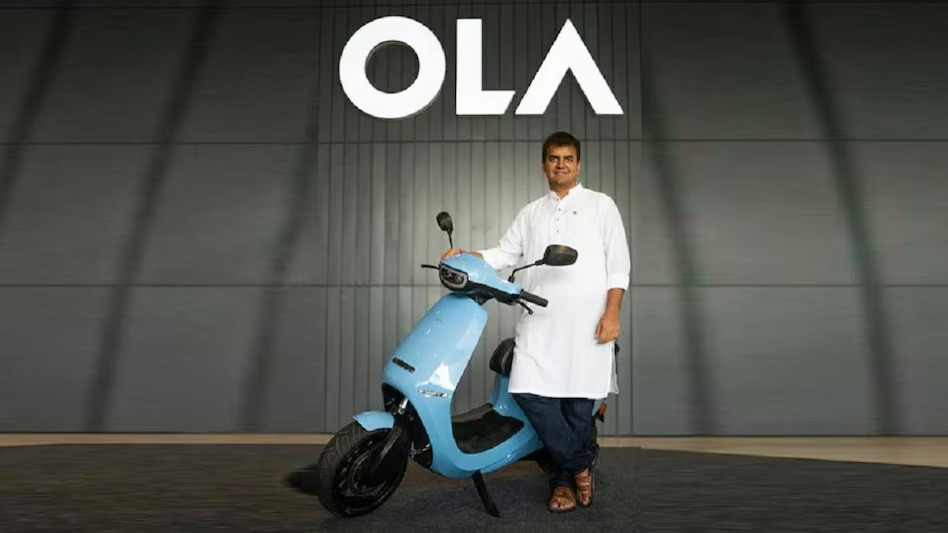
Ola Electric Mobility is facing fresh scrutiny over its June-quarter financial results after its auditor, BSR & Co., the Indian affiliate of KPMG, issued a qualified conclusion concerning the electric two-wheeler maker’s decision to reverse a ₹57 crore provision for penalties under the government’s battery-cell Production Linked Incentive (PLI) scheme.
The company reversed the provision even though the Ministry of Heavy Industries (MHI) had not formally approved its request for an extension of the PLI investment deadline or waived the associated penalties. The accounting treatment helped Ola Electric reduce its reported June-quarter loss, making the auditor’s qualification particularly important for investors.
The development adds to a series of challenges for Ola Electric, which is simultaneously dealing with weak revenue growth, declining market share and regulatory scrutiny. Since its stock-market listing in August 2024, the company’s shares have fallen about 46%, compared with a 17% gain in the Nifty Auto index, while its electric two-wheeler market share has fallen from around 35% in FY24 to 8% in June 2026.
The ₹57 crore accounting issue
The central issue is straightforward.
Ola Electric had previously recognised a provision of ₹57 crore for potential penalties related to missed milestones under the government’s Advanced Chemistry Cell battery PLI scheme.
In the June quarter, the company reversed the entire provision.
The reversal reduced expenses and therefore reduced the reported loss.
However, at the end of the quarter, the Ministry of Heavy Industries had not yet approved Ola’s request for an extension and waiver.
That uncertainty prompted BSR & Co. to qualify its limited review of the financial statements.
How the accounting change affected Ola’s results
| Metric | Reported Q1 FY27 | Without ₹57 crore reversal |
|---|---|---|
| Net loss | ₹336 crore | ₹393 crore |
| Revenue | ₹455 crore | ₹455 crore |
| Revenue YoY change | -45% | -45% |
| PLI provision reversal | ₹57 crore | Not reversed |
| Auditor conclusion | Qualified | — |
The difference is significant.
Ola’s reported net loss was ₹336 crore, compared with ₹428 crore in the year-ago quarter. But without the ₹57 crore reversal, the June-quarter loss would have been approximately ₹393 crore.
OLA ELECTRIC Q1 FY27 LOSS

Reported loss
₹336 crore
████████████████████████████

Without ₹57 crore reversal
₹393 crore
████████████████████████████████

Year-ago loss
₹428 crore
██████████████████████████████████
This means the reversal materially changed the headline loss figure, even though Ola continued to report a year-on-year reduction in losses.
Why the auditor objected
The auditor’s concern was not necessarily that Ola’s accounting treatment was definitively wrong.
Instead, BSR & Co. said it did not have sufficient evidence to determine whether the reversal was justified because the Ministry of Heavy Industries had not formally approved the requested extension and waiver.
That distinction is important.
A qualified conclusion does not automatically mean fraud or accounting manipulation.
It means the auditor could not obtain sufficient appropriate evidence to conclude that a particular accounting treatment was fully supportable.
What the auditor was looking for
Ola misses PLI milestone
        ↓
Potential penalty
        ↓
₹57 crore provision created
        ↓
Ola requests extension + waiver
        ↓
MHI decision pending
        ↓
Ola reverses provision
        ↓
Auditor asks:
"Is the waiver formally approved?"
        ↓
No
        ↓
Qualified conclusion
The uncertainty therefore centres on the timing and evidence supporting the reversal.
What is the battery PLI scheme?
The government introduced the Advanced Chemistry Cell PLI programme to encourage domestic manufacturing of advanced batteries in India.
The objective is to reduce dependence on imported battery cells and establish a domestic battery manufacturing ecosystem.
Ola Electric was selected under the programme in 2022 with an awarded capacity of 20 GWh.
The company subsequently decided to initially limit its cell manufacturing capacity to 6 GWh, with plans to expand later after additional investment.
That change contributed to its failure to meet the original investment milestones under the scheme.
Ola’s battery PLI journey
| Stage | Development |
|---|---|
| 2022 | Selected under ACC battery PLI |
| Original awarded capacity | 20 GWh |
| Investment requirement | ₹225 crore per GWh |
| Initial capacity decision | 6 GWh |
| Investment milestone | Missed |
| Government notice | March 2025 |
| Provision created | ₹57 crore |
| Extension/waiver request | Submitted to MHI |
| Formal waiver by June 30, 2026 | Not received |
| Provision reversal | Q1 FY27 |
The original investment requirement was ₹225 crore per GWh of awarded capacity within two years. Ola did not meet that timeline.
Why Ola believes it can avoid the penalty
Ola Electric has argued that it expects the Ministry of Heavy Industries to approve its request.
The company said it had held discussions with the ministry and was confident of obtaining the requested extension and waiver.
Based on that expectation, it reversed the existing provision and did not create a new provision from April 1, 2026.
The company therefore believes the ₹57 crore liability will ultimately not have to be paid.
But the critical issue is that confidence is not the same as formal government approval.
That is the gap highlighted by the auditor.
Why the timing matters
The market reaction is covered in our report on Ola Electric shares slipping 6% after the Q1 results, while rival demand keeps building, as with Ather pre-orders crossing 50,000.
If the government eventually grants the waiver, Ola’s accounting treatment could receive stronger support.
If the government rejects the request or imposes a penalty, Ola may have to recognise the liability again.
SCENARIO 1

MHI approves waiver
        ↓
₹57 crore penalty avoided
        ↓
No major additional liability
        ↓
Earlier reversal supported


SCENARIO 2

MHI rejects waiver
        ↓
Penalty remains payable
        ↓
Provision may need to be restored
        ↓
Future earnings affected
This makes the ministry’s decision an important potential catalyst for Ola Electric.
Revenue remains another major problem
The auditor issue is not Ola Electric’s only challenge.
The company reported ₹455 crore of revenue in the June quarter, down 45% year-on-year.
This marked the company’s seventh consecutive quarter of revenue decline, according to the report.
That means the business is facing a more fundamental issue than a one-off accounting dispute.
The company needs to restore sales growth while simultaneously improving profitability.
Ola Electric Q1 FY27 snapshot
| Metric | Q1 FY27 |
|---|---|
| Revenue | ₹455 crore |
| Revenue growth YoY | -45% |
| Net loss | ₹336 crore |
| Net loss without provision reversal | ₹393 crore |
| PLI provision reversed | ₹57 crore |
| Market share, June 2026 | ~8% |
The revenue decline suggests that Ola’s operational recovery remains incomplete.
Market share has fallen sharply
Perhaps the most worrying number for the company’s core business is its market share.
Ola Electric’s share of India’s electric two-wheeler market has fallen from approximately 35% in FY24 to 8% in June 2026.
OLA ELECTRIC MARKET SHARE

FY24
35%
███████████████████████████████████

June 2026
8%
████████
That represents a dramatic loss of market position.
The company once dominated India’s electric scooter market, but competitors have steadily increased their presence.
Competition has intensified
Ola Electric is competing against established two-wheeler manufacturers and other EV-focused companies.
The competitive environment now includes companies with:
- Established dealer networks
- Strong brand recognition
- Large manufacturing capacity
- Existing customer relationships
- Wider product portfolios
- Greater financial resources
As the market matures, early-mover advantages become less powerful.
Customers have more choices, and established manufacturers are increasingly entering the electric segment.
Ola’s cost structure remains challenging
Electric vehicle manufacturing requires significant upfront investment.
Ola has been investing in:
- Battery manufacturing
- Vehicle production
- Research and development
- Software
- Charging infrastructure
- Distribution
- Service networks
- New products
These investments can weigh heavily on a company that is simultaneously experiencing falling revenue.
Heavy investment
      +
Falling revenue
      +
Competitive pricing
      ↓
High cash requirements
      ↓
Pressure on profitability
This is why government incentives such as PLI support can be financially important for EV manufacturers.
PLI support works in two different ways for Ola
Ola is involved in more than one government PLI framework.
The company has received support under the PLI-Auto scheme, separate from the battery-cell PLI programme.
In December 2025, Ola received approval for approximately ₹366.78 crore under the PLI-Auto programme for FY25.
The battery PLI issue discussed in the latest results is different.
Ola’s PLI exposure
| Scheme | Focus | Status |
|---|---|---|
| PLI-Auto | EVs and auto components | Ola received ~₹366.78 crore for FY25 |
| ACC Battery PLI | Advanced battery cells | Milestone dispute |
| Battery PLI provision | Potential liquidated damages | ₹57 crore reversed |
| Waiver request | Extension + penalty waiver | MHI approval pending |
The distinction is important because receiving an incentive under one scheme does not automatically resolve obligations under another.
What a qualified audit conclusion means
For investors, the phrase “qualified opinion” can sound alarming.
But there are different levels of auditor conclusions, and a qualification does not automatically mean a company’s entire financial statement is unreliable.
In this case, the auditor’s concern is specifically tied to the reversal of the PLI provision and the lack of sufficient evidence from MHI approval.
Simple explanation
Clean conclusion:
Auditor has enough evidence and finds no material issue with the reviewed matter.
Qualified conclusion:
Auditor has identified a specific matter where sufficient evidence is unavailable or a departure may exist.
Adverse opinion:
Auditor concludes that the financial statements are materially misstated overall.
Disclaimer:
Auditor cannot obtain enough evidence to form a conclusion.
Ola’s current situation is therefore not equivalent to an adverse audit opinion.
This is not the first auditor concern at Ola
BSR & Co. had previously flagged internal financial-control issues in a qualified opinion on the FY25 results of Ola Electric Technologies Pvt. Ltd., the operating subsidiary responsible for nearly all of Ola Electric Mobility’s revenue.
That history makes the latest qualification more significant for investors.
The latest issue is different, but it adds to existing questions around the company’s financial controls and accounting processes.
Experts disagree on how serious the issue is
Corporate-governance researcher Shriram Subramanian of InGovern Research Services described the move as potentially reflecting aggressive accounting, particularly if Ola continues to exclude the provision from its annual accounts despite not receiving final approval from the Ministry of Heavy Industries.
However, Paras Savla of KPB & Associates cautioned that the auditor qualification alone does not prove the accounting treatment is wrong.
His view is that the auditor needs sufficient evidence to determine whether the treatment is appropriate.
This distinction is important for shareholders.
Auditor qualification
        ≠
Proof of wrongdoing

Instead:

Auditor qualification
        ↓
Accounting uncertainty
        ↓
Need for additional evidence
        ↓
Investor scrutiny
Why investors are watching the issue closely
Ola Electric is a relatively young listed company.
It listed in August 2024, meaning investors have only a limited public-market track record through which to assess its financial controls and long-term profitability.
Since listing, the stock has fallen approximately 46%, significantly underperforming the Nifty Auto index, which gained around 17% over the same period.
Stock performance since listing
| Indicator | Performance |
|---|---|
| Ola Electric | ~46% decline |
| Nifty Auto | ~17% gain |
| Relative performance gap | ~63 percentage points |
The weak stock performance indicates that investors are already demanding evidence of a turnaround.
Ola faces three major challenges
The latest developments can broadly be divided into three categories.
1. Financial performance
Revenue continues to decline and losses remain substantial.
2. Accounting uncertainty
The ₹57 crore provision reversal has triggered a qualified auditor conclusion.
3. Competitive pressure
Market share has fallen dramatically.
                 OLA ELECTRIC
                      │
       ┌──────────────┼──────────────┐
       ▼              ▼              ▼
   Revenue         Accounting     Market share
    decline        uncertainty       decline
       │              │              │
       └──────────────┼──────────────┘
                      ▼
             Investor concerns
The company’s recovery therefore requires improvement across multiple areas rather than simply resolving the PLI dispute.
The battery business remains strategically important
Ola Electric has invested heavily in developing its own battery-cell manufacturing capabilities.
The strategy is designed to reduce dependence on imported cells and give the company greater control over:
- Battery costs
- Cell technology
- Vehicle performance
- Supply chains
- Localisation
- Future EV economics
India is also seeking to establish itself as a major battery-manufacturing hub.
That makes Ola’s battery ambitions strategically important beyond the company itself.
Why the government PLI programme matters
The ACC battery PLI scheme was created to encourage large-scale domestic battery manufacturing.
The government’s broader objective is to build a local ecosystem for advanced battery technologies.
Government incentives
        ↓
Battery manufacturing investment
        ↓
Domestic cell production
        ↓
Lower import dependence
        ↓
EV ecosystem development
        ↓
India manufacturing hub
Ola’s inability to meet the original investment timeline highlights the difficulty of translating policy targets into actual manufacturing capacity.
The ₹225 crore-per-GWh requirement is significant
Ola’s original award covered 20 GWh.
At the stipulated investment level of ₹225 crore per GWh, the implied investment commitment was substantial.
Original capacity calculation
| Item | Figure |
|---|---|
| Awarded capacity | 20 GWh |
| Investment requirement | ₹225 crore/GWh |
| Implied investment commitment | ₹4,500 crore |
| Initial capacity later pursued | 6 GWh |
The ₹4,500-crore figure is a simple calculation based on the reported ₹225 crore per GWh requirement multiplied by the original 20 GWh award. It should not be interpreted as the amount Ola has already spent.
The company’s decision to initially limit capacity to 6 GWh was a major change from its original plan.
Why Ola’s battery strategy changed
The decision to limit initial capacity appears to have been linked to the need for additional investment and a phased approach to manufacturing.
Building large-scale battery capacity requires enormous capital expenditure and involves technology and execution risks.
For an EV company experiencing rapid changes in demand and competition, committing billions of rupees before achieving sufficient scale can be financially risky.
Ola therefore chose a more gradual expansion path.
But that decision created tension with the original PLI milestones.
What happens if MHI grants the waiver?
If the Ministry of Heavy Industries approves the extension and penalty waiver, Ola could avoid the ₹57 crore liability.
That would remove one immediate financial concern.
More importantly, it would eliminate a significant part of the accounting uncertainty that triggered the auditor’s qualified conclusion.
MHI approval
    ↓
Penalty waived
    ↓
₹57 crore provision unnecessary
    ↓
Accounting treatment supported
    ↓
Audit concern reduced
However, it would not solve Ola’s revenue decline or market-share problem.
What happens if MHI rejects the request?
If the ministry does not grant the waiver, Ola could potentially have to recognise the liability.
The financial impact would be relatively small compared with the company’s overall losses, but the accounting and governance implications could be more significant.
MHI rejection
      ↓
Penalty liability
      ↓
Provision potentially restored
      ↓
Higher loss
      +
Additional cash outflow
      +
Further investor scrutiny
The market could therefore react more strongly to the signal about financial controls than to the ₹57 crore itself.
The bigger concern is not ₹57 crore
For a company reporting quarterly losses of hundreds of crores, ₹57 crore is not transformative by itself.
The bigger concern is what the episode tells investors about financial reporting.
Investors need confidence that:
- Provisions are recognised appropriately
- Liabilities are not removed prematurely
- Government approvals are properly documented
- Internal controls are effective
- Financial statements accurately reflect uncertainty
This is why the auditor’s qualification has attracted more attention than the absolute value of the provision.
Ola’s market-share decline is more fundamental
The company’s fall from approximately 35% market share in FY24 to 8% in June 2026 represents a much larger strategic challenge.
A company can recover from a one-time ₹57 crore accounting adjustment.
Recovering 27 percentage points of market share is much harder.
That requires:
- Competitive products
- Reliable service
- Attractive pricing
- Strong distribution
- Customer trust
- Product innovation
- Manufacturing efficiency
The company’s ability to reverse this market-share decline will likely be more important to long-term investors than the PLI provision itself.
What Ola needs to prove
The company now needs to demonstrate progress on several fronts.
| Area | What investors want to see |
|---|---|
| Revenue | Return to growth |
| Market share | Stabilisation and recovery |
| Losses | Sustained reduction |
| Gross margins | Improvement |
| Cash flow | Lower cash burn |
| Battery manufacturing | Milestone achievement |
| PLI dispute | Formal MHI resolution |
| Governance | Stronger financial controls |
| Product portfolio | Successful new launches |
| Service | Better customer experience |
A successful turnaround would require progress across most of these metrics.
Ola Electric’s recovery challenge
                 TURNAROUND
                     │
       ┌─────────────┼─────────────┐
       ▼             ▼             ▼
   Sales growth   Cost control   Market share
       │             │             │
       ▼             ▼             ▼
    Revenue       Lower loss    Competitive
     recovery                    recovery
       │             │             │
       └─────────────┼─────────────┘
                     ▼
              Better cash flow
                     │
                     ▼
             Investor confidence
The PLI issue is therefore one piece of a much larger turnaround story.
Key numbers to watch
| Metric | Current figure |
|---|---|
| Q1 FY27 revenue | ₹455 crore |
| Revenue YoY | -45% |
| Q1 FY27 net loss | ₹336 crore |
| Loss without ₹57 crore reversal | ₹393 crore |
| FY25 comparable loss | ₹428 crore |
| PLI provision reversed | ₹57 crore |
| Original battery capacity award | 20 GWh |
| Initial capacity pursued | 6 GWh |
| Investment requirement | ₹225 crore/GWh |
| Market share in FY24 | ~35% |
| Market share in June 2026 | ~8% |
| Share performance since listing | ~46% decline |
| Nifty Auto performance since comparable period | ~17% gain |
| PLI-Auto incentive approved for FY25 | ₹366.78 crore |
What investors should watch next
The most immediate catalyst is the Ministry of Heavy Industries’ decision on Ola’s request for an extension and waiver.
Investors should also monitor:
- Whether the ₹57 crore provision remains reversed
- Any additional auditor comments
- Ola’s full-year FY27 accounting treatment
- Revenue recovery
- EV two-wheeler market share
- Vehicle deliveries
- Battery-cell production milestones
- Cash burn
- New product launches
- Regulatory developments
- Progress on financial controls
A formal MHI decision could remove one major uncertainty, but operational recovery will remain the bigger challenge.
The broader implication for India’s EV industry
Ola’s experience also highlights the difficulty of building a domestic battery ecosystem.
India wants to reduce dependence on imported cells and develop local manufacturing.
But battery factories require:
- Large capital investments
- Advanced technology
- Reliable supply chains
- High utilisation
- Skilled workers
- Strong demand
- Long-term policy certainty
If companies struggle to meet production milestones, government incentives may need to balance strict performance requirements with the realities of building a new industry.
Why the PLI dispute matters beyond Ola
The outcome could also be watched by other companies participating in India’s battery manufacturing programmes.
A decision to grant extensions or waive penalties could influence how policymakers handle delays across the industry.
Conversely, strict enforcement could reinforce the government’s commitment to milestone-based incentives.
Ola PLI case
      ↓
MHI decision
      ↓
Precedent for battery PLI beneficiaries
      ↓
Investment planning
      ↓
Domestic battery manufacturing
The issue is therefore relevant to India’s wider EV and energy-storage ambitions.
Conclusion
Ola Electric’s latest financial results have drawn attention not only because the company continues to report significant losses, but because its auditor, BSR & Co., has issued a qualified conclusion over the reversal of a ₹57 crore PLI-related penalty provision. The provision was reversed even though the Ministry of Heavy Industries had not formally approved Ola’s request for an extension and waiver.
The accounting decision helped Ola report a ₹336 crore net loss for Q1 FY27, compared with ₹428 crore a year earlier. Without the ₹57 crore reversal, the loss would have been approximately ₹393 crore. Revenue simultaneously fell 45% year-on-year to ₹455 crore.
The PLI issue stems from Ola’s original 20 GWh battery-cell manufacturing award. The company later chose to initially pursue only 6 GWh, after which it missed investment milestones linked to the scheme. Ola has now asked MHI for additional time and a waiver of the associated liquidated damages.
For investors, however, the ₹57 crore issue is only one part of the story. Ola’s more fundamental challenge is the sharp deterioration in its competitive position. Its market share has fallen from around 35% in FY24 to 8% in June 2026, while its stock has declined about 46% since its August 2024 listing.
The next major question is whether MHI approves the requested waiver. If it does, one important accounting uncertainty could disappear. If it does not, Ola may have to restore the provision and potentially recognise the liability again.
But even a complete resolution of the PLI issue would not solve Ola Electric’s bigger problems.
The company needs to restore revenue growth, regain market share, reduce losses, strengthen financial controls and successfully scale its battery manufacturing operations.
For Ola Electric, therefore, the ₹57 crore PLI dispute is less about the size of the potential penalty and more about whether the company can rebuild investor confidence while executing a difficult operational turnaround.
Frequently Asked Questions
What did Ola Electric’s auditor flag?
BSR & Co., the Indian affiliate of KPMG, issued a qualified conclusion on the June-quarter results over Ola Electric’s decision to reverse a ₹57 crore provision tied to the battery PLI scheme.
What is the battery PLI scheme?
It is a production-linked incentive programme for domestic battery cell manufacturing, which carries penalties if a company fails to meet its committed milestones.
Why does Ola Electric think it can avoid the penalty?
The company believes it will not incur the penalty the provision covered, which is why it reversed the ₹57 crore. The auditor did not accept that judgement without qualification.
Get the day’s top stories in your inbox
One concise email. No spam, unsubscribe anytime.


