
Clarification, November 13, 2026: The 35% figure measures surveyed Indian organisations’ self-reported readiness for cyberattacks generally, not a separate test of readiness for AI-specific attacks. The headline has been clarified accordingly.
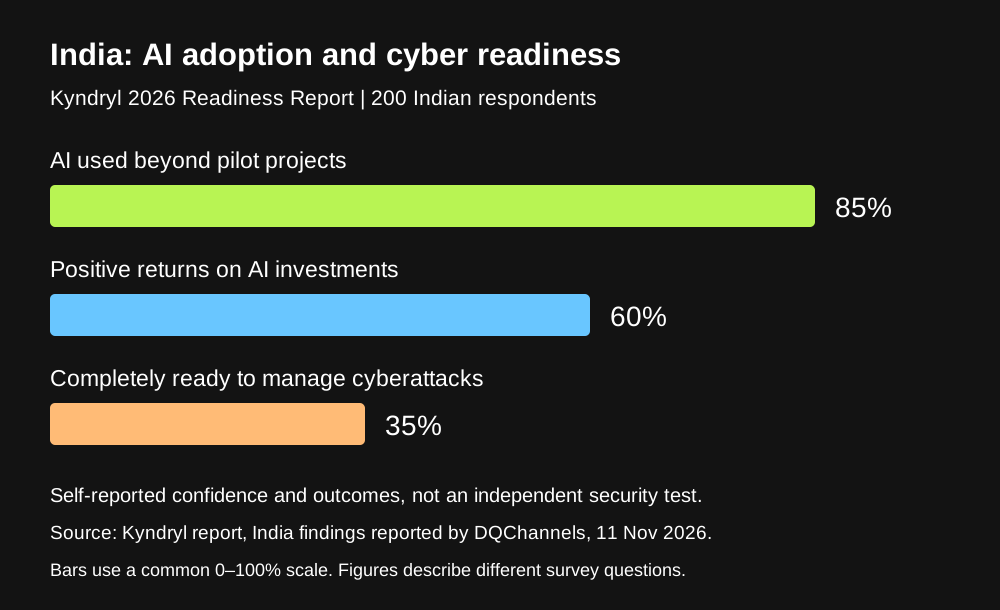
Indian businesses are accelerating their adoption of artificial intelligence, but their ability to defend against increasingly sophisticated cyberattacks is struggling to keep pace. Only 35% of Indian organisations surveyed by technology services company Kyndryl said they were completely prepared to manage cyberattacks, a decline of 10 percentage points from the previous year. The findings highlight a widening gap between enterprise AI adoption and the security capabilities needed to manage its risks.
The findings come from Kyndryl’s 2026 Readiness Report, released on November 10, 2026. The study surveyed 3,700 senior business leaders across 21 countries, including 200 respondents in India. While 60% of Indian respondents reported positive returns from AI investments, overall readiness to manage external risks fell to 27%. The results suggest that companies are finding commercial value in AI while facing growing challenges around cybersecurity, infrastructure modernisation and organisational governance.
Only 35% of Indian Organisations Feel Prepared for Cyberattacks
Cybersecurity has emerged as one of the biggest concerns for Indian businesses adopting AI.
According to Kyndryl, only 35% of Indian organisations said they were completely prepared to manage cyberattacks. That represents a 10-percentage-point decline compared with 2025.
The global picture is also concerning. Only 26% of organisations worldwide described themselves as completely prepared to manage cyberattacks, down 11 percentage points from the previous year.
The findings indicate that businesses are struggling to maintain confidence in their security capabilities as technology environments become more complex.
AI systems increasingly interact with corporate databases, customer information, internal applications and business processes. These connections create additional opportunities for attackers to exploit vulnerabilities, misuse credentials or manipulate automated systems.
For companies deploying AI agents, the risks can extend beyond accessing information. An improperly secured agent may have permissions to execute actions across multiple applications, potentially increasing the consequences of a successful attack.
AI Adoption Is Growing Faster Than Security Readiness
The report highlights a significant difference between the pace of AI deployment and the preparedness of organisations managing its risks.
Around 85% of Indian organisations surveyed are deploying AI in workflows beyond pilot projects. However, scaling these initiatives remains difficult.
Kyndryl identified several challenges:
- 70% of Indian business leaders said their organisations had more AI pilots than they could realistically scale.
- 58% said innovation frequently stalls after the proof-of-concept stage.
- 31% reported experiencing an AI investment failure.
- 50% said their organisations had significantly changed their AI strategies during the previous year.
These findings suggest that businesses are still working out how to integrate AI into established operations while maintaining appropriate oversight.
The problem is not limited to technology. Companies must also determine who is responsible for AI-related decisions, how employees should interact with automated systems and how security teams can monitor activities across different applications.
As AI moves from experimentation into everyday business processes, weaknesses in existing governance structures can become more difficult to manage.
60% of Indian Businesses Report Positive AI Returns
Despite declining security readiness, Indian organisations are reporting stronger financial results from AI investments.
Kyndryl found that 60% of Indian business leaders said their organisations were seeing positive returns from AI and machine learning initiatives. This was an improvement from 57% in 2025.
The findings indicate that businesses are increasingly using AI for practical applications rather than limiting deployments to experimental projects.
However, the growing commercial value of AI does not necessarily mean that organisations have developed the necessary security infrastructure.
Companies may successfully deploy AI for customer service, software development, data analysis and internal automation while still lacking sufficient controls to prevent unauthorised access or misuse.
This creates a challenge for business leaders: they must continue capturing the benefits of AI without allowing security and operational risks to grow alongside adoption.
AI Helps Detect Threats, but Response Capabilities Remain a Concern
One of the report’s more interesting findings is the difference between AI’s role in detecting cyber threats and organisations’ confidence in responding to them.
Three out of four Indian business leaders said AI helps their organisations identify threats faster.
At the same time, confidence in managing cyberattacks has weakened.
This distinction matters because detecting suspicious activity is only one part of cybersecurity. Organisations must also investigate alerts, determine whether systems have been compromised, isolate affected infrastructure and restore normal operations.
AI-powered security tools can help analyse large volumes of information and identify unusual behaviour. However, they cannot automatically guarantee that a company has the people, processes and infrastructure needed to contain an attack.
The growing use of AI agents introduces additional considerations. These systems may access multiple applications and perform tasks without requiring a human to approve every individual action.
If an attacker manipulates an AI agent or gains access to its credentials, the potential consequences could extend across connected business systems.
80% of Indian Organisations Are Using AI Agents
Kyndryl’s research also highlights the increasing use of AI agents in business operations.
Around 80% of Indian organisations surveyed are using AI agents to automate workflows that previously required coordination between multiple teams or systems.
AI agents can perform tasks such as retrieving information, processing requests, interacting with applications and coordinating activities across business functions.
However, these capabilities create new security challenges.
Unlike traditional software that generally follows predefined instructions, AI agents can interpret information and determine the next steps needed to complete a task. When connected to sensitive corporate systems, this flexibility makes access controls particularly important.
Organisations need to establish clear limits on what agents can access and which actions they are authorised to perform.
Security teams must also maintain visibility into agent activity, monitor unusual behaviour and ensure that automated actions can be stopped when something goes wrong.
The report’s findings suggest that businesses are adopting these systems faster than they are developing the organisational capabilities needed to manage them securely.
Infrastructure Modernisation Remains a Major Challenge
Cybersecurity is not the only area where Indian enterprises face readiness problems.
Kyndryl found that 71% of Indian business leaders considered their IT infrastructure mostly or fully modernised. However, 59% said significant re-architecture would still be required to support AI at scale.
This highlights an important difference between modern infrastructure and infrastructure designed for advanced AI workloads.
AI applications often require access to large datasets, high-performance computing resources and connections between multiple business systems. Older technology environments may struggle to support these requirements efficiently.
Fragmented databases, outdated applications and inconsistent identity-management systems can also make it harder to enforce security policies across an organisation.
Modernisation therefore involves more than purchasing new hardware or moving applications to the cloud. Businesses must also ensure that their infrastructure supports secure data access, monitoring, resilience and reliable integration.
Leadership Disagreements Are Slowing AI Adoption
The report also identifies organisational alignment as a challenge.
Around 37% of Indian organisations surveyed reported disagreements between their chief human resources officers and chief technology officers or chief information officers over AI strategy.
These disagreements can create difficulties when companies attempt to introduce automation across departments.
Technology leaders may prioritise infrastructure, security and system integration, while human resources teams focus on workforce changes, employee training and the impact of automation on existing roles.
Without coordination, businesses can end up with fragmented AI strategies and unclear responsibilities.
For companies planning large-scale deployments, aligning technology, security and workforce strategies will be essential to ensuring that AI projects deliver sustainable results.
Key Findings From Kyndryl’s India Study
| Indicator | Finding |
|---|---|
| Organisations completely prepared for cyberattacks | 35% |
| Overall readiness for external risks | 27% |
| Organisations reporting positive AI returns | 60% |
| Organisations deploying AI beyond pilot projects | 85% |
| Organisations using AI agents | 80% |
| Leaders struggling to scale AI pilots | 70% |
| Leaders saying innovation stalls after proof of concept | 58% |
| Organisations reporting an AI investment failure | 31% |
| Organisations requiring significant IT re-architecture | 59% |
| Organisations reporting HR and technology leadership disagreements | 37% |
Source: Kyndryl 2026 Readiness Report. India findings are based on 200 survey respondents.
The Bigger Picture
Kyndryl’s findings reveal a growing challenge for India’s enterprise technology sector. Businesses are moving beyond AI experimentation and reporting measurable returns, but security readiness is not advancing at the same pace. The growing use of AI agents makes this gap particularly important because automated systems can interact with sensitive information and execute actions across connected applications.
The findings also show why cybersecurity cannot be treated as a separate technology investment. Infrastructure modernisation, employee training, leadership accountability and AI governance all influence how effectively an organisation can manage cyber risks. Companies that focus only on deploying AI tools may find it difficult to scale those investments safely.
Looking Ahead
Indian enterprises will need to strengthen their security frameworks as AI becomes more deeply integrated into everyday operations. This includes tighter access controls for AI agents, continuous monitoring, regular security assessments, clear accountability and improved incident-response capabilities. Businesses will also need to modernise legacy infrastructure and ensure that cybersecurity teams are involved throughout the AI deployment process.
For India’s growing AI economy, the challenge is no longer simply adopting artificial intelligence. It is building organisations capable of using it securely and reliably. Kyndryl’s findings suggest that companies are beginning to see the financial benefits of AI, but closing the gap between adoption and cybersecurity readiness will be essential to sustaining that progress.
Sources: DQChannels coverage of the India findings and Kyndryl’s global report announcement.
Get the day’s top stories in your inbox
One concise email. No spam, unsubscribe anytime.


