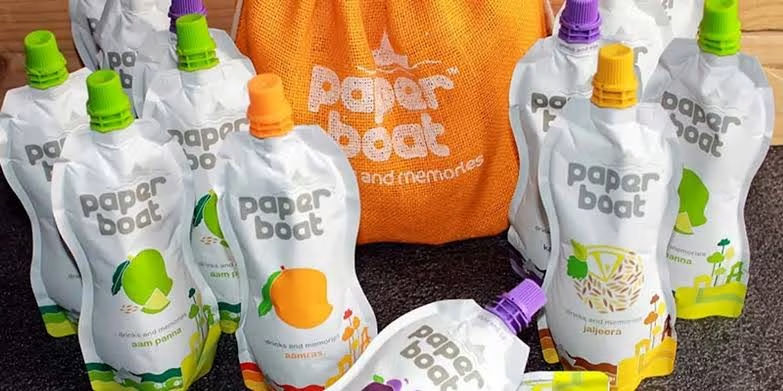
Paper Boat maker Hector Beverages reported a 13.8% year-on-year increase in operating revenue to ₹760 crore in FY26, extending the company’s growth trajectory despite a sharp deterioration in profitability. The company’s revenue rose from ₹668 crore in FY25, supported largely by stronger sales of traded goods, but expenses increased considerably faster than revenue.
The higher cost base resulted in a steep 96% decline in profit after tax to just ₹2 crore in FY26 from ₹46 crore a year earlier. EBITDA also fell nearly 40% to ₹41.4 crore, bringing the EBITDA margin down to 5.4% from 10.3%. The results highlight the growing pressure on Paper Boat’s parent as it expands distribution and promotional spending in India’s competitive packaged beverage market.
What Happened
Hector Beverages, the company behind the Paper Boat brand, recorded operating revenue of ₹760 crore in the financial year ended March 2026, according to its annual financial statements sourced from the Registrar of Companies.
The company also reported ₹18 crore in other income, taking total income to ₹778 crore, compared with ₹682 crore in FY25.
While the top line continued to grow, profitability moved sharply in the opposite direction. Total expenditure increased 22% to ₹776 crore from ₹636 crore in the previous financial year.
As a result, the company generated only a marginal profit despite crossing the ₹750 crore revenue mark.
Key Financial Highlights
| Metric | FY25 | FY26 | Change |
|---|---|---|---|
| Operating revenue | ₹668 crore | ₹760 crore | +13.8% |
| Total income | ₹682 crore | ₹778 crore | Higher |
| Total expenditure | ₹636 crore | ₹776 crore | +22% |
| EBITDA | ₹68.6 crore | ₹41.4 crore | -39.7% |
| EBITDA margin | 10.3% | 5.4% | Down |
| Profit after tax | ₹46 crore | ₹2 crore | -96% |
| Total assets | — | ₹522.5 crore | — |
| Cash and bank balance | — | ₹101 crore | -29% YoY |
The figures show that Hector Beverages’ main challenge is no longer simply generating revenue growth. The company now needs to control the cost of that growth and restore operating margins.
Revenue Growth Comes From Traded Goods
A major change in Hector Beverages’ revenue mix occurred during FY26.
Revenue from traded goods increased 30.2% to ₹574 crore from ₹441 crore in FY25. The category accounted for more than three-fourths of the company’s operating revenue during the year.
At the same time, revenue from manufactured goods declined 18.6% to ₹184 crore from ₹226 crore.
Revenue Mix
| Revenue Category | FY25 | FY26 | Change |
|---|---|---|---|
| Traded goods | ₹441 crore | ₹574 crore | +30.2% |
| Manufactured goods | ₹226 crore | ₹184 crore | -18.6% |
| Operating revenue | ₹668 crore | ₹760 crore | +13.8% |
The shift suggests that the company’s overall revenue growth was increasingly driven by products sourced through its trading operations rather than goods manufactured directly by the company.
This change in mix is important because different product categories can carry different gross margins, working-capital requirements and distribution economics.
Expenses Rise Faster Than Revenue
The same pattern of topline growth outrunning profitability has shown up across consumer and fintech names this season, including Easebuzz, where FY26 profit fell 42%.
Hector Beverages’ expenditure grew substantially faster than its operating revenue in FY26.
Total expenses increased 22% to ₹776 crore, compared with a 13.8% rise in operating revenue. The largest expense category remained material consumption, which reached ₹485 crore and represented about 62.5% of total expenditure.
Material costs increased from ₹447 crore in FY25, putting additional pressure on the company’s gross profitability.
Employee benefit expenses, by comparison, remained relatively stable and declined slightly to ₹88 crore from ₹90 crore.
The bigger increases came from several operating and growth-related expenses.
Advertising Spending Jumps
Advertising and promotional expenditure rose 55.6% to ₹28 crore during FY26.
The increase indicates that Hector Beverages stepped up investments in brand-building and consumer acquisition as it competed for space in India’s crowded beverages market.
Paper Boat competes with multinational beverage companies as well as large Indian packaged-food and beverage businesses and regional brands.
Building brand visibility in such a market can require substantial spending, particularly as companies launch new products and expand into additional distribution channels.
However, higher marketing expenditure needs to generate sufficient incremental sales to justify its effect on profitability.
Selling and Distribution Costs Also Increase
Selling and distribution expenses rose 15.5% to ₹67 crore in FY26.
Distribution is particularly important for packaged beverages because the products need to be available across supermarkets, modern retail outlets, convenience stores, e-commerce platforms and other sales channels.
Expanding physical availability can increase revenue, but it also adds logistics and distribution costs.
Hector Beverages’ FY26 results indicate that the company is investing in this part of the business even as its bottom-line profitability remains under pressure.
Job Work Expenses More Than Double
Another significant increase came from job work charges.
The company’s job work expenses more than doubled to ₹25 crore during FY26. Other operating expenses, including legal and professional fees, travel and rent, added another ₹83 crore.
These expenses contributed to the widening gap between revenue growth and operating profitability.
For a consumer brand, such costs can rise during periods of expansion as the company increases production, distribution and organizational capacity.
The challenge is ensuring that the resulting revenue growth eventually produces sufficient operating leverage.
EBITDA Margin Nearly Halves
The pressure on operating expenses was reflected directly in Hector Beverages’ EBITDA.
EBITDA fell 39.7% to ₹41.4 crore in FY26 from ₹68.6 crore in FY25.
Consequently, the EBITDA margin dropped to 5.4% from 10.3%.
This means the company generated significantly less operating profit from every rupee of revenue than it did a year earlier.
The decline is particularly important because EBITDA is a useful measure of the underlying performance of the business before interest, taxes, depreciation and amortisation.
A sustained margin decline could make future expansion more dependent on additional capital unless the company improves operating efficiency.
Profit Falls 96%
The sharpest deterioration came at the bottom line.
Hector Beverages’ profit after tax plunged 96% to ₹2 crore in FY26 from ₹46 crore in FY25.
The company therefore retained only a small portion of its revenue as net profit despite achieving double-digit top-line growth.
The result illustrates how revenue growth does not necessarily translate into stronger earnings when input costs and operating expenditure rise faster.
For the business, improving profitability will likely become increasingly important as it moves toward a larger scale.
Paper Boat’s Position in the Beverage Market
Paper Boat has built its brand around beverages inspired by traditional Indian flavours and products, creating a differentiated position within the packaged drinks market.
Its portfolio competes across a broader beverage ecosystem that includes established multinational brands from companies such as PepsiCo and Coca-Cola, Indian consumer companies and regional beverage manufacturers.
The company’s brand positioning gives it an opportunity to occupy a distinct segment rather than compete solely on price.
However, India’s beverage market remains highly competitive, with companies spending heavily on advertising, distribution and new product launches.
Why the Revenue Growth Matters
Despite the profit decline, the 13.8% increase in operating revenue remains significant.
The company has demonstrated that it can continue expanding its top line even while the broader consumer market becomes more competitive.
The larger question is whether Hector Beverages can improve the quality and profitability of that growth.
The sharp rise in traded-goods revenue indicates that the company’s business mix is changing. Management may need to balance this growth with stronger economics across manufacturing, sourcing and distribution.
Balance Sheet Position
Hector Beverages reported total assets of ₹522.5 crore at the end of FY26.
Its cash and bank balance declined 29% to ₹101 crore, while current assets stood at ₹365 crore.
The reduction in cash is worth monitoring because the company is simultaneously dealing with rising expenses and continuing investment in growth.
Maintaining sufficient liquidity will be important as the company expands its distribution network and supports inventory requirements.
The Challenge of Profitable Growth
The FY26 results highlight a common challenge for consumer startups and emerging brands: moving from revenue expansion to sustainable profitability.
Hector Beverages increased revenue by ₹92 crore during the year, but its profit fell by ₹44 crore.
That means the incremental revenue came with significantly higher costs.
The company will need to improve operating leverage by increasing sales without allowing advertising, distribution, material and other expenses to rise at the same pace.
Areas to Watch
- Advertising efficiency
- Material and procurement costs
- Distribution expenses
- Product mix
- Manufacturing utilization
- Traded-goods margins
- Repeat consumer purchases
- Cash generation
Progress across these areas will determine whether the company can rebuild its EBITDA margin.
Competitive Pressure in Packaged Beverages
Not every consumer brand is seeing the squeeze, with Beardo nearing ₹300 crore in FY26 revenue as profit jumped 70%.
Paper Boat operates in a market where consumer preferences can change quickly.
Large beverage companies have significant advantages in distribution, marketing budgets and manufacturing scale. Regional brands can also compete aggressively on price and local consumer preferences.
Paper Boat’s differentiated product positioning can help it stand apart, but maintaining that advantage requires continued product development and brand investment.
The challenge is particularly pronounced when advertising and distribution expenses are already rising rapidly.
What Investors and Industry Participants Should Watch
The next set of financial results will provide an indication of whether FY26’s margin pressure was temporary or part of a longer trend.
Revenue growth will remain important, but investors are likely to pay closer attention to EBITDA margins, operating expenses and cash generation.
The shift toward traded goods will also be worth monitoring because a continued change in revenue mix could affect the company’s overall profitability.
If Hector Beverages can sustain growth while bringing expenses under control, margins could recover. If expenses continue rising faster than revenue, strong top-line performance may continue to produce limited profits.
Industry Impact
Hector Beverages’ results reflect the broader economics of India’s evolving packaged-food and beverage industry.
Consumer brands can achieve significant revenue growth by expanding distribution and marketing, but the cost of securing shelf space and consumer attention can be substantial.
The company’s FY26 performance demonstrates that building scale is only one part of the equation. Brands must also develop efficient supply chains, control promotional spending and maintain healthy product-level margins.
For other D2C and consumer startups, the results offer a similar lesson: revenue growth becomes increasingly valuable when it can be converted into operating cash flow and sustainable profits.
Looking Ahead
Hector Beverages enters FY27 with a substantially larger revenue base but significantly weaker profitability. The ₹760 crore operating revenue recorded in FY26 shows that Paper Boat continues to expand, particularly through traded goods, but the 96% decline in profit highlights the cost of that expansion. With total expenditure rising 22%, advertising spending increasing sharply and EBITDA margins nearly halving, the company’s next challenge is to improve the efficiency of its growth rather than simply increase sales.
The key indicators to watch will be revenue mix, material costs, distribution spending and the company’s ability to convert additional sales into operating profit. A recovery in EBITDA margins would suggest that the company is beginning to achieve greater scale benefits, while continued margin compression could increase pressure on cash resources and future funding requirements. For India’s packaged beverage industry, Paper Boat’s performance will also provide a useful indicator of how challenger brands can balance distinctive products and aggressive distribution with the financial discipline required to compete against much larger players.
Frequently Asked Questions
What was Paper Boat revenue in FY26?
Hector Beverages, which makes Paper Boat, reported operating revenue of ₹760 crore in FY26, up 13.8% from ₹668 crore in FY25. Growth came largely from stronger sales of traded goods.
Why did Paper Boat profit fall 96%?
Expenses rose faster than revenue. Advertising spending jumped, selling and distribution costs increased, and job work expenses more than doubled. EBITDA margin nearly halved, taking profit down 96%.
Who owns Paper Boat?
Paper Boat is owned by Hector Beverages, the company that reports these financials. It competes in India’s packaged beverages market, where heavy advertising and distribution spending is typically required to hold shelf share.
Get the day’s top stories in your inbox
One concise email. No spam, unsubscribe anytime.


