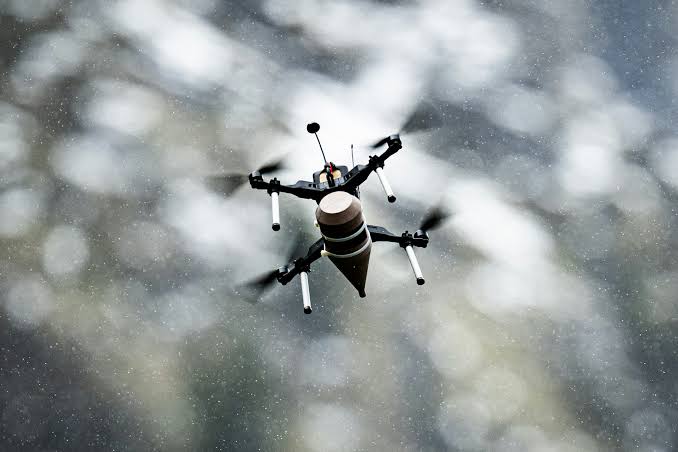
Researchers at Switzerland’s École Polytechnique Fédérale de Lausanne (EPFL) have developed tiny aerial and water-based vehicles that can move using sound waves instead of conventional motors or onboard actuators. The research team created specially shaped hollow structures that convert acoustic energy into directional thrust, opening a potential new approach to powering extremely small robots.
The technology is based on acoustic resonance, a phenomenon similar to the sound produced when air is blown across the opening of a bottle. By carefully designing miniature cavities and exposing them to sound at specific frequencies, the researchers can generate concentrated air jets that produce enough thrust to move lightweight vehicles. The work was published in Science Advances and demonstrates a new way of creating propulsion without conventional moving parts.
How Sound Waves Can Move a Drone
The EPFL researchers developed hollow structures known as acoustic resonators.
When sound waves at the correct frequency enter one of these cavities, the air trapped inside begins to oscillate strongly. The resulting airflow is directed through a specially designed opening.
This creates an imbalance between incoming and outgoing air, generating a small but usable amount of thrust.
Sound-Powered Propulsion
Sound source
↓
Specific acoustic frequency
↓
Air inside cavity oscillates
↓
Air pushed through nozzle
↓
Directional jet
↓
Thrust
↓
Micro-vehicle moves
The researchers tuned the shape and dimensions of the cavities to specific frequencies, allowing them to convert acoustic energy into controlled movement.
The Technology Is Based on Resonance
Advanced hardware research is accelerating well beyond software. Sensing research is advancing in parallel, with China developing a magnetic sensor able to detect submarines 500 metres away, even as India struggles with a 53% gap in specialist AI engineering talent.
The principle is related to Helmholtz resonance, the same basic phenomenon responsible for the tone produced when air moves across the opening of a bottle.
At the right frequency, air inside a cavity can oscillate much more strongly than it does at other frequencies.
The EPFL team used this effect to create miniature propulsion systems.
From Bottle Sound to Drone Propulsion
Bottle cavity
↓
Air resonates
↓
Sound produced
Researchers reverse the concept
↓
Sound enters engineered cavity
↓
Strong air oscillation
↓
Air jet
↓
Propulsion
The innovation lies in using the resonant airflow not simply to create sound, but to generate mechanical thrust.
Researchers Built Tiny Flying Vehicles
The team used the acoustic resonators to propel small aerial vehicles.
The experimental microfliers were designed to be extremely lightweight so that the relatively small thrust generated by the resonators could produce movement.
The researchers also demonstrated that the technology could work in water, suggesting that the underlying principle may have applications beyond aerial robots.
Experimental Platforms
Acoustic resonator
↓
Microflier
+
Small watercraft
↓
Sound-powered movement
↓
Proof of concept
The experiments demonstrate that sound can be transformed into useful mechanical motion at very small scales.
The Drones Do Not Need Conventional Motors
One of the most important features of the technology is that the propulsion mechanism does not require traditional rotating motors or mechanical actuators on the vehicle itself.
Instead, the specially designed cavity acts as a mechanical propulsion element.
This could simplify the construction of extremely small robots.
Conventional Micro-Drone
Battery
+
Motor
+
Propeller
+
Electronics
↓
Flight
Acoustic Micro-Drone
Sound source
+
Acoustic resonator
↓
Air jet
↓
Thrust
The simpler mechanical design could be valuable when engineers are working with very small robots where space and weight are major constraints.
The Sound Does Not Directly Push the Drone
A common misconception is that the sound waves simply push the drone through the air.
That is not exactly how the system works.
Instead, sound waves excite the air inside a carefully designed resonant cavity. The cavity converts the acoustic energy into an asymmetric airflow that produces a directional jet.
The thrust comes from this airflow.
The Key Difference
Not:
Sound wave
↓
Directly pushes drone
But:
Sound wave
↓
Excites cavity
↓
Air oscillates
↓
Asymmetric airflow
↓
Jet
↓
Thrust
This distinction is central to how the technology operates.
Acoustic Cavities Can Be 3D Printed
The researchers demonstrated that the hollow structures can be manufactured using relatively accessible materials.
The cavities can be made from 3D-printed plastics, rubber-like polymers and glass.
This could make the technology easier to experiment with and customize.
Manufacturing Process
Digital cavity design
↓
3D printing
↓
Acoustic testing
↓
Frequency tuning
↓
Thrust measurement
↓
Micro-robot integration
The ability to rapidly manufacture different cavity shapes could allow engineers to optimize the technology for different applications.
Frequency Controls the Amount of Thrust
The amount of propulsion generated by the resonators depends heavily on the frequency of the sound waves.
When the sound frequency matches the resonant characteristics of the cavity, the internal air movement becomes much stronger.
Changing the frequency changes the strength of the resulting thrust.
Frequency Relationship
Low resonance
↓
Weak airflow
↓
Low thrust
Correct resonance
↓
Strong airflow
↓
Higher thrust
Different resonance
↓
Different propulsion response
This gives researchers a way to control the performance of the tiny propulsion system.
The System Can Enable Controlled Motion
The researchers say the technology can produce directional thrust and controlled motion.
By designing resonators with different orientations or tuning their response to particular frequencies, engineers can potentially control how a small vehicle moves.
This could eventually allow acoustic propulsion systems to be combined to create more complex motion.
Why Tiny Robots Need New Propulsion Methods
Conventional propulsion becomes increasingly difficult as robots shrink.
Motors, batteries, gears and propellers cannot simply be scaled down indefinitely while maintaining useful performance.
Small robots have extremely limited space for energy storage and mechanical components.
Micro-Robot Challenge
Smaller robot
↓
Less available space
↓
Smaller battery
↓
Less available power
↓
Smaller motor
↓
Lower propulsion capability
↓
Limited operating time
Acoustic propulsion offers a different approach by moving some of the energy-generation hardware outside the robot.
The Sound Source Can Remain External
One of the potential advantages of the concept is that the sound source does not necessarily need to be located on the tiny vehicle.
The external acoustic source can generate the sound field while the vehicle contains the resonant structure.
This could reduce the amount of electronics and power-storage hardware required onboard.
External Power Concept
External acoustic source
↓
Sound waves
↓
Micro-drone resonator
↓
Air jet
↓
Thrust
↓
Vehicle movement
For extremely small robots, moving some of the energy-generation equipment off the vehicle could be valuable.
The Technology Could Help Create Smaller Robots
The researchers describe their work as a demonstration of how a simple mechanical structure can effectively become a robotic actuator.
Instead of using a conventional motor to generate motion, the geometry of the material itself performs part of the actuation process.
This concept could eventually contribute to smaller and simpler robotic systems.
Micro-Robotics Could Benefit
Micro-robots are being developed for applications ranging from inspection and environmental monitoring to biomedical research.
Their small size allows them to enter spaces that larger robots cannot reach.
However, providing power and movement at such scales remains a major engineering challenge.
Micro-Robot Applications
Tiny spaces
+
Complex environments
+
Limited room for hardware
↓
Micro-robot
↓
Inspection
+
Monitoring
+
Research
+
Potential medical applications
A lightweight propulsion mechanism could expand the possibilities for these systems.
Potential Applications in Hard-to-Reach Spaces
Small robots could potentially be used to explore narrow or confined environments.
Examples could include industrial equipment, pipes, machinery and other locations that are difficult for conventional robots to access.
An acoustic propulsion system could provide an alternative to miniature motors and propellers.
Potential Underwater Applications
The EPFL researchers also demonstrated sound-powered movement on water.
This suggests that the principle is not restricted to aerial vehicles.
Acoustic propulsion could potentially be adapted for very small aquatic robots.
Air and Water
Sound
↓
Acoustic resonator
↓
Directional flow
↓
Thrust
↓
Air vehicle
OR
↓
Water vehicle
The ability to work across different environments makes the underlying concept particularly interesting for robotics research.
The Technology Is Still Experimental
Despite the promising demonstration, the technology is still at the research stage.
The experiments involved very small and lightweight vehicles.
Scaling the concept to larger drones would require substantially more thrust and energy.
The technology should therefore not be viewed as a replacement for conventional drone motors in today’s consumer or industrial drones.
Power and Range Remain Challenges
A sound-powered vehicle still requires an external source of acoustic energy.
This means the technology does not eliminate the need for energy; instead, it changes how that energy reaches the robot.
A practical system would need to deliver sufficient acoustic power over the required distance.
Current Concept
External energy source
↓
Sound field
↓
Tiny vehicle
↓
Propulsion
Potential limitation:
↓
Range depends on acoustic field
+
Environmental conditions
+
Available acoustic power
This could limit the technology’s use in open environments.
Sound Attenuates With Distance
Sound energy decreases as it travels through the environment.
The farther a micro-drone moves from the acoustic source, the more difficult it may become to deliver sufficient energy to its resonator.
This makes acoustic propulsion particularly interesting for controlled environments where the sound source can be positioned close to the robot.
Potential Controlled Environments
Laboratory
+
Factory
+
Pipeline
+
Enclosed structure
+
Specialized inspection area
↓
Acoustic source nearby
↓
Micro-robot
Such environments could offer more practical conditions than unrestricted outdoor flight.
Outdoor Drone Use Would Be More Difficult
For conventional drones, a battery allows the aircraft to carry its own energy source.
A sound-powered micro-drone relying on an external acoustic field could have a more limited operating area.
Outdoor conditions such as wind, background noise and distance from the acoustic source could also affect performance.
The technology will therefore need substantial development before it can support autonomous outdoor missions.
The Research Could Change How Actuators Are Designed
The broader significance of the work extends beyond drones.
An actuator is a component that converts energy into mechanical movement.
Traditional actuators often involve motors, gears, magnetic systems or other moving parts.
The EPFL research demonstrates that carefully engineered structures can themselves perform an actuation function when exposed to the appropriate energy source.
Traditional Actuator
Energy
↓
Motor
↓
Mechanical movement
↓
Robot action
Acoustic Resonator
Sound
↓
Resonant structure
↓
Airflow
↓
Mechanical thrust
↓
Robot action
This could inspire new approaches to miniature robotics.
Resonant Structures Could Be Customized
Because the acoustic response depends on geometry, engineers can design cavities for particular frequencies and thrust requirements.
Changing the cavity’s dimensions, shape or nozzle can modify its behavior.
This makes the technology highly adaptable at the design stage.
Design Variables
Cavity shape
+
Cavity volume
+
Opening size
+
Nozzle geometry
+
Material
+
Sound frequency
↓
Resonant response
↓
Thrust
Engineers could optimize these parameters for different robotic applications.
3D Printing Could Accelerate Development
Additive manufacturing makes it possible to create complex internal structures that would be difficult to manufacture using conventional methods.
Researchers can quickly produce multiple designs and test them experimentally.
This rapid design cycle could help improve the efficiency of future micro-robotics research.
The Research Builds on Earlier Acoustic Robotics
Sound has previously been used in robotics for purposes including levitation, sensing and communication.
Researchers have also explored acoustic waves for manipulating small objects.
The EPFL work differs because the sound is used to create active propulsion through a specially engineered resonator.
Acoustic Robotics
Sound for sensing
+
Sound for communication
+
Sound for levitation
+
Sound for manipulation
+
Sound for propulsion
↓
Broader acoustic robotics field
The new propulsion method adds another potential application to this growing field.
Possible Future Applications
If the technology can be scaled and controlled effectively, possible applications could include:
- Micro-scale inspection robots
- Confined-space exploration
- Environmental sensing
- Laboratory robotics
- Small aquatic robots
- Educational robotics
- Specialized industrial inspection
- Swarm robotics research
Many of these applications would involve controlled environments rather than conventional outdoor drone operations.
Swarm Robotics Could Be an Interesting Direction
Large numbers of tiny robots could potentially perform tasks collectively.
A propulsion system with few or no onboard moving parts could simplify the construction of extremely small machines.
Potential Swarm Model
Acoustic source
↓
Many resonator-based robots
↓
Robot 1
+
Robot 2
+
Robot 3
+
Robot 4
+
More micro-robots
↓
Collective movement
↓
Inspection or sensing
However, coordinating and powering large numbers of robots would introduce additional technical challenges.
External Acoustic Control Could Enable New Robot Architectures
If the energy source and control signals can be delivered through an acoustic field, engineers could potentially design robots with extremely minimal onboard hardware.
The robot could essentially act as a passive or semi-passive mechanical system responding to external sound.
This could reduce complexity at the smallest scales.
Medical Robotics Could Eventually Benefit
Miniature robots are an area of interest in biomedical research.
Researchers have explored tiny machines for tasks inside the human body, although such applications require extremely high levels of safety and control.
The current acoustic propulsion research is not a medical device and is far from clinical use.
Nevertheless, advances in miniature actuation could contribute to the broader field of micro-robotics.
The Research Also Highlights the Role of Materials
The performance of the resonators depends not only on geometry but also on the properties of the materials used.
Lightweight and mechanically suitable materials can help maximize the useful thrust relative to vehicle mass.
Future work could therefore involve exploring new materials and manufacturing techniques.
What It Means for Drone Technology
The research shows that propulsion does not always require a conventional motor and propeller.
For large drones, batteries and motors remain far more practical.
But at the micro-scale, where every gram and cubic millimeter matters, alternative propulsion mechanisms can become attractive.
The technology therefore represents a potential new branch of micro-drone engineering rather than a direct replacement for today’s drone systems.
What It Means for Robotics
The research demonstrates that physical structures can be engineered to perform functions traditionally handled by electronic or mechanical components.
This could encourage designers to integrate sensing, actuation and energy conversion directly into the shape and material of a robot.
Future Robot Design
Material
+
Geometry
+
Resonance
+
External energy
↓
Mechanical function
↓
Smaller robot
This concept could become increasingly important as robotics moves toward smaller scales.
What Investors and Industry Should Watch
Key developments to monitor include:
- Improvements in acoustic thrust
- Longer operating distances
- Greater payload capacity
- Autonomous control
- Outdoor testing
- Miniaturization
- Energy efficiency
- Swarm applications
- Underwater applications
- Commercial partnerships
The technology will need to demonstrate substantial improvements in these areas before commercial adoption becomes realistic.
Key Facts at a Glance
| Metric | Detail |
|---|---|
| Research institution | EPFL |
| Location | Lausanne, Switzerland |
| Technology | Acoustic resonators |
| Energy source | Sound waves |
| Propulsion mechanism | Directional air jets |
| Vehicles demonstrated | Tiny aerial and water vehicles |
| Main manufacturing method | 3D printing |
| Key principle | Acoustic resonance |
| Conventional motors required | No onboard conventional motor for the demonstrated propulsion |
| Research publication | Science Advances |
| Current stage | Experimental research |
| Potential fields | Micro-robotics, inspection and small autonomous systems |
Infographic: How Sound-Powered Drones Work
SOUND SOURCE
↓
SPECIFIC FREQUENCY
↓
ACOUSTIC RESONATOR
↓
AIR INSIDE CAVITY OSCILLATES
↓
AIR FORCED THROUGH NOZZLE
↓
CONCENTRATED AIR JET
↓
DIRECTIONAL THRUST
↓
MICRO-DRONE MOVES
↓
POTENTIAL APPLICATIONS
INSPECTION
+
MICRO-ROBOTICS
+
CONFINED SPACES
+
AQUATIC ROBOTS
+
SWARM ROBOTICS
The Bigger Picture
Researchers at EPFL have demonstrated a new approach to micro-robotic propulsion in which specially designed acoustic cavities convert sound waves into directional thrust. Instead of using a conventional motor and propeller, the tiny vehicles use resonance to make air inside the cavity oscillate and then direct that airflow through a nozzle. The resulting jet produces enough thrust to move extremely lightweight aerial and water-based vehicles. The structures can also be manufactured using materials such as 3D-printed plastics, making the concept relatively accessible for experimental development.
The technology is still far from replacing conventional drone propulsion. Its biggest limitation is that the sound source must supply energy to the resonator, potentially restricting operating distance and making outdoor applications more difficult. Nevertheless, the research could be important for micro-robotics, where conventional batteries, motors and actuators become increasingly difficult to miniaturize. By turning the geometry of a simple cavity into a propulsion mechanism, the EPFL team has demonstrated how sound and engineered materials could work together to create a new generation of extremely small robots.
Looking Ahead
Future research will likely focus on improving thrust, energy efficiency, control and operating distance. Engineers will also need to determine how multiple acoustic resonators can be combined to provide stable movement in different directions and whether the technology can support autonomous operation. Underwater robots and controlled indoor environments could be among the more practical early applications because acoustic sources can be positioned relatively close to the vehicles.
Over the longer term, the concept could contribute to the development of micro-robots that are substantially smaller and mechanically simpler than today’s drones. If researchers can overcome the limitations associated with external sound sources and limited thrust, acoustic propulsion could find applications in inspection, environmental monitoring, swarm robotics and other specialized fields. For now, the research is best viewed as a proof of concept showing that sound waves can be transformed into useful mechanical propulsion at very small scales
Frequently Asked Questions
How do sound waves move these drones?
Specially shaped hollow structures resonate and convert acoustic energy into directional thrust, so no conventional motor is needed.
Who developed the sound-powered drones?
Researchers at Switzerland’s Ecole Polytechnique Federale de Lausanne (EPFL) developed them.
Does the sound physically push the drone?
No. The sound does not directly push it. Resonance inside 3D-printed acoustic cavities generates the thrust, and frequency controls how much.
Get the day’s top stories in your inbox
One concise email. No spam, unsubscribe anytime.


