
Rising atmospheric carbon dioxide (CO₂) levels may be changing the protein composition of wheat, potentially affecting the quality of bread and other wheat-based foods. A study led by researchers at Germany’s Leibniz Institute for Food Systems Biology at the Technical University of Munich found that wheat grown under elevated CO₂ conditions developed different levels of several important proteins, including gluten proteins and amylase/trypsin inhibitors (ATIs). The findings, published in Food Chemistry in September 2026, suggest that climate change could influence not only agricultural production but also the quality characteristics of a major global staple food.
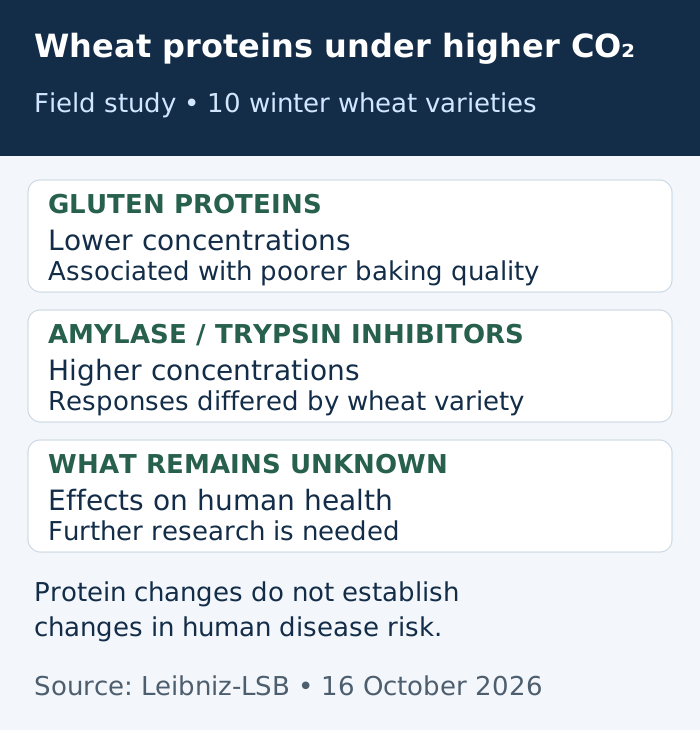
The researchers examined 10 varieties of winter wheat under field conditions, comparing plants exposed to ambient CO₂ concentrations of 450 parts per million (ppm) with plants grown at 546 ppm. Higher CO₂ levels were associated with lower concentrations of several gluten proteins and higher levels of certain ATIs. The changes were also linked to poorer baking quality, while their potential implications for wheat-related health conditions remain uncertain. Scientists say further research is necessary to understand the biological effects and identify wheat varieties that can maintain good quality as atmospheric CO₂ continues to rise.
Key Takeaways
- Protein composition is changing: Elevated CO₂ altered the amounts of several proteins found in wheat grains.
- Gluten proteins declined: Researchers observed lower levels of key gluten proteins, which help determine dough structure and baking performance.
- Certain inhibitors increased: Amylase/trypsin inhibitors, or ATIs, increased under elevated CO₂ conditions.
- Baking quality suffered: Lower gluten protein concentrations were associated with poorer baking performance.
- Health effects remain uncertain: The study did not establish that rising CO₂ causes more wheat-related illnesses.
- Wheat varieties responded differently: Genetic differences influenced how strongly plants reacted to elevated CO₂.
- Crop breeding may help: Researchers recommend identifying varieties that preserve baking quality and have favourable protein profiles under future growing conditions.
How Rising CO₂ Can Change Wheat Proteins
Carbon dioxide is essential for photosynthesis, the process through which plants use sunlight to convert carbon dioxide and water into sugars. Higher atmospheric CO₂ can sometimes increase plant growth, particularly when other resources such as water and nutrients are available.
However, faster growth or higher yields do not necessarily mean that the resulting food will have an identical nutritional composition. Changes in the growing environment can influence how plants allocate resources and produce proteins and other compounds.
Wheat is particularly important because it provides food for billions of people. It is used to produce bread, pasta, noodles, biscuits, flour and other staple products. In India, wheat is also a major ingredient in everyday foods such as roti, chapati and many regional preparations.
The new research suggests that elevated CO₂ can affect the balance of proteins in wheat grains. Rather than changing every protein in the same direction, the treatment produced different responses among different protein groups.
This matters because wheat proteins perform several functions. Some determine how flour behaves during processing and baking, while others are involved in the plant’s natural defence mechanisms. Their composition can influence the grain’s functional properties and may also be relevant to how some people tolerate wheat products.
What Did the Researchers Discover?
The research team cultivated 10 winter wheat varieties under field conditions. One group grew at an ambient CO₂ concentration of approximately 450 ppm, while another was exposed to an elevated concentration of 546 ppm.
After harvesting the grain, researchers used high-resolution mass spectrometry and related analytical techniques to measure selected proteins and peptides.
The study examined three important categories: gluten proteins, puroindolines and amylase/trypsin inhibitors. It also measured selected peptides associated with coeliac disease.
The results showed that higher CO₂ levels were associated with increased ATI content, while the levels of puroindolines, gluten proteins and certain coeliac disease-active peptides decreased. The magnitude of these changes depended substantially on the wheat variety.
| Protein group | Observed change under elevated CO₂ | Why it matters |
|---|---|---|
| Gluten proteins | Decreased | Important for dough elasticity, structure and baking performance |
| Amylase/trypsin inhibitors (ATIs) | Increased | Plant defence proteins being studied for possible links to wheat-related disorders |
| Puroindolines | Decreased | Influence wheat kernel hardness and flour-processing properties |
| Selected coeliac disease-active peptides | Decreased | Relevant to research on immune reactions to gluten |
The table summarises the study’s findings for the proteins and peptides examined. It does not represent a measurement of every protein in wheat or a direct assessment of human health outcomes.
The findings show why researchers increasingly examine food quality alongside crop productivity. A variety that produces a large harvest may not necessarily retain the same protein profile or processing characteristics when environmental conditions change.
Why Lower Gluten Protein Levels Matter for Bread
Gluten is a group of proteins that forms an important structural network when wheat flour is mixed with water. This network helps dough stretch, retain gas produced during fermentation and maintain its shape as bread rises.
The balance of gluten proteins influences the texture, elasticity and strength of dough. When the concentration or composition of these proteins changes, flour may behave differently during mixing, fermentation and baking.
The researchers found that the reduction in gluten proteins under elevated CO₂ was associated with poorer baking quality. This suggests that atmospheric changes could have implications for the food-processing industry, particularly for manufacturers that depend on consistent flour performance.
For commercial bakeries, changes in wheat quality can affect product consistency, production processes and the characteristics of the finished loaf. Millers and food manufacturers may need to account for differences in protein composition when selecting grain varieties or blending flour.
However, lower levels of certain gluten proteins do not automatically mean that bread will become unsuitable for baking. Baking quality depends on several factors, including the wheat variety, flour composition, milling process, moisture, processing conditions and the specific product being made.
The research therefore identifies a potential quality challenge rather than predicting that all future wheat or bread will deteriorate in the same way.
Could These Protein Changes Affect Human Health?
The health implications are one of the most important and uncertain aspects of the findings.
ATIs are naturally occurring wheat proteins that help protect plants against pests. They have also been investigated for possible links to wheat allergies and non-coeliac wheat sensitivity. Some research suggests that these proteins may activate certain immune responses, but their effects depend on the biological context and the person involved.
The study found that ATI levels increased under elevated CO₂. This raises questions about whether future changes in wheat composition could affect the tolerability of wheat products for some people.
However, the research did not directly test whether eating the wheat produced under elevated CO₂ causes symptoms, increases disease risk or changes the prevalence of wheat-related disorders.
The researchers also observed lower levels of selected coeliac disease-active peptides. These are fragments of gluten proteins that can be involved in immune reactions in people with coeliac disease. Yet the finding does not mean the wheat would be safe for people with coeliac disease, because the study did not establish how the changes affect the body’s immune response.
The overall balance is complex: some protein groups increased, others decreased, and the health implications cannot be determined simply by measuring their concentrations.
Further studies involving biological and immunological testing are needed before researchers can draw conclusions about how these changes might affect human health.
The practical takeaway is that consumers do not need to stop eating wheat because of this study. It identifies a possible long-term food-quality concern, not evidence that ordinary wheat consumption has suddenly become dangerous.
Why the Findings Matter for India
India is one of the world’s major wheat producers and consumers. Wheat is central to household food consumption, agricultural incomes and the supply chains serving flour mills, bakeries and food manufacturers.
Environmental changes that affect wheat quality could therefore have consequences extending beyond farm yields. If protein composition changes under future atmospheric conditions, the characteristics of grain supplied to millers and food processors could also change.
For farmers, the implications may include greater demand for wheat varieties that maintain consistent quality under changing environmental conditions. For breeders, the challenge will be to develop varieties that balance yield, resilience, nutritional characteristics and processing performance.
For the food industry, reliable information about wheat quality could help mills and manufacturers select appropriate grain varieties and manage changes in flour performance.
The effects will not necessarily be identical across India’s wheat-growing regions. Temperature, rainfall, irrigation, soil fertility, fertiliser use and local growing practices also influence crop development. The findings from this study should not be treated as a precise forecast for every Indian wheat variety or growing region.
Nevertheless, the research highlights a broader issue for food security: producing enough grain is essential, but maintaining its quality also matters.
Climate Change and the Future of Food Quality
Atmospheric CO₂ concentrations have risen substantially over recent decades. The research team cited an increase from approximately 340 ppm in 1980 to around 425 ppm in 2024. Depending on future emissions, concentrations could rise further over the coming decades.
Plants respond to elevated CO₂ in different ways. Some crops can increase growth under suitable conditions, but the overall outcome depends on water availability, nutrients, temperature and other environmental factors.
Previous research has also raised concerns that elevated CO₂ may reduce the concentration of certain nutrients in important food crops, including protein, iron and zinc. Those findings are part of a wider investigation into how climate change can affect both the quantity and nutritional quality of food.
The wheat study adds another dimension by examining specific proteins that influence processing properties and may be relevant to wheat-related disorders.
It would be incorrect to conclude that all crops will respond identically or that the findings establish a universal decline in food quality. Instead, the research indicates that crop responses can be complex and may require more detailed evaluation than yield measurements alone provide.
Agricultural research will increasingly need to examine whether crops can maintain stable nutritional and functional properties under future environmental conditions.
Can Wheat Breeding Help Solve the Problem?
The researchers identified crop breeding as a potential way to address some of the challenges associated with rising CO₂.
Because the response varied among the 10 wheat varieties, scientists may be able to identify cultivars whose protein composition remains comparatively stable under elevated CO₂. Breeders could then investigate how to preserve desirable characteristics while maintaining high yields and resilience to other environmental stresses.
The objective would be to develop wheat varieties that retain good baking quality while producing favourable levels of proteins relevant to food processing and tolerability.
Such work would require further testing across locations, seasons and growing conditions. Researchers would also need to examine how changes in protein composition translate into actual baking performance and, where health implications are suspected, into measurable biological effects.
Breeding is not an immediate solution, but it provides a practical route for adapting agriculture to changing environmental conditions. It can also help reduce the risk that farmers and food manufacturers will face increasingly unpredictable crop-quality characteristics.
The Bigger Picture
The study demonstrates that rising CO₂ can influence wheat in ways that extend beyond growth and yield. Changes in gluten proteins, ATIs and other components may affect the properties of flour and raise questions about the future tolerability of wheat products. The findings also show that different varieties respond differently, creating opportunities for targeted agricultural research.
At the same time, the evidence needs to be interpreted carefully. The experiment examined 10 varieties under specific field conditions, and the researchers have not established direct human health consequences. The next challenge is to reproduce the results across more locations and seasons, understand their biological significance and develop crop varieties that maintain both productivity and quality.
Looking Ahead
Scientists are likely to focus on identifying wheat cultivars that remain stable under elevated CO₂ while preserving baking quality and desirable protein characteristics. Further field experiments, food-processing studies and biological testing will be necessary to determine how widespread the observed effects are and whether they have meaningful consequences for consumers.
For farmers, food manufacturers and policymakers, the findings reinforce the need to treat food quality as part of climate adaptation. Future crop strategies will need to consider not only how much wheat can be harvested, but also how its composition affects processing, nutrition and consumer needs.
Frequently Asked Questions
1. How does rising CO₂ affect wheat proteins?
The study found that elevated CO₂ increased certain amylase/trypsin inhibitors while reducing gluten proteins, puroindolines and selected coeliac disease-active peptides. The extent of the changes varied by wheat variety.
2. Does this mean wheat is becoming unhealthy?
No such conclusion can be drawn from this study. Researchers identified changes in protein composition but said further biological and immunological research is needed to establish any health consequences.
3. Why are gluten proteins important?
Gluten proteins help dough stretch and retain its structure. Lower levels of the proteins examined were associated with poorer baking quality in the study.
4. What are amylase/trypsin inhibitors?
ATIs are naturally occurring wheat proteins that help defend the plant against pests. They are also being investigated for possible links to wheat allergies and non-coeliac wheat sensitivity, but the health implications of the changes observed in this study remain uncertain.
5. Could the findings affect wheat farming in India?
Potentially, but the study does not provide a direct forecast for Indian wheat production. Its findings highlight why researchers may need to evaluate wheat quality and identify suitable varieties under changing environmental conditions.
6. What can scientists do to address the problem?
Researchers can test more wheat varieties, repeat field experiments across different locations and seasons, investigate the biological effects of protein changes and breed cultivars that maintain good baking quality under elevated CO₂ conditions.
Source check, 19 October 2026: The Leibniz institute’s release describes cultivar-dependent protein changes and reduced baking quality. It stresses that the biological and immunological significance requires further study.
Get the day’s top stories in your inbox
One concise email. No spam, unsubscribe anytime.


