
Indian artificial intelligence company Sarvam AI has launched Sarvam Prism, a specialised AI decision model designed to help businesses automate fast, structured decisions. Built on the company’s Sarvam 105B model, Prism focuses on tasks where an AI system must select from a predefined set of answers rather than generate long-form responses. These include customer-support routing, document intelligence, security checks and evaluating the performance of AI agents.
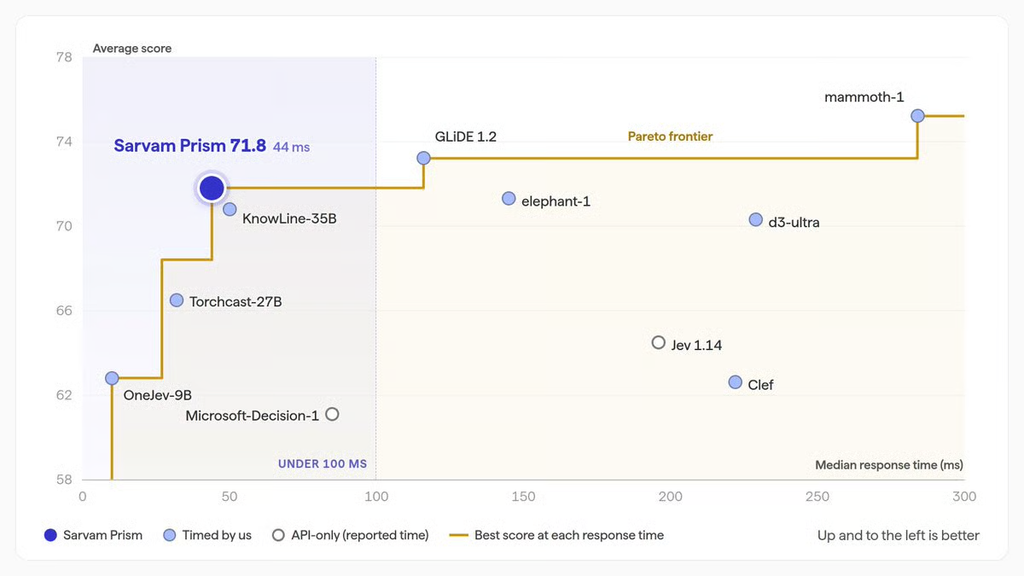
Announced on November 3, 2026, Sarvam Prism recorded an average score of 71.8 across three decision-making benchmarks, with a median response time of 44 milliseconds on an NVIDIA B200 GPU, according to the company. Sarvam is also releasing the model’s weights under the Apache 2.0 licence, allowing enterprises to customise it using their own data and deploy it on their own infrastructure. <Cite refs={[“turn707828search0″,”turn707828search2″,”turn707828search4”]}/>
What Is Sarvam Prism?
Sarvam Prism is a System 1 decision model, a category designed around fast and intuitive judgments.
Unlike conventional AI chatbots, which generate text token by token, Prism evaluates a question and a fixed set of possible answers. It then assigns a probability to each option and identifies the most likely choice.
For example, a customer-support platform could use Prism to classify an incoming message into categories such as billing, technical support, account access or refund requests.
Instead of asking a general-purpose chatbot to generate a response and then extracting the relevant category, a business can send the information directly to Prism and receive structured probabilities.
The model supports three main decision formats:
- Yes or no: Determines whether a statement or condition is true.
- Pick one: Selects the most appropriate option from a predefined list.
- Ordered scale: Assigns a score across a defined range of choices.
This makes Prism particularly useful for enterprise applications where decisions need to be fast, consistent and easy for software systems to process.
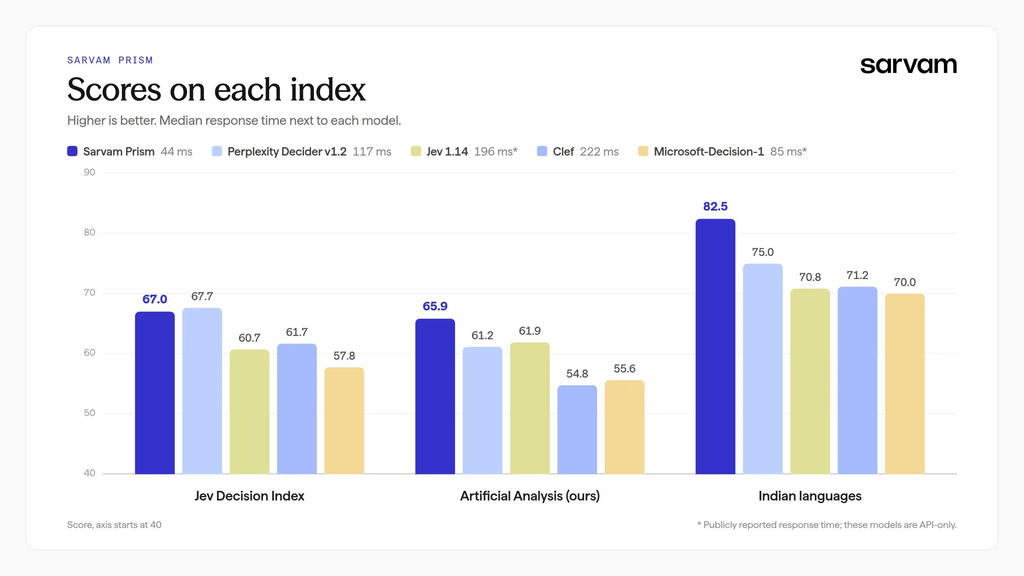
Sarvam Prism Delivers 44ms Response Time
One of the biggest claims surrounding the launch is Prism’s combination of decision accuracy and response speed.
Sarvam tested Prism against 24 other decision models using three evaluation indices. The company reported an average score of 71.8 and a median response time of 44 milliseconds on a single NVIDIA B200 GPU.
According to Sarvam, this was the highest-scoring model among the 25 models tested that responded in under 100 milliseconds.
| Decision model | Average score | Median response time |
|---|---|---|
| Mammoth-1 | 75.2 | 284 ms |
| GLiDE 1.2 | 73.2 | 116 ms |
| Sarvam Prism | 71.8 | 44 ms |
| Elephant-1 | 71.3 | 145 ms |
| StartLux-27B | 70.8 | 117 ms |
| KnowLine-35B | 70.8 | 50 ms |
| Perplexity Decider v1.2 | 68.0 | 117 ms |
| Microsoft-Decision-1 | 61.1 | 85 ms |
Source: Sarvam AI’s evaluation of 25 decision models. Scores and response times are based on the company’s testing methodology.
The results show that Prism does not have the highest overall accuracy score in the comparison. Mammoth-1 and GLiDE 1.2 scored higher, but their reported response times were considerably longer.
Prism’s advantage is its position on the accuracy-and-speed trade-off. It combines a competitive decision score with a response time below 50 milliseconds.
Strong Performance on Indian Languages
Another important part of the launch is Prism’s performance on Indian-language decision tasks.
Sarvam reported a score of 82.5 on its internal Indian-language benchmark, higher than the other models included in its comparison.
| Model | Indian-language benchmark score |
|---|---|
| Sarvam Prism | 82.5 |
| KnowLine-35B | 82.6 |
| Mammoth-1 | 80.1 |
| GLiDE 1.2 | 79.4 |
| Elephant-1 | 74.0 |
| Perplexity Decider v1.2 | 75.0 |
| Jev 1.14 | 70.8 |
| Microsoft-Decision-1 | 70.0 |
Prism’s 82.5 score is close to KnowLine-35B’s 82.6, so it is not the highest result in the full comparison. However, it combines this performance with a substantially faster reported response time.
The model supports English, 10 Indian languages and Hinglish, making it relevant to businesses operating across India’s multilingual customer base.
This could be useful for companies handling customer queries, document processing and automated workflows in multiple Indian languages.
Sarvam Focuses on Reliable Confidence Scores
Accuracy alone is not enough for enterprise automation. Businesses also need to know how confident an AI model is about its decisions.
For example, a customer-support system might automatically route a message when the model is highly confident but send uncertain cases to a human employee.
Sarvam says Prism is designed to provide calibrated confidence scores, meaning the model’s actual error rate should remain within or below the error rate suggested by its confidence estimates.
In tests involving answers with at least 90% confidence, the company reported the following results:
| Language category | Expected error rate | Actual error rate |
|---|---|---|
| English | 3.3% | 2.2% |
| Indian languages | 5.4% | 4.4% |
These results suggest that Prism made fewer mistakes than its confidence estimates predicted in the tested datasets.
For enterprises, this capability could help determine which decisions can be automated and which require human review. However, the figures come from Sarvam’s own evaluation and should be assessed through independent testing before being treated as universal performance guarantees.
Model Designed for Consistent Decisions
AI systems can sometimes change their answers when the order of available options changes.
For example, a model might select one answer when the choices are presented as A, B and C, but choose another when the same options are rearranged.
Sarvam says Prism addresses this issue by placing options in a fixed internal order before evaluating them. The model then returns the probabilities under the original option names.
In an experiment involving 2,000 questions, Sarvam reported that Prism’s answers did not change when options were shuffled using its fixed-order evaluation method.
This is important for enterprise software because decisions often involve selecting from dynamically generated lists, such as product catalogues, customer intents or available tools.
Consistent outputs can make automated workflows easier to test and maintain
Prism Can Evaluate AI Agents and Security Risks
Sarvam is positioning Prism as a tool for evaluating the decisions made by AI agents, not just for processing ordinary customer requests.
AI agents can perform multiple steps, interact with external tools and complete tasks on behalf of users. Businesses need ways to determine whether these agents completed their assignments correctly and whether their actions require human review.
Sarvam tested Prism on 700 recorded agent runs, covering 1,770 evaluation questions.
| Agent evaluation task | Sarvam Prism accuracy |
|---|---|
| Determine whether a task succeeded | 75.0% |
| Determine whether human review is needed | 86.4% |
| Identify which agent caused a failure | 69.6% |
| Overall accuracy | 78.5% |
The company also tested Prism on an internal cybersecurity benchmark covering 5,517 questions.
| Decision model | Cybersecurity benchmark accuracy |
|---|---|
| Sarvam Prism | 89.0% |
| Clef | 84.5% |
| Jev 1.14 | 78.6% |
| Microsoft-Decision-1 | 76.1% |
The cybersecurity evaluation included tasks involving phishing detection, jailbreak attempts and classification of attack types.
These results suggest that Prism could be useful in automated security workflows, although the cybersecurity benchmark is currently an internal evaluation rather than an independently validated industry-wide test.
Sarvam Releases Prism With Apache 2.0 Open Weights
A major part of the announcement is the release of Prism’s model weights under the Apache 2.0 licence.
This gives enterprises the ability to access the model, customise it with their own datasets and deploy it on infrastructure they control, subject to the licence terms.
The model is available through two routes:
- Hugging Face: Enterprises and developers can access the open weights and related model files.
- Sarvam API: Developers can use the hosted model without operating their own GPU infrastructure.
Sarvam says the open-weight version can run in FP8 precision on a single GPU with at least 120GB of memory.
The company’s API documentation lists pricing at ₹4 per million input tokens and ₹0 per million output tokens. Prism does not generate conventional text responses, so its output consists of structured decision probabilities rather than generated paragraphs.
How Sarvam Made Prism Faster
Prism is built as a LoRA fine-tune of Sarvam 105B. Instead of generating a response one token at a time, it processes the input and evaluates the available options in a single forward pass.
Sarvam also describes several engineering improvements that helped reduce inference time.
These include converting model weights to FP8 precision, using grouped expert computation, capturing the forward pass as a CUDA Graph and optimising attention operations.
According to the company, these changes reduced the median response time from 664 milliseconds to 44 milliseconds, making the final model approximately 15 times faster than its initial implementation without a reported reduction in accuracy.
This optimisation is particularly important for applications that need to make thousands or millions of small decisions quickly.
The Bigger Picture
Sarvam Prism represents a different approach to enterprise AI. Rather than trying to make one large language model handle every task, the company is developing a specialised system for decisions that have predefined answers and measurable outcomes.
This approach could make AI automation faster and easier to integrate into existing business software. Customer support, document processing, security monitoring and AI-agent evaluation are all areas where structured decisions can be more useful than lengthy generated responses.
The release of open weights also gives Indian enterprises more flexibility to customise and deploy AI models on their own infrastructure. However, real-world adoption will depend on independent performance testing, integration costs and how reliably Prism performs on each company’s data.
Looking Ahead
Sarvam has made Prism available through Hugging Face and its hosted API, giving developers and enterprises two ways to experiment with the model. The company has also indicated that it plans to release more evaluation results as it tests the system across additional real-world applications.
The next challenge will be demonstrating that Prism’s speed, calibration and benchmark performance translate into reliable business outcomes. If enterprises can use specialised decision models to automate repetitive workflows while keeping uncertain cases under human supervision, systems such as Sarvam Prism could become an important part of the next generation of AI-powered software.
Get the day’s top stories in your inbox
One concise email. No spam, unsubscribe anytime.


