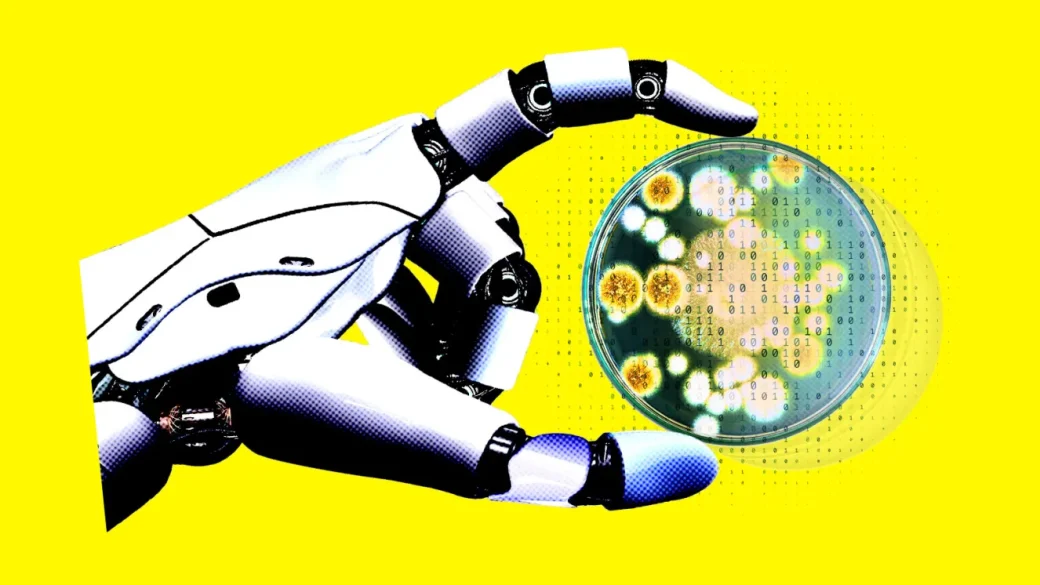
Scientists have used artificial intelligence to design entirely new viruses that have never existed in nature, marking a major milestone in synthetic biology. In a study published in the journal Science, researchers from Stanford University and the Arc Institute developed AI-generated bacteriophages—viruses that infect bacteria rather than humans—and demonstrated that several of these synthetic viruses successfully infected and destroyed E. coli bacteria in laboratory experiments. The achievement could significantly accelerate the development of new treatments for antibiotic-resistant infections, while also raising important questions about biosafety, biosecurity, and the governance of AI in biotechnology.
The research relied on Evo 2, a genome-generating AI model trained on millions of bacteriophage genomes. Instead of modifying existing viruses, the AI designed complete viral genomes from scratch. Researchers synthesized hundreds of these AI-generated genomes, ultimately identifying 16 functional bacteriophages, some of which outperformed a naturally occurring reference phage in destroying E. coli. The work represents the first successful demonstration of AI creating functional viruses that did not previously exist in nature.
AI Creates Functional Viruses From Scratch
Unlike earlier approaches that edited known viral genomes, the researchers used generative AI to design entirely new bacteriophage DNA sequences.
Key highlights include:
- AI designed complete viral genomes.
- The viruses target bacteria, not humans.
- Researchers synthesized and tested hundreds of AI-generated designs.
- 16 synthetic viruses successfully infected E. coli.
- Several performed better than a natural benchmark bacteriophage.
Research Snapshot
| Item | Details |
|---|---|
| Research Institutions | Stanford University and Arc Institute |
| AI Model | Evo 2 |
| Published In | Science |
| Organism Created | Synthetic bacteriophages |
| Successful AI-Designed Viruses | 16 |
| Target | E. coli bacteria |
Why Bacteriophages Matter
Bacteriophages, or phages, are viruses that infect bacteria rather than humans or animals.
Scientists are increasingly interested in phage therapy because:
- It can target harmful bacteria with high precision.
- It may help combat antibiotic-resistant infections.
- It generally leaves beneficial bacteria largely unaffected.
- It could provide alternatives when antibiotics become ineffective.
If AI can rapidly design customized phages, doctors may eventually be able to develop personalized treatments against drug-resistant bacterial infections much faster than current methods.
Potential Benefits Beyond Medicine
Researchers believe AI-designed biological systems could eventually accelerate innovation across several fields.
Potential applications include:
- New treatments for antibiotic-resistant diseases.
- Faster development of therapeutic bacteriophages.
- Synthetic biology research.
- Biotechnology and industrial microbiology.
- Agricultural disease control.
The ability to design functional genomes computationally could significantly reduce the time required to discover and engineer useful biological organisms.
Biosafety and Biosecurity Concerns
Despite its medical promise, the research has prompted strong warnings from biosecurity experts.
Key concerns include:
- AI could eventually be used to design more dangerous pathogens if applied irresponsibly.
- Existing regulatory frameworks may not adequately address AI-generated biological designs.
- Advances in DNA synthesis make it easier to physically build AI-designed genomes once sequences are generated.
- Oversight will need to evolve alongside rapidly advancing AI capabilities.
Importantly, the viruses created in this study infect bacteria only and do not infect humans. Researchers also emphasized that the AI was trained using bacteriophage genomes rather than human pathogens. Experts note that designing safe bacteriophages is far less complex than creating human-infecting viruses, but they agree that stronger safeguards will be essential as AI capabilities continue to improve.
Opportunities and Risks
| Potential Benefits | Potential Risks |
|---|---|
| Faster phage therapy development | Misuse of AI for pathogen design |
| New tools against antibiotic resistance | Need for stronger biosafety oversight |
| Accelerated synthetic biology research | Governance may lag technological progress |
| Improved biotechnology innovation | Greater scrutiny of DNA synthesis and AI models |
Calls for Stronger Oversight
Researchers and public health experts have called for updated governance covering both AI systems and biological research.
Suggested safeguards include:
- Enhanced screening of DNA synthesis orders.
- Stronger laboratory biosafety standards.
- Responsible release of powerful biological AI models.
- International cooperation on biosecurity regulations.
- Continuous monitoring of high-risk biological research.
Many experts argue that the greatest opportunity lies in using AI to fight antibiotic-resistant bacteria while ensuring the technology cannot be redirected toward harmful applications.
Looking Ahead
The successful creation of AI-designed bacteriophages marks a landmark achievement in synthetic biology, demonstrating that generative AI can move beyond analyzing biological data to designing functional living systems. By producing entirely new viruses capable of infecting bacteria, researchers have opened the door to faster development of phage therapies and other biotechnology applications that could help address growing challenges such as antibiotic resistance.
Looking ahead, the breakthrough is likely to intensify discussions about how AI should be governed in the life sciences. While the current research involved only bacteria-infecting viruses and offers significant medical potential, experts broadly agree that advances in AI-powered genome design should be accompanied by robust biosafety standards, stronger DNA synthesis screening, and international oversight to ensure these powerful technologies are used responsibly.
Frequently Asked Questions
What did researchers actually create?
Researchers from Stanford University and the Arc Institute used an AI model called Evo 2 to design 16 functional synthetic bacteriophages — viruses that infect bacteria, not humans — that had never existed in nature.
Do these AI-designed viruses infect humans?
No. The bacteriophages target E. coli bacteria, not humans, and some of them outperformed a naturally occurring reference phage at destroying the bacteria.
Why does this achievement matter for medicine?
It could accelerate the development of phage therapies for antibiotic-resistant infections, though it also raises biosafety, biosecurity, and AI governance questions.
Get the day’s top stories in your inbox
One concise email. No spam, unsubscribe anytime.


