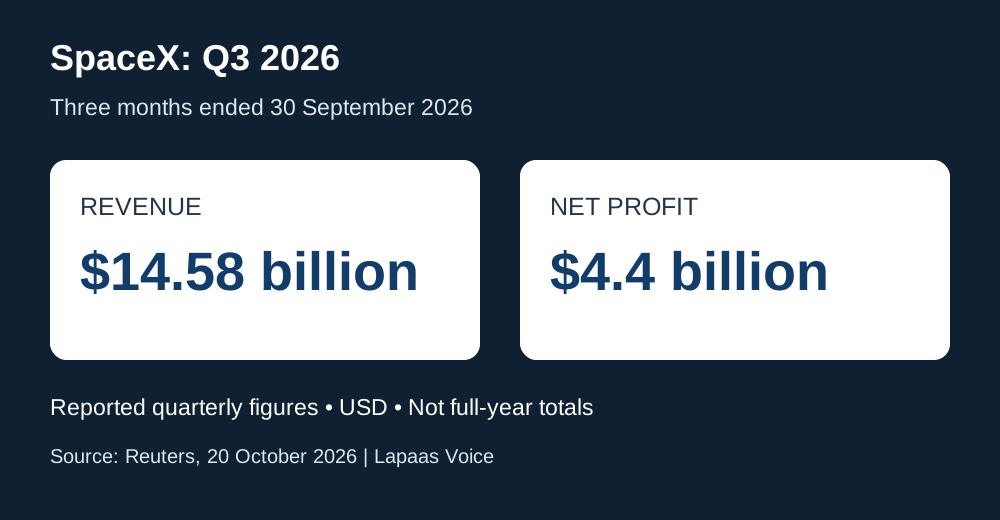
SpaceX reported record third-quarter 2026 revenue of $14.58 billion and net income of $4.4 billion, marking a major financial milestone for Elon Musk’s aerospace and technology company. Revenue surged 161% year over year, supported by rapid growth in its artificial intelligence business, expanding Starlink connectivity services and continued demand for space-related operations.
The results highlight SpaceX’s transformation from a rocket-launch and satellite-internet company into a broader technology business with substantial AI infrastructure operations. Its Super Intelligence segment generated $7.56 billion in quarterly revenue, overtaking connectivity services as the company’s largest revenue contributor. However, the expansion also comes with significant investment requirements, as SpaceX spent $19.6 billion on capital expenditure during the quarter.
Source check, 21 October 2026: Reuters’ 20 October results report confirms $14.58 billion in revenue and $4.4 billion in net profit for the three months ended 30 September 2026. These are quarterly reported figures, not full-year results or analyst forecasts. Revenue increased 161% year on year.
View the accessible SpaceX Q3 2026 results infographic: revenue US$14.58 billion and net profit US$4.4 billion for the quarter ended 30 September 2026. Source: Reuters, 20 October 2026.
Key Takeaways
- Record revenue: SpaceX generated $14.58 billion in Q3 2026, up 161% from $5.58 billion a year earlier.
- Net profit: The company reported $4.4 billion in net income, reversing a $1.1 billion loss in the third quarter of 2025.
- AI leads revenue: Its Super Intelligence segment contributed $7.56 billion, becoming the company’s largest revenue business.
- Starlink continues growing: Connectivity revenue reached $5.25 billion, supported by consumer, enterprise and government demand.
- Heavy investment: Capital expenditure climbed to $19.6 billion as SpaceX expanded its computing infrastructure and space operations.
- Profitability improves: Operating income reached $2.79 billion, while adjusted EBITDA rose to $8.81 billion.
SpaceX Revenue Jumps 161% in the Third Quarter
SpaceX’s third-quarter performance represents a substantial acceleration in its business growth. Revenue increased from $5.58 billion in Q3 2025 to $14.58 billion in Q3 2026, demonstrating the growing contribution of its AI and connectivity operations.
The company also significantly exceeded analyst expectations. Revenue was higher than the approximately $12.72 billion forecast by analysts, while net income of $4.4 billion surpassed expectations of around $1.57 billion.
The improvement was particularly notable compared with the previous quarter. SpaceX reported revenue of $7.81 billion and a net loss of $541 million in Q2 2026 before returning to profitability in Q3.
| Financial metric | Q3 2025 | Q3 2026 |
|---|---|---|
| Revenue | $5.58 billion | $14.58 billion |
| Net income | -$1.1 billion | $4.4 billion |
| Operating income | -$273 million | $2.79 billion |
| Adjusted EBITDA | $2.17 billion | $8.81 billion |
| Capital expenditure | $6.88 billion | $19.59 billion |
The results show that SpaceX has expanded both its revenue base and its earnings. Nevertheless, the company continues to invest heavily in computing infrastructure, satellite networks and launch technology, making future cash requirements an important consideration.
AI Becomes SpaceX’s Largest Revenue Business
The most significant change in SpaceX’s business mix is the rapid expansion of its Super Intelligence segment, which encompasses AI models, software and computing infrastructure.
The segment generated $7.56 billion in revenue during Q3 2026, compared with just $813 million in the same quarter a year earlier. That represents growth of approximately 830%.
The increase reflects expanded cloud and computing agreements, the integration of acquired businesses and wider commercial adoption of AI products, including Grok.
SpaceX’s AI operations also benefit from demand for computing capacity. AI developers require powerful data centers and specialized processors to train models and serve customers. By providing computing infrastructure and related services, SpaceX can generate revenue beyond its traditional aerospace operations.
The segment reported $431 million in operating income for the quarter, compared with an operating loss of $1.72 billion a year earlier. Its improved performance suggests that the expanding AI business is beginning to contribute meaningfully to SpaceX’s overall profitability.
However, rapid revenue growth does not eliminate the risks associated with AI infrastructure. Data centers require substantial capital, energy and advanced hardware, and the returns on those investments depend on continued customer demand.
Starlink Remains a Major Financial Engine
Although AI has become SpaceX’s largest revenue segment, Starlink remains a critical part of the company’s business.
SpaceX’s connectivity segment generated $5.25 billion in Q3 2026 revenue, up 69% from $3.1 billion a year earlier. The segment includes satellite internet services and connectivity offerings for consumers, enterprises and government customers.
Starlink’s consumer subscriber base reached approximately 13.6 million by the end of September, compared with 12 million at the end of June.
The service provides broadband connectivity in locations where traditional terrestrial networks may be unavailable, unreliable or expensive to deploy. It also serves aviation, maritime, enterprise and government customers.
This recurring connectivity revenue provides an important financial foundation for SpaceX. Unlike launch contracts, which can be tied to individual missions, subscriptions can generate repeat revenue as long as customers continue using the service.
The company reported $2.37 billion in operating income from connectivity, making it an important contributor to overall earnings even as AI takes the lead in revenue.
SpaceX Continues Investing Heavily in AI and Space Infrastructure
SpaceX’s financial growth is accompanied by a significant increase in capital expenditure. The company spent approximately $19.6 billion during Q3 2026, nearly three times the $6.88 billion reported in the same quarter last year.
Most of the spending was directed toward the Super Intelligence segment, which accounted for approximately $16.44 billion of quarterly capital expenditure. The investments support computing capacity, data-center infrastructure and the expansion of AI operations.
SpaceX also continues investing in launch vehicles, satellites and related infrastructure. These projects are essential to its long-term plans, including expanding Starlink and developing Starship for larger and more ambitious space missions.
The spending illustrates the capital-intensive nature of the company’s strategy. SpaceX is attempting to build capacity across several industries simultaneously, potentially positioning itself to capture more value from the growing demand for AI computing and global connectivity.
However, the approach also creates financial risks. If demand grows more slowly than expected or computing prices decline, some infrastructure investments may take longer to generate adequate returns.
The Traditional Space Business Remains Important
SpaceX’s space segment generated approximately $1.77 billion in Q3 2026 revenue, up modestly from $1.67 billion a year earlier.
The segment includes launch services and other space-related operations. It reported an operating loss of approximately $7 million during the quarter, compared with operating income of $259 million in Q3 2025.
Although this business now contributes less revenue than AI and connectivity, it remains strategically important. SpaceX’s launch capabilities support satellite deployment, commercial missions and the expansion of its own satellite infrastructure.
The company’s reusable rocket technology has helped it maintain a competitive position in the launch market. Its longer-term ambitions also depend on developing Starship into a vehicle capable of supporting larger payloads and future missions.
SpaceX’s aerospace operations therefore remain central to its wider strategy, even as the company increasingly resembles a technology and infrastructure provider.
What the Results Mean for SpaceX’s Future
SpaceX’s latest results suggest that its diversified business model is producing substantial revenue and improving profitability. AI infrastructure provides a new source of growth, while Starlink offers recurring revenue and launch services support the company’s broader space ambitions.
The combination could strengthen SpaceX’s position across several large markets. However, investors and industry observers will need to examine the sustainability of its growth, the returns generated by its infrastructure spending and the competitive environment facing its AI business.
The company’s financial performance also highlights the importance of distinguishing between revenue, operating income and net income. Revenue measures sales, operating income reflects the profitability of core operations after operating expenses, and net income includes additional items such as non-operating income, interest and taxes.
For SpaceX, all three measures matter as it balances expansion with the goal of generating sustainable earnings.
The Bigger Picture
SpaceX’s third-quarter results reflect a broader shift in the technology industry. Companies that once focused on a single core business are increasingly expanding into AI infrastructure, cloud computing and other adjacent markets.
The company’s growing AI operations demonstrate how computing capacity has become a major commercial opportunity. Meanwhile, Starlink illustrates the value of recurring connectivity revenue, and the launch business provides infrastructure that supports SpaceX’s broader ambitions.
The central challenge is managing these businesses without allowing capital expenditure to outpace the financial returns they generate. Strong revenue growth is encouraging, but long-term success will depend on sustained customer demand, disciplined investment and the ability to maintain profitability as competition increases.
Looking Ahead
SpaceX’s next challenge will be converting its rapidly growing AI business into durable earnings while continuing to invest in satellite connectivity and space technology. The company’s computing expansion and commercial AI agreements could support further growth, although the scale of its capital expenditure means returns on investment will remain an important metric to watch.
The company’s future performance will also depend on Starlink subscriber growth, enterprise demand and progress in its launch programs. If SpaceX can maintain strong revenue growth while improving the efficiency of its investments, it could strengthen its position as a major player across AI, telecommunications and aerospace.
Frequently Asked Questions
1. How much revenue did SpaceX generate in Q3 2026?
SpaceX reported $14.58 billion in revenue for the third quarter of 2026, representing a 161% increase from $5.58 billion in Q3 2025.
2. How much profit did SpaceX make in Q3 2026?
The company reported $4.4 billion in net income, reversing a net loss of approximately $1.1 billion in the same quarter of 2025.
3. Which SpaceX business generated the most revenue?
The Super Intelligence segment was the largest revenue contributor, generating $7.56 billion in Q3 2026. Connectivity, including Starlink, generated approximately $5.25 billion.
4. Why is SpaceX spending so much on infrastructure?
SpaceX is expanding its AI computing capacity, data-center infrastructure, satellite network and launch operations. These investments are intended to support future demand, although they also create substantial capital requirements and financial risks.
Get the day’s top stories in your inbox
One concise email. No spam, unsubscribe anytime.