Spotify says it has removed more than 50 million spam and low-quality tracks from its music recommendations in 2026, as the streaming platform steps up efforts to protect human artists from impersonation, deceptive uploads and content designed to manipulate streaming systems.
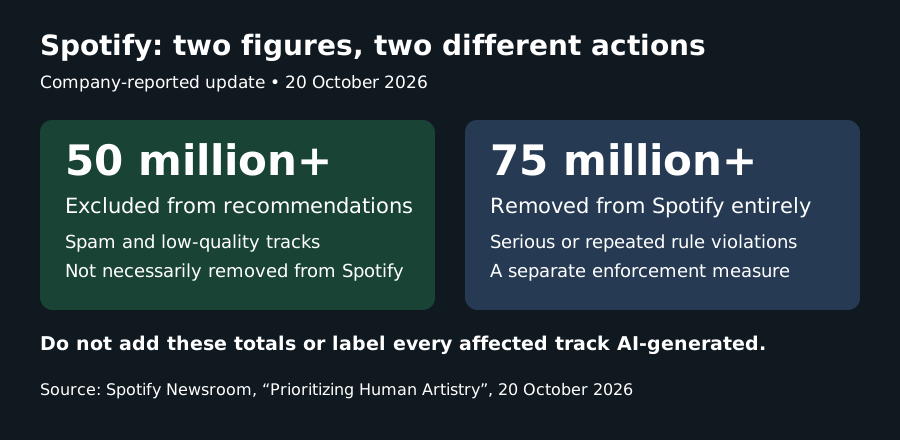
Correction, 21 October 2026: Spotify’s 50-million figure covers spam and low-quality tracks excluded from recommendations, not a verified count of exclusively AI-generated songs. It is separate from the 75-million figure for tracks removed entirely.
In an update published on October 20, 2026, Spotify said the changes were part of a year-long effort to prioritise human artistry while giving listeners more information about who is behind the music they hear. The company also reported that it had removed more than 75 million spammy tracks from the platform altogether for serious or repeated violations of its rules. These are separate figures: the 50 million tracks have been excluded from recommendations, while the 75 million figure refers to tracks removed from Spotify entirely.
The company is also expanding tools that identify AI-generated artist identities, disclose how AI contributes to music production and allow artists to review releases delivered to their profiles. Spotify plans to make its Artist Profile Protection tool available to all artists by the end of 2026.
The announcement highlights a growing challenge for music-streaming services: generative AI makes it easier to produce music at scale, but platforms must distinguish legitimate creative uses of AI from spam, impersonation and attempts to exploit recommendation and royalty systems.
Key takeaways
- 50 million tracks filtered: Spotify says it removed more than 50 million tracks identified as spam or low-quality content from recommendations during 2026.
- 75 million tracks removed entirely: The company separately reported removing more than 75 million spammy tracks for serious or repeated rule violations.
- AI Persona badges: Thousands of artist profiles identified as AI-generated personas are now labelled.
- Artist Profile Protection: Artists can review releases attributed to them, with wider availability planned by the end of 2026.
- AI Credits: Artists can disclose AI contributions to vocals, lyrics, production and other aspects of a track.
- Human artist verification: More than 300,000 artists have received Spotify’s verification badge, according to the company.
- Detection remains challenging: Spotify combines listener feedback, upload patterns, metadata and third-party AI detection tools rather than relying on a single signal.
What does Spotify mean by removing 50 million AI spam tracks?
The headline figure needs an important clarification: Spotify has not said that all 50 million tracks were permanently deleted from its music catalogue.
Instead, the company says it has taken more than 50 million tracks classified as spam or low-quality content out of recommendations. These tracks are no longer supposed to be surfaced through the relevant editorial and algorithmic recommendation systems.
The distinction matters because a track can remain available on a streaming platform without being actively promoted to listeners. Recommendation systems influence which songs people discover through personalised playlists, automated suggestions and other discovery features.
Spotify says it reviewed songs that listeners were skipping, ignoring or explicitly saying they did not want to hear. The company found that many of these tracks matched content its systems had already identified as spam or low-quality material.
Over the six months before its October announcement, Spotify made multiple updates to its recommendation system to reduce the presence of this content and surface more music from human artists.
The company also said listener concerns about spam appearing in recommendations had decreased since the changes were introduced. This is Spotify’s own assessment; it did not publish a detailed independent measurement of the change in the announcement.
Spotify’s AI spam crackdown by the numbers
| Metric | Figure reported by Spotify | What it means |
|---|---|---|
| Tracks removed from recommendations in 2026 | More than 50 million | Spam and low-quality tracks excluded from recommendations |
| Spammy tracks removed from the platform | More than 75 million | Tracks removed for serious or repeated rule violations |
| Verified artists | More than 300,000 | Artist profiles carrying Spotify’s verification badge |
| Independent artists among verified profiles | More than 70% | Share of verified artists identified as independent |
| AI Persona profiles labelled | Thousands | Artist identities identified as AI-generated personas |
| Daily AI Credits submissions | Tens of thousands | Disclosures about AI’s role in music creation |
| Artist Profile Protection rollout | By end of 2026 | Planned availability to all artists |
Source: Spotify’s October 20, 2026 update. Figures are company-reported.
The figures describe different parts of Spotify’s enforcement and transparency programme. They should not be added together as if they represent a single count of AI-generated songs: the categories cover recommendation filtering, full removals, artist verification and disclosures.
View the accessible infographic comparing Spotify recommendation exclusions with removals. For a separate creator update, read Spotify paid podcast memberships in 34 markets.
How Spotify identifies AI-generated spam and low-quality music
Spotify says there is no single reliable signal that can identify every spam track. Instead, the company combines multiple indicators to determine which uploads may be low-quality, deceptive or designed to manipulate the platform.
1. Listener engagement and feedback
Spotify examines how listeners interact with tracks, including whether people skip songs, ignore them or report that they do not want to hear them.
These signals can help identify content that repeatedly appears in recommendations despite attracting little interest or generating negative feedback. However, a low skip rate or high skip rate alone cannot establish whether a song was created with AI or is spam.
2. Upload patterns
The company monitors patterns associated with mass uploads and potentially abusive distribution practices.
Generative AI can reduce the time and effort required to create large volumes of music. That can be useful for legitimate creators, but it can also make it easier for bad actors to flood a service with repetitive or minimally differentiated tracks.
Spotify says it looks for suspicious upload behaviour and adapts its systems as new tactics emerge.
3. Metadata and search manipulation
Metadata helps describe a track, its creators and its intended audience. Spotify says it monitors metadata alongside other signals to identify potential abuse.
The company also identifies search-engine optimisation manipulation and spammy playlist networks as tactics it seeks to counter. Such practices can attempt to make tracks more visible without building genuine listener interest.
4. Third-party AI detection tools
Spotify uses information from multiple external AI detection tools as part of its assessment process.
The company acknowledges that AI detection technology has limitations. As music-generation systems improve, distinguishing AI-generated content from human-created work may become more difficult.
This is why Spotify says it combines detection results with engagement, metadata and upload behaviour rather than treating an AI detector’s output as conclusive proof.
Why AI-generated music spam is a concern for artists
AI music generation can help musicians experiment with arrangements, develop ideas and explore new sounds. Spotify’s stated policy is not to prohibit all music created with AI.
The problem it identifies is the misuse of these capabilities to produce large quantities of spam, impersonate artists or manipulate the streaming ecosystem.
There are several ways this can affect the industry.
Competition for attention: A large volume of repetitive uploads can make it harder for listeners to discover music they actually want to hear. It can also increase the challenge of gaining visibility for emerging artists.
Artist impersonation: Uploaders may attempt to publish music under another artist’s name or use AI-generated voices that imitate performers without permission.
Royalty manipulation: Spam tactics may be designed to generate streams or divert revenue through artificial activity. Spotify says its enforcement efforts are intended to reduce these opportunities.
Listener confusion: An AI-generated artist identity may appear to be a real person, making it difficult for listeners to understand who is behind a song.
The challenge for platforms is to address these forms of abuse without treating every use of AI as misconduct. A musician using AI for part of a recording is not necessarily engaging in spam or deception.
Spotify’s new and expanding tools to protect artists
The latest announcement builds on measures Spotify began outlining in September 2025. The company’s approach combines content enforcement, artist identity protection and greater transparency about how music is made.
AI Persona badges identify AI-generated artist identities
Spotify introduced its AI Persona badge to help listeners identify artist profiles whose public identities are AI-generated and do not represent real people.
The company says thousands of such profiles are now labelled. It can apply labels based on its own review as well as information artists provide through Spotify for Artists.
By default, AI Personas are excluded from editorial and algorithmic recommendations unless a listener chooses to follow them or otherwise engages with them. This is a policy about how the platform recommends these identities, rather than a blanket ban on every track made using AI.
The distinction is important: the badge addresses whether an artist’s public identity represents a real person. It does not, by itself, explain every way AI may have been used to create a song.
Spotify’s announcement about the badges is available through its official AI Persona update.
Artist Profile Protection helps prevent misattributed releases
One of the most direct protections for musicians is Artist Profile Protection.
Music uploaded through distributors can sometimes be incorrectly attributed to an artist with a similar name or deliberately delivered to the wrong profile. When that happens, listeners may see unfamiliar music on a musician’s page, potentially causing confusion and harming the artist’s identity.
Spotify says thousands of artists have opted into the beta programme. The tool allows participating artists to review releases that list them as an artist when those releases are delivered to Spotify.
This gives musicians a more proactive role in deciding which releases appear on their profiles. Spotify says it plans to make the feature available to all artists by the end of 2026.
The protection is relevant to AI-generated music as well as other types of uploads. A misattributed track can create problems regardless of how it was produced.
AI Credits disclose how AI was used in a song
Spotify’s AI Credits feature allows artists to disclose specific contributions made with AI, including vocals, lyrics and production.
The company says it receives tens of thousands of AI Credits submissions daily. Where the information has been submitted through participating labels or distributors, listeners can view disclosures in the Song Credits section on mobile.
This approach recognises that AI use is not always an all-or-nothing category. A musician might write lyrics and perform vocals personally while using AI to assist with a different production task.
Spotify’s approach is intended to provide more context without automatically penalising artists for disclosing responsible uses of AI.
There is a limitation: the system relies on information provided by artists, labels and distributors. The absence of an AI Credit does not prove that AI was not used.
Verified by Spotify helps signal human identity
Spotify also reports that more than 300,000 artists have been verified. The company says these profiles represent more than 99% of the artists listeners actively search for on the platform, and more than 70% of verified artists are independent.
The badge is intended to help listeners identify artists who are real people presenting themselves authentically.
Verification, AI Persona badges and AI Credits serve different purposes. Verification concerns the artist’s identity, the AI Persona badge identifies an AI-generated public persona, and AI Credits explain disclosed uses of AI in making a track.
Together, the features aim to give listeners more information about both the people behind music and the tools used to produce it.
How Spotify’s 1,000-stream royalty threshold fits into the strategy
Spotify also highlighted its 1,000-stream royalty eligibility threshold, which has been in place since 2024.
According to the company, tracks with indicators suggesting a high probability of being AI-generated are 10 times more likely than other tracks to fall below that threshold.
This is a relative likelihood reported by Spotify, not a statement that every AI-generated track receives no royalties or that every human-created song crosses the threshold.
The company presents the threshold as one measure that can make it harder for bad actors to profit by generating large volumes of low-performing content.
It is important to separate the royalty threshold from the AI spam crackdown. A track may fail to meet royalty eligibility requirements without necessarily being spam, and AI use alone does not automatically establish a violation.
Spotify’s wider enforcement effort focuses on behaviours such as mass uploads, duplication, manipulation and impersonation rather than simply the presence of AI in the creative process.
Does Spotify ban AI-generated music?
No. Spotify’s October 2026 update does not announce a blanket ban on AI-generated music.
Instead, the company says it supports artists’ freedom to decide whether and how to use AI in their creative processes while taking action against spam, deception and unauthorised impersonation.
The platform’s approach separates three issues:
| Issue | Spotify’s approach |
|---|---|
| AI used as a creative tool | Artists can disclose how AI contributed through AI Credits |
| AI-generated artist identity | AI Persona badges provide transparency, and these personas are excluded from recommendations by default |
| Spam, impersonation or deceptive uploads | Spotify uses enforcement systems and policies to identify and address abuse |
This distinction matters because AI can be used in many ways, from limited production assistance to fully generated songs and virtual artist identities.
A policy that treats every use of AI as equivalent would fail to distinguish a musician using a tool creatively from an uploader attempting to exploit the platform. Spotify’s stated strategy is to focus on the identity, disclosure and behaviour involved.
How Spotify’s approach compares with the wider music industry
Spotify is not the only streaming service responding to the rise of AI-generated music. Across the industry, platforms and music companies are exploring ways to label synthetic content, protect artist identities and reduce abuse.
The measures differ. Some services are expanding disclosure labels, while others are introducing filtering controls or stricter restrictions on AI-generated content.
Spotify’s announced approach combines recommendation filtering, artist verification, AI Persona labels, credits for AI contributions and tools to review profile attribution.
This mix reflects a broader problem: identifying AI-generated content is only one part of managing its impact. Platforms must also decide whether a track is deceptive, whether an artist has consented to the use of their identity and whether upload behaviour is intended to manipulate discovery or payments.
As generative music tools improve, those decisions are likely to require ongoing updates to policies and detection systems. Spotify itself acknowledges that bad actors can adapt their tactics and that AI detection will become more challenging.
What does the crackdown mean for independent musicians?
Independent artists often rely on streaming platforms to reach listeners without the marketing budgets or distribution power of major labels. Better spam controls could help reduce competition from mass-uploaded content and make discovery systems more useful.
Artist Profile Protection may be particularly relevant to musicians whose releases are mistakenly placed on someone else’s profile. AI Credits can also give independent artists a way to explain their use of new creative tools directly to listeners.
However, the impact will depend on how accurately the systems work and how quickly artists can resolve mistakes. Automated detection can produce false positives, while bad actors may change tactics to avoid enforcement.
Spotify says it combines multiple signals to improve confidence and is continuing to adapt its systems. The company has not released enough detail in this announcement to independently assess the accuracy of its spam classifications or quantify the effect on individual artists’ earnings.
The policy’s success will therefore depend not only on the volume of tracks filtered, but also on whether legitimate music remains discoverable and artists have effective ways to challenge errors.
What happens next?
Spotify says its work on AI and spam enforcement will continue as music-generation technology evolves. The planned expansion of Artist Profile Protection to all artists by the end of 2026 is one of the next milestones.
The company is also working to give listeners more ways to see when AI has contributed to music creation. AI Credits, AI Persona badges and artist verification are expected to remain part of its broader identity and transparency strategy.
The central challenge is balancing creative freedom with safeguards against manipulation. AI can help musicians develop new sounds and workflows, but the same technology can also be used to create misleading identities or large volumes of low-quality uploads.
Spotify’s latest figures show the scale of its response, but they do not settle the wider debate over AI music. Questions about detection accuracy, fair distribution of royalties, consent and the visibility of independent artists will continue to shape how streaming platforms manage the technology.
Frequently asked questions
1. Did Spotify delete 50 million AI-generated songs?
Not necessarily. Spotify said it removed more than 50 million tracks identified as spam or low-quality content from recommendations. The company separately reported that it had removed more than 75 million spammy tracks from the platform entirely for serious or repeated rule violations.
2. Why is Spotify removing AI spam from recommendations?
Spotify says spam and low-quality uploads can degrade music discovery, confuse listeners and potentially divert attention or royalties away from legitimate artists. Its changes aim to reduce the visibility of this content.
3. Does Spotify prohibit all AI-generated music?
No. Spotify allows artists to use AI creatively and offers AI Credits for disclosing how it contributed to a track. Its enforcement efforts focus on spam, deception, impersonation and other violations rather than banning every song involving AI.
4. What is Spotify’s AI Persona badge?
It is a label for artist profiles whose public identities are identified as AI-generated personas rather than real people. Spotify says these personas are excluded from editorial and algorithmic recommendations by default, unless a listener follows or otherwise engages with them.
5. What is Artist Profile Protection?
Artist Profile Protection lets participating artists review releases that list them as an artist when those releases are delivered to Spotify. The tool is designed to help prevent unauthorised or incorrectly attributed music from appearing on the wrong profile. Spotify plans to make it available to all artists by the end of 2026.
6. How does Spotify detect AI-generated spam?
Spotify combines listener engagement and feedback, upload patterns, metadata and information from third-party AI detection tools. It also looks for tactics such as mass uploads, duplicates, search manipulation, spammy playlist networks and artificially short tracks.
7. What are Spotify AI Credits?
AI Credits allow artists to disclose where AI contributed to a song, such as vocals, lyrics or production. The information can appear in Song Credits on mobile when submitted through supported labels or distributors. A missing credit does not prove that AI was not used.
8. What does the 1,000-stream royalty threshold mean?
Spotify’s threshold, in place since 2024, determines eligibility for recorded-music royalties under its policy. Spotify says tracks with indicators of a high probability of being AI-generated are 10 times more likely to fall below the threshold than other tracks. This does not mean all AI music is automatically ineligible for royalties.
9. When will Artist Profile Protection be available to all Spotify artists?
Spotify said in its October 20, 2026 update that it plans to make Artist Profile Protection available to all artists by the end of 2026.
Get the day’s top stories in your inbox
One concise email. No spam, unsubscribe anytime.