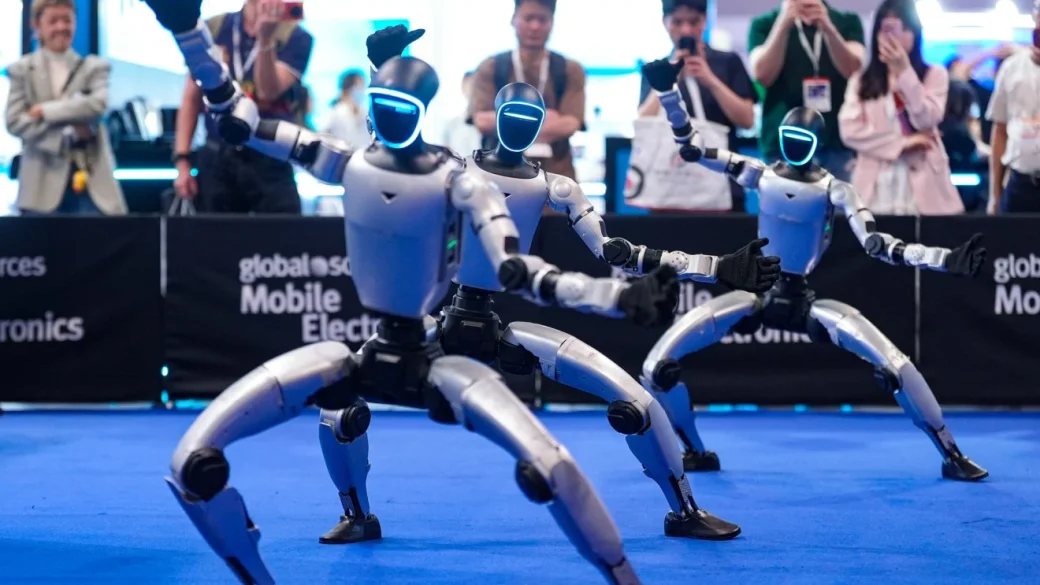
Unitree Robotics, the Chinese maker of humanoid and quadruped robots known for its backflipping, dancing and martial-arts demonstrations, made a spectacular debut on Shanghai’s STAR Market on Wednesday. Shares opened at 1,100 yuan, compared with an initial public offering price of 150.8 yuan, representing a gain of roughly 629%. The stock later pulled back, but was still trading around 900 yuan, or nearly six times the IPO price, underscoring the extraordinary investor enthusiasm surrounding China’s robotics industry.
The listing marks a major milestone for China’s humanoid-robotics sector and gives mainland investors direct exposure to one of the country’s most prominent robotics companies. Unitree raised roughly $900 million in its IPO, while its IPO valuation was about $9 billion. Retail demand was extraordinary, with the retail portion of the offering reportedly more than 5,500 times oversubscribed and about 9.8 million orders submitted. The debut comes as China pushes robotics and embodied artificial intelligence as strategic technologies to address manufacturing needs and a shrinking workforce.
Unitree Stock Jumps More Than 600% In Shanghai Debut
Unitree’s first trading session immediately demonstrated the level of speculation surrounding humanoid robotics.
The company priced its IPO at 150.8 yuan per share. Shares opened at 1,100 yuan, the session’s early high, before falling back toward 900 yuan.
At 1,100 yuan, the stock was approximately 629% above its IPO price. Even at 900 yuan, it remained nearly 497% above the offering price.
Unitree IPO: Key Numbers
| Metric | Figure |
|---|---|
| IPO price | 150.8 yuan |
| Opening/early high | 1,100 yuan |
| Early gain from IPO price | ~629% |
| Later reported trading level | ~900 yuan |
| Gain at 900 yuan | ~497% |
| IPO proceeds | About $900 million |
| IPO valuation | About $9 billion |
| Retail oversubscription | More than 5,500x |
| Retail orders | About 9.8 million |
| Founder | Wang Xingxing |
The enormous gap between the IPO price and the opening price shows that demand far exceeded the amount of stock available to investors at the offering price.
Unitree’s IPO Surge
IPO price: 150.8 yuan
⬇
Opening/early high: 1,100 yuan
⬇
Peak gain: ~629%
⬇
Later trading: ~900 yuan
⬇
Still nearly 6x IPO price
The scale of the move puts Unitree among the most dramatic technology-stock debuts in China’s recent market history.
Why Investors Are Betting On Unitree
Chinese hard-tech valuations are running hot more broadly — see China’s semiconductor industry reaching a record $245 billion.
Unitree has become one of the most recognizable names in China’s robotics industry because of its highly mobile machines.
Its humanoid robots have demonstrated abilities including running, dancing, boxing, martial arts and backflips. Those demonstrations have helped turn the company into a household technology brand in China, with its robots appearing at major televised events.
But Unitree is not simply a robotics demonstration company.
The company sells commercially available quadruped and humanoid robots, giving it a level of productisation that many competitors have yet to achieve.
Unitree’s Product Evolution
| Period | Development |
|---|---|
| 2016 | Unitree founded in Hangzhou |
| 2023 | Go2 robot dog launched |
| 2024 | G1 humanoid robot introduced |
| 2025 | Unitree expands humanoid and quadruped shipments |
| 2026 | Unitree launches Shanghai STAR Market IPO |
Unitree initially built its reputation around quadruped robots before expanding aggressively into humanoid machines.
Humanoid Robotics Is Becoming A Major Investment Theme
The Unitree IPO is significant because it gives China’s mainland stock market a high-profile pure-play humanoid robotics company.
Other Chinese robotics companies have listed or are preparing to list, but Unitree’s Shanghai debut is expected to serve as an important valuation reference point for the sector.
Morningstar analysts described the listing as an important A-share valuation benchmark for embodied AI and humanoid robotics.
China’s Robotics Investment Story
Robotics
↓
Embodied AI
↓
Humanoid Robots
↓
Industrial Automation
↓
Service Robots
↓
Potential Labor Replacement
This investment thesis is particularly relevant to China because the country is dealing with demographic pressures and a declining working-age population.
Robotics could help manufacturers maintain production capacity while reducing dependence on human labour in certain repetitive or physically demanding tasks.
Retail Investors Were Extremely Bullish
The scale of retail demand was one of the most striking aspects of Unitree’s IPO.
The retail portion was reportedly more than 5,500 times oversubscribed, while approximately 9.8 million orders were submitted.
IPO Demand At A Glance
| Indicator | Result |
|---|---|
| Retail oversubscription | >5,500x |
| Retail orders | ~9.8 million |
| IPO price | 150.8 yuan |
| Early market price | 1,100 yuan |
| IPO valuation | ~$9 billion |
Such demand indicates that investors are willing to assign substantial future value to companies involved in humanoid robotics, even though widespread commercial deployment remains limited.
Unitree Is Already Generating Revenue
One factor separating Unitree from many early-stage robotics companies is that it has already achieved meaningful commercial shipments.
Reuters reported that Unitree sold more than 5,500 humanoid robots and 18,000 quadruped robots in 2025, according to company filings.
Another report said Unitree shipped nearly 6,000 humanoid robots during the first half of 2026, highlighting the pace at which the company is attempting to scale production.
Unitree Robot Shipments
| Category | Reported Volume |
|---|---|
| Humanoid robots sold in 2025 | 5,500+ |
| Quadruped robots sold in 2025 | 18,000+ |
| Humanoids shipped in H1 2026 | Nearly 6,000 |
These numbers are important because they show that Unitree is moving beyond prototypes and demonstrations toward commercial manufacturing.
However, shipment volume should not be confused with widespread industrial adoption. Reuters noted that relatively few Unitree robots are currently being used commercially at scale.
Unitree’s Valuation Has Exploded
The IPO initially valued Unitree at approximately $9 billion.
Following the huge first-day surge, its market capitalization briefly moved above 400 billion yuan, equivalent to roughly $59 billion, according to the Financial Times.
Market Value Transformation
| Stage | Approximate Valuation |
|---|---|
| IPO valuation | ~$9 billion |
| Intraday post-debut value | >$59 billion |
| Approximate increase | More than 6x |
This valuation jump demonstrates the premium investors are placing on the future growth potential of robotics.
It also raises questions about whether the stock price has moved far ahead of the company’s current earnings and commercial adoption.
The Valuation Comes With Significant Risk
Unitree’s stock surge has created an enormous valuation gap between the company’s current business and the expectations embedded in its share price.
The Financial Times reported that the company’s trailing price-to-earnings ratio reached nearly 1,200 after the debut.
Valuation Warning Sign
IPO P/E: ~219x
⬇
Post-debut trailing P/E: nearly 1,200x
That means investors are paying an exceptionally high multiple for the company’s existing earnings in anticipation of very rapid future growth.
The valuation could remain elevated if Unitree delivers strong growth and the humanoid robotics market expands rapidly. But if adoption is slower than expected, such a valuation could become difficult to justify.
China Wants To Lead The Robotics Race
Unitree’s IPO is taking place against the backdrop of a much larger Chinese industrial strategy.
China has invested heavily in robotics, artificial intelligence, electric vehicles, batteries, drones and other advanced technologies.
The country’s leadership sees automation as particularly important as demographic changes reduce the available workforce.
The World Robot Conference in Beijing is taking place alongside Unitree’s market debut, with hundreds of mostly Chinese companies showcasing robotics technologies.
Why Robotics Matters To China
| Challenge | Potential Robotics Response |
|---|---|
| Aging population | Automated labor |
| Shrinking workforce | Industrial robots |
| Manufacturing costs | Higher automation |
| Productivity | AI-powered machines |
| Strategic technology competition | Domestic robotics ecosystem |
| Export competitiveness | Low-cost robot manufacturing |
This makes Unitree more than just another technology stock. Its performance is becoming a market indicator for China’s ambitions in embodied AI.
Unitree Has Backing From Major Technology Companies
The company’s rise has also been supported by prominent Chinese technology investors and strategic partners.
Reuters reported that Unitree has backing from companies including Tencent, Alibaba and DeepSeek.
DeepSeek’s involvement is particularly relevant because combining advanced AI models with physical robots could accelerate the development of machines capable of understanding environments and carrying out increasingly complex tasks.
Unitree’s Strategic Ecosystem
Unitree
↙ ↓ ↘
Tencent | Alibaba | DeepSeek
↓
AI + Robotics + Manufacturing
The combination of artificial intelligence and robotics is increasingly being described as embodied AI, in which AI systems interact with and act upon the physical world.
Unitree Faces Global Competition
Unitree is competing against some of the world’s best-known robotics companies.
Its rivals include Boston Dynamics, owned by Hyundai Motor Group, and Tesla, which is developing the Optimus humanoid robot.
Major Humanoid Robotics Players
| Company | Country | Key Focus |
|---|---|---|
| Unitree | China | Humanoid and quadruped robots |
| Boston Dynamics | US | Advanced mobile robots |
| Tesla | US | Optimus humanoid |
| UBTech | China | Humanoid robotics |
| AgiBot | China | Humanoid robotics |
China’s advantage increasingly lies not only in robot design but also in manufacturing scale and supply-chain depth.
That combination could allow Chinese companies to produce robots at lower costs and iterate more quickly than competitors in markets with higher manufacturing expenses.
The US-China Robotics Competition Is Intensifying
Unitree’s debut also comes amid growing technology tensions between China and the United States.
The US has taken steps to restrict certain Chinese robotics imports and technology access, while China continues to promote domestic development of advanced robotics.
Reuters recently reported that some of Unitree’s successful robot-dog designs benefited from openly published research originating from US military-funded robotics programs.
The broader issue is increasingly about who can turn robotics research into affordable mass-produced machines.
The Global Robotics Race
US
Research strength
+
AI leadership
+
Advanced robotics companies
China
Manufacturing scale
+
Supply chains
+
Government support
+
Rapid commercialization
↓
Global Competition In Humanoid Robotics
The ability to combine software, AI, hardware and manufacturing could ultimately prove more important than any individual robot demonstration.
The Bigger Picture
Unitree’s extraordinary Shanghai debut is a powerful signal of investor enthusiasm for humanoid robotics and embodied AI. The company’s shares rose from an IPO price of 150.8 yuan to as high as 1,100 yuan, while its market capitalization briefly exceeded $59 billion. At the same time, the company has already demonstrated meaningful commercial traction through thousands of robot shipments.
But the valuation also highlights the gap between current robotics adoption and investor expectations. Humanoid robots remain far from widespread commercial deployment, and Unitree will need to prove that its technology can move from impressive demonstrations into reliable, economically viable real-world applications.
Looking Ahead
The next test for Unitree will be whether it can convert the excitement surrounding its IPO into sustained business growth. The company has a growing product portfolio, commercial shipments and strong visibility in China, but its valuation now assumes that the global humanoid robotics market will expand rapidly. Production costs, robot reliability, AI capabilities and customer demand will determine whether those expectations are justified.
For China’s robotics industry, however, Unitree’s listing could prove even more significant. A successful public-market valuation could encourage other robotics companies to pursue IPOs and provide additional capital for research, manufacturing and commercialization. If that happens, the Unitree debut may ultimately be remembered not simply as a spectacular stock-market opening, but as an important milestone in China’s attempt to build a globally competitive humanoid robotics industry.
Frequently Asked Questions
How much did Unitree Robotics stock rise?
The shares reached about 1,100 yuan in early trading, a gain of roughly 629% over the IPO price, before easing to around 900 yuan.
What does Unitree make?
Unitree builds humanoid and quadruped robots, known for backflipping, dancing and martial-arts demonstrations.
How much did Unitree raise?
The IPO raised about $900 million.
Get the day’s top stories in your inbox
One concise email. No spam, unsubscribe anytime.


