
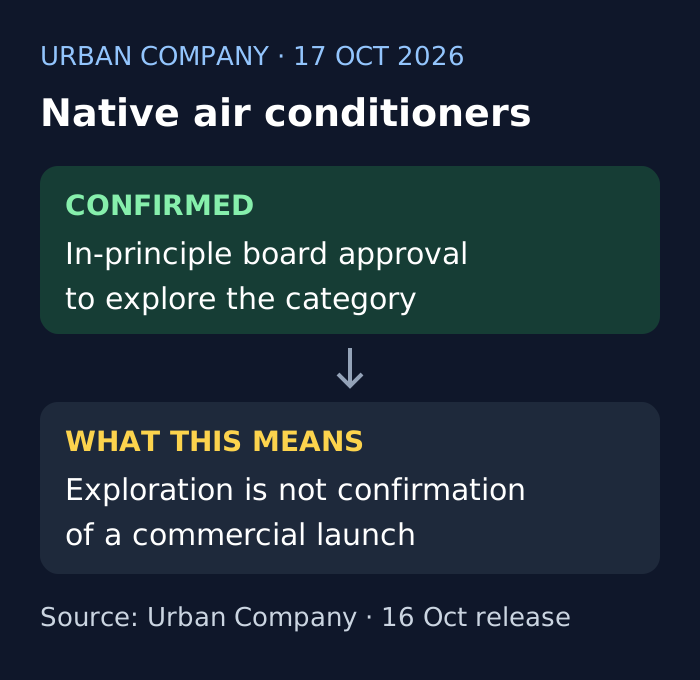
Urban Company is preparing to expand into India’s residential air-conditioner market through its in-house Native brand, marking a potential move from home services and smaller appliances into a major consumer electronics category. The Gurugram-based company has received in-principle board approval to explore residential air conditioners, citing its experience servicing millions of AC units annually and its understanding of the problems customers face with existing products. However, a commercial launch has not been formally approved, and the company will need further evaluation and specific board approval for the launch and related capital expenditure.
The proposed expansion comes as Urban Company builds Native into a broader home-products business. The brand already sells water purifiers and smart locks, while the company’s service network handles air-conditioner installation, maintenance and repairs. Entering the appliance market could allow Urban Company to connect product sales with installation and after-sales support through its app. The opportunity is significant, but the company will face established manufacturers such as Voltas, Daikin, Samsung and Godrej, as well as newer brands targeting Indian households.
Key Takeaways
- New category: Urban Company is exploring residential air conditioners under its Native brand.
- Approval status: The board has granted in-principle approval; a commercial launch and associated capital expenditure require further approval.
- Strategic advantage: The company says it services millions of AC units annually, giving it first-hand knowledge of consumer pain points.
- Existing portfolio: Native currently sells water purifiers and smart locks.
- Revenue growth: Native generated ₹105 crore in operating revenue in the July–September 2026 quarter, compared with ₹75 crore a year earlier.
- Competition: The proposed entry would put Native against established manufacturers and emerging appliance brands.
- Rollout approach: Urban Company has indicated that the initial one to two years would focus on learning, with distribution expected to be largely through its own app.
Why Is Urban Company Entering the Air-Conditioner Market?
Urban Company built its business around connecting households with service professionals for cleaning, repairs, beauty treatments and other home services. Air-conditioner servicing has been an important part of its appliance-service offering, giving the company experience with installation, maintenance and common product failures.
That experience could provide an advantage when developing an appliance of its own. Service professionals regularly encounter problems involving cooling performance, installation quality, maintenance requirements, energy use and repair costs. Feedback from those interactions can help a manufacturer identify where existing products fall short of customer expectations.
Urban Company says it has been investing in research and development to address gaps it has observed in the market. Its leadership has also indicated that the AC initiative will be approached carefully rather than as an immediate, large-scale expansion.
The strategy is consistent with Native’s broader positioning. Instead of selling appliances without a service connection, Urban Company wants products that can be purchased, installed, serviced and repaired through its platform.
That approach could help it differentiate its offering. However, turning service expertise into a successful appliance business requires additional capabilities, including product engineering, manufacturing partnerships, quality assurance, inventory management, warranty administration and spare-parts availability.
What Is Native, Urban Company’s Appliance Brand?
Native is Urban Company’s in-house brand for home products. Its existing portfolio includes water purifiers and smart locks, providing the company with a starting point for expanding into other categories where installation and ongoing service matter.
The brand is intended to connect physical products with Urban Company’s service network. A customer buying a Native product can potentially access installation, maintenance and repairs through the same platform used to book other household services.
The residential AC category fits this model because air conditioners require more than a one-time purchase. Customers often need installation, seasonal maintenance, cleaning, repairs and replacement parts throughout the product’s life.
Urban Company has said it wants to add no more than one new product category at a time and expects any addition to satisfy several criteria: a meaningful consumer problem, scope for better design and engineering, attractive economics and a clear connection with the platform’s services.
The AC proposal is therefore not simply about adding another appliance to the catalogue. It reflects an attempt to build a more integrated home-products business.
How Urban Company’s Service Network Could Help
One of the biggest challenges for an appliance manufacturer is the customer experience after a product leaves the showroom. Installation problems, delayed repairs and inconsistent servicing can affect customer satisfaction even when the underlying product performs well.
Urban Company’s existing network could help it address these issues. Its app already connects customers with service professionals, while the company has accumulated operational data and experience from AC installation and repair jobs.
If Native enters the market, it could design its products with installation and servicing requirements in mind. That might include easier access to components, clearer diagnostic procedures, better maintenance planning or product features informed by recurring customer complaints.
A connected service model could also give Urban Company more control over the customer journey. Customers might be able to purchase an AC, schedule installation and request maintenance through one platform instead of dealing with separate sellers and service providers.
However, the model’s effectiveness will depend on execution. The company will need to ensure that service availability, repair quality and spare-parts supply remain dependable as sales increase. A large service network does not automatically guarantee that every technician can install or repair every product correctly.
Urban Company will also need to determine whether its existing partners can support the additional workload without affecting the quality of services already offered through the platform.
India’s AC Market Offers a Large Opportunity
India’s residential air-conditioner market has attracted established appliance manufacturers as well as newer consumer technology companies. Rising temperatures, increasing household incomes, urbanisation and relatively low AC penetration compared with several developed markets provide room for long-term expansion.
The market is also becoming more competitive. Brands such as Voltas, Daikin, Samsung, Godrej, Haier and Blue Star have established manufacturing, distribution and service networks. They compete through product reliability, energy efficiency, cooling performance, pricing, financing options and dealer reach.
New entrants are trying to identify specific gaps rather than compete only on price. Optimist, a startup founded by Urban Ladder co-founder Ashish Goel, has raised $12 million to develop air conditioners designed for Indian conditions. Helium Smart Air, founded in 2025, has also raised funding to pursue the category.
Urban Company’s potential entry adds another model: an appliance brand backed by a large home-services platform.
Its advantage may lie in the connection between product design and after-sales service. Yet the company will still need to establish product credibility, secure supply arrangements and convince customers that Native offers a compelling alternative to established brands.
What Could Native ACs Offer Customers?
Urban Company has not yet announced a final product specification, launch date, price range or confirmed commercial model for its proposed residential ACs. It would therefore be premature to describe particular features as confirmed.
Based on the company’s stated strategy, potential areas of differentiation could include easier installation, service-friendly product design, clearer maintenance support and a more integrated booking experience. These are strategic possibilities rather than confirmed product features.
Energy efficiency could also be important in a market where electricity consumption is a major consideration for households. Customers increasingly compare star ratings, cooling capacity, operating costs and maintenance requirements when selecting an air conditioner.
A successful product would need to balance purchase price with performance over its useful life. A cheaper AC may not necessarily be more economical if it consumes more electricity or requires frequent repairs. Conversely, a premium product must justify its price through measurable benefits that customers value.
Urban Company’s service-led model could help it explain these trade-offs, but the product itself will need to meet customer expectations on cooling performance, reliability and durability.
Financial Context: Native Is Growing, but the Core Business Faces Pressure
The AC proposal arrives as Urban Company expands its product portfolio and invests in several businesses. Native generated ₹105 crore in operating revenue during the July–September 2026 quarter, compared with ₹75 crore in the corresponding period a year earlier.
That represents year-on-year growth of 40%. The increase suggests that Native is becoming a more meaningful part of Urban Company’s overall operations, although the segment’s revenue alone does not establish its profitability.
Urban Company’s consolidated revenue from operations rose 41.4% year on year to ₹537.3 crore in the September quarter. However, its consolidated net loss widened to ₹182.5 crore from ₹59.3 crore a year earlier.
The company attributed significant spending pressure to investment in InstaHelp, its instant domestic-help service, amid intense competition and customer-acquisition spending. Its financial performance illustrates the challenge of expanding several businesses at the same time.
| Financial metric | Q2 FY27 | Q2 FY26 |
|---|---|---|
| Consolidated revenue from operations | ₹537.3 crore | ₹380.0 crore |
| Consolidated net loss | ₹182.5 crore | ₹59.3 crore |
| Native operating revenue | ₹105 crore | ₹75 crore |
Figures are rounded and based on company disclosures and reporting published on October 16–17, 2026.
Urban Company’s board has also approved a proposal to raise up to ₹2,500 crore through permissible funding routes, subject to the relevant process and conditions. The company has described the proposed fundraising as providing flexibility to invest in its businesses, strengthen InstaHelp and pursue selected acquisitions.
The Native AC initiative must be viewed in this wider financial context. A new appliance category can require substantial investment in product development, supply chains, inventory, marketing and after-sales infrastructure. The company will need to assess these costs against its existing priorities.
When Could Urban Company Launch Its ACs?
Urban Company has not confirmed a commercial launch date. Its board has approved exploring the category in principle, but the company has stated that a launch and related capital expenditure require further evaluation and specific board approval.
During its October 16 earnings call, management indicated that the next one to two years would largely be a learning period for the AC initiative. The company also expects to keep distribution largely within its own app during the initial phase.
That approach could allow Urban Company to gather customer feedback and refine its product before committing to a broader rollout. Selling through its own platform may also help it connect product purchases with installation and maintenance services.
However, a controlled distribution strategy can limit reach compared with the dealer networks used by established manufacturers. Urban Company will need to decide how to balance service quality, distribution costs and customer access as the project develops.
Until the company announces formal launch details, customers should not assume that Native air conditioners are available to buy or that a specific model or price has been finalised.
The Bigger Picture
Urban Company’s proposed AC entry reflects a wider trend in Indian consumer technology: service platforms are exploring physical products that can strengthen their relationships with customers. Native’s existing appliance portfolio and Urban Company’s experience in installation and repair could create a differentiated route into the market.
The opportunity is substantial, but the company must prove that its service expertise can translate into competitive hardware. Product quality, manufacturing economics, energy efficiency, warranties and reliable after-sales support will matter as much as the convenience of buying through an app. The board’s in-principle approval is an early step, not a guarantee that the product will launch on a particular schedule.
Looking Ahead
The next milestones will be further board approval, product development, manufacturing arrangements and a formal decision on commercial launch and capital expenditure. Urban Company has signalled a measured approach, with the initial period expected to focus on learning from customer feedback and refining the product. The company has not yet announced confirmed specifications, pricing or a release date.
For the Indian AC market, Native’s potential entry would add a service-led competitor to an industry dominated by established appliance brands. Urban Company will need to demonstrate that its platform can deliver a compelling combination of product performance and long-term service. Its existing network offers a possible advantage, but sustained customer adoption will depend on the quality and economics of the final product.
Frequently Asked Questions
1. Is Urban Company launching air conditioners under Native?
Urban Company has received in-principle board approval to explore residential ACs under Native. A commercial launch and related capital expenditure require further evaluation and specific board approval.
2. Why is Urban Company entering the AC market?
The company says it services millions of AC units each year, giving it direct insight into customer pain points and product gaps. It wants to connect appliance sales with installation, maintenance and repair through its platform.
3. When will Native air conditioners launch?
No confirmed commercial launch date has been announced. Management has indicated that the next one to two years may focus on learning and development.
4. What products does Native already sell?
Native currently sells water purifiers and smart locks. Residential air conditioners would represent a further expansion into consumer appliances.
5. Who are Urban Company’s main competitors in the AC market?
Established brands include Voltas, Daikin, Samsung, Godrej, Haier and Blue Star. Newer entrants are also developing products tailored to Indian consumers.
6. How is Urban Company performing financially?
For Q2 FY27, consolidated revenue from operations increased 41.4% year on year to ₹537.3 crore, while its net loss widened to ₹182.5 crore. Native’s operating revenue rose to ₹105 crore from ₹75 crore in the year-ago quarter.
Source check, October 17, 2026: Urban Company’s October 16 results release confirms in-principle board approval to explore residential air conditioners under Native. This describes exploration, not an announced commercial launch. The Q2 FY27 shareholder report and results provide the financial figures discussed above.
Get the day’s top stories in your inbox
One concise email. No spam, unsubscribe anytime.


