
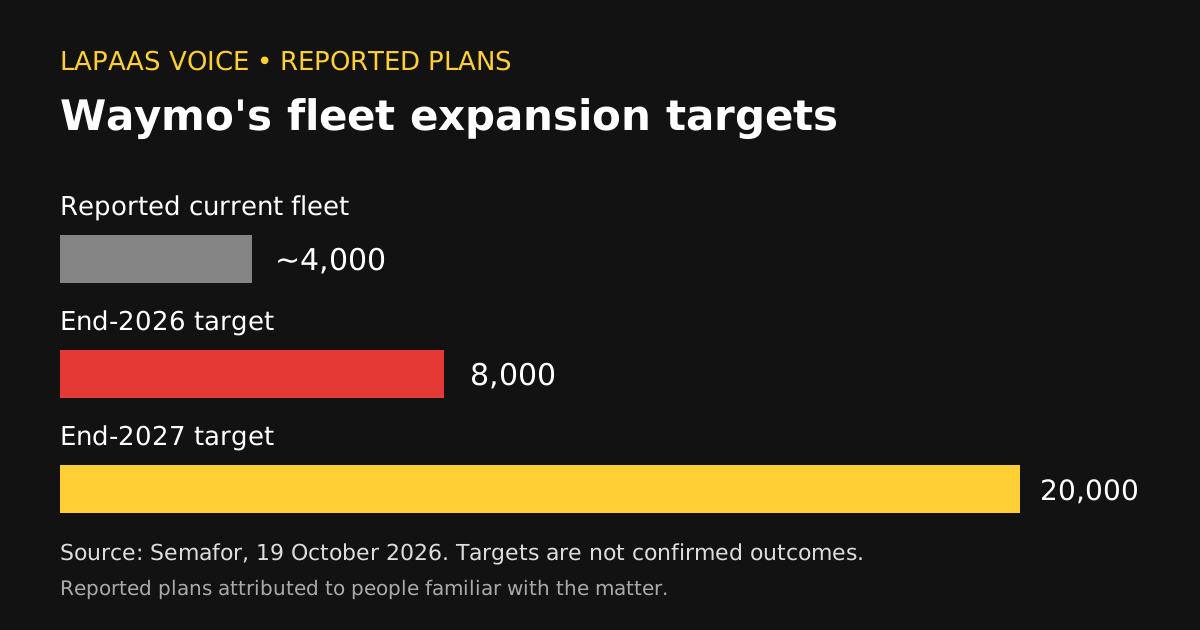
Waymo, Alphabet’s autonomous-driving subsidiary, is planning a major expansion of its robotaxi fleet, targeting 20,000 vehicles by the end of 2027. The company reportedly wants to increase its fleet from approximately 4,000 vehicles to 8,000 by the end of 2026 before reaching the larger target the following year. The expansion plan was reported by Semafor on October 19, 2026, citing people familiar with the matter, and subsequently covered by Reuters.
The reported expansion comes after Waymo secured $5 billion in debt financing earlier in October to support its growth in the United States and international markets. The company is expanding its driverless ride-hailing service as demand for autonomous transportation grows and competitors pursue their own robotaxi ambitions. However, reaching 20,000 vehicles will require more than buying cars. Waymo must also expand charging, maintenance, fleet management, passenger support and operational safety systems while entering new cities and meeting local regulatory requirements.
Key Takeaways
- Fleet target: Waymo reportedly aims to reach 20,000 robotaxis by the end of 2027.
- Near-term milestone: The company plans to increase its fleet to 8,000 vehicles by the end of 2026.
- Current fleet: Waymo’s fleet was reported at approximately 4,000 vehicles.
- Financing: The company secured $5 billion in debt financing to support expansion.
- Geographic growth: Waymo operates in multiple US cities and is preparing for additional international markets.
- Competition: The expansion comes as autonomous ride-hailing companies compete to scale their services.
- Execution challenge: Vehicle availability, safety, regulation and operating infrastructure will all influence how quickly the fleet grows.
How Quickly Does Waymo Plan to Expand?
Waymo’s reported plan involves two major stages: doubling its fleet by the end of 2026 and then increasing it to 20,000 by the end of 2027.
| Milestone | Reported fleet target | Significance |
|---|---|---|
| Current fleet | Approximately 4,000 | Starting point for expansion |
| End of 2026 | 8,000 | Doubles the reported current fleet |
| End of 2027 | 20,000 | Five times the reported current fleet |
These are targets reported by Semafor and Reuters, not confirmed future fleet totals.
The plan would require Waymo to add approximately 4,000 vehicles by the end of 2026, followed by another 12,000 during 2027 if it reaches each milestone as reported.
That second stage would be particularly demanding. Expanding from 8,000 to 20,000 vehicles would require a 150% increase in the fleet within a year, alongside the operational work needed to deploy vehicles in additional markets.
The targets also illustrate the difference between owning vehicles and operating a commercial robotaxi service. A vehicle must be equipped with the necessary autonomous-driving technology, tested, validated and integrated into the company’s operations before it can reliably serve passengers.
Waymo’s reported plan therefore represents an ambitious scaling target rather than a guarantee that 20,000 vehicles will all be available for passenger rides by the deadline.
Why Waymo Is Raising Billions for Expansion
Waymo secured $5 billion in debt financing earlier in October 2026, with lenders including PIMCO, Blackstone and Sixth Street. The funding is intended to support the company’s expansion in the United States and internationally.
Debt financing differs from an equity investment. Rather than selling additional ownership in the company to raise the money, a borrower takes on obligations that must be repaid under agreed terms.
For a capital-intensive business such as robotaxi transportation, financing can help cover vehicles, autonomous-driving hardware, fleet infrastructure and other expansion requirements. It can also give the company additional flexibility to scale its operations without relying exclusively on new equity funding.
However, borrowing introduces financial commitments. Waymo will need to generate sufficient commercial activity and manage its operating expenses while meeting its financing obligations. The economic outcome will depend on factors such as vehicle utilisation, maintenance costs, ride pricing and the expense of deploying its technology.
Waymo’s funding strategy also reflects the scale of investment required to move autonomous driving from limited deployments into a larger transportation business.
The company previously closed a $16 billion equity funding round that valued it at approximately $126 billion. The combination of equity capital and debt financing gives Waymo access to substantial resources, but it does not remove the operational and commercial risks of expansion.
How Waymo’s Robotaxi Business Works
Waymo uses a combination of sensors, computing hardware, mapping systems and autonomous-driving software to operate vehicles without a human driver behind the wheel during eligible commercial rides.
Its system, known as the Waymo Driver, uses information from the vehicle’s surroundings to identify other road users, interpret traffic conditions and plan driving movements. The technology must work across changing environments, including busy intersections, pedestrians, cyclists, roadworks and unusual driving situations.
Scaling this system across thousands of vehicles introduces additional complexity. Each vehicle must be maintained, monitored and kept ready for service. The company also needs processes for handling unusual incidents, assisting passengers and responding to situations the automated driving system cannot resolve independently.
Robotaxi operations therefore combine software development with a substantial physical infrastructure business. More vehicles can increase the number of rides the company is capable of offering, but only if charging, cleaning, maintenance and operational support expand alongside the fleet.
The 20,000-vehicle ambition signals that Waymo is attempting to build a larger transportation network rather than simply demonstrate autonomous-driving technology on a limited number of roads.
Waymo Is Expanding Beyond Its Existing US Markets
Waymo operates its driverless ride-hailing service in multiple US cities and has announced plans to expand into additional markets.
The company said on October 16 that it plans to bring its autonomous ride-hailing service to Toronto in 2028, marking its first planned deployment in Canada. It has also announced international ambitions involving cities such as London, Tokyo and Singapore.
These markets represent different operating environments. Road layouts, weather, traffic patterns, regulations and passenger expectations can vary significantly between cities and countries.
A system that works well in one US city may require additional testing and adaptation before it can operate commercially elsewhere. Local authorities may also require approvals, reporting arrangements and evidence that the service meets applicable safety standards.
International expansion can help Waymo reach more customers and diversify its operations, but it can also increase costs and management complexity.
The reported fleet target should therefore be considered alongside the company’s geographic plans. Adding vehicles in an established market may require different resources from launching a service in a new city where infrastructure and regulatory relationships must be developed from the beginning.
Vehicle Supply and Fleet Infrastructure Will Be Critical
Waymo’s expansion depends on securing suitable vehicles and equipping them for autonomous operation.
The company has used Jaguar I-Pace electric SUVs and has also developed its next-generation autonomous-driving system for other vehicle platforms. It has been working with vehicles based on models from Hyundai and Zeekr as part of its broader fleet strategy.
Waymo has also ordered thousands of vehicles manufactured by Zeekr, a brand owned by China’s Geely group, according to recent reporting. The vehicles are adapted with Waymo’s autonomous-driving technology and related hardware.
Using different vehicle platforms could help the company increase supply and manage costs, but it also introduces engineering and operational requirements. Sensors, computing systems and vehicle components must work reliably together, while maintenance teams need the right equipment and training for each platform.
Charging is another important consideration. Electric robotaxis must spend time replenishing their batteries, reducing the time they can carry passengers. As the fleet expands, Waymo will need enough charging capacity and suitable facilities to keep vehicles available throughout operating hours.
Cleaning, inspections and maintenance also affect utilisation. A large fleet does not automatically translate into a proportionate increase in completed rides if vehicles spend too much time out of service.
Competition in the Robotaxi Market Is Intensifying
Waymo is expanding while other companies work to develop autonomous transportation services.
Tesla has promoted its robotaxi ambitions, while Amazon-backed Zoox is developing a purpose-built autonomous passenger vehicle. Other mobility and technology companies are exploring autonomous driving through partnerships, testing programmes and commercial deployments.
The competitive challenge is not limited to developing a capable driving system. Companies must also make the service commercially attractive, earn passenger trust and operate within local regulatory frameworks.
Waymo’s existing commercial experience gives it a base from which to expand, but it still needs to demonstrate that the economics of driverless transportation can work at a much larger scale.
Important factors include the cost of each vehicle, the expense of autonomous-driving hardware, fleet maintenance, insurance, remote assistance and the number of paid rides each vehicle can complete.
If vehicles spend more time carrying passengers and less time waiting for charging or maintenance, the business may be able to spread its fixed costs across more rides. If utilisation remains low, the financial benefits of a larger fleet could be limited.
Safety and Regulation Will Shape the Expansion
Autonomous-driving companies must operate within safety and regulatory requirements that can differ between jurisdictions.
A larger fleet increases the number of vehicles exposed to real-world traffic conditions. Waymo will need to maintain its safety processes while expanding into new areas and operating across a wider range of roads, weather conditions and traffic patterns.
The company has faced scrutiny over incidents involving its vehicles, as have other autonomous-driving developers. Such incidents can trigger investigations, operational changes or restrictions, depending on the circumstances.
Regulatory approval is also not necessarily transferable from one city to another. A company may need to demonstrate that its vehicles can handle local road conditions and comply with the rules governing commercial passenger services.
These requirements can affect the pace of expansion. Even if vehicles are available and financing is secured, commercial operations may be delayed by testing, local approvals or infrastructure constraints.
Waymo’s ability to scale will therefore depend on maintaining safety and regulatory compliance alongside the pace of fleet growth.
What the Expansion Could Mean for Passengers
A larger robotaxi fleet could increase vehicle availability, reduce waiting times in established service areas and help Waymo reach more customers.
More vehicles may also make it easier for the company to offer rides across a wider geographical area and serve periods of higher demand. However, the effect will depend on where the vehicles are deployed and whether the company can support them operationally.
Passengers may also benefit from improvements in service reliability as Waymo gains experience from a larger number of trips. At the same time, availability, prices and service areas can vary, and a larger fleet does not guarantee cheaper rides.
For drivers and the wider transportation industry, the expansion raises continuing questions about the role of autonomous vehicles in commercial mobility. Robotaxis may change some aspects of ride-hailing operations, but the effects on employment, traffic and transportation costs will depend on how widely the services are adopted.
The Bigger Picture
Waymo’s reported plan to reach 20,000 vehicles reflects the shift from autonomous-driving demonstrations toward large-scale commercial operations. Its $5 billion debt financing provides resources for expansion, while its existing ride-hailing service offers a foundation for growing into new US and international markets.
The challenge is to make fleet growth operationally and financially sustainable. Vehicle supply, charging infrastructure, maintenance, safety and local regulatory approvals must expand alongside the autonomous-driving technology. The target is ambitious, and its success will depend on execution rather than financing alone.
Looking Ahead
The next milestone is the reported target of 8,000 vehicles by the end of 2026. Waymo’s progress toward that figure will offer an early indication of how quickly it can secure vehicles, equip them for autonomous operation and integrate them into commercial service. The subsequent target of 20,000 vehicles by the end of 2027 will require a much larger expansion across its operating network.
Over the longer term, investors and competitors will watch whether Waymo can convert its technological lead and financing into a sustainable transportation business. Its expansion into additional cities could increase passenger access to autonomous rides, but safety, regulation and unit economics will remain central to the company’s ability to grow.
Frequently Asked Questions
1. How many robotaxis does Waymo plan to operate by 2027?
Waymo reportedly aims to expand its fleet to 20,000 vehicles by the end of 2027, up from approximately 4,000 vehicles at the time of the report.
2. How many vehicles does Waymo want by the end of 2026?
The reported target is 8,000 vehicles by the end of 2026.
3. How is Waymo financing its expansion?
Waymo secured $5 billion in debt financing in October 2026 to support its expansion in the United States and internationally.
4. Which company owns Waymo?
Waymo is a subsidiary of Alphabet, the parent company of Google.
5. Is Waymo expanding internationally?
Yes. Waymo has announced plans involving markets such as Toronto, London, Tokyo and Singapore. Its planned Toronto service is expected to launch in 2028.
6. Does a larger robotaxi fleet guarantee lower prices?
No. A larger fleet could improve availability and utilisation, but prices will also depend on operating costs, demand, competition and the efficiency of each vehicle’s service.
Sources and further reading
- Semafor’s original fleet-target reporting, 19 October 2026
- Waymo’s official $5 billion financing announcement
Get the day’s top stories in your inbox
One concise email. No spam, unsubscribe anytime.


