
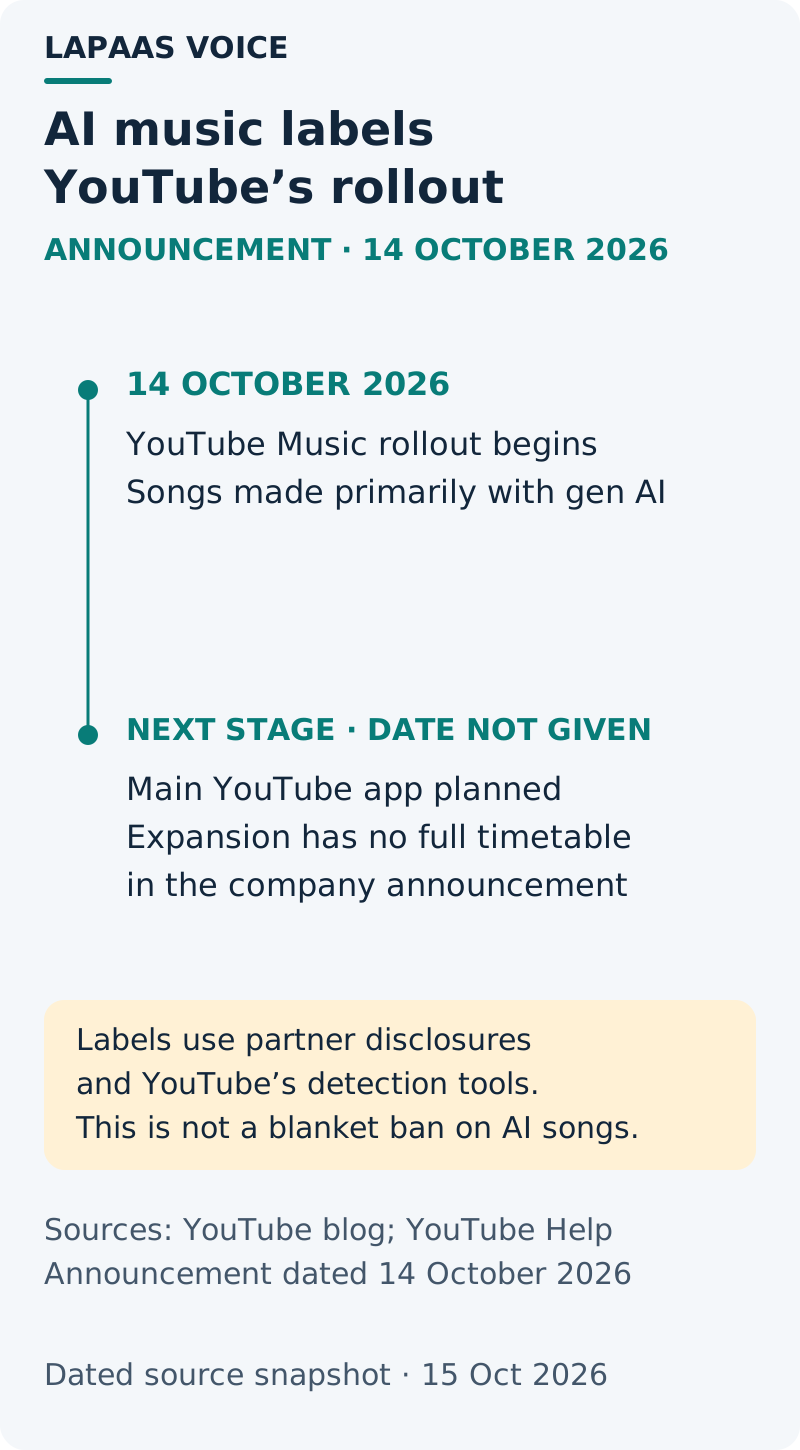
YouTube is introducing labels that identify songs created primarily using generative artificial intelligence (AI), beginning with YouTube Music and expanding to its main video platform. The new labels are designed to help listeners understand when AI has played a significant role in producing music, including generating compositions and vocals. The rollout began on October 14, 2026, according to YouTube’s announcement.
The move comes as AI music-generation tools make it easier to create complete songs without traditional recording sessions, instrumental performances or human-sung vocals. YouTube says listeners want more transparency about the music they hear. Its approach relies on disclosures from music partners and the platform’s own detection tools, placing greater emphasis on identifying AI involvement rather than automatically banning AI-created tracks.
Key Takeaways
- YouTube Music is receiving the labels first: YouTube plans to expand the feature to its main YouTube platform.
- The labels focus on significant AI involvement: Songs created primarily with generative AI, including AI-generated compositions and vocals, are central to the rollout.
- Music partners must disclose AI use: YouTube’s guidelines distinguish between fully AI-generated, partly AI-generated and non-AI-generated content.
- YouTube can use its own detection tools: The company may use additional signals when partner disclosures are missing.
- The policy is about transparency, not a blanket ban: AI involvement alone does not automatically make a track ineligible for monetization.
- Streaming platforms are taking different approaches: Some are emphasizing disclosure, while others are considering recommendation controls or additional restrictions.
How YouTube’s AI Music Labels Will Work
YouTube Music began rolling out the new labels on October 14. When listeners play a track in which AI has played a significant role, a label will appear on the player page. Tapping it will open additional information about AI’s role in the music’s creation.
YouTube says the system will also expand to the main YouTube app. That matters because songs are distributed through more than dedicated music-streaming services: they also appear in music videos, lyric videos, visualizers, Shorts and other creator uploads.
The company is working with music partners and using its own detection tools to identify tracks that meet its criteria. The stated objective is to give listeners clearer information about the origins of the music, rather than leaving them to guess whether a song was made by a person, an AI system or a combination of both.
YouTube has not presented the announcement as a universal label for every track that has touched an AI tool. Its stated focus is music created primarily using generative AI. That distinction is important because AI can be used for very different tasks, from generating an entire song to making a small adjustment during production.
What Counts as AI-Generated Music?
YouTube’s music-partner guidance establishes three disclosure categories: Fully Gen AI, Partly Gen AI and No Gen AI. The categories are intended to help partners describe how generative AI was used in a particular piece of content.
| Classification | What it means | Example |
|---|---|---|
| Fully Gen AI | All of the content was created using generative AI | A track generated from text prompts, including its composition and vocals |
| Partly Gen AI | Generative AI created some of the content | A musician uses AI to create a string section and records live vocals and instruments |
| No Gen AI | The content does not fall within the guidance’s generative-AI categories | An engineer uses automated mastering software or standard pitch correction |
The examples come from YouTube’s published guidance for music partners. The company also identifies AI-assisted songwriting and AI-generated music-video visuals accompanying human-performed audio as possible cases of partial generative-AI use.
This distinction helps separate generative AI from other forms of digital music production. Software that corrects a singer’s pitch or automatically adjusts equalization, compression and sound balance is not automatically treated as generative AI under YouTube’s examples.
The categories also show why a simple human-versus-machine distinction may not capture how modern music is produced. A song can contain human lyrics, live instruments, AI-generated melodies and digitally processed vocals in different combinations. Disclosure gives listeners context without necessarily making a judgment about the quality or artistic value of the finished track.
YouTube Will Combine Partner Disclosures With Detection Tools
Music partners are expected to provide information about generative-AI use when delivering content to YouTube. According to the company’s help documentation, disclosures can be supplied through supported industry delivery formats or through the relevant attributes in YouTube Studio.
YouTube can also use additional signals to supplement partner declarations. If no AI information is provided, the platform initially treats the status as unknown unless it can make a determination using other signals. Its systems may then designate content as fully or partly generated with AI.
This creates two routes for identifying AI-generated music: information supplied by the organisations delivering tracks and detection performed by YouTube.
The combined approach could improve coverage, but it also raises questions about accuracy and consistency. AI-assisted production is not always easy to classify from the final audio alone, particularly when human performances and generated elements are blended together. YouTube’s public guidance explains the categories and examples, but it does not provide a comprehensive accuracy rate for its music-detection systems.
The quality of the labels will therefore depend on how consistently partners classify their catalogues and how effectively YouTube can identify tracks when disclosure information is missing.
Why AI Music Transparency Is Becoming Important
Generative AI tools can create songs, vocals and instrumental arrangements from written prompts or other inputs. They can also help musicians develop melodies, experiment with arrangements and speed up parts of the production process.
These capabilities are expanding creative possibilities, but they are making it harder for listeners to understand how a track was made. In some cases, a generated song may resemble a conventional recording closely enough that its production method is not obvious to the audience.
Transparency can help listeners make informed choices about what they hear. It may also help artists, labels and distributors explain how their work was produced as AI becomes more integrated into the music business.
The issue extends beyond listeners. The industry is debating the use of artists’ voices and likenesses, the rights associated with training data, attribution, compensation and the potential for large volumes of low-cost generated music to compete for attention with human-produced recordings. Labels alone cannot settle these questions, but they can provide a basic layer of information.
A disclosure system is also useful because AI use is not necessarily a sign of deception or poor quality. Some artists may use generative tools openly as part of their creative process. A consistent label can distinguish disclosure from a broader judgment about whether a track should be promoted, monetized or removed.
How YouTube’s Approach Compares With Other Music Platforms
YouTube’s move is part of a wider shift across music streaming services. Platforms are developing different ways to identify AI-created music, although their policies do not all have the same purpose or consequences.
| Platform | Reported approach | Main distinction |
|---|---|---|
| YouTube Music | Rolling out labels for tracks created primarily using generative AI | Focuses on transparency about a track’s creation |
| YouTube | Plans to extend the music labels to the main platform | Brings disclosure to music content outside the dedicated music app |
| Spotify | Introduced AI Persona labels for profiles representing AI-generated identities | Focuses on identifying AI artist identities and controlling their recommendations |
| Apple Music | Announced plans for AI music labels later in 2026 | Aims to provide more information about AI involvement |
| Deezer | Labels detected AI-generated tracks and has taken steps to limit their use in recommendations | Combines identification with measures against certain AI-music practices |
These approaches should not be treated as identical. A label identifying an AI-generated artist is different from a label describing how an individual song was produced. Likewise, a platform can disclose AI involvement without restricting a track’s visibility or revenue.
YouTube’s announcement focuses on helping listeners understand a track’s origin. Other services have explored additional controls, including how AI-associated music appears in recommendations. The broader industry is still working out which measures best balance creative experimentation, listener choice and the interests of human artists.
Will AI-Generated Songs Be Demonetized on YouTube?
YouTube’s announcement does not establish a blanket ban on monetizing AI-generated music. The company is introducing labels to make AI involvement more transparent, and its broader guidance states that disclosure alone does not automatically affect a video’s audience or eligibility to earn money.
That does not mean every AI-generated track is guaranteed to earn revenue. Content remains subject to YouTube’s other rules, and separate issues involving copyright, impersonation, rights ownership, spam or other policy violations may affect individual uploads.
Creators should also distinguish between declaring AI use and complying with all other platform requirements. YouTube says that repeatedly failing to disclose qualifying AI-generated or altered content can lead to enforcement measures, including the manual application of labels, content removal or suspension from the YouTube Partner Program.
For music partners, accurate metadata will be particularly important as the new labels roll out. For independent creators, the relevant requirements depend on the type of content and the disclosure options available in YouTube Studio.
What the Change Means for Artists, Labels and Listeners
For listeners, the most immediate change is a clearer signal about a track’s production. Instead of relying on a song’s sound, artist profile or online discussion to guess whether AI was involved, users will be able to access a disclosure on supported tracks.
For artists and producers, the policy makes accurate information about AI use more important. Musicians who combine live performances with generated elements may need to work with their distributors or music partners to classify their releases correctly. Clear definitions could reduce confusion, although hybrid production will continue to present difficult cases.
Record labels, distributors and other music partners will also have a role in implementing the system. Their metadata helps determine how YouTube classifies tracks, while the platform’s detection tools provide a supplementary route when information is missing.
The effect on discovery and competition is less certain. Labels may help users make more informed decisions, but they do not by themselves prevent AI-generated tracks from competing for streams. Their long-term value will depend on how visible the labels are, how reliably the system works and whether listeners use the information.
The Bigger Picture
YouTube’s AI music labels represent a shift toward making the production process more visible to audiences. As generative tools become more capable, music platforms face pressure to explain when AI is responsible for a substantial part of what people hear. Clear disclosure may become a standard feature of digital music distribution, much like credits and other track metadata.
However, transparency is only one part of the debate. Questions about copyright, consent, artist identity, royalty allocation and recommendation systems remain separate challenges. YouTube’s rollout does not resolve them, and the company has not announced a general prohibition on AI-generated music. The measure instead gives listeners additional context while the industry continues to develop rules for a rapidly changing market.
What Happens Next?
The next stage will be the expansion of the labels from YouTube Music to the main YouTube platform. The rollout will also test how effectively YouTube and its music partners can identify AI-generated tracks across a broad catalogue, including songs that combine human performances with generated components. The company has not announced a complete timetable for the expansion.
Over time, the response from listeners, artists and music distributors may influence how detailed these disclosures become. Greater transparency could make it easier to distinguish fully generated songs from hybrid productions, but questions about monetization, recommendations and rights will require separate policy decisions. For now, YouTube’s stated priority is to make AI involvement in music more visible rather than to exclude AI-created tracks from the platform.
Frequently Asked Questions
1. When did YouTube start labeling AI-generated songs?
YouTube Music began rolling out the labels on October 14, 2026. YouTube has said the labels will also expand to its main platform, although it has not specified a complete rollout date.
2. Where will listeners see the AI music label?
The label will appear on the player page for eligible tracks in YouTube Music. Tapping it opens additional information about AI’s role in creating the music. The feature is also planned for the main YouTube platform.
3. Does YouTube ban or demonetize AI-generated songs?
No blanket ban or automatic demonetization was announced with this labeling change. AI-generated tracks remain subject to YouTube’s wider policies, including applicable copyright and monetization requirements.
4. Does using Auto-Tune make a song AI-generated?
Not automatically. YouTube’s music-partner guidance gives standard pitch correction and automated AI mastering as examples that fall under its No Gen AI category. Generative AI used to create compositions, vocals or other substantial musical elements is treated differently.
Get the day’s top stories in your inbox
One concise email. No spam, unsubscribe anytime.


