
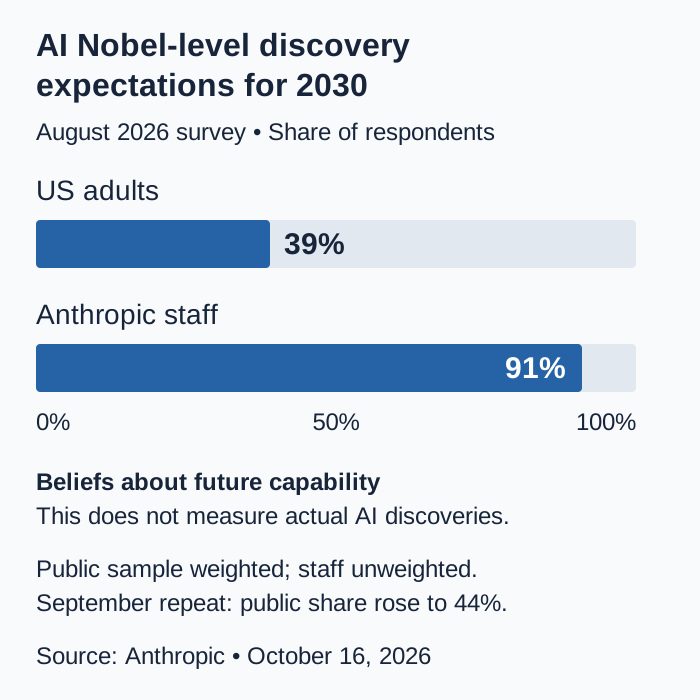
Anthropic has found a significant divide between its employees and the wider American public over how quickly artificial intelligence will advance. In a survey published on October 16, 2026, the AI company reported that 91% of its staff expect AI to make a Nobel-level scientific discovery by 2030, compared with just 39% of US adults. The findings suggest that people working directly with advanced AI systems anticipate much faster progress than the broader population.
The report, titled The AI Expectations Gap, examines expectations about AI capabilities, workplace adoption, productivity and employment. It draws on a survey of 10,980 US adults and an internal poll of 1,334 Anthropic employees conducted in August 2026. The study also found that Anthropic staff expect AI to perform a much larger share of their current work by 2030. However, the results measure what respondents believe may happen, not verified predictions about AI capabilities, future job losses or economic growth.
Key Takeaways
- Nobel-level discoveries: 91% of Anthropic staff expect AI to make a Nobel-level discovery by 2030, compared with 39% of US adults.
- Workplace automation: Anthropic employees expect AI to perform an average of 75% of their current work hours by 2030, versus 28% among employed US respondents.
- Productivity: 59% of Anthropic staff who answered the relevant question said AI reduces suitable tasks to one-quarter of the time or less, compared with 26% of US adults who use AI at work.
- Scientific research: Around 90% of Anthropic staff expect AI to be able to design, conduct and publish scientific studies by 2027, compared with 38% of US adults.
- Economic outlook: Respondents’ answers imply substantially different economic scenarios, but these are model-based estimates rather than forecasts guaranteed to materialise.
- Employment concerns: People who expect AI to automate more of their own work also tend to anticipate higher unemployment.
What Did Anthropic’s AI Expectations Survey Find?
Anthropic’s research team compared the views of people working at the frontier of AI development with those of the general US population. The goal was to understand whether disagreement about AI’s economic impact comes mainly from different beliefs about technological progress or from different expectations about how businesses and workers will use AI.
The results show that both groups broadly agree about what AI can do today. Their expectations diverge when considering how quickly capabilities may improve over the next several years.
Anthropic employees work with advanced AI systems as part of their jobs and may have more direct experience of their strengths and limitations. Most members of the public, by contrast, encounter AI through a narrower range of products and tasks.
That difference in experience may help explain why employees of an AI company expect more rapid progress. It does not establish that employees’ expectations will necessarily prove correct, particularly when forecasts extend several years into the future.
The gap in expectations about scientific breakthroughs
| Survey question | Anthropic staff | US adults |
|---|---|---|
| Expect AI to make a Nobel-level discovery by 2030 | 91% | 39% |
| Expect AI to design, conduct and publish scientific studies by 2027 | About 90% | 38% |
| Expect AI to complete at least seven of eight listed tasks by 2030 | 96% | 41% |
Source: Anthropic’s October 2026 research report. Figures represent respondents’ expectations, not measured AI performance or independently verified probabilities.
The results indicate a major difference in confidence about the speed of AI development. A Nobel-level discovery is an especially demanding benchmark because it implies more than generating plausible text or summarising existing research. Such a result would require a meaningful scientific contribution, although the precise relationship between AI’s contribution and eventual Nobel recognition would depend on the circumstances.
The survey does not show that AI has already made a discovery worthy of a Nobel Prize. It shows that most surveyed Anthropic employees expect AI to reach that level by 2030, while fewer than half of surveyed US adults share that expectation.
Why Anthropic Employees Expect Faster AI Progress
One possible explanation is exposure. Anthropic employees regularly use AI tools and work alongside systems that may be more capable than those available to many ordinary users.
Experience can change expectations. A person who uses AI only to draft emails may see it primarily as a writing assistant. Someone using advanced systems for coding, research, analysis and other complex tasks may have a different view of what the technology could accomplish as capabilities improve.
The report also found that people who regularly use AI at work tend to expect faster progress than those who have never used an AI tool. Among people who regularly use AI at work, 56% expect AI to complete at least seven of the eight listed tasks by 2030. That compares with 28% among people who have never used an AI tool.
However, regular AI users still do not share the expectations of Anthropic staff to the same extent. The difference suggests that familiarity with AI matters, but the type of work people perform and the systems they encounter may also influence their views.
There is another important limitation: employees of an AI company are not a representative sample of all workers. Their professional environment may expose them to emerging capabilities, but it may also make them more optimistic about the technology their industry is developing.
AI Could Automate More of Employees’ Work by 2030
The survey’s findings about individual jobs reveal an even sharper difference between Anthropic staff and the wider workforce.
Anthropic employees expect AI to be capable of performing an average of 75% of their current work hours by 2030. Among employed US respondents, the average expectation is 28%.
| Employment measure | Anthropic staff | Employed US respondents |
|---|---|---|
| Average share of current work AI could perform by 2030 | 75% | 28% |
| Expect AI to perform at least 80% of their current work | More than half | About 5% |
These figures measure respondents’ expectations about their own work, not actual job replacement.
The distinction between performing tasks and eliminating jobs is essential. A job typically consists of multiple responsibilities, including communication, decision-making, collaboration and accountability. AI may be capable of handling some tasks without removing the need for a human employee.
Businesses may also choose not to automate every task that technology can perform. Customer preferences, data security, reliability, regulations, liability and organisational processes can slow adoption.
Anthropic’s report found that US adults expect these practical obstacles to constrain AI use. Customers preferring to interact with people was the most frequently selected concern, followed by privacy and security, reliability and legal or regulatory issues.
The results suggest that technological capability alone will not determine the scale of workplace automation. The extent of adoption will depend on whether businesses can integrate AI into their operations and whether customers, employees and regulators accept its use.
How Much Productivity Could AI Deliver?
Anthropic staff also reported much larger expected productivity gains from AI on tasks suited to the technology.
Among Anthropic employees, 59% said a task that AI is well suited to could take one-quarter of the time or less when AI is used. Among US adults who use AI at work, the corresponding figure was 26%.
The difference matters because productivity gains depend on more than whether AI can complete a task. They also depend on how much faster it works, the quality of its output and how much human review remains necessary.
For example, an AI system might produce a first draft of a report in minutes, but a worker may still need to verify facts, check calculations, add context and obtain approval. The time saved on drafting does not necessarily equal the total time saved on the complete task.
Anthropic’s report distinguishes between AI’s technical capabilities and the rate at which businesses adopt them. Even when AI can perform a task, organisations may take time to change their processes, train workers and establish safeguards.
This helps explain why the public may expect less dramatic economic change than people working at an AI company. The two groups may differ not only in their views of future model capabilities, but also in how quickly those capabilities will translate into real-world productivity.
What the Survey Suggests About Economic Growth
Anthropic used a separate economic model to translate respondents’ expectations into potential economic scenarios. The model considers several factors, including AI capabilities, adoption, task automation, productivity gains and the difficulty workers may face when changing occupations.
Based on the model, the median US adult’s responses implied annual US GDP growth of 5.4% in 2030. The median Anthropic employee’s responses implied growth of 17.1%.
| Respondent group | Model-implied annual GDP growth in 2030 |
|---|---|
| Median US adult | 5.4% |
| Median Anthropic employee | 17.1% |
| Median visitor to Anthropic’s online scenario explorer | 12.5% |
These figures are outputs from Anthropic’s economic model using respondents’ answers. They are not official economic forecasts or measured growth rates.
The difference is substantial, but it must be interpreted carefully. The model calculates what could follow if a respondent’s assumptions about AI capabilities, adoption and productivity were realised. It does not establish that the US economy will grow at those rates.
Actual economic outcomes will depend on many factors beyond AI, including investment, consumer demand, policy, energy availability, business competition and the distribution of productivity gains.
The exercise is useful because it makes the assumptions behind different expectations more explicit. If AI capabilities improve quickly and businesses adopt the technology widely, the economic impact could be larger than if adoption remains gradual. But the magnitude and timing of that impact remain uncertain.
Do Anthropic Employees Expect More Unemployment?
The report found that people who expect AI to perform a larger share of their own work also tend to anticipate higher unemployment.
This relationship appeared among both Anthropic employees and the wider US workforce. The groups differed in how much work they expected AI to automate, but their views on the connection between automation and unemployment were broadly similar when compared at similar levels of expected exposure.
The finding suggests that concerns about employment are not confined to people unfamiliar with advanced AI. Even workers who build and use frontier systems can expect disruption when they anticipate substantial automation.
However, the relationship is not a prediction that unemployment will rise by a particular amount. The survey records individual expectations, and the study’s economic model depends on assumptions about how quickly displaced workers find new jobs and how new work emerges.
Automation can reduce demand for some tasks while creating demand for others. Whether the net effect is higher unemployment, shorter working hours, new occupations or greater output will depend on the pace of change and how effectively workers and employers adapt.
Retraining and job transitions remain important
The survey asked respondents how long a person displaced by AI in 2030 might need to find a job in a different occupation.
The median Anthropic employee expected the transition to take around 12 months. The median US adult response was in the range of seven to 12 months.
These are expectations rather than measured re-employment outcomes. Still, they highlight the possibility that even if AI increases overall productivity, individual workers may experience difficult transitions.
Training, access to new opportunities and the ability to move between occupations could influence how the benefits and costs of AI are distributed across the economy.
What the Findings Mean for Businesses and Workers
For businesses, the survey highlights the importance of separating what AI can technically do from what an organisation is ready to deploy. Companies will need to evaluate reliability, data protection, costs and employee workflows before handing important responsibilities to AI systems.
For workers, the results suggest that understanding AI tools may become increasingly useful as organisations experiment with automation. Yet the survey does not mean that every worker should expect most of their job to disappear by 2030. Exposure differs substantially by occupation, task and workplace.
For policymakers, the findings underline the value of measuring AI adoption and its labour-market effects rather than relying solely on forecasts. Better information about productivity, job transitions and changes in hiring could help governments and employers respond as the technology develops.
The survey also demonstrates why public discussion of AI can be polarised. People with different experiences may interpret the same technology very differently. More evidence about actual performance, adoption and economic outcomes will be needed to determine which expectations are most accurate.
The Bigger Picture
Anthropic’s survey reveals a pronounced expectations gap between people developing advanced AI and the wider public. Staff are substantially more optimistic about future capabilities, productivity gains and the proportion of their own work AI may perform. The findings may reflect greater exposure to advanced systems, but they remain a snapshot of beliefs rather than proof of what will happen by 2030.
The most consequential question is how technological progress translates into real economic change. Scientific discoveries, productivity growth and automation are related but distinct outcomes, each shaped by adoption, reliability and human decisions. The coming years will show whether AI develops at the pace Anthropic employees expect and whether its economic benefits can be realised without imposing unmanageable costs on workers and institutions.
Looking Ahead
The survey adds evidence to the debate over how quickly AI could transform scientific research and employment. Researchers, companies and governments will need to track real-world capabilities and adoption rather than treating any single survey as a definitive forecast. Future studies will be particularly useful if they compare expectations with measurable outcomes over time.
For workers and businesses, the practical response is to prepare for change while recognising uncertainty. AI tools may automate some tasks, accelerate others and create new kinds of work, but the balance will differ across occupations and industries. The gap between Anthropic staff and public expectations is a reminder that experience with technology can shape forecasts—and that the real test will be what AI can reliably accomplish in practice.
Frequently Asked Questions
1. What did Anthropic’s AI survey find?
Anthropic found that 91% of its surveyed employees expect AI to make a Nobel-level discovery by 2030, compared with 39% of US adults. The survey also found major differences in expectations about productivity and job automation.
2. Does the survey mean AI will definitely make a Nobel-level discovery by 2030?
No. The figures measure what respondents expect, not the probability that such a discovery will occur. The survey does not establish that AI has already made a Nobel-level scientific contribution.
3. How much of their work do Anthropic employees expect AI to perform by 2030?
Anthropic staff expect AI to be capable of performing an average of 75% of their current work hours, compared with 28% among employed US respondents.
4. Why do Anthropic employees expect faster AI progress?
Their work gives them direct exposure to advanced AI systems and their development. That experience may shape their expectations, although it does not guarantee that their forecasts will prove accurate.
5. Does the report predict massive unemployment?
The report does not establish a definite future unemployment rate. It finds that people who expect AI to automate more of their work also tend to expect higher unemployment, while actual outcomes will depend on adoption, job creation and worker transitions.
6. What did Anthropic’s economic model estimate for GDP growth?
Using respondents’ answers, the model implied annual US GDP growth of 5.4% in 2030 for the median US adult and 17.1% for the median Anthropic employee. These are model-based scenarios, not official forecasts.
Survey source and timing
Source update, 17 October 2026: Anthropic’s research report uses August 2026 surveys: 10,980 US adults in a weighted online opt-in panel and 1,334 employees in an unweighted internal poll. The 39% comparison is from August. A September repeat raised the public share expecting Nobel-level AI capability by 2030 to 44%. The results describe respondents’ expectations, rather than measured capabilities or guaranteed outcomes.
Get the day’s top stories in your inbox
One concise email. No spam, unsubscribe anytime.


