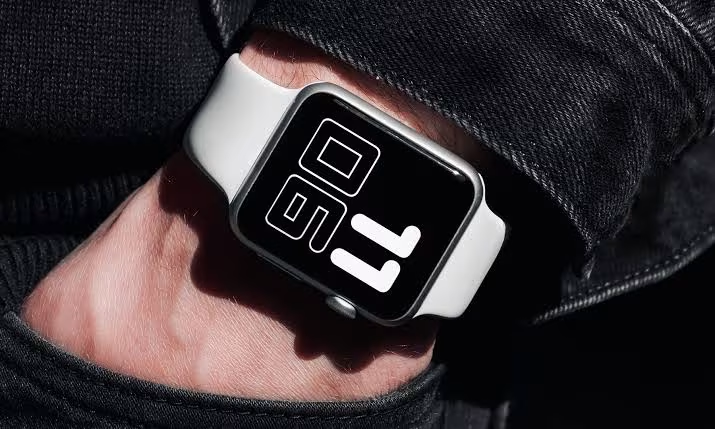
Apple is exploring new directions for its wearable lineup, including a possible screen-free device, as the company considers how to reinvent the Apple Watch amid changing trends in the smartwatch and fitness-tracking market. The reported plans include devices with different screen shapes and sizes, as well as products without displays, according to Bloomberg reporting cited by multiple outlets. Apple has not yet settled on a specific design or confirmed that a screen-free wearable will reach the market.
The development would represent a significant departure from Apple’s traditional smartwatch strategy. Since its launch more than a decade ago, the Apple Watch has remained centred around a display, with Apple gradually expanding its functionality through health monitoring, fitness tracking, communications, cellular connectivity and other smart features. Apple’s current lineup includes the Apple Watch Series 11, Apple Watch SE 3 and Apple Watch Ultra 3.
The reported screen-free concept appears to be influenced by the growing popularity of fitness-focused wearables that deliberately remove the display. Products such as Whoop have built their experience around collecting health and fitness data while minimising distractions. These devices can be lighter and offer longer battery life because they do not need to power a large screen or support constant on-device interaction.
Apple’s interest in this category could allow it to target consumers who want health and fitness tracking without the notifications, apps and constant interaction associated with a conventional smartwatch.
A screen-free Apple wearable could potentially focus primarily on collecting health and activity data and then presenting detailed information through the iPhone or another Apple device. Instead of checking a wrist display for notifications, users could rely more heavily on their phone, AirPods or voice-based interactions.
This approach could also fit Apple’s increasing emphasis on artificial intelligence. The company is reportedly working on an AI-powered version of Siri and expanding AI capabilities across its products. Future wrist-worn devices could potentially use voice interaction and AI-generated health insights to compensate for the absence of a screen.
Health monitoring is likely to remain central to any such product. Apple’s existing wearable strategy has increasingly focused on health and safety features, while the company continues to expand the role of the Health app. A screen-free device could therefore function more like an always-on health sensor than a miniature smartphone.
The potential move also reflects a broader change in the wearable market. Smart rings, screen-free fitness bands and other specialised devices are gaining attention among consumers who prioritise health tracking, battery life and comfort over smartphone-style functionality.
The appeal of removing the screen is relatively straightforward. A display requires power, adds weight and encourages users to interact with the device. A screen-free wearable could potentially be smaller, lighter and more comfortable to wear continuously.
Battery life could become another major advantage. A device without a bright OLED display would have fewer demands on its battery, potentially allowing Apple to offer significantly longer usage between charges. Longer battery life is particularly important for health tracking because users need to wear the device consistently to collect useful data.
Apple is also reportedly considering changes beyond a screen-free product. The company is exploring different screen shapes and sizes, including the possibility of a round display, although a round Apple Watch is reportedly considered less likely to reach the market. It is also evaluating products positioned above the current Ultra and Hermès models, along with more affordable concepts below or around the existing entry-level range.
This suggests Apple may be looking at a broader restructuring of its wearable portfolio rather than simply preparing another incremental Apple Watch update.
The current Apple Watch design has remained broadly familiar for years, even as Apple has introduced thinner hardware, larger displays, the Ultra line and new health capabilities. A broader redesign could therefore help the company create new product categories while maintaining the existing Apple Watch range for customers who prefer a traditional smartwatch.
A screen-free device could also help Apple address a different segment of the market.
Traditional smartwatches appeal to consumers who want notifications, calls, apps, navigation and health tracking on their wrists. Fitness bands and smart rings appeal more to people who primarily want health information without carrying another full-featured screen.
Apple could potentially serve both groups by maintaining its conventional Watch lineup while introducing a simpler wearable focused on health.
The move would put Apple into closer competition with companies such as Whoop and other specialised fitness wearable makers. Apple’s advantage would be its enormous ecosystem, allowing a new wearable to integrate closely with iPhone, Apple Health, AirPods and other devices.
However, Apple would also face a challenge in explaining why consumers need another wearable when the Apple Watch already provides most of the same health-tracking functions.
Pricing could therefore become important. A cheaper, simpler device could attract consumers who do not want to spend hundreds of dollars on a full smartwatch.
At the other end of the market, Apple could potentially position a premium screen-free health wearable as an accessory for users who already own an Apple Watch or other Apple devices.
The company is reportedly exploring products across both higher and lower price points, suggesting that it is considering a wider expansion of its wearable portfolio.
The potential product also raises questions about how Apple would handle interaction without a display.
Voice could become one option. Users could interact through Siri, while audio responses could be delivered through AirPods. Haptic feedback could provide silent alerts, and the iPhone could handle more detailed information.
That would create a different relationship between the user and the wearable: the wrist device would primarily sense and communicate, while the phone would remain the main visual interface.
Such an approach could fit into Apple’s broader strategy of making its devices work together rather than treating every product as an independent computer.
For Apple, the biggest opportunity may therefore be less about creating another fitness tracker and more about developing a new type of personal computing device.
A screen-free wearable could continuously collect information about activity, movement and health while remaining largely invisible to the user. AI could then interpret that information and deliver useful recommendations through other Apple devices.
However, this approach would also raise privacy and data-security concerns. A wearable that continuously collects health and behavioural information would need strong safeguards around how that data is stored, processed and shared.
Apple has historically marketed privacy as a major differentiator, making data protection likely to be an important part of any future health-focused wearable strategy.
There is also no guarantee that the reported concept will become a commercial product. Apple regularly explores different hardware designs and technologies before deciding which ideas are worth bringing to consumers.
The company has reportedly not selected a final direction for the next generation of its wearable portfolio, meaning the screen-free concept could change substantially or never launch.
For the smartwatch industry, however, Apple’s exploration is significant even before a product is announced.
The company’s entry into a new category can accelerate consumer awareness and force competitors to rethink their own products. If Apple ultimately launches a screen-free wearable, rivals could face pressure to improve battery life, health monitoring, AI capabilities and integration across devices.
The broader trend also suggests that the future of wearables may not be about putting increasingly powerful miniature smartphones on people’s wrists.
Instead, the industry could move toward specialised devices that collect data continuously and use AI to determine when users actually need information.
In that scenario, the screen itself becomes less important.
For consumers, the choice could eventually be between a traditional smartwatch designed for interaction and a quieter wearable designed primarily for sensing, health tracking and AI-assisted insights.
For Apple, exploring both approaches could allow it to participate in the next stage of the wearable market without abandoning the Apple Watch.
Broader industry impact: Apple’s reported exploration of a screen-free wearable indicates that the smartwatch category could be entering a new phase in which health sensing, AI and battery life become more important than displays. The concept could allow Apple to compete directly with specialised fitness wearables while using its existing ecosystem to provide the visual and conversational interface elsewhere.
If Apple ultimately launches such a device, it could also validate the idea that wearables do not always need screens to be useful. The company’s influence could push the broader industry toward lighter, longer-lasting and more health-focused devices, while AI increasingly handles the interpretation and delivery of the information collected by them.
Frequently Asked Questions
Is Apple making a screen-free wearable?
Apple is reported to be exploring a screen-free device among new directions for its wearable lineup. Nothing has been confirmed or announced.
Why would Apple drop the screen?
The smartwatch and fitness-tracking market is maturing, so a screen-free, sensor-led device is one way to reinvent the category rather than iterating on the existing Apple Watch.
What else is Apple planning for India?
Its services push continues — see our report on Apple Pay’s expected India launch by October 2026.
Get the day’s top stories in your inbox
One concise email. No spam, unsubscribe anytime.


