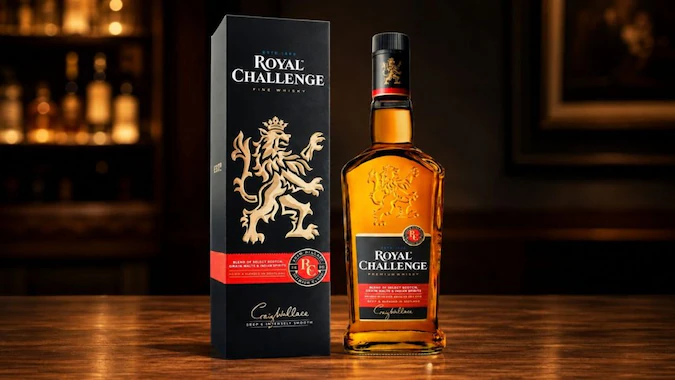
India’s food safety regulator, the Food Safety and Standards Authority of India (FSSAI), has warned Diageo that a claim on its popular Royal Challenge whisky saying the product is “matured in American oak casks” could mislead consumers. A confidential notice issued on July 20 said most of the spirit in the product was not matured in wooden casks, raising questions about how the whisky’s ageing process is represented on its label.
The warning adds to mounting regulatory scrutiny of Diageo’s Indian operations and the wider alcoholic-beverage industry. FSSAI has already taken action against several whisky and rum products over the use of artificial or nature-identical flavouring substances, putting greater focus on how spirits are manufactured, blended and marketed in India.
FSSAI Questions Royal Challenge Whisky Label
The dispute centres on the wording printed on Royal Challenge Whisky.
The front label describes the product as a blend of Indian grain spirit and imported Scotch that is “matured in American oak casks.” However, FSSAI said its review found that a major portion of the spirit was not matured.
According to the regulator’s notice, grain neutral spirit is the second-listed ingredient after demineralised water, while the predominant portion of the spirit is reportedly non-matured.
FSSAI said the claim that the complete alcohol content was matured in wooden casks could therefore give consumers a misleading impression about the product.
Key Details
| Particular | Details |
|---|---|
| Company | Diageo India / United Spirits |
| Brand | Royal Challenge Whisky |
| Regulator | FSSAI |
| Label claim questioned | “Matured in American oak casks” |
| Notice date | July 20, 2026 |
| Main concern | Major portion of spirit reportedly not matured |
| Other concern | Vague reference to “Scotch” |
| Broader issue | Whisky labelling and composition |
What Does the Royal Challenge Label Say?
Royal Challenge is one of Diageo’s major whisky brands in India.
The front label describes it as a blend containing Indian grain spirit and imported Scotch, followed by the claim that it has been matured in American oak casks.
The back label lists demineralised water, grain neutral spirit and Scotch among its ingredients, along with permitted natural colours and added nature-identical whisky flavouring substances.
FSSAI’s concern is that the prominent maturation claim could lead consumers to believe that the whisky’s entire alcohol component underwent the maturation process described on the bottle.
FSSAI Says Age Claims Must Reflect the Youngest Spirit
The regulator also raised a broader point about age-related claims on blended spirits.
FSSAI told Diageo that when a product makes a claim concerning the age of the spirit, the claim should correspond to the youngest spirit used in the blend rather than the oldest component.
This interpretation could have implications beyond Royal Challenge if other blended spirits use prominent ageing or maturation claims.
For consumers, the distinction is important because a blend can contain spirits with different production histories and ages.
FSSAI Also Questions the Use of “Scotch”
The regulator has raised another labelling concern involving the word “Scotch”.
According to the notice, the reference to Scotch on the Royal Challenge label is too vague and does not adequately communicate the product’s true characteristics.
FSSAI has asked Diageo to specify what type of Scotch is being used.
The issue highlights the regulator’s increasing focus on whether alcohol labels provide consumers with sufficiently clear information about ingredients and production methods.
Diageo Faces Wider Regulatory Scrutiny
The warning comes shortly after FSSAI prohibited the sale of several whisky and rum products manufactured in Madhya Pradesh over concerns about artificial flavouring.
The products affected include Royal Challenge Whisky and Antiquity Blue Whisky from Diageo’s portfolio, along with Bagpiper Deluxe Whisky and Old Cask Deluxe XXX Rum produced by Inbrew in the state.
The regulator’s action was linked to the use of artificial or “nature-identical” flavouring substances that it said were being used to replicate characteristics associated with traditionally aged spirits.
Diageo has challenged aspects of the regulatory action in court and maintains that its products comply with applicable laws.
Why the Latest Warning Matters
The latest notice is important because it goes beyond the use of flavouring.
It focuses on how the product is described to consumers.
Food and beverage labels are designed to communicate important characteristics of a product, including ingredients, processing and manufacturing methods.
If a label creates an impression that does not accurately reflect the composition or production process, regulators can consider it misleading.
The Royal Challenge case could therefore become relevant to broader discussions about how blended alcoholic beverages are marketed in India.
Royal Challenge Is a Major Diageo Brand
Royal Challenge is one of Diageo’s leading whisky brands in India.
The company says more than 4.5 million nine-litre cases of Royal Challenge are sold in the country annually, placing the brand among its important products in the Indian market.
The whisky is positioned in the mid-prestige segment.
Its large sales base means that any change to the product’s labelling, manufacturing process or marketing could affect a substantial number of consumers.
What the Regulatory Action Could Mean for Labels
If regulators require changes to the wording, manufacturers may need to revise packaging across their portfolios.
That can involve:
- New label designs
- Printing and packaging changes
- Updated ingredient declarations
- Changes to advertising
- Revised product descriptions
- Inventory management for existing packaging
For large consumer brands, label changes can become a significant operational exercise because products are distributed across multiple states and retail channels.
India’s Alcohol Industry Faces Greater Scrutiny
The developments come as FSSAI increases its scrutiny of India’s food and beverage industry, where packaging claims and ingredient disclosures have become a competitive battleground.
The regulator has recently taken action involving alcohol products as well as high-caffeine beverages marketed as “energy drinks”.
The broader trend indicates that regulators are increasingly examining whether products are labelled and marketed in accordance with established standards. Other Indian watchdogs are tightening enforcement in parallel, including SEBI’s crackdown on misleading financial content.
For alcohol companies, this could mean greater attention to ingredients, flavouring, ageing claims and descriptions of imported spirits.
The Difference Between Maturation and Flavouring
One of the central issues in the broader regulatory dispute is the distinction between genuine maturation and the addition of flavouring.
Traditional whisky maturation involves keeping spirit in wooden casks for a period of time, allowing it to develop characteristics through interaction with the wood and other chemical processes.
Flavouring substances can be used to alter the taste or aroma of a product without relying entirely on the same maturation process.
FSSAI’s recent actions indicate that it is examining whether manufacturers are clearly distinguishing these processes and accurately representing them to consumers.
What Diageo Has Said
Diageo India has said it follows high quality standards and is engaging with the regulator to address questions surrounding its products and labelling.
The company has also indicated that it is monitoring the situation following FSSAI’s recent regulatory action.
The latest warning does not by itself establish that Diageo intentionally misled consumers or that the product is unsafe.
It is a regulatory concern regarding the accuracy and interpretation of product labelling.
No Immediate Financial Impact Expected
Diageo’s Indian business has indicated that the recent regulatory action is not expected to have a material financial impact, although the company continues to monitor developments.
The financial consequences will depend on whether the company needs to change labels, reformulate products, alter manufacturing processes or withdraw products from specific markets.
The impact could also vary because alcohol regulation and pricing differ across Indian states.
Potential Impact on Other Whisky Brands
The most significant longer-term implication could be the precedent created by FSSAI’s interpretation of maturation claims.
If the regulator requires greater precision around statements involving ageing, cask maturation and blended spirits, other whisky manufacturers could face similar scrutiny.
Brands that prominently advertise wood maturation may need to review their labels to ensure that claims accurately describe the product as a whole.
This could lead to broader changes in how premium and mass-market Indian whiskies are marketed.
Consumers Could Get More Detailed Information
From a consumer perspective, stricter labelling requirements could make it easier to understand what is actually inside a bottle.
Clearer information could cover:
- Type of spirit used
- Origin of imported components
- Maturation process
- Age of the youngest spirit in a blend
- Added flavouring substances
- Nature of Scotch used
- Other permitted additives
Greater transparency could help consumers distinguish between different categories of whisky and understand the differences in production methods.
Regulatory Challenge for the Industry
Alcohol manufacturers will need to balance marketing considerations with increasingly detailed regulatory expectations.
Terms such as “aged”, “matured”, “oak”, “Scotch” and “premium” can carry significant commercial value because they influence how consumers perceive a product.
The more regulators scrutinise those claims, the more carefully companies will need to substantiate them.
This could increase compliance costs but may also encourage greater consistency across the industry.
What Investors Should Watch
Investors tracking Diageo’s Indian operations should monitor several developments:
- FSSAI’s further action on Royal Challenge
- Any changes to the product’s labels
- Court proceedings involving the broader liquor ban
- Potential impact on manufacturing facilities
- Sales disruption in affected states
- Regulatory action involving other brands
- Changes to product formulations
- Compliance costs
The current warning is primarily a regulatory and labelling issue, but repeated interventions could have wider implications if they result in product changes or distribution restrictions.
Broader Industry Impact
FSSAI’s warning to Diageo reflects a broader tightening of regulatory scrutiny over India’s alcoholic-beverage industry. The regulator is increasingly examining not just whether products meet safety standards, but also whether companies accurately describe ingredients, maturation processes and other characteristics on their labels.
For the whisky industry, the case could push manufacturers toward more precise descriptions of blended spirits and ageing claims. It could also encourage consumers to pay closer attention to labels and distinguish between genuine maturation and the use of flavouring substances.
Looking Ahead
The FSSAI warning puts a fresh spotlight on Royal Challenge Whisky and the way Diageo describes its products to Indian consumers. The regulator’s position is that the “matured in American oak casks” claim is misleading because a major portion of the spirit is reportedly not matured, while the reference to “Scotch” is considered insufficiently specific.
The development comes at a particularly sensitive time for Diageo, which is already facing regulatory action over several spirits manufactured in Madhya Pradesh. While the latest notice does not establish a safety issue or a deliberate attempt to deceive consumers, it could force the company and other liquor makers to reassess how maturation, ingredients and imported spirits are described on packaging.
For India’s alcohol industry, the bigger issue is likely to be the precedent. If FSSAI continues enforcing stricter standards around product descriptions, whisky and spirits companies may need to invest more heavily in compliance, label verification and manufacturing transparency.
Frequently Asked Questions
Why has FSSAI warned Diageo over Royal Challenge whisky?
FSSAI issued a confidential notice on July 20, 2026 saying the front-label claim that Royal Challenge whisky is “matured in American oak casks” could mislead consumers. The regulator’s review found that a major portion of the spirit in the blend was not matured in wooden casks, and that grain neutral spirit is the second-listed ingredient after demineralised water.
Who owns Royal Challenge whisky?
Royal Challenge is owned by Diageo India, which operates in the country through United Spirits. It is one of Diageo’s leading whisky brands in India, with the company reporting sales of more than 4.5 million nine-litre cases annually, positioned in the mid-prestige segment.
Is Royal Challenge whisky safe to drink after the FSSAI notice?
The FSSAI notice does not establish that the product is unsafe or that Diageo intentionally misled consumers. It is a regulatory concern about the accuracy and interpretation of the product’s labelling — specifically the maturation claim and the vague reference to “Scotch”. Diageo India says it follows high quality standards and is engaging with the regulator.
Get the day’s top stories in your inbox
One concise email. No spam, unsubscribe anytime.


