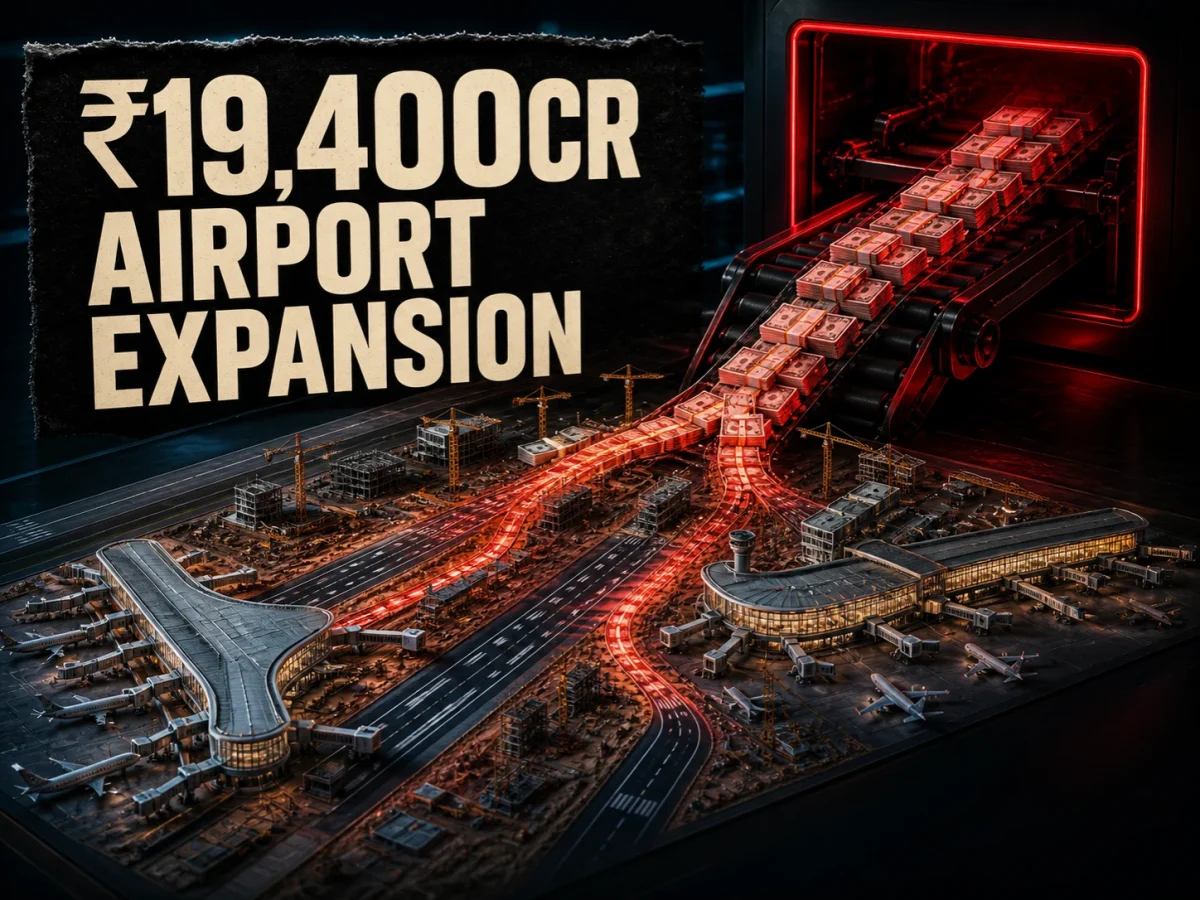
GMR Airports is planning to invest as much as ₹19,400 crore ($2 billion) over the next five to seven years to expand and modernize its airports in New Delhi and Hyderabad. The investment reflects the airport operator’s expectations that India’s rapidly expanding aviation market will require substantially more passenger capacity and upgraded infrastructure over the coming decade. The company plans to allocate about ₹13,800 crore to Rajiv Gandhi International Airport in Hyderabad and up to ₹5,600 crore to Delhi airport.
The expansion comes as India’s domestic aviation market continues to grow and airlines prepare for a much larger fleet. Government estimates cited in the report project Indian air passenger traffic to increase six-fold to around 1.1 billion passengers over the next 14 years, while the commercial aircraft fleet could rise from about 400 planes in 2014 to more than 2,350 by 2040. GMR said the planned projects are intended to keep its major airport assets ahead of this demand curve.
GMR Airports’ ₹19,400 Crore Expansion Plan
The proposed investment will be concentrated at GMR’s two largest strategic airport assets: Delhi and Hyderabad. Rather than being funded directly by GMR Airports as the holding company, the investments will be funded through a combination of debt and equity raised by the respective airport ventures.
Hyderabad will receive the larger share of the planned capital because the airport has significant room for passenger growth. GMR intends to increase its annual passenger-handling capability to around 80 million from its current capacity of about 34 million.
Expansion Investment At A Glance
| Airport | Planned Investment | Current Annual Capacity | Planned Capacity |
|---|---|---|---|
| Hyderabad | ₹13,800 crore | 34 million passengers | ~80 million passengers |
| New Delhi | ₹5,600 crore | 100 million passengers* | Expansion and modernization |
| Total | ₹19,400 crore | — | — |
*Delhi’s expanded terminal capacity was already raised to about 100 million passengers annually following the completion of its latest expansion phase.
The Hyderabad project represents the larger capacity expansion, potentially adding roughly 46 million passengers of annual capacity compared with the airport’s current 34-million-passenger level.
Hyderabad Airport To More Than Double Capacity
Hyderabad’s Rajiv Gandhi International Airport is at the center of GMR’s planned investment. The company expects the airport’s upgraded infrastructure to accommodate approximately 80 million passengers annually, more than twice the current annual volume of around 34 million passengers.
The scale of the planned expansion reflects strong traffic growth at the airport. During the first half of FY2026, Hyderabad handled 15.4 million passengers, up 11.3% from 13.8 million in the corresponding period a year earlier. Domestic and international passenger traffic both increased by about 11% during the period.
Hyderabad Airport Traffic And Financial Growth
| Metric | Earlier Period | Latest Period | Growth |
|---|---|---|---|
| H1 Passenger Traffic | 13.8 million | 15.4 million | 11.3% |
| Q2 Passenger Traffic | 6.9 million | 7.3 million | 5.5% |
| H1 Total Income | ₹1,152 crore | ₹1,299 crore | 12.7% |
| Q2 Total Income | ₹577 crore | ₹674 crore | 16.9% |
| H1 EBITDA | ₹731 crore | ₹820 crore | 12.3% |
| Q2 EBITDA | ₹369 crore | ₹430 crore | 16.5% |
| H1 PAT | ₹99 crore | ₹162 crore | 63.7% |
The figures show why GMR sees Hyderabad as a major long-term growth opportunity. Passenger traffic is rising while airport revenues are benefiting from both aviation and non-aviation businesses.
Delhi Airport Investment Focuses On A Major Aviation Hub
GMR plans to spend up to ₹5,600 crore on New Delhi airport. The investment is smaller than the Hyderabad allocation but is aimed at maintaining and modernizing one of India’s most important aviation gateways.
Delhi airport’s most recent major expansion included a new Terminal 1, a fourth runway and a cross taxiway. The completed expansion increased the airport’s overall terminal capacity to approximately 100 million passengers annually. The expansion was fully commissioned in October 2024.
GMR has also been increasing the airport’s international handling capabilities. Pier C at Terminal 3 was converted into an international pier, increasing Terminal 3’s annual international capacity by 50% to 32 million passengers and increasing wide-body stand availability by about 40%.
These improvements are important as international aviation becomes an increasingly significant part of India’s growth story.
India’s Aviation Market Is Entering A New Growth Phase
GMR’s investment decision comes against a backdrop of rapidly increasing Indian air travel demand. India is already the world’s third-largest domestic aviation market, behind the United States and China, according to the report. Government projections suggest the country’s passenger traffic could reach around 1.1 billion passengers over the next 14 years.
The expected expansion of India’s airline fleet is another major factor. The commercial fleet is projected to exceed 2,350 aircraft by 2040, compared with roughly 400 aircraft in 2014. More aircraft will require additional airport slots, terminal capacity, runways, parking stands, cargo infrastructure and passenger-processing facilities.
India’s Long-Term Aviation Demand
INDIA AIR PASSENGER TRAFFIC
Current trajectory
        │
        ▼
Rapid domestic + international growth
        │
        ▼
~1.1 billion passengers
projected over the next 14 years
        │
        ▼
More airport capacity required
        │
        ▼
Terminal + runway + cargo + commercial expansion
The scale of the projected demand explains why airport operators are investing years ahead of expected traffic.
GMR Is Expanding Beyond Delhi And Hyderabad
The ₹19,400 crore plan could be only part of GMR Airports’ broader expansion strategy. The company currently operates six airports in India, one airport in the Philippines and has another airport under construction in Greece. It also took over operations of Nagpur airport in June 2026.
GMR has said that investment plans for Nagpur are under discussion, suggesting that additional capital could eventually be directed toward the airport. The company’s portfolio is therefore becoming more geographically diversified within India.
The recent start of commercial operations at GMR’s Bhogapuram airport in Andhra Pradesh also adds another major asset to the company’s Indian airport network. The new airport began commercial operations on August 17, 2026.
Airport Business Is More Than Passenger Terminals
GMR’s strategy also increasingly includes businesses surrounding the airport itself. These include duty-free retail, cargo, maintenance, repair and overhaul (MRO), hospitality and commercial real estate.
At Hyderabad, for example, GMR commissioned Cargo Terminal 2 with an initial capacity of around 50,000 metric tonnes per year and infrastructure that can eventually support expansion to 100,000 tonnes. The facility includes a temperature-controlled pharmaceutical zone designed for pharma and perishable cargo.
At Delhi, GMR has also been developing Aerocity-related commercial projects, including a roughly 1-million-square-foot office building and a luxury hotel project with about 380 rooms.
GMR’s Airport Ecosystem
| Business | Delhi | Hyderabad |
|---|---|---|
| Passenger terminals | Major expansion completed | Expansion planned |
| Cargo | Cargo Terminal 1 concession | Cargo Terminal 2 operational |
| Duty-free | Major business | Expanded store |
| Commercial real estate | Aerocity development | GMR Aerocity |
| Hospitality | Hotel development | Airport-linked hospitality |
| MRO | Airport ecosystem | GMR Aero Technic |
This diversified model allows GMR to generate revenue from passengers and businesses operating around the airport, rather than relying entirely on aeronautical fees.
GMR Is Not Planning To Enter The Airline Business
Despite discussions within the Indian government about potentially allowing airport operators to run airlines, GMR currently does not intend to enter the airline business.
GMR executive director Saurabh Chawla said the company wants to remain focused on airports and related businesses such as aircraft maintenance and real estate development around its aviation facilities.
The decision separates GMR’s strategy from the airline sector, where competition remains concentrated. The report noted that IndiGo and Air India together control nearly 90% of India’s domestic airline market, making airport infrastructure and related businesses an alternative avenue for GMR to participate in aviation growth without taking airline operating risk.
GMR And Adani Are Betting On India’s Airport Growth
The investment also highlights the intensifying competition between India’s two major private airport operators, GMR Airports and Adani Airport Holdings.
GMR is currently India’s largest airport operator by annual passenger traffic, while Adani is the country’s largest airport operator by the number of airports. Adani has separately been reported to be planning approximately $15 billion of investment to increase passenger capacity across its aviation facilities over the next five years.
| Airport Operator | Key Position | Expansion Signal |
|---|---|---|
| GMR Airports | Largest by annual passenger traffic | ₹19,400 crore planned for Delhi and Hyderabad |
| Adani Airports | Largest by number of airports | Reported $15 billion capacity investment |
| GMR strategy | Airports + adjacent businesses | Focus on domestic airport opportunities |
| Adani strategy | Expanding national airport network | Large-scale capacity build-out |
The two groups’ investment plans indicate that India’s airport infrastructure market is entering a period of sustained private-sector capital expenditure.
The Bigger Picture
GMR’s ₹19,400 crore investment plan is effectively a long-term bet on the growth of India’s aviation economy. The company is preparing its two most important airports for significantly higher passenger volumes while simultaneously expanding cargo, retail, MRO and commercial real estate opportunities around its airport assets. Hyderabad’s planned increase to roughly 80 million passengers annually is particularly significant because it would more than double the airport’s current capacity.
The investment also reflects a broader shift in India’s airport industry. As passenger numbers and airline fleets expand, airport operators are increasingly being positioned as large infrastructure and commercial platforms rather than simply providers of runways and terminals. GMR’s strategy of combining aviation infrastructure with retail, cargo, MRO, hotels and real estate could become increasingly important to the economics of India’s next generation of airports.
Looking Ahead
Over the next five to seven years, execution will be the key factor for GMR. The company will need to coordinate large-scale construction while keeping Delhi and Hyderabad airports operational, manage financing through the respective airport ventures and ensure that additional capacity comes online in line with passenger growth. The Hyderabad expansion, in particular, represents a substantial increase from the airport’s existing 34-million-passenger capacity.
For India’s aviation sector, the planned investment points toward a much larger airport infrastructure market by the 2030s. With passenger traffic potentially reaching around 1.1 billion over the next 14 years and the commercial fleet projected to exceed 2,350 aircraft by 2040, GMR’s expansion could be an early stage of a much broader airport modernization cycle across the country.
Get the day’s top stories in your inbox
One concise email. No spam, unsubscribe anytime.


