
Headline clarification, 16 October 2026: The headline has been clarified to refer to fresh subscriptions in selected gold ETF Fund of Funds (FoFs), rather than a blanket halt to gold ETF inflows. The HDFC notice and Tata notice set out scheme-specific restrictions; they do not announce a suspension of exchange trading. The original publication date and the article’s reported aggregate figures and attributed rationale are unchanged.
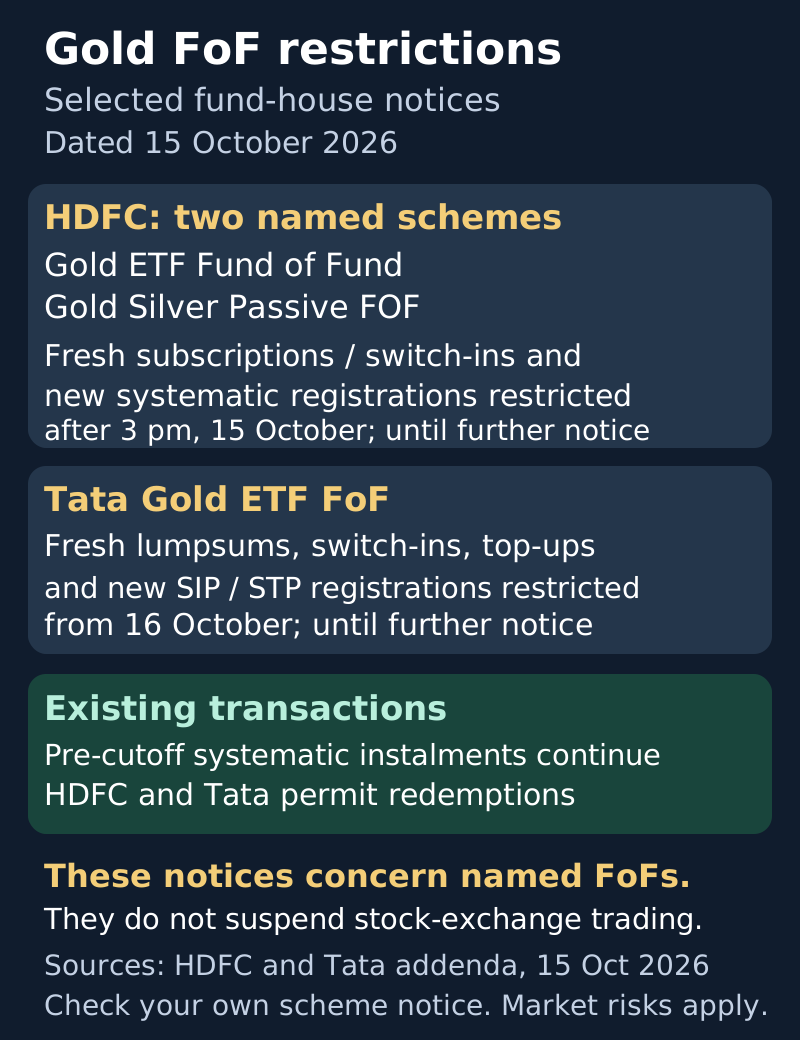
Several major Indian mutual fund houses have temporarily restricted fresh investments in gold exchange-traded fund (ETF) Fund of Funds (FoFs) just before the festive season, when demand for gold typically increases. The restrictions, announced on October 15 and 16, 2026, affect new lump-sum investments, switch-ins and registrations for systematic investment plans (SIPs) in specified schemes. Fund houses including HDFC Mutual Fund, ICICI Prudential Mutual Fund, Tata Mutual Fund and Kotak Mahindra Mutual Fund are among those that have announced restrictions. Existing investors can generally continue redeeming their investments, and SIP instalments registered before the effective dates are continuing under the published notices.
The move comes as policymakers remain attentive to India’s gold import bill, pressure on the rupee and the country’s external trade balance. Gold ETF inflows had risen sharply in September, while Dussehra and Diwali were approaching. Reports link the restrictions to discussions involving the Securities and Exchange Board of India (SEBI), although the public notices issued by fund houses generally did not specify a reason. Investors should also distinguish between gold ETF FoFs and gold ETFs traded directly on stock exchanges: the restrictions do not amount to a blanket ban on buying exchange-traded gold ETF units.
Key Takeaways
- Fresh investments restricted: Several fund houses have temporarily stopped accepting new subscriptions in specified gold ETF FoF schemes.
- Existing SIPs generally continue: Instalments registered before the effective date are continuing under the relevant scheme notices.
- Redemptions remain available: Existing investors can generally withdraw their money or make permitted switch-outs.
- Direct gold ETFs remain available: Investors can still buy eligible gold ETF units on stock exchanges through a demat and trading account.
- September inflows surged: Gold ETFs received net inflows of ₹4,450.61 crore in September 2026, up about 71.4% from August.
- Festive demand is a concern: Higher gold purchases can increase imports, potentially affecting the trade balance and foreign-exchange demand.
- Duration remains uncertain: Several restrictions are described as temporary and effective until further notice.
What Exactly Has Changed for Gold Investors?
The restrictions primarily affect gold ETF Fund of Funds, or FoFs. These are mutual fund schemes that invest in gold ETFs rather than buying physical gold directly for each investor.
A FoF allows investors to obtain gold-price exposure through a conventional mutual fund account. Depending on the scheme, investors may be able to invest through lump-sum purchases or systematic contributions without directly placing trades in a demat account.
The latest notices from multiple asset management companies restrict certain fresh transactions in their gold FoFs. These include new lump-sum investments, additional investments, switch-ins from other mutual fund schemes and new SIP or systematic transfer plan (STP) registrations. Some fund houses have also restricted top-ups or modifications to existing SIPs that would increase contributions.
The precise restrictions vary by scheme, so investors should check the addendum issued by their own fund house rather than assume every gold-related product has identical rules.
What is affected and what is not?
| Transaction | General position under the published notices |
|---|---|
| Fresh lump-sum investment in affected gold FoFs | Temporarily restricted |
| New SIP registration in affected schemes | Temporarily restricted |
| Switch-in from another mutual fund scheme | Restricted in affected schemes |
| Existing SIP instalments registered before the cutoff | Generally continue |
| Existing investments and holdings | Remain invested unless the investor chooses otherwise |
| Redemption or withdrawal | Generally permitted |
| Direct purchase of gold ETFs on stock exchanges | Still available |
Investors should check the specific scheme addendum because effective dates and transaction restrictions can differ between fund houses.
The key distinction is that the restrictions concern the acceptance of new money into specified mutual fund schemes. They do not mean existing gold investments have been frozen or that investors are unable to sell their holdings.
Which Mutual Fund Houses Have Restricted Fresh Investments?
Multiple asset management companies have announced restrictions on fresh subscriptions in gold ETF FoFs. Reported names include HDFC Mutual Fund, ICICI Prudential Mutual Fund, Tata Mutual Fund, Kotak Mahindra Mutual Fund, Axis Mutual Fund, DSP Mutual Fund, Aditya Birla Sun Life Mutual Fund and Invesco India Mutual Fund.
Other fund houses, including UTI and several smaller or newer managers, have also been mentioned in reports covering restrictions on gold-related investment schemes. Around 17 mutual fund houses were reported to have introduced restrictions across affected gold FoFs.
The precise scope is not identical across every scheme. Some notices cover fresh and additional lump-sum investments, switch-ins and new systematic registrations, while others specify additional restrictions on SIP top-ups or related transactions.
Investors should therefore consult the latest official addendum from their asset management company. A fund house’s restriction on a gold FoF should not automatically be interpreted as a restriction on all its gold products.
The restrictions have also been reported in connection with regulatory discussions. Reuters reported that the decision followed a nudge from SEBI, citing a mutual fund executive and bullion industry officials familiar with the discussions. However, the public notices did not generally provide a detailed explanation, and SEBI had not responded to a Reuters request for comment at the time of that report.
Why Were Fresh Gold Fund Investments Restricted?
The timing has drawn attention because India is approaching a period when gold purchases traditionally rise. Gold is an important part of festive and wedding-related buying, and Dhanteras and Diwali are particularly associated with purchases of the metal.
India relies heavily on imports to meet domestic gold demand. A sharp increase in imports can raise the country’s import bill and contribute to pressure on the trade balance and demand for foreign currency.
The rupee has also faced pressure from higher global oil prices and foreign investor selling in Indian equities. Both can influence foreign-exchange conditions, making policymakers attentive to other sources of import demand.
Reports suggest that the restrictions may be a precaution against another seasonal surge in gold-related investment flows. When investors put money into a gold ETF FoF, the fund generally invests in underlying gold ETFs. Demand for gold-backed investment products can therefore affect how funds source and manage their gold exposure.
However, the restrictions should not be described as an officially confirmed government ban on gold investment. The stated terms come from fund-house notices, while the explanation involving regulatory discussions and import concerns has been reported by news organisations and market participants.
The distinction matters because the measure’s exact objective and duration have not been fully explained in the public notices.
Gold ETF Inflows Rose Sharply in September
The restrictions followed a strong month for gold investment funds. According to data from the Association of Mutual Funds in India (AMFI), gold ETFs attracted net inflows of ₹4,450.61 crore in September 2026, compared with ₹2,596.70 crore in August.
That represents an increase of approximately 71.4% in monthly net inflows.
| Metric | Reported figure |
|---|---|
| Gold ETF net inflows, September 2026 | ₹4,450.61 crore |
| Gold ETF net inflows, August 2026 | ₹2,596.70 crore |
| Month-on-month increase | Approximately 71.4% |
| Gold imports in August 2026 | $2.3 billion |
| Gold imports in September 2026 | $1.8 billion |
ETF figures refer to net investment flows. Import figures are reported in US dollars.
The inflow data shows that investors were allocating substantially more money to gold ETFs in September than in the previous month. Gold is often used as a portfolio diversifier, particularly during periods of uncertainty or when equity-market performance disappoints.
However, the rise in ETF inflows does not prove that investment funds alone caused changes in physical gold imports. ETF flows, jewellery demand, bullion inventories, imports and domestic prices are related through several market mechanisms, but they are not interchangeable measures.
Gold imports actually declined between August and September, according to the reported figures. That makes the timing of the restrictions notable: the measures were introduced ahead of the next expected seasonal demand period rather than after a reported September import surge.
Gold ETF FoFs Versus Gold ETFs: Understanding the Difference
The distinction between the two products is essential for investors deciding what to do next.
A gold ETF is an exchange-traded fund that provides exposure to gold prices. Investors generally buy and sell its units through a stock exchange using a demat and trading account.
A gold ETF FoF is a mutual fund that invests in one or more gold ETFs. Investors buy or redeem units through the mutual fund, subject to the scheme’s rules and applicable cutoffs.
This structure means that restrictions on fresh subscriptions to a FoF do not automatically stop exchange trading in the underlying ETF. Investors who already have a demat account may still be able to buy ETF units on the exchange, subject to normal trading conditions.
| Feature | Gold ETF | Gold ETF FoF |
|---|---|---|
| How investors buy | Through a stock exchange | Through the mutual fund |
| Demat account | Generally required | Generally not required |
| Underlying exposure | Gold-linked ETF units | Invests in gold ETF units |
| Fresh-investment restrictions | Not covered by the reported FoF restrictions simply because of those notices | Fresh transactions restricted in affected schemes |
| Costs to consider | ETF expenses and trading costs | FoF expenses plus the underlying ETF’s costs |
Investors should not assume that either structure is always cheaper or more convenient. The comparison depends on the scheme’s expenses, brokerage, bid-ask spread, tracking performance and the investor’s account setup.
Can Investors Still Buy Gold ETFs on the Stock Exchange?
Yes. The reported restrictions on fresh subscriptions to gold ETF FoFs do not amount to a blanket suspension of gold ETFs traded on stock exchanges.
An investor with a demat and trading account can generally place an order for a listed gold ETF during market hours. The transaction then depends on normal exchange trading, liquidity and the market price.
There is an important consideration, however: when demand for an ETF changes sharply, its exchange-traded price can move away from the indicative net asset value (iNAV) or underlying value of its gold holdings. An investor who buys at a significant premium could pay more than the value implied by the fund’s underlying assets.
Before buying, investors can compare the market price with the ETF’s indicative value, review the bid-ask spread and check the fund’s trading volume. These checks can help identify situations where execution costs or a premium make a purchase less attractive.
The continued availability of exchange trading does not mean a direct gold ETF purchase is automatically the right alternative for everyone. It is a different route to gold exposure, with its own operational requirements and costs.
What Happens to Existing Gold SIPs and Investments?
For investors who already hold units in an affected gold FoF, the restrictions generally do not require them to sell their investments. The published notices state that redemptions remain permitted, while SIP and STP instalments registered before the relevant cutoff continue to be processed under the applicable scheme terms.
Investors should confirm their own scheme’s rules, particularly if they recently submitted a new registration, modified an existing SIP or requested a top-up close to the effective date.
A restriction on fresh subscriptions is not the same as a freeze on existing assets. Investors can generally continue holding their units, and their investment value remains linked to the performance of the underlying gold exposure and the applicable fund expenses.
There is also no automatic reason to redeem solely because a fund house has stopped accepting new money. Selling an investment should be based on an investor’s objectives, asset allocation, liquidity needs and view of the risks—not just the announcement of a subscription restriction.
At the same time, investors should avoid assuming that existing SIPs will continue indefinitely without change. The fund houses have described the restrictions as temporary or effective until further notice, so investors should monitor official communications for updates.
What Could the Restrictions Mean for Gold Prices and Imports?
The effect on the gold market is uncertain. Restricting new subscriptions to FoFs may reduce one channel through which investors gain exposure to gold, but it does not eliminate physical gold demand or prevent investors from using other investment routes.
Some investors may continue buying listed gold ETFs, while others may choose physical jewellery, coins, bars or other gold-linked products. The eventual effect depends on how investors respond and whether the restrictions are short-lived or extended.
India’s physical gold demand is influenced by more than mutual fund flows. Jewellery purchases, weddings, international prices, domestic premiums, currency movements and household savings decisions all play a role.
The restrictions may be intended as a precaution against a surge in demand during the festive period, but the final effect on imports and the rupee will depend on several variables. It would be premature to conclude that the move will necessarily lower gold prices or significantly reduce the import bill.
For investors, the immediate practical change is clearer than the broader market effect: new investments in specified FoFs are restricted, while other routes to gold exposure remain available.
The Bigger Picture
The restrictions highlight the tension between investor demand for gold and India’s dependence on imported bullion. Gold-backed investment products provide households with a convenient way to obtain exposure to the metal, but a rapid rise in demand can become a wider economic concern when imports and foreign-exchange conditions are under pressure. The decision to restrict fresh subscriptions in selected FoFs shows how investment-product rules can become part of a broader policy discussion, although the fund houses’ public notices did not fully spell out the rationale.
For investors, the most important distinction is between the products affected and those that remain available. The measures do not generally stop existing SIP instalments or redemptions, and they do not constitute a blanket ban on exchange-traded gold ETFs. The restrictions may alter how new money enters gold mutual funds during the festive period, but their long-term effect on imports, prices and investor behaviour remains uncertain.
What Happens Next?
Investors should watch for updated notices from their asset management companies, including any clarification on which schemes are covered, the transactions restricted and when fresh subscriptions may resume. Several notices describe the measures as temporary and effective until further notice, but a reopening date has not been confirmed across the affected fund houses. Any change in SEBI guidance or official communication from the industry could alter the current arrangements.
For those considering new gold exposure, the immediate decision is whether to wait, use an available investment route or reassess the role of gold in their portfolio. Direct exchange-traded gold ETFs remain available under normal trading conditions, but investors should check liquidity, spreads and the relationship between market price and indicative value. Neither the restrictions nor the festive calendar guarantee a particular direction for gold prices, so decisions should be based on risk tolerance, time horizon and overall asset allocation.
Frequently Asked Questions
1. Have gold ETFs been banned in India?
No. The reported restrictions concern fresh subscriptions to specified gold ETF Fund of Funds. Gold ETFs listed on stock exchanges remain available for trading under normal market conditions.
2. Can I continue my existing gold FoF SIP?
Generally, yes. SIP instalments registered before the relevant cutoff are continuing under the published scheme notices. Check your fund house’s latest addendum to confirm the treatment of your specific investment.
3. Can I redeem my existing gold FoF investment?
Yes, redemptions generally remain permitted under the notices. Investors should check the scheme’s normal redemption procedures, applicable cutoffs and settlement timelines.
4. Why have fund houses restricted fresh gold FoF investments?
The public notices generally did not specify a reason. Media reports link the move to discussions involving SEBI and concerns about seasonal gold demand, imports and pressure on the rupee. This reported rationale should not be confused with a detailed official explanation from every fund house.
5. Should investors buy gold ETFs directly instead?
That depends on the investor’s circumstances. Direct gold ETFs remain available through a demat and trading account, but investors should compare costs, liquidity, spreads and the ETF’s market price against its indicative value. The restrictions alone do not establish that switching routes is the right decision for everyone.
Get the day’s top stories in your inbox
One concise email. No spam, unsubscribe anytime.


