
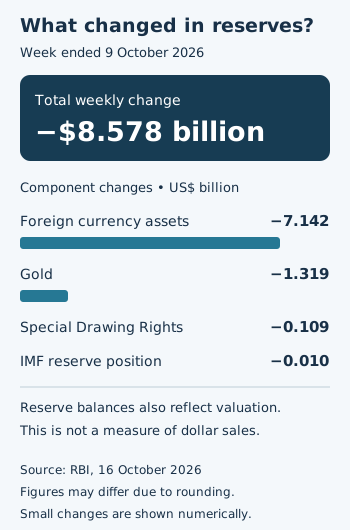
India’s foreign exchange reserves declined by $8.58 billion to $726.03 billion in the week ended October 9, 2026, marking the fifth consecutive weekly fall, according to data released by the Reserve Bank of India (RBI). The latest reduction followed a $12.95 billion decline in the previous week and extended the drawdown from the record high of $785.71 billion reached on September 4. Over five weeks, the country’s reserves have fallen by approximately $59.7 billion as the central bank manages pressure on the rupee.
The decline comes amid elevated crude oil prices, demand for dollars to pay for imports and foreign investor outflows. The RBI has been selling dollars to limit excessive volatility in the currency market, while also introducing measures intended to redirect some dollar demand away from the spot market. The rupee strengthened to ₹94.96 per dollar on October 16, but the continuing reduction in reserves highlights the trade-off involved in supporting the currency during a period of external pressure.
Key Takeaways
- Latest reserves: India’s forex reserves stood at $726.03 billion for the week ended October 9, 2026.
- Weekly decline: Reserves fell by $8.58 billion, following a $12.95 billion reduction in the previous week.
- Five-week decline: The cumulative reduction from the September 4 record high reached approximately $59.7 billion.
- Foreign currency assets: The largest component fell by $7.14 billion to $597.61 billion.
- Gold reserves: The value of gold reserves declined by $1.32 billion to $105.09 billion.
- Rupee movement: The Indian currency closed at ₹94.96 per dollar on October 16, recovering from levels close to ₹97 earlier in the month.
- Important context: The reserve decline reflects both central-bank intervention and valuation changes; it should not be interpreted as an equivalent amount of dollar sales.
India’s Forex Reserves Fall for the Fifth Consecutive Week
The RBI’s latest figures show that the decline in India’s foreign exchange reserves has continued since the country recorded an all-time high in early September.
| Reporting period | Forex reserves |
|---|---|
| September 4, 2026 | $785.71 billion |
| Previous reporting week, ended October 2 | $734.61 billion |
| Latest reporting week, ended October 9 | $726.03 billion |
| Change during the latest week | -$8.58 billion |
| Cumulative fall from September 4 peak | Approximately $59.68 billion |
Source: Reserve Bank of India data reported on October 16, 2026. Figures are rounded.
The record high followed substantial foreign-currency inflows linked to a concessional swap facility introduced earlier in the year to attract overseas deposits. The scheme helped banks bring in a large volume of foreign currency, providing a temporary boost to reserves.
The subsequent decline reflects a different set of pressures. The RBI has been intervening in the foreign exchange market as demand for dollars rises and the rupee faces depreciation pressure.
A declining reserve balance is not automatically a sign of a balance-of-payments crisis. Foreign exchange reserves are designed to fluctuate as the central bank manages currency movements, meets external obligations and responds to changes in international markets. The speed and persistence of the decline, however, are important indicators for policymakers and investors.
What Caused the Latest $8.58 Billion Decline?
Two factors are particularly important: changes in the value of the assets held in reserves and the RBI’s foreign exchange operations.
The central bank holds foreign currency assets, gold, Special Drawing Rights (SDRs) and India’s reserve position with the International Monetary Fund (IMF). Movements in these components determine the headline reserve figure.
During the week ended October 9, foreign currency assets and gold reserves accounted for most of the decline. The RBI’s intervention to supply dollars to the market also contributed to the reduction in reserves.
However, the headline fall cannot be attributed entirely to dollar sales. Foreign currency assets include holdings denominated in currencies such as the euro, pound and yen. When these currencies change in value against the US dollar, the reported dollar value of India’s holdings can rise or fall even without a corresponding purchase or sale.
Gold prices also affect the value of the reserve stock. A decline in gold’s dollar value can reduce total reserves even if the physical quantity of gold held by the central bank remains unchanged.
The distinction matters because reserve data captures both transactions and valuation effects.
Breakdown of India’s Foreign Exchange Reserves
The latest weekly figures show that foreign currency assets remain by far the largest component of India’s reserves.
| Component | Value for week ended October 9 | Weekly change |
|---|---|---|
| Foreign currency assets | $597.61 billion | -$7.14 billion |
| Gold reserves | $105.09 billion | -$1.32 billion |
| Special Drawing Rights | $18.55 billion | -$0.11 billion |
| Reserve position with the IMF | $4.78 billion | -$0.01 billion |
| Total forex reserves | $726.03 billion | -$8.58 billion |
Figures are rounded; component totals may differ slightly because of rounding.
Foreign currency assets are the most important component because they provide the RBI with liquid foreign-currency resources. These holdings can be used to support market operations, manage periods of external stress and help meet international payment needs.
Gold provides another form of reserve diversification. SDRs are international reserve assets created by the IMF, while India’s reserve position with the IMF reflects its claims under the institution’s arrangements.
The combination allows the RBI to maintain a diversified buffer rather than relying on a single type of asset.
Why Is the RBI Selling Dollars?
The RBI’s intervention is aimed at managing excessive volatility in the rupee, particularly when dollar demand rises sharply or currency-market conditions become disorderly.
India imports large quantities of crude oil and other commodities that are generally priced in dollars. When oil prices rise, the amount of foreign currency needed to pay for imports can increase, placing additional pressure on the rupee if dollar inflows do not keep pace.
Foreign portfolio investment outflows can add to that pressure. When overseas investors sell Indian assets and convert the proceeds into dollars, demand for foreign currency increases.
The RBI can sell dollars from its reserves in the market, increasing the supply of dollars and helping moderate abrupt exchange-rate movements. Such intervention does not necessarily aim to maintain a fixed rupee-dollar rate. Instead, it can help prevent sudden or excessive volatility.
Market estimates cited by IDFC First Bank’s chief economist suggested the RBI sold around $9.8 billion during the latest reporting week, while foreign currency assets also recorded a small revaluation gain. That estimate is an analyst assessment, not an official RBI breakdown of transactions.
The distinction between intervention and valuation is important when interpreting reserve changes. A weekly decline of $8.58 billion does not mean the RBI necessarily sold exactly $8.58 billion in foreign currency.
Rupee Recovers Despite Falling Reserves
The rupee strengthened to ₹94.96 per dollar on October 16, compared with ₹95.06 in the previous session. It gained around 1.9% during the week, marking its strongest weekly performance in seven months.
The currency had approached ₹96.96 per dollar earlier in October, placing it close to a record low. The subsequent recovery followed recent RBI measures and a shift in market positioning.
These measures included a dedicated dollar window for state-owned oil marketing companies and tighter rules for certain foreign exchange derivatives. The central bank also introduced a Foreign Exchange Risk Reserve requirement for specified derivative transactions.
The dedicated channel is intended to redirect some oil companies’ dollar requirements away from direct spot-market purchases. The objective is to reduce immediate pressure on the market while allowing the RBI to manage the underlying foreign-currency demand.
However, the measures cannot eliminate the need for dollars to pay for imports. If crude prices remain elevated, foreign investment outflows continue or dollar demand remains stronger than supply, pressure on reserves and the rupee may persist.
The rupee’s recovery therefore does not necessarily mean the underlying external pressures have disappeared.
What Falling Forex Reserves Mean for India’s Economy
Foreign exchange reserves act as a financial buffer for an economy that trades, borrows and invests internationally. They help the central bank manage currency volatility and provide confidence that the country can meet external payment obligations.
A substantial reserve stock can reassure investors and lenders that India has resources available to deal with periods of market stress. It also gives the RBI greater flexibility to respond to sudden movements in global financial conditions.
Nevertheless, the pace of reserve depletion matters. If the RBI needs to supply dollars repeatedly to smooth currency movements, the reserve stock can decline over time. Policymakers must balance the benefits of intervention against the value of retaining a strong external buffer.
The latest decline should be considered alongside the broader position. Despite the fall from September’s peak, reserves remained approximately $34.9 billion higher than at the end of March 2026 and $28.2 billion above their level a year earlier, according to the reported RBI data.
That context suggests the recent decline has not erased the reserve gains recorded earlier in the year. It does, however, show how quickly the headline figure can change when inflows, currency valuation and central-bank operations move in different directions.
The Role of Crude Oil and Foreign Investment
Crude oil prices remain a key variable for India’s external accounts because the country depends heavily on imported energy. Higher prices increase the dollar cost of imports and can widen the trade deficit if export earnings and other inflows do not rise sufficiently.
A wider trade deficit can increase the economy’s need for foreign financing. If foreign investors simultaneously reduce their exposure to Indian assets, the supply of dollars may become more constrained.
The combination can place pressure on the rupee, requiring the RBI to decide how much volatility to tolerate and how much intervention is appropriate.
A sustained fall in reserves would therefore need to be assessed against oil prices, foreign investment flows, export performance, remittances and other balance-of-payments components. No single weekly reserve figure can establish whether India’s external position is improving or deteriorating on its own.
The Bigger Picture
India’s falling forex reserves reflect the tension between defending currency stability and maintaining a substantial external buffer. The RBI’s intervention has helped the rupee recover from its recent lows, but supplying dollars to the market can reduce reserves, while changes in gold and foreign-currency valuations can further affect the headline figure.
The country still holds a large reserve stock, and the latest total remains above its end-March and year-earlier levels. The key question is whether external pressures ease enough to reduce the need for sustained intervention. Crude oil prices, foreign investor behaviour and dollar demand will remain important factors in determining the direction of reserves and the rupee.
Looking Ahead
The next RBI weekly reserve release will provide another indication of whether the drawdown is continuing, slowing or stabilising. Investors will also watch the rupee’s movement, crude oil prices, foreign portfolio flows and the impact of measures designed to redirect oil companies’ dollar demand. Changes in the headline reserve number will need to be assessed alongside valuation effects and market transactions.
For the RBI, the challenge is to manage disorderly currency movements without using reserves unnecessarily or treating a particular exchange rate as an inflexible target. For businesses and investors, the latest data highlights the importance of monitoring India’s external accounts rather than interpreting a single weekly decline in isolation.
Frequently Asked Questions
1. What are India’s forex reserves now?
India’s foreign exchange reserves stood at $726.03 billion for the week ended October 9, 2026, according to the RBI.
2. Why have India’s forex reserves fallen for five consecutive weeks?
The decline reflects RBI intervention in the currency market, pressure from dollar demand for imports and valuation changes in foreign currency assets and gold.
3. How much have reserves fallen from their record high?
Reserves have declined by approximately $59.7 billion from the record $785.71 billion reported for the week ended September 4, 2026.
4. Does falling forex reserves mean India is running out of dollars?
No. Reserves remain substantial and provide a buffer for external payments and currency-market operations. However, persistent declines can indicate that the central bank is facing continued pressure to supply foreign currency.
5. Why does the RBI sell dollars?
The RBI can sell dollars to moderate excessive volatility in the rupee. Such intervention increases dollar supply in the market, although it can also reduce reserves.
6. Will the rupee strengthen if forex reserves rise?
Not necessarily. A reserve increase can support confidence, but the rupee also depends on oil prices, interest-rate differences, trade flows, foreign investment and broader dollar movements. There is no automatic one-to-one relationship between reserve changes and the exchange rate.
Source note (17 October 2026): The RBI Weekly Statistical Supplement released on 16 October records reserves of US$726.027 billion as of 9 October, down US$8.578 billion over the week. The release supports the reserve balances and component changes; it does not measure dollar sales or establish the cause of the decline.
For the initial report on the same RBI release, see our 16 October coverage of the US$8.578 billion weekly reserve decline.
Get the day’s top stories in your inbox
One concise email. No spam, unsubscribe anytime.


