
India is set to sharply increase its imports of Venezuelan crude oil in October, with shipments potentially reaching their highest level in almost seven years as discounted Venezuelan barrels become more attractive to Indian refiners. Kpler estimates that Venezuelan crude deliveries to India could rise to about 465,000 barrels per day (bpd), more than double September’s 196,000 bpd.
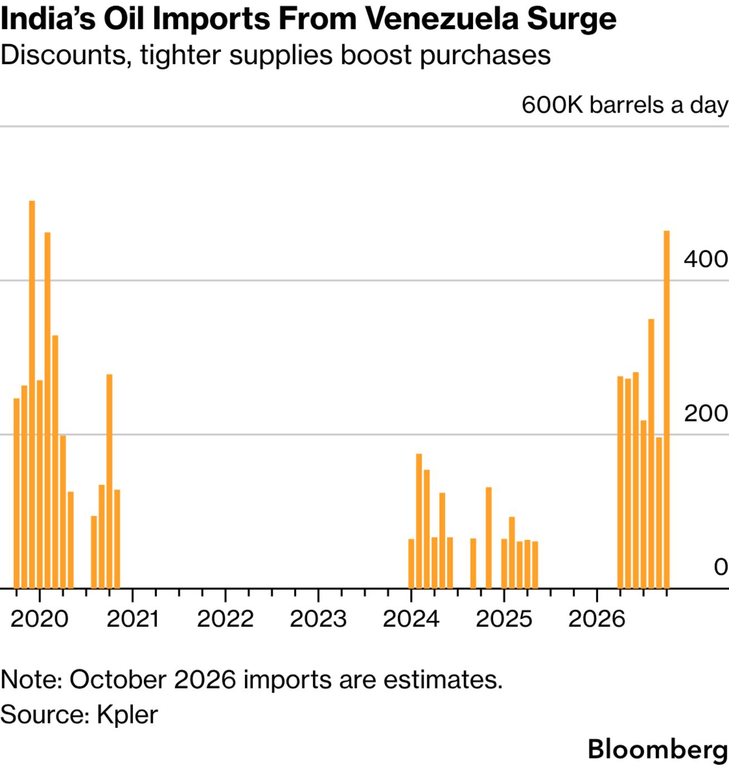
The increase is closely associated with Reliance Industries and its Jamnagar refining complex in Gujarat. Shipping data shows that Venezuelan cargoes bound for India are listing Sikka as their destination, the port serving Reliance’s massive Jamnagar refinery. The shift comes as Russian crude, traditionally a major source of relatively competitive heavy oil for Indian refiners, has become more expensive and more exposed to sanctions-related risks.
Key takeaways
- India’s Venezuelan crude arrivals could reach about 465,000 bpd in October, according to Kpler.
- September Venezuelan imports were about 196,000 bpd.
- If scheduled cargoes arrive on time, October would represent India’s highest Venezuelan oil inflow since December 2019.
- Kpler analyst Sumit Ritolia expects actual October deliveries to be closer to 350,000 bpd because some tankers may not discharge until the end of the month.
- All Venezuelan cargoes currently bound for India list Sikka as their destination, linking the surge closely to Reliance’s Jamnagar complex.
- Venezuelan Merey crude is trading at a discount while Russian Urals has moved to a premium before shipping costs.
- Reliance’s highly complex refinery configuration gives it an advantage in processing heavy, high-sulfur Venezuelan crude.
- Higher tanker rates remain a major risk to the economics of long-distance Venezuelan shipments.
India’s Venezuela oil imports are making a major comeback
India’s relationship with Venezuelan crude has changed dramatically during 2026.
Venezuelan oil had previously been an important component of India’s crude basket, particularly for refiners capable of processing heavy and high-sulfur grades. But sanctions, changing US policy and commercial uncertainty disrupted the trade for extended periods.
Purchases resumed in February 2026, and flows accelerated as Indian refiners looked for alternatives to Russian and Middle Eastern barrels.
The latest October estimate represents another major step in that recovery.
Kpler estimates Venezuelan deliveries could reach around 465,000 bpd in October compared with approximately 196,000 bpd in September. That represents an increase of roughly 137% month on month if the full scheduled volume arrives.
However, the headline figure should not be treated as a guaranteed monthly average.
Shipments counted in tanker-tracking data can be affected by loading schedules, voyage times, port congestion and discharge dates. Kpler’s Sumit Ritolia expects the actual October volume to be closer to 350,000 bpd because some vessels may not unload until later in the month.
That distinction matters because the 465,000-bpd number represents scheduled or expected deliveries rather than a completed monthly import figure.
Why Reliance is at the centre of the shift
The strongest connection between the Venezuelan import surge and Reliance comes from the destination of the cargoes.
The Venezuelan shipments currently bound for India list Sikka on Gujarat’s western coast as their destination. Sikka is the marine gateway for Reliance’s Jamnagar refining complex.
Reliance operates one of the world’s largest and most sophisticated refining systems at Jamnagar. The company says the complex has 1.4 million barrels per day of crude processing capacity and has processed more than 216 different crude grades.
That flexibility is important because Venezuelan crude is not an easy barrel for every refinery to process.
Venezuela’s flagship Merey crude is a dense, high-sulfur grade. Heavy sour crude generally requires sophisticated conversion, desulfurisation and blending capabilities to turn a relatively difficult feedstock into commercially valuable fuels and other products.
Jamnagar’s configuration was designed precisely around the ability to process a broad range of crude qualities.
This gives Reliance more flexibility than refiners whose plants are optimised around lighter or medium grades.
The economic advantage is straightforward: if a difficult crude is sufficiently discounted, a complex refinery can potentially turn that discount into a refining-margin advantage.
The price equation is changing
The most important reason for the Venezuelan buying surge is not simply availability. It is relative economics.
Merey crude is currently trading at a discount, while Russian Urals crude has moved to a premium before shipping costs.
For a refinery, the relevant calculation is not simply the headline crude price. The buyer must consider the crude differential, freight, insurance, quality adjustment, refinery configuration, product yields and the expected value of refined products.
A cheap heavy barrel can become unattractive if freight becomes too expensive.
Conversely, a difficult barrel can become highly competitive when its discount is large enough to compensate for processing complexity and transportation.
This is why Venezuela’s current pricing is particularly relevant to Reliance.
The company has the equipment and blending infrastructure required to handle Merey, allowing it to potentially capture value from barrels that are less suitable for other Indian refiners.
Russian oil is becoming less attractive
The Venezuelan increase is also part of a broader change in India’s crude procurement strategy.
Russia became India’s dominant crude supplier after the Ukraine war, helped by discounted barrels and relatively attractive economics. Indian refiners significantly increased purchases of Russian crude as Western buyers reduced their exposure to Moscow.
But the economics have changed.
By September, Russia’s share of India’s crude imports had fallen to roughly 35%, compared with levels as high as 56% in July, according to Kpler data.
The decline reflects several factors, including higher Russian crude prices, competition from China, tighter availability and growing sanctions-related risks.
Russian Urals, which previously provided Indian refiners with a major price advantage, has increasingly traded at a premium.
That changes the refinery procurement calculation.
If Venezuelan crude can be purchased at a sufficiently large discount, it becomes an increasingly logical replacement for some Russian barrels, particularly for refiners equipped to process heavy sour crude.
Venezuela gives India another supply corridor
There is also a strategic element to the shift.
India imports most of the crude oil it consumes, making the country highly dependent on international supply chains. That dependence becomes particularly important when geopolitical conflicts disrupt major oil-producing regions or shipping routes.
Venezuelan crude provides India with another source outside the traditional Gulf supply network.
The location also matters. Venezuela’s shipments to India travel across the Atlantic rather than relying on the Strait of Hormuz.
That does not make Venezuelan oil immune to logistical problems. The voyage is long, tanker availability matters and freight rates can materially change the delivered cost.
But diversification itself has value.
India’s crude-import strategy increasingly appears to be based not on dependence on a single discounted supplier, but on maintaining access to multiple crude grades from different regions.
The numbers show how quickly Venezuela has returned
India’s Venezuelan imports have climbed rapidly during 2026.
| Period | Venezuelan crude imports to India |
|---|---|
| February 2026 | About 35,000 bpd |
| March 2026 | About 342,000 bpd |
| August 2026 | About 358,000 bpd |
| September 2026 | About 196,000 bpd |
| October 2026 estimate | Up to 465,000 bpd |
| Kpler’s October expectation | Around 350,000 bpd |
The numbers demonstrate both the speed and volatility of the recovery.
In March, Reuters reported Venezuelan crude exports to India at about 342,000 bpd, up sharply from February. By August, Kpler data cited by Indian media put imports at around 358,000 bpd.
September then saw a decline to roughly 196,000 bpd before October schedules pointed toward another major increase.
This volatility is typical of seaborne crude markets. A refinery’s purchasing strategy can change quickly depending on price differentials, shipping economics, refinery maintenance and the availability of competing grades.
Why every Indian refinery cannot simply copy Reliance
The Venezuelan opportunity should not be interpreted as though every Indian refinery can immediately replace Russian oil with Venezuelan crude.
Merey is a particularly heavy and sulfur-rich crude.
Processing such barrels requires suitable refinery equipment and an appropriate blending strategy. Some Indian refineries can process heavy crude, but their ability to absorb large volumes continuously may be more limited.
This is one reason Reliance is particularly important in the current shift.
Jamnagar’s complexity allows the company to switch between different crude grades depending on market economics.
Reliance says its refinery complex has a complexity index of 21.1 and can process almost all grades of crude produced globally.
That capability becomes more valuable when crude markets are fragmented and price relationships change rapidly.
Freight could determine whether the surge lasts
The biggest threat to sustained Venezuelan imports is transportation cost.
Venezuela is geographically far from India. A cargo may look attractive at the loading port but become significantly less competitive after freight and insurance are included.
Earlier in 2026, freight rates for Venezuelan crude heading toward Asia increased sharply. Business Standard reported that freight for supplies from the Americas had risen to around $8-$10 per barrel during the period when Venezuelan crude economics deteriorated.
Higher tanker rates can therefore erase part of the crude discount.
This creates an important ceiling for the current surge.
If Merey remains sufficiently discounted relative to competing crude grades, Indian refiners have an incentive to continue buying it. If the discount narrows while freight remains high, Russian, Middle Eastern, African or other Atlantic Basin grades could regain their advantage.
Venezuela itself faces a shipping challenge
The issue is not limited to Indian buyers.
Venezuelan oil exports also faced logistical pressure in September. Reuters reported that Venezuela’s total crude exports fell nearly 9% month on month to about 1.08 million bpd as high freight costs prompted traders to seek larger discounts and caused tanker rerouting and delays.
Exports to India fell to about 253,000 bpd in September from 297,000 bpd in August in the Reuters shipping-data analysis.
That makes the October Indian import estimate even more dependent on the movement of individual cargoes.
A surge in scheduled cargoes does not necessarily translate into an equivalent volume of crude physically discharged during the month.
India is building a more diversified crude basket
The Venezuelan story fits into a much larger change in India’s oil-import pattern.
India’s crude imports reached a 2026 high in September, with overall arrivals around 5.26 million bpd. West Asian supplies recovered sharply during the month, while Russian imports fell.
This means Venezuela is not replacing one supplier on a one-for-one basis.
Instead, Indian refiners are assembling a broader procurement portfolio.
Russia remains important. Middle Eastern suppliers remain critical. African and Latin American crude can provide additional alternatives. The US and other Atlantic Basin suppliers also remain part of the mix.
For India, that diversification reduces the risk that disruption in any single supply corridor will leave refiners without suitable feedstock.
For refiners, however, diversification also makes crude optimisation more important. The winner is not necessarily the refinery that buys the cheapest barrel. It is the refinery that can buy the right barrel, process it efficiently and sell the resulting products into the most profitable markets.
What this means for Reliance
For Reliance, the Venezuelan opportunity potentially strengthens one of the core advantages of the Jamnagar model: feedstock flexibility.
A refinery capable of processing a wider range of crude can respond to price dislocations more aggressively than a less complex facility.
If Venezuelan heavy crude remains discounted against competing grades, Reliance could use more of it as part of its overall crude slate.
However, this should not be interpreted as a permanent strategic replacement of Russian oil.
Refinery economics change constantly. Reliance has historically sourced crude from a wide range of countries, including Russia, Saudi Arabia, Iraq and Canada.
Its advantage is precisely that it does not need to depend on one grade or one producing country.
The Venezuelan purchases therefore look more like opportunistic crude optimisation than a permanent realignment.
The sanctions question remains important
Venezuelan oil also carries a different regulatory risk from ordinary commercial crude.
The country has been subject to extensive US sanctions, and oil transactions have historically depended on specific US authorisations and policy changes.
In 2026, the US policy environment changed sufficiently to allow Venezuelan oil to return to international markets through authorised channels. Reuters reported that Indian refiners resumed Venezuelan purchases after a period of interruption, while Reliance also secured Venezuelan crude through arrangements governed by the evolving US framework.
Reliance has previously purchased Venezuelan crude directly from PDVSA under an arrangement in which US authorities controlled the handling of proceeds and commercial terms.
That means the economics of Venezuelan oil cannot be separated completely from US policy.
Any future tightening of sanctions, changes to licences, restrictions on shipping companies or changes in the permitted payment structure could affect Indian imports.
For refiners, regulatory certainty is therefore almost as important as the crude discount.
The bigger picture
The return of Venezuelan crude to India is a sign of how dramatically global oil trade has changed.
For years, India’s refiners benefited from a relatively clear hierarchy of crude economics. Russian oil became exceptionally attractive after Western sanctions disrupted traditional trade flows, while Middle Eastern crude remained the backbone of India’s import system.
That environment is now more complicated.
Russian barrels have become more expensive. Middle Eastern supply chains have been affected by geopolitical disruptions. Freight costs are elevated. Sanctions are reshaping the list of commercially usable suppliers.
In that environment, a refinery such as Jamnagar becomes strategically valuable because its ability to process different crude grades gives it more options.
Venezuela is therefore not important simply because India is buying more Venezuelan oil. It is important because the trade illustrates the growing value of refinery flexibility in an increasingly fragmented global oil market.
FAQs
How much Venezuelan oil could India import in October 2026?
Kpler estimates scheduled Venezuelan crude deliveries to India could reach around 465,000 bpd in October. However, Kpler’s Sumit Ritolia expects actual deliveries to be closer to 350,000 bpd because some cargoes may not discharge before the end of the month.
Why is Reliance buying Venezuelan crude?
Venezuelan Merey crude is a heavy, high-sulfur grade that can be difficult for less-complex refineries to process. Reliance’s Jamnagar complex has extensive conversion and blending capabilities, allowing the company to process a broad range of crude grades when their economics are attractive.
Is Venezuela replacing Russia as India’s main oil supplier?
No. The current shift represents diversification rather than a complete replacement. Russia remains a major supplier, but its share has fallen as Russian crude has become more expensive and sanctions-related risks have increased.
Will India’s Venezuelan oil imports remain this high?
Not necessarily. The sustainability of the increase will depend on the discount available on Venezuelan crude, tanker freight rates, refinery economics, cargo availability and the future US sanctions framework governing Venezuelan oil trade.
Looking Ahead
The next few months will show whether October’s scheduled Venezuelan cargoes represent a temporary spike or the beginning of a sustained increase in Latin American crude’s role in India’s oil basket. The key indicator will be the delivered cost of Merey relative to Russian Urals, Middle Eastern medium-sour grades and other alternative barrels.
For Reliance, the development highlights the continuing value of Jamnagar’s complexity rather than a simple preference for Venezuelan crude. As global oil trade becomes increasingly shaped by sanctions, freight disruptions and geopolitical risk, refiners with the ability to switch between a wide range of feedstocks are likely to have greater room to optimise margins and protect supply security.
Get the day’s top stories in your inbox
One concise email. No spam, unsubscribe anytime.


