
India’s wireless data economy expanded sharply in FY26, but telecom operators generated significantly less revenue from each gigabyte of data consumed. According to the Telecom Regulatory Authority of India’s (TRAI) latest annual telecom report, average revenue realisation per GB fell 10.59% to ₹8.02 in 2025-26 from ₹8.97 in 2024-25.
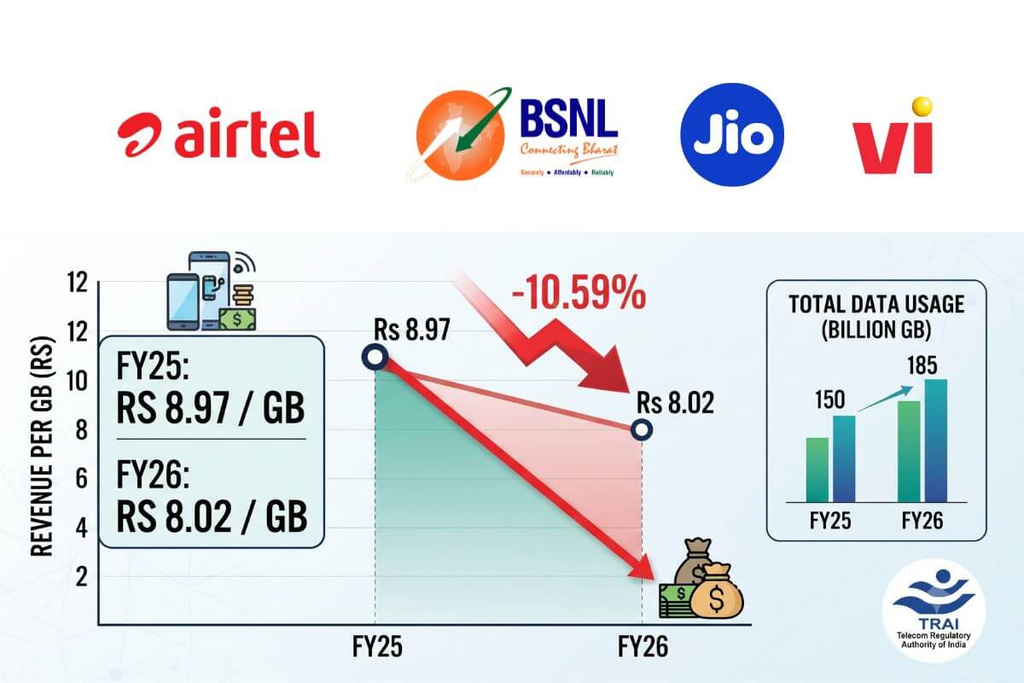
The decline came even as wireless data consumption jumped 24.74% to 2,85,376 petabytes (PB), while total revenue from wireless data increased 11.53% to ₹2,39,874 crore. The numbers highlight a widening gap between how quickly Indian consumers are consuming mobile data and how quickly telecom operators are monetising that traffic.
Key takeaways
- Average revenue realisation per GB declined 10.59% to ₹8.02 in FY26.
- Wireless data usage increased 24.74% to 2,85,376 PB.
- Wireless data revenue increased 11.53% to ₹2,39,874 crore.
- Wireless data subscribers rose 9.29% to 1,026.75 million by March 2026.
- Average monthly data consumption per wireless data subscriber increased 18.49% to 25.51 GB.
- Data revenue per subscriber per month increased to ₹245.66.
- Overall wireless ARPU increased 3.59% to ₹180.73 per month.
- India’s total internet subscriber base crossed 1.09 billion.
- Overall telecom gross revenue increased 8.59% to ₹4,04,067 crore.
- Adjusted Gross Revenue (AGR) increased 10.44% to ₹3,34,659 crore.
Data usage is growing much faster than data monetisation
TRAI’s Indian Telecom Services—Yearly Performance Indicators 2025-26, released on October 5, shows a clear divergence between data consumption and revenue.
Wireless data usage increased from 2,28,779 PB in FY25 to 2,85,376 PB in FY26. That represents a 24.74% increase in just one year.
Revenue from that data, however, increased at less than half that pace. Wireless data revenue rose from ₹2,15,078 crore to ₹2,39,874 crore, an 11.53% increase.
The result is straightforward: operators are carrying considerably more data without receiving a proportionate increase in revenue.
| Metric | FY25 | FY26 | Change |
|---|---|---|---|
| Wireless data usage | 2,28,779 PB | 2,85,376 PB | +24.74% |
| Wireless data revenue | ₹2,15,078 crore | ₹2,39,874 crore | +11.53% |
| Revenue per GB | ₹8.97 | ₹8.02 | -10.59% |
| Wireless data subscribers | 939.51 million | 1,026.75 million | +9.29% |
| Monthly data use/subscriber | 21.53 GB | 25.51 GB | +18.49% |
The numbers show why revenue per GB is falling. More subscribers are using more data, but the additional traffic is not generating revenue at the same rate as existing traffic.
What ₹8.02 per GB actually means
The ₹8.02 figure is an average revenue realisation, not the price consumers directly pay for one GB of mobile data.
Consumers generally buy bundled telecom plans that combine data, voice, SMS and other services. The revenue-per-GB figure is calculated at the industry level by relating wireless data revenue to the volume of wireless data consumed.
It therefore provides a useful measure of telecom monetisation.
A falling figure means operators are earning less revenue for every unit of data transported, even if their overall revenue can continue rising because customers are consuming dramatically more data.
That distinction is important.
The report does not mean that every Indian mobile plan became 10.59% cheaper on a per-GB basis. It means the industry’s average revenue realisation associated with each GB of wireless data declined by that amount.
Consumers are using 25.51 GB a month on average
One of the strongest indicators of India’s data-first telecom market is the increase in average consumption.
Average wireless data usage per wireless data subscriber rose from 21.53 GB per month in FY25 to 25.51 GB in FY26, an increase of 18.49%.
That growth is taking place alongside a larger user base.
The number of wireless data subscribers increased 9.29%, from 939.51 million at the end of March 2025 to 1,026.75 million at the end of March 2026.
India therefore experienced two sources of data growth simultaneously:
More people using mobile data + existing users consuming more data = rapidly increasing network traffic.
Video streaming, social media, cloud applications, gaming, short-form video, video calls and increasingly AI-powered applications are all contributing to the broader shift toward mobile data consumption.
The rise of 5G is another important structural factor, although the TRAI data itself does not attribute the entire increase specifically to 5G.
Data revenue is still growing
A falling revenue-per-GB number does not mean India’s telecom companies are losing money on data.
Quite the opposite: total wireless data revenue increased by ₹24,796 crore during FY26.
Revenue rose from ₹2,15,078 crore to ₹2,39,874 crore, representing 11.53% annual growth.
The reason is scale.
If data consumption grows much faster than the price realised per GB, total revenue can still rise.
A simplified example illustrates the economics:
Data volume ↑ 24.74%
Revenue per GB ↓ 10.59%
Total data revenue ↑ 11.53%
This is one of the central features of India’s telecom market: operators are increasingly monetising enormous volumes of data rather than charging high prices for individual units of consumption.
Data revenue per subscriber is moving in the opposite direction
There is another interesting detail in the TRAI numbers.
While revenue per GB declined, average revenue from wireless data per data subscriber per month increased from ₹231.64 in FY25 to ₹245.66 in FY26, according to the report data.
This suggests that consumers are generating more data revenue for operators on an individual basis even though the amount earned for each gigabyte is falling.
In other words:
Revenue per user can rise while revenue per GB falls.
The reason is higher consumption.
If a customer uses substantially more data, the operator can earn more from that customer even when each additional GB is worth less.
This distinction will become increasingly important as Indian telecom companies attempt to increase Average Revenue Per User (ARPU).
Overall wireless ARPU also increased
TRAI reported that overall wireless ARPU increased 3.59% to ₹180.73 per month in FY26 from ₹174.46 in FY25.
That is a different metric from revenue per GB.
ARPU measures the average revenue generated per wireless subscriber per month, whereas revenue per GB measures the average revenue associated with each gigabyte of wireless data.
The simultaneous movement of the two metrics is revealing:
- Wireless ARPU: up 3.59%
- Data revenue per subscriber: up to ₹245.66
- Revenue per GB: down 10.59%
- Data consumption per subscriber: up 18.49%
This suggests that telecom operators are gradually improving monetisation at the subscriber level even while data itself becomes cheaper to monetise.
Telecom operators need more than data growth
The TRAI figures highlight a long-running challenge for India’s telecom industry.
Data traffic has become enormous, but simply carrying more traffic does not automatically translate into equivalent revenue growth.
Operators therefore need other ways to increase monetisation.
These include:
Higher tariffs
Price increases can raise ARPU without requiring customers to consume more data.
Premiumisation
Operators can encourage customers to move toward higher-priced plans with greater data allowances, 5G access, entertainment subscriptions and other bundled services.
Postpaid conversion
Postpaid customers can generate recurring revenue and may be more attractive for premium services.
Enterprise connectivity
Businesses can generate higher-value revenue through private networks, cloud connectivity, IoT and other specialised communications services.
Fixed wireless access
5G-based home broadband can turn mobile network capacity into a substitute or complement to fixed-line broadband.
Digital services
Telecom companies can add entertainment, cloud storage, financial services and other digital products around the connectivity relationship.
The latest data helps explain why operators are increasingly focused on ARPU rather than simply chasing subscriber numbers.
India’s broader telecom revenue is growing
The decline in data revenue per GB is occurring against a generally healthier financial backdrop for the telecom industry.
TRAI reported total gross revenue of ₹4,04,067 crore in FY26, up 8.59% from ₹3,72,097 crore in FY25.
Adjusted Gross Revenue increased 10.44% to ₹3,34,659 crore from ₹3,03,025 crore.
The growth indicates that the sector is not dependent exclusively on the monetisation of individual gigabytes.
Voice, data, interconnection, enterprise services, broadband and other telecom activities all contribute to overall industry revenue.
The data segment remains one of the biggest growth engines, but its falling revenue realisation per unit means operators need scale and pricing power to maintain profitability.
India’s internet subscriber base crosses 1.09 billion
The country’s broader internet ecosystem also expanded significantly.
Total internet subscriptions reached 1,092.79 million at the end of March 2026, up 12.76% from 969.10 million a year earlier.
Broadband subscribers increased 12.90% to 1,065.88 million, while narrowband subscriptions rose 7.72% to 26.91 million.
Wireless connections remain the dominant form of internet access.
TRAI reported 1,046.26 million wireless internet subscribers compared with 46.54 million wired internet subscribers.
That structure reinforces the importance of mobile networks in India’s digital economy.
For a large part of the population, the smartphone remains the primary gateway to the internet.
Wireless subscriber growth remains strong
India’s overall wireless subscriber base also expanded during FY26.
Wireless subscribers, including mobile and fixed wireless access, increased 10.19% to 1,282.33 million from 1,163.76 million.
Mobile subscribers alone increased 9.40% to 1,265.73 million, adding 108.74 million during the year.
The figures demonstrate that the Indian telecom market is still adding connections even after years of rapid mobile adoption.
However, the composition of growth matters.
Operators increasingly need to turn subscriber growth into higher-value customers rather than relying solely on additional low-value connections.
Rural connectivity continues to expand
The growth is not limited to India’s largest cities.
TRAI reported that rural wireless teledensity increased from 58.40% at the end of March 2025 to 59.08% in March 2026.
Urban wireless teledensity rose from 123.99% to 141.30%.
Urban penetration is already well above 100% because individuals can have multiple mobile connections.
Rural connectivity therefore remains particularly important for future subscriber expansion.
More rural users coming online would create additional data demand, although the monetisation per user could differ significantly from urban customers.
5G adds another layer to the data economics
The rapid expansion of 5G networks has also changed the economics of mobile data.
Faster networks make it easier for customers to consume high-bandwidth content. A smartphone user who previously consumed a few gigabytes a month can increasingly stream higher-quality video, use cloud applications and interact with data-intensive services without the same network constraints.
That can push total traffic sharply higher.
But faster networks do not automatically allow operators to charge proportionately more for each gigabyte.
In fact, as data capacity expands and larger data bundles become common, the effective price of each additional GB can continue falling.
This makes 5G both an opportunity and a monetisation challenge.
Why the revenue-per-GB decline matters for Jio, Airtel and Vodafone Idea
The TRAI numbers are particularly relevant for India’s major private telecom operators.
Reliance Jio, Bharti Airtel and Vodafone Idea all need to manage rapidly increasing network traffic while improving financial returns.
Jio and Airtel have stronger financial positions and extensive 5G networks, while Vodafone Idea is still working through its balance-sheet and network-investment challenges.
For all operators, however, the same structural problem exists:
Network usage is growing faster than unit monetisation.
This increases the importance of tariff increases and premium plans.
It also explains why industry analysts have been watching ARPU so closely.
If operators can increase monthly revenue per customer faster than network costs rise, they can turn traffic growth into stronger financial performance.
Telecom’s cost base is changing too
Data growth also requires continuous investment.
More traffic requires additional spectrum, radio equipment, fibre backhaul, data capacity, energy and network infrastructure.
The economics become more complicated when the operator receives only ₹8.02 on average for each GB of traffic while the volume of traffic grows by nearly one-quarter.
Operators therefore need economies of scale.
A larger customer base and more traffic can spread fixed network costs across a greater revenue base. But sustained investment is still required to prevent congestion and maintain network quality.
This is particularly important as customers become accustomed to high-speed mobile connectivity.
The data economy is becoming a volume business
The FY26 numbers reinforce a broader transformation in Indian telecom.
In the early stages of mobile internet, data was relatively scarce and expensive. Operators could charge customers for relatively small data allowances.
The market has gradually moved toward abundant data.
Today, customers often receive hundreds of gigabytes or effectively unlimited usage under certain plans, particularly on 5G.
As supply and consumption increase, the economic value of an individual GB naturally declines.
The industry is consequently moving toward a model where volume, subscriber quality and bundled services matter more than the standalone price of data.
What the numbers mean for consumers
For consumers, the falling revenue per GB can be positive in one respect.
It indicates that mobile data is becoming increasingly affordable relative to the amount of usage customers receive.
The average subscriber consumed 25.51 GB per month in FY26, up substantially from 21.53 GB.
However, falling revenue per GB does not guarantee that monthly mobile bills will fall.
Telecom companies can raise tariffs while still offering more data.
That is why consumers can simultaneously receive larger data allowances and pay higher monthly prices.
The key measure for consumers is therefore not simply the price per GB, but the total price of the connectivity package relative to how much they actually use.
The bigger picture
TRAI’s FY26 data paints a picture of an Indian telecom market caught between extraordinary usage growth and difficult unit economics.
Wireless data consumption rose almost 25%, while revenue from that data increased just 11.53%. As a result, average revenue realisation per GB fell 10.59% to ₹8.02. At the same time, wireless ARPU increased 3.59%, showing that operators can still improve customer-level monetisation even as individual gigabytes become less valuable.
The trend is likely to shape the next phase of India’s telecom competition. With networks carrying increasingly large amounts of 4G and 5G traffic, operators will need to combine tariff increases, premiumisation, enterprise services and digital bundles to ensure that rising data consumption translates into sustainable returns.
Looking ahead
The most important metric to watch is no longer simply how much data Indians consume. The bigger question is whether telecom operators can increase revenue per customer quickly enough to offset the falling value of each gigabyte and the cost of expanding network capacity.
FY26 suggests that the industry is making some progress: overall wireless ARPU rose and total data revenue increased despite lower revenue per GB. But if data traffic continues to grow at a significantly faster pace than monetisation, pricing power and premium services will become increasingly important to the financial performance of India’s telecom companies.
FAQs
What is India’s average revenue per GB of wireless data?
TRAI reported average revenue realisation of ₹8.02 per GB in FY26, down 10.59% from ₹8.97 in FY25.
Why did revenue per GB fall?
Wireless data usage grew 24.74%, substantially faster than wireless data revenue, which grew 11.53%. More data consumption therefore translated into a lower average revenue realisation per GB.
How much mobile data does an average subscriber use?
Average wireless data usage reached 25.51 GB per subscriber per month in FY26, up 18.49% from 21.53 GB in FY25.
Did telecom operators’ overall revenue fall?
No. India’s telecom gross revenue increased 8.59% to ₹4,04,067 crore in FY26, while adjusted gross revenue increased 10.44% to ₹3,34,659 crore.
Does ₹8.02 mean consumers pay ₹8.02 for every GB?
No. It is an industry-level average revenue realisation calculated from wireless data revenue and data usage. Consumers generally pay for bundled plans rather than purchasing every GB separately.
Get the day’s top stories in your inbox
One concise email. No spam, unsubscribe anytime.


