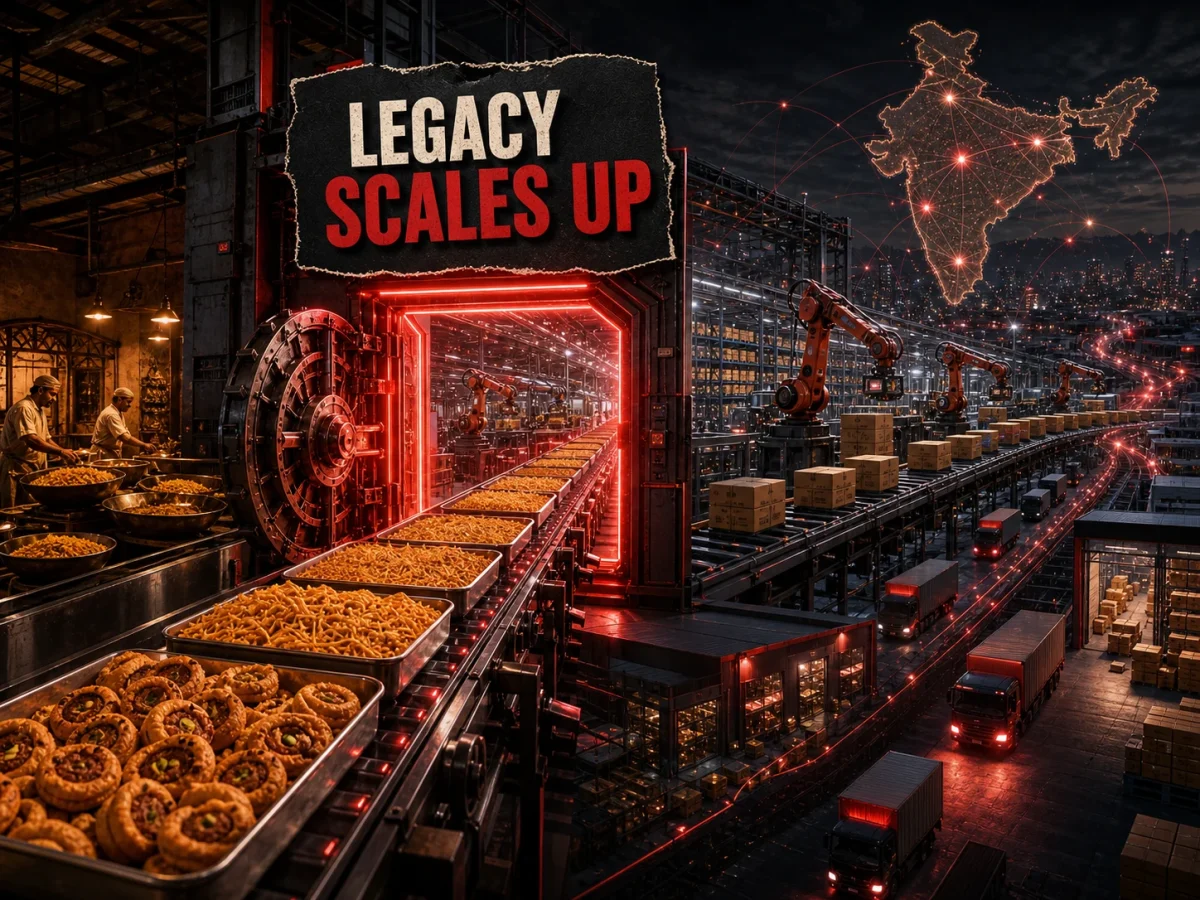
Jagdish Farshan, the Vadodara-born snacks and sweets company, has raised ₹43.5 crore in a Series A round led by Sharrp Ventures, alongside angel investors. The first institutional capital in the company’s long history is intended for manufacturing, supply-chain capacity, distribution, technology, digital commerce and expansion beyond Gujarat.
Key takeaways
- The ₹43.5 crore Series A is Jagdish Farshan’s first institutional funding round.
- Sharrp Ventures, the investment office associated with Marico founder Harsh Mariwala, led the round; Sharrp principal Divya Gupta separately described its investment as ₹25 crore.
- The capital is earmarked for factories, supply chains, retail and institutional distribution, technology, digital commerce and new geographies.
- The difficult part is not opening stores quickly. It is reproducing taste, freshness and unit economics outside the brand’s home market.
Everyone else is reporting a funding round; we are explaining the operating system that Jagdish Farshan must build for the money to create a national brand. The central question is whether an 88-year-old regional food business can standardise production and distribution without weakening the product identity that earned consumer trust.
What the Jagdish Farshan funding round includes
YourStory reported that Jagdish Farshan raised ₹43.5 crore in Series A funding led by Sharrp Ventures and joined by angel investors. Entrepreneur India independently reported the same round size, stage, lead investor and planned uses of capital.
Sharrp Ventures is the investment office of Harsh Mariwala, the founder and chairman of Marico. In a public post about the transaction, Sharrp principal Divya Gupta said the firm led the first institutional round with a ₹25 crore investment. That figure describes Sharrp’s contribution, while ₹43.5 crore is the reported total round.
| Deal detail | Verified information | Why it matters |
|---|---|---|
| Round | ₹43.5 crore Series A | First institutional capital for the company |
| Lead investor | Sharrp Ventures | Adds consumer-brand investment experience |
| Other participants | Group of angel investors | Broadens the capital base |
| Advisers | Karnametic Partners; Badaya Law Partners | Investment banking and legal support |
| Planned deployment | Manufacturing, supply chain, distribution, technology, digital commerce and geography | Targets the main bottlenecks in national expansion |
The company did not announce a valuation, ownership percentage, revenue figure or profitability metric with the round. Those omissions matter: the funding amount shows the size of the new capital pool, but not the price investors placed on the business or how efficiently Jagdish Farshan currently converts sales into cash.
Why Jagdish Farshan is unusual for a Series A company
Jagdish Farshan is not a typical young startup seeking product-market fit. Its official company history traces the brand to Vadodara in 1938 and says the business now spans manufacturing, retail, exports and online channels. The company’s own website lists more than 22 Indian outlets, international locations and exports to more than 25 countries, while the funding announcement counts 27 outlets in central Gujarat and two in North America.
The different outlet totals likely reflect timing or counting methods across live corporate pages and the transaction announcement. The important point is the operating shape: Jagdish Farshan already has stores, production experience, cross-border demand and a recognised regional product. The Series A is intended to scale a functioning business rather than prove that customers want Gujarati snacks.
That changes the risk profile. A software startup can distribute another copy of its product at a low marginal cost. A food company must buy ingredients, control recipes, protect shelf life, package goods, pass safety checks, move inventory and forecast demand in every new market.
Jagdish Farshan’s Series A is therefore a scale-up round, not an idea-stage bet: investors are funding the systems required to reproduce a trusted regional food experience across more factories, stores, distributors and digital channels.
Manufacturing consistency is the first test
The company says it sells snacks, namkeen and sweets across a portfolio of more than 500 products and stock-keeping units. A wide catalogue attracts different customer groups, but it also multiplies sourcing, production, packaging and inventory decisions.
National expansion can expose small variations that loyal consumers notice immediately. The same bhakharwadi must have familiar texture, seasoning and freshness whether it is purchased near Vadodara, delivered through quick commerce or shipped to a distant retailer. New equipment may raise output, but process control and staff training determine whether volume preserves quality.
Food safety also becomes more complex as facilities and vendors increase. Jagdish Farshan will need traceability for ingredients, repeatable recipes, packaging standards and rapid responses when a batch falls outside specification. Capital can purchase machinery; it cannot instantly create disciplined operating routines.
Distribution will decide whether growth is profitable
A regional brand can know its home market street by street. A national brand must decide which cities, retailers and formats deserve inventory before demand is fully visible. Sending too little creates empty shelves; sending too much creates discounting, expiry risk and trapped working capital.
The funding plan covers both retail and institutional distribution. Retail includes the company’s own stores and third-party channels. Institutional distribution may include workplaces, travel locations, hospitality buyers or other large accounts. Each route has different margins, order sizes and service requirements.
Digital commerce adds reach but not simplicity. E-commerce and quick-commerce channels can reveal demand rapidly, yet they require inventory close to customers, consistent catalogues, reliable fulfilment and packaging that survives transport. The company’s official site says products are available through its own online store and platforms including Blinkit, Swiggy Instamart, BigBasket and Amazon in selected markets.
The wider investment environment matters too. Our report on private equity investment in India shows how capital is seeking scalable Indian businesses, while the Clipto funding round illustrates how investors pair money with a specific expansion thesis. Jagdish Farshan’s thesis is more physical: turn regional affection into repeatable national distribution.
Why Sharrp Ventures may be strategically relevant
Sharrp Ventures’ connection to Harsh Mariwala makes its role notable in a packaged-food transaction. Marico grew consumer brands through disciplined distribution, product positioning and supply-chain execution. The investment does not mean Jagdish Farshan will copy Marico, but it gives the company access to an investor familiar with the long time horizons and operating detail of consumer products.
Gupta said Sharrp sees significant headroom in Gujarati snacks and farsan and believes strong regional brands can become larger organised food businesses. That is a category thesis, not proof of an outcome. Jagdish Farshan still has to show that consumers outside Gujarat will buy frequently enough to support new factories, marketing and distribution.
The distinction between patient capital and rapid expansion will be important. Opening many outlets can inflate revenue while rent, staffing and inventory absorb cash. A measured rollout—testing a few markets, learning which products travel well and expanding only after repeat demand appears—may preserve more value than a headline-driven store count.
What could go wrong after the funding
The first risk is brand dilution. Jagdish Farshan’s heritage is an advantage only if new customers experience the quality associated with that history. Too many new products or inconsistent franchises can turn a clear identity into a generic snack catalogue.
The second risk is working capital. Ingredients, packaging and finished inventory consume money before a retailer or customer pays. Fast revenue growth can therefore create a cash squeeze if stock moves slowly or distributors demand long payment terms.
The third risk is channel conflict. Company-owned stores, distributors, marketplaces and quick-commerce platforms may compete on price. If promotions differ sharply, customers can learn to wait for discounts and retail partners can lose confidence.
The fourth risk is governance. Institutional funding usually brings tighter reporting, board oversight and performance targets. That discipline can help a family-led company scale, but it also changes decision-making rhythms. The strongest outcome would combine professional systems with the product judgment accumulated across four generations.
What to watch over the next 12 to 24 months
Neither Jagdish Farshan nor its investors disclosed a formal expansion timetable. Readers should therefore watch operating evidence rather than assume the funding has already produced national scale.
- Capacity: announcements of new or expanded manufacturing lines, quality systems and packaging technology.
- Geography: entry into cities outside the company’s central Gujarat base, with evidence of repeat demand.
- Distribution: more third-party retail, institutional accounts and reliable quick-commerce availability.
- Product focus: a clear group of hero products that can travel nationally instead of uncontrolled SKU expansion.
- Economics: sustainable store productivity, inventory turns and margins—not only a larger top line.
- Leadership: hiring in operations, supply chain, technology and category management to support professional scale.
A useful comparison is the way other businesses attract capital for a precise growth mechanism. The BlackRock investment in Ather Energy concerns public-market ownership rather than a food-brand Series A, but both stories show that a large cheque matters only when it strengthens the operating plan behind the asset.
For Jagdish Farshan, the round is a credible starting point: it is newly announced, independently reported and tied to specific capabilities. The investment case will become stronger only when those capabilities produce consistent products, wider availability, repeat customers and healthy cash generation.
Frequently asked questions
How much funding did Jagdish Farshan raise?
Jagdish Farshan raised ₹43.5 crore in a Series A round. It is the company’s first institutional capital raise.
Who invested in Jagdish Farshan?
Sharrp Ventures led the round alongside a group of angel investors. Sharrp principal Divya Gupta publicly described the firm’s own investment as ₹25 crore.
How will Jagdish Farshan use the funding?
The company says it will invest in geographic expansion, manufacturing and supply-chain capacity, retail and institutional distribution, technology, digital commerce and product development.
Why is this Series A significant?
The round gives an established regional food brand institutional capital to build national-scale systems. Its success will depend on preserving taste and quality while improving distribution and unit economics.
Get the day’s top stories in your inbox
One concise email. No spam, unsubscribe anytime.


